
Key Takeaways
- Sales reps lose 71% of their time to admin work, leaving only 35% for selling, which hurts CRM adoption and revenue targets.
- AI-powered lead management software like Coffee delivers 3-5x ROI through 8-12 hours weekly time savings, better conversions, and pipeline accuracy.
- The ROI model uses team metrics like leads processed, automation rates, deal values, and costs to generate precise projections.
- Coffee outperforms legacy CRMs like Salesforce and HubSpot with autonomous data capture, reducing setup from months to days and boosting data quality.
- Calculate your B2B team's ROI instantly with Coffee's free ROI framework and achieve proven 3-5x returns.
Executive Overview: How Coffee Calculates B2B Lead Management ROI
ROI for B2B lead management software follows a clear formula: (Revenue Lift – Software Cost) / Software Cost × 100%. Value drivers extend beyond simple cost savings to include substantial weekly time savings, conversion rate improvements, and pipeline accuracy gains.
The framework centers on four core metrics that determine software ROI: leads processed monthly, automation rate percentage, average deal value, and cost per seat annually. Each metric feeds directly into the ROI formula. Leads processed and automation rate determine time savings, while deal value and cost per seat calculate net returns against investment.

The table below shows how these metrics map to common B2B benchmarks, with the automation rate reflecting the industry-standard time lost to admin work that Coffee's AI agent can reclaim.
| Metric | Description | B2B Benchmark |
|---|---|---|
| Leads Processed/Mo | Volume handled by team | Varies by team size and industry |
| Automation Rate | % Time saved from manual tasks | Up to 71% (industry benchmark) |
| Avg Deal Value | Per Closed-Won opportunity | Varies by industry |
| Cost/Seat/Yr | Software investment | Varies by vendor |
Calculate your team's ROI using these metrics with Coffee's framework.
Market Context: Why AI Agents Change CRM ROI
Legacy CRMs like Salesforce and HubSpot operate as passive databases that require constant manual maintenance. These systems create fragmented workflows, forcing reps to toggle between multiple tools for data entry, enrichment, and outreach. The manual data entry burden drives low adoption and poor data quality, which then produces unreliable forecasts.
The 2026 shift toward AI agents represents a fundamental category evolution. Coffee's Intelligence layer introduced in February 2026 shows how autonomous agents handle data unification and task automation without human intervention. This architectural change moves teams from reactive data storage to proactive pipeline management.

Despite this category evolution, current SERP analysis reveals a significant gap: no interactive ROI calculators exist specifically for AI-powered CRM agents in B2B environments. Sales forums consistently request “real ROI models for B2B sales force” tools that provide concrete financial justification for software investments. Coffee's ROI framework fills this gap with a structured, repeatable model.
How Coffee's ROI Model Works in Practice
The ROI model follows a simple three-step process tailored to B2B sales teams.
Step 1: Input Collection. Enter your team's current metrics including leads processed monthly, pre and post conversion rates, hours saved per rep, hourly wage rates, and Coffee software costs.
Step 2: Automated Calculations. The system computes Time Savings ROI using the formula: Hours Saved × Rep Wage × 50 weeks. Pipeline Lift calculates as: Accuracy Improvement % × Deal Size × Closed Wins. These formulas capture both productivity gains and revenue increases.
Step 3: Results Output. The model then produces ROI projections that include net returns, payback periods, and comparisons against manual processes.
The table below summarizes the core calculation types and how Coffee applies them.
| Calculation Type | Formula | Coffee Example |
|---|---|---|
| Time Savings | Hours Saved × Wage × 50 | Weekly hours saved at typical rep wage rate across 50 weeks |
| Pipeline Lift | Accuracy% × Deal × Wins | Improved accuracy on average deal value across multiple closed wins |
The ROI framework incorporates Coffee-specific performance data, so teams can model realistic scenarios based on actual AI agent results rather than generic assumptions.
Key B2B Sales Metrics and Coffee Performance
Coffee implementations consistently deliver measurable improvements across three critical areas: time savings, conversion gains, and pipeline visibility. The 8-12 hour weekly savings mentioned earlier comes specifically from automated data entry and enrichment, which creates substantial annual value per team member.

Conversion improvements start with lift in pipeline accuracy through AI-powered lead scoring and qualification. When reps have accurate, complete lead data at their fingertips, they can prioritize high-intent prospects and personalize outreach. Both behaviors reliably increase conversion rates. Coffee's autonomous agent captures and structures data from emails, calendars, and call transcripts, removing the manual entry bottleneck that causes data quality issues.

Pipeline visibility improves through Coffee's Compare feature, which automatically tracks week-over-week changes without manual CSV exports. This reduces pipeline review friction and gives leaders real-time insight into deal progression.
The table below quantifies Coffee's advantage across three dimensions: time savings, ROI multiple, and setup speed. It highlights how an AI-agent architecture outperforms manual CRM approaches.
| Metric | Coffee Performance | HubSpot Manual | Salesforce Legacy |
|---|---|---|---|
| Time Savings/Year | Substantial | Moderate | Moderate |
| ROI Multiple | High | Moderate | Moderate |
| Setup Time | Days | Weeks | Months |
A mid-market case study illustrates this impact. A company generating tens of millions in revenue achieved more than $90,000 in pipeline lift with a 4x ROI compared to its previous HubSpot implementation.
Common ROI Pitfalls and How Coffee Addresses Them
B2B teams frequently underestimate ROI when they focus only on software license costs and ignore implementation complexity and adoption challenges. Common pitfalls include using inaccurate manual baselines, undervaluing AI-driven data quality improvements, and overlooking savings from reduced tool fragmentation.
These issues often appear together because manual systems hide true labor costs, scatter data across tools, and make accurate baselines difficult to capture. As a result, teams compare new software against an unrealistically efficient version of their current process.
Strategic considerations for Coffee evaluation include team size fit, CRM compatibility, and data maturity. Coffee works best for teams of 1 to 100 reps that either need a primary CRM or want a smart layer on top of Salesforce or HubSpot. Coffee's dual-model approach addresses these needs by offering both Standalone CRM and Companion App options, so teams can match deployment to their current infrastructure.
Trade-off analysis highlights Coffee's instant authentication and autonomous data capture compared with legacy systems that require extensive manual configuration. The agent-first architecture removes the productivity drain of traditional CRM maintenance and delivers higher quality data for forecasting and pipeline management.
Implementation Roadmap: Three Phases to Coffee ROI
Successful Coffee implementation follows a streamlined three-phase approach. Phase 1 focuses on workspace connection through Google Workspace or Microsoft 365 integration. The Coffee Agent begins autonomous data capture as soon as this connection completes, which removes the weeks-long setup period common with legacy systems.
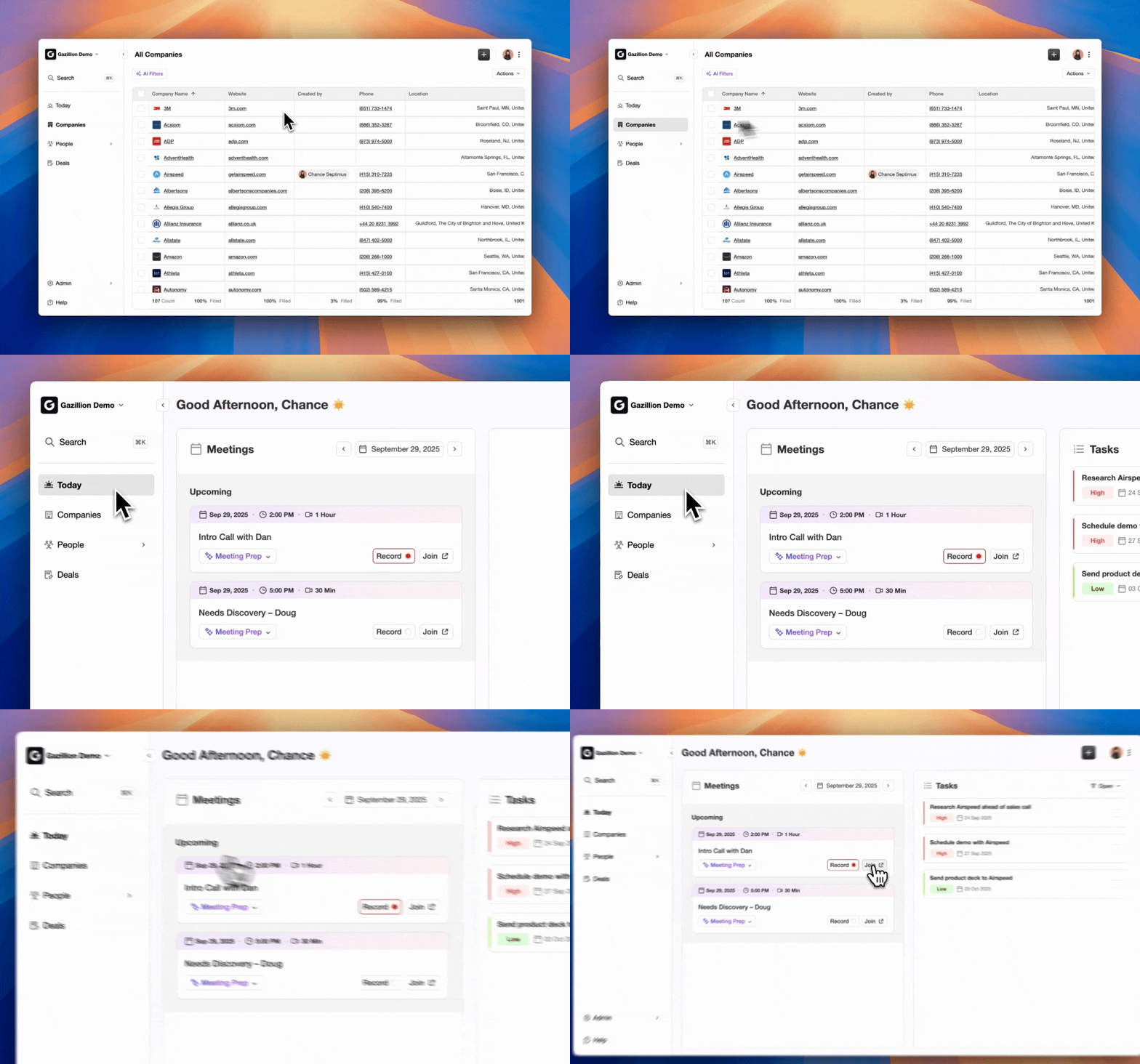
Phase 2 covers agent configuration, where teams define routing rules, fields, and views that match their sales process. Coffee's architecture advantage comes from its purpose-built AI agent design rather than bolted-on automation features. See how visitor identification and enrichment drive compound ROI to understand the impact of this integrated intelligence.
Phase 3 centers on performance monitoring using Coffee's built-in analytics. Weekly ROI tracking becomes automatic, which gives leaders continuous validation of software returns. Because tracking runs in the background, teams can export performance data for executive reporting and budget justification without manual data compilation.
See Coffee's autonomous agent in action with a free trial and experience the agent-driven approach to lead management.
Frequently Asked Questions
How accurate are Coffee's ROI projections compared to actual results?
Coffee's ROI calculations rely on real agent performance data from its integrated data warehouse, which tracks customer interactions and outcomes. The projections use conservative estimates based on median performance across similar team sizes and industries. Actual results often exceed model predictions because teams also gain from reduced tool fragmentation and improved data quality.
What differentiates Coffee's ROI from traditional CRM solutions like HubSpot?
Coffee delivers stronger ROI through autonomous agent capabilities that remove manual data entry. While HubSpot requires human maintenance for data quality, Coffee's agent automatically captures, enriches, and structures information from emails, calendars, and calls. This architectural difference produces the ROI multiples discussed earlier and supports more accurate pipeline forecasting.
Does Coffee integrate with existing security and compliance requirements?
Coffee maintains SOC 2 Type 2 certification and GDPR compliance, which supports enterprise-grade security for B2B implementations. The platform integrates with Salesforce and HubSpot instances while preserving existing security protocols. Data processing occurs within Coffee's secure infrastructure without disrupting current compliance frameworks.
How does Coffee's pricing model affect long-term ROI calculations?
Coffee uses seat-based pricing where teams pay for human users while the agent's unlimited labor is included. This approach creates predictable costs that scale with team growth instead of usage-based metering. ROI improves over time as the agent handles more work without additional software expense.
What implementation timeline should teams expect for ROI realization?
Coffee implementations typically achieve positive ROI within 6-12 months due to time savings from automated data entry. The agent begins capturing and enriching data as soon as the workspace connects, which delivers early productivity gains. Full ROI realization, including pipeline intelligence and conversion improvements, usually occurs within the first year.
Conclusion: Turning AI Agent Data into Measurable ROI
The ROI framework for B2B lead management software centers on quantifiable time savings, conversion improvements, and pipeline accuracy gains. Coffee's AI agent architecture delivers these returns through autonomous data handling and intelligent workflow automation, which removes the productivity drains of legacy CRM systems.
Calculate your team's specific ROI and try Coffee free to transform your B2B sales productivity with agent-driven lead management.