
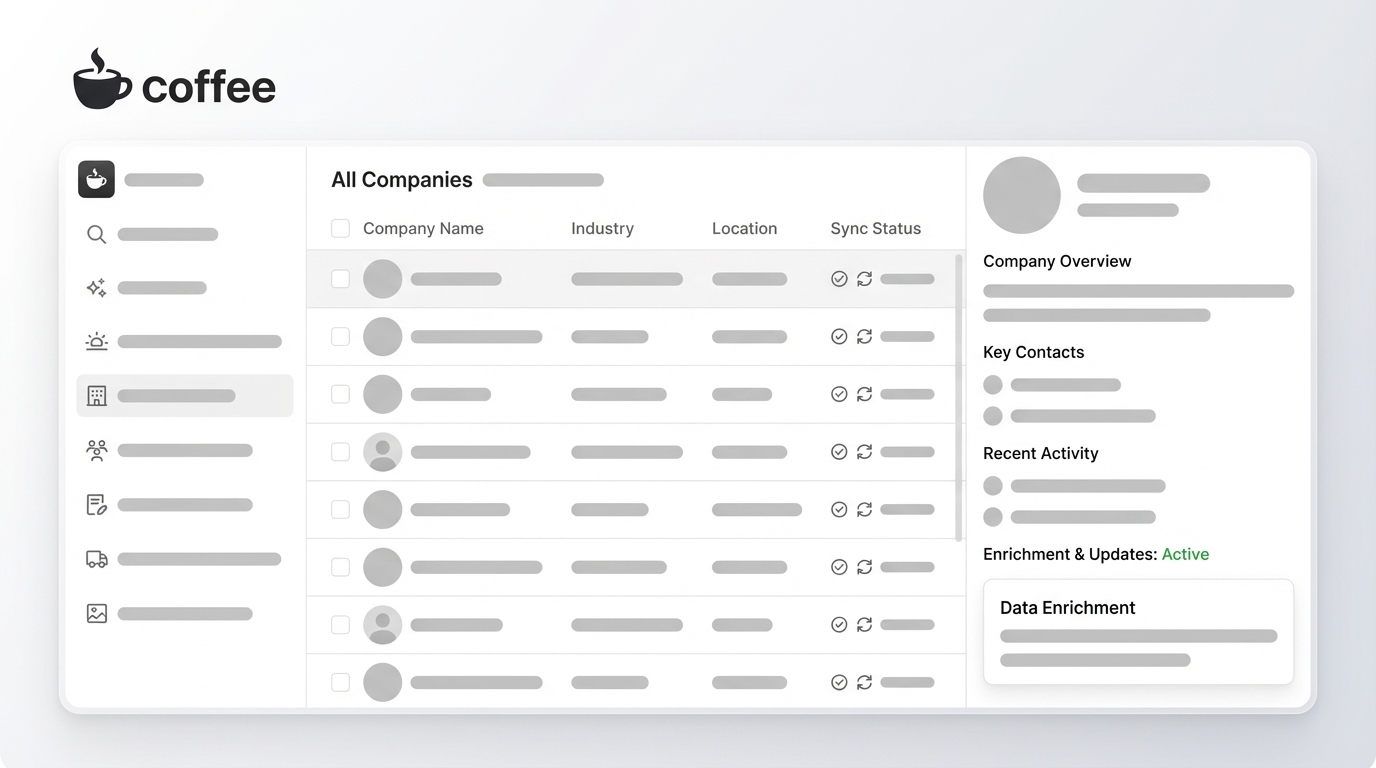
Key Takeaways on Attio vs Coffee for Company Data
-
Attio CRM creates company records from email and calendar syncs using domain detection, but users often need manual corrections.
-
Enrichment pulls employee count, industry, and funding from public sources, yet struggles with unstructured data and real-time accuracy.
-
Domain matching and email sync work for native tools, but Attio lacks direct integrations for platforms like Apollo and relies on slower Zapier flows.
-
Company hierarchies and custom attributes in Attio are flexible, although they require manual setup and limit each record to one pipeline stage.
-
Coffee’s agent-led automation removes Attio’s manual work, so teams gain proactive company data management and save 8–12 hours per week.
How Attio CRM Builds Company Records from Email and Calendar
Attio creates company records by detecting domains when users sync their email and calendar systems. Upon email/calendar sync, Attio automatically populates CRM with company and people records from communication history, which reduces the need for manual company creation in many workflows.
The system identifies company domains from email addresses and then creates company records with these standard fields:
|
Field Type |
Data Source |
Update Method |
|---|---|---|
|
Company Name |
Domain parsing |
Automatic |
|
Website Domain |
Email extraction |
Automatic |
|
Employee Count |
Public databases |
Enrichment |
|
Industry |
Third-party sources |
Enrichment |
Attio’s 2026 updates include AI Attributes that auto-summarize notes, enrich records, and generate consistent fields across objects. These AI features reduce some manual data entry, yet teams still need to review records to confirm accuracy and fill gaps.
Attio Company Enrichment and Update Limits in 2026
Attio’s enrichment engine adds extra company data from public sources to create a fuller profile. The data enrichment engine enhances records with job titles, employee count, funding, social profiles, industry from public sources, which gives teams more context on each account.
The enrichment process works through these mechanisms:
|
Feature |
How It Works |
Limitations |
|---|---|---|
|
Contact Enrichment |
Auto-fills job titles, social profiles |
Limited to public data availability |
|
Company Data |
Pulls funding, employee count, industry |
No unstructured data processing |
|
Real-time Updates |
Periodic refresh from data partners |
Delays in external source updates |
Attio automatically enriches contacts with location, social profiles, employment history, reducing manual entry. When enrichment returns incomplete or outdated data, users still need to verify and correct records, work that modern AI agents can handle more proactively.
Attio Email Sync, Domain Matching, and Integration Gaps
Attio’s email sync connects communication tools directly to company records. The platform monitors Gmail and Outlook to detect new domains and then creates matching company records automatically.
Real-time syncing works well for these native integrations, yet gaps appear with external sales tools. Missing native integrations for niche sales tools like Apollo and Lemlist force reliance on Zapier which may introduce sync delays. This reliance on third-party automation adds latency, extra configuration, and more potential failure points.
Common sync limitations include:
-
Manual configuration for complex domain matching rules
-
Zapier dependency that introduces latency and extra subscription costs
-
Limited coverage for social selling platforms such as LinkedIn
-
Incomplete data unification across email, calls, and other channels
Attio Company Hierarchies and Relationship Mapping Trade-offs
Attio supports company hierarchies through a flexible object model that allows parent-child relationships and team structures. Attio offers a highly flexible data architecture that allows organizations to create custom objects, akin to ‘Notion for CRM’.
This flexibility introduces configuration complexity for many teams. Users must design and maintain hierarchy rules manually, and a company record can only be in one stage of a single list at a time, limiting accurate representation of multiple simultaneous deals or opportunities.
Attio’s AI relationship mapping links contacts and companies automatically, yet complex B2B sales cycles with many stakeholders still benefit from additional agent-led automation that keeps relationships current.
Custom Attributes, Segmentation, and Stage Restrictions
Attio’s custom attributes let teams add tailored fields to company records, including various data types and calculated values. Calculated Attributes auto-compute values based on other data points, such as deal health scores from activity.
Despite this flexibility, users encounter limits when they segment accounts or manage complex motions. The one-stage-per-list restriction creates friction for companies that run multi-threaded sales processes or manage several active opportunities within the same account.
Pipeline Insights from Attio Company Data
Attio uses enriched company data to generate pipeline insights and show deal progression. Teams can see engagement patterns and track changes in real time through the platform’s collaboration features.
These analytics remain lighter than those in dedicated revenue intelligence tools. Attio does not provide deep historical tracking or advanced predictive models, which restricts long-term relationship analysis and accurate forecasting.
Attio vs Coffee for Company Data: Passive CRM vs Active Agent
Attio and Coffee differ most in how they treat company data. Attio behaves like a passive database that depends on human oversight, while Coffee acts as an autonomous agent that manages company information proactively.
|
Feature |
Attio (Passive) |
Coffee Agent |
Impact |
|---|---|---|---|
|
Data Creation |
Domain-based, manual fixes |
Workspace/365 auto-unification |
8–12h/week saved |
|
Enrichment |
Public sources, gaps require human input |
Licensed data partners for job titles, funding, LinkedIn |
Higher accuracy |
|
Relationship Mapping |
Manual hierarchy setup |
Automatic association of notes and interactions with records |
Zero configuration |
|
Pipeline Intelligence |
Basic reporting |
Pipeline Compare with week-over-week history tracking |
Stronger strategic insight |
Coffee’s agent-led model tackles the core issue that affects Attio and similar CRMs: dependence on humans for data quality. When 40% of CRM data becomes obsolete annually and 85% of sellers admit making embarrassing mistakes because of faulty CRM data, intelligent automation becomes essential.
Coffee works as a standalone CRM for growing teams or as a companion agent that upgrades existing Salesforce and HubSpot setups. This flexibility lets organizations adopt agent-led automation without replacing their current stack. Get started with Coffee to remove manual company data management from your team’s workload.

Common CRM Company Data Gaps That Hurt Sales
Modern CRMs capture core company details, yet major gaps remain in completeness and accuracy. Standard fields such as company name, domain, industry, employee count, and contact information only cover structured data.
In practice, only 28% of organizations actively enrich CRM data using third-party sources, and 70% of revenue leaders lack confidence in their CRM data. Sales teams then struggle to trust company records, which leads to missed opportunities and inefficient prospecting.
Attio narrows these gaps with automated enrichment, yet its passive design still leaves crucial information trapped in emails, call transcripts, and meeting notes. Traditional CRMs cannot reliably process this unstructured data or connect it back to company records at scale.

Conclusion: Why Coffee Fits US SMB and Mid-Market Teams
Attio CRM delivers a modern interface and flexible data architecture for company management, but it still functions as a passive system that needs human intervention to keep data clean. Enrichment and workflows improve on legacy tools, yet teams still face incomplete data unification, manual configuration, and constant oversight.
US SMB and mid-market companies that want true automation around company data benefit more from Coffee’s agent-led approach. The Coffee Agent manages company information proactively, unifies structured and unstructured data, and delivers accurate insights without manual effort.
Stop relying on passive CRMs that add work instead of removing it. Get started with Coffee today and turn company data management from a time sink into a clear competitive advantage.
FAQ
How does Attio enrich company data automatically?
Attio enriches company data through integrations with public databases and third-party sources such as Clearbit and Apollo. When a company record appears through email domain detection, the system queries these sources and fills fields like employee count, industry, funding details, and social profiles. The enrichment runs in the background and updates records with available public information, yet users still need to step in when data looks incomplete or inaccurate.
What are Attio’s main limitations for company data syncing?
Attio’s company data syncing has several key limits. The platform lacks native integrations with many sales tools, which forces teams to use Zapier and accept sync delays and extra costs. Data uploads sometimes fail to process leads correctly, which creates unnamed entities and partial records. The system also struggles with complex domain matching and cannot reliably process unstructured data from emails, calls, and meetings that contain valuable company context.
Does Attio handle company hierarchies effectively?
Attio supports company hierarchies through its flexible object model, so users can create parent-child relationships and custom structures. The system still requires significant manual configuration to build useful hierarchies and has a key restriction where company records can exist in only one stage of a single list at a time. This limit makes it hard to represent complex B2B relationships where companies hold several active opportunities or layered decision processes.
How does Attio compare to Coffee for company information management?
Attio works as a passive database that depends on human oversight for data quality, while Coffee operates as an autonomous agent that manages company information proactively. Coffee scans Google Workspace or Microsoft 365 to create and enrich company records with data from licensed partners, removes manual data entry, and offers pipeline insights with historical tracking through its Pipeline Compare feature. Unlike Attio’s domain-based model that often needs manual fixes, Coffee’s agent handles company data management independently and saves teams an estimated 8–12 hours per week.

What does Coffee pricing include for company data management?
Coffee uses seat-based pricing where companies pay for human users while the agent’s unlimited work is included. This pricing covers automatic company record creation and enrichment, real-time data unification from communication tools, AI-powered relationship mapping, pipeline intelligence with historical tracking, and meeting management with automated summaries. Coffee can run as a standalone CRM or as a companion agent for Salesforce and HubSpot, which gives teams flexibility regardless of their current stack.