
Key Takeaways
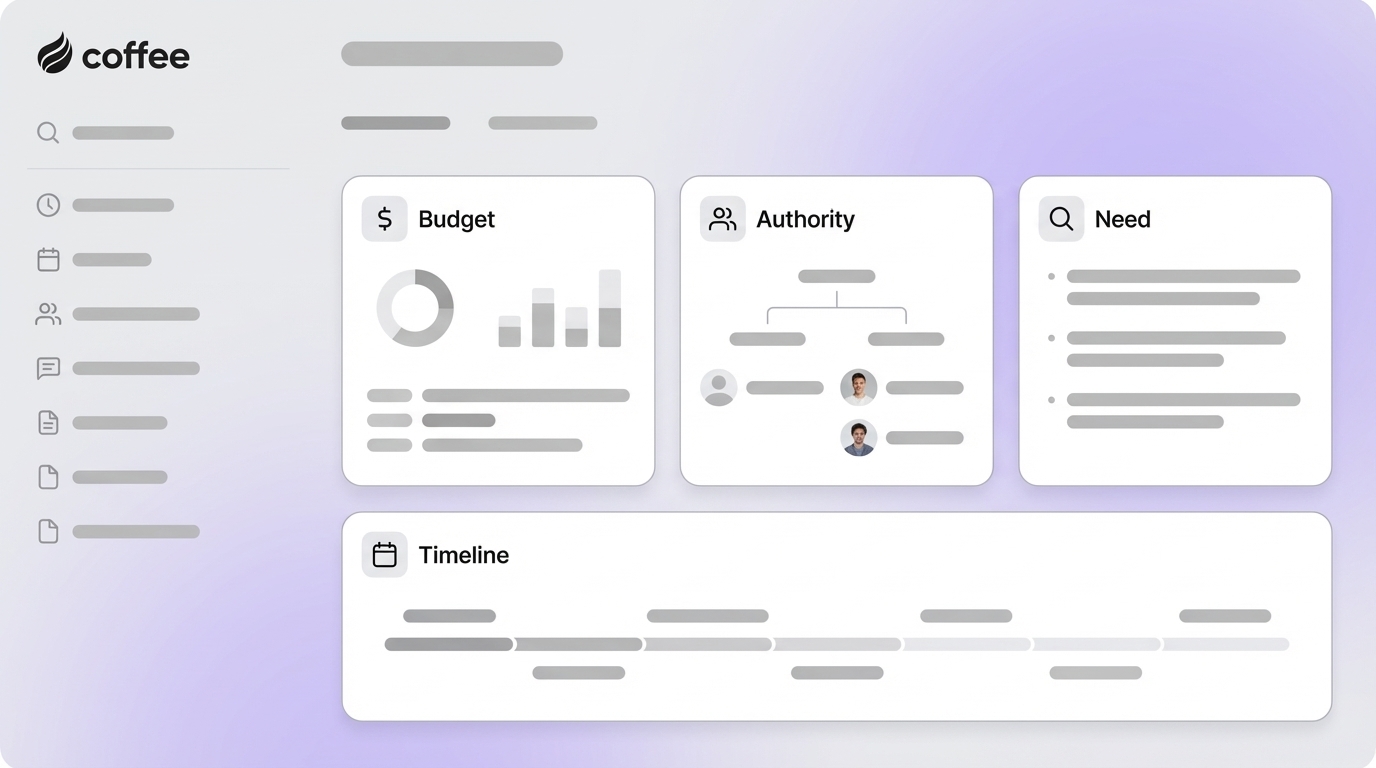
- Advanced BANT upgrades traditional qualification with four pillars: value-based ROI, multilevel stakeholder mapping, root-cause diagnostics, and trigger-driven timelines for complex B2B sales.
- Value-based budget techniques reveal funding paths and ROI expectations across departments instead of stopping at a simple budget check.
- Multilevel authority mapping clarifies champions, economic buyers, influencers, and blockers so you can navigate real decision circles with confidence.
- Deep need diagnostics use root-cause questioning and SPIN-style prompts to uncover hidden requirements and tie pains to measurable business outcomes.
- Teams that implement these techniques with Coffee’s AI agents automate BANT qualification, remove manual CRM entry, and qualify deals about 2x faster.
How Advanced BANT Changes Each Pillar
Advanced BANT methodology for complex B2B sales builds on four enhanced pillars that fix common gaps in traditional qualification.
The table below shows how each classic BANT question turns into a diagnostic tool that fits multi-stakeholder, enterprise-style buying.
|
Pillar |
Traditional Approach |
Advanced Technique |
Complex Sales Impact |
|
Budget |
“Do you have budget?” |
Value-based ROI calculations |
Uncovers funding mechanisms across stakeholders |
|
Authority |
“Are you the decision maker?” |
Multilevel stakeholder power maps |
Maps influence networks and approval chains |
|
Need |
“What problems do you have?” |
Root-cause diagnostic trees |
Surfaces latent needs across departments |
|
Timeline |
“When do you want to buy?” |
Trigger event urgency qualifiers |
Identifies business catalysts driving urgency |
These advanced techniques reflect the reality that BANT enables fast lead qualification for high-velocity scenarios with 500+ leads per month, and they turn that speed into a smarter filter for complex buyer journeys instead of a basic tire-kicker screen.
Advanced Budget Techniques: Build a Clear ROI Story
Value-based budget qualification replaces a yes-or-no budget check with a deeper look at funding paths, ROI thresholds, and cross-functional approvals. Sales teams use structured questions to learn how organizations justify investments when several departments share the impact.
Effective value-based budget prompts include statements such as “Describe the business outcome that would justify this level of investment across your organization” and “Explain how you usually measure ROI for initiatives that span multiple departments.” These prompts surface funding sources, approval layers, and success metrics that basic budget questions never reach.
The ROI justification framework maps cost of inaction against solution value through a clear sequence. Start by documenting current state costs such as productivity losses, compliance risks, and competitive disadvantages. Next, quantify solution benefits through efficiency gains, revenue acceleration, and risk reduction so stakeholders can see a before-and-after contrast. Then present these findings in stakeholder-specific language that matches each decision-maker’s priorities and success metrics.
Multi-stakeholder budget mapping shows how IT, Operations, and Finance share or split funding responsibilities for complex purchases. MEDDIC coaching questions like “What evidence do you have that they can free up Money if this is important enough?” confirm whether budget can actually appear in multi-stakeholder deals.
Coffee’s autonomous CRM agent strengthens budget qualification by enriching funding data from multiple sources and tracking budget conversations across email threads and call transcripts. The agent surfaces financial signals that suggest purchasing readiness and keeps budget intelligence structured and current without manual data entry.
Multilevel Authority Mapping: See the Real Power Structure
Authority mapping in complex B2B sales focuses on the full decision ecosystem instead of a single “decision-maker” label. Many B2B deals involve five or more stakeholders, including Champions, Decision Authorities, Influencers, Blockers from Legal, Security, and Procurement, plus end users.
The stakeholder power grid groups participants into four clear categories. Champions show high influence and high support. Economic Buyers hold budget authority and own outcomes. Influencers bring domain expertise and shape implementation. Blockers raise risk concerns or protect competing priorities. Visual maps then use connecting lines to show reporting structures, influence paths, and dependencies, with color-coding for influence level, interest, department, and stance.
Advanced authority prompts sound conversational while still probing deeply. Examples include “Who else will feel the impact of this decision,” “Whose approval matters for initiatives of this scope,” and “What concerns might Legal or Security raise about this approach.” These non-confrontational prompts help champions validate your map and reveal hidden decision participants.
Relationship dynamics analysis then looks at alliances, tensions, and influence patterns inside the buying committee. Teams document communication preferences, decision styles, and success metrics for each stakeholder. A four-level engagement framework aligns interaction intensity with stakeholder influence using Power-Interest grids.
Coffee supports this authority work by generating organizational charts from meeting transcripts and email interactions, then flagging authority signals and relationship patterns. The agent tracks engagement levels, spots new participants as they appear, and alerts sales teams when authority shifts could change deal momentum.

Deep Need Diagnostics: Expose Root Causes and Hidden Pains
Advanced need qualification uncovers hidden requirements and systemic issues that surface-level discovery never touches. Root-cause diagnostic trees connect visible symptoms to underlying business drivers so you can define a complete solution across all affected groups.
Diagnostic prompts include statements such as “Explain why solving this problem matters now,” “Describe what happens if this situation continues unchanged,” and “Share how this challenge affects other areas of your business.” SPIN Implication questions like “If integration keeps failing, what impact does it have on your team’s productivity and overall customer experience” highlight ROI consequences.
Need-payoff exploration then links these pains to measurable business outcomes. Questions such as “How much would it help your revenue goals if your team no longer loses leads or time due to failed integrations” reveal concrete value-based justifications.
Multi-dimensional need analysis examines three connected layers that together form a full requirement picture. Functional requirements define what the solution must do and sit at the surface. Emotional drivers show how stakeholders feel about the current state, including frustration, anxiety, or urgency that functional specs alone miss.
Political considerations explain how the decision affects organizational dynamics and why a functionally strong solution might still face resistance. Document needs across all three dimensions for every stakeholder group so you can spot overlaps and conflicts that shape solution design and adoption.
Coffee turns unstructured inputs such as call recordings, email threads, and shared documents into organized need intelligence. The agent detects recurring patterns across similar deals, surfaces requirements that stakeholders have not clearly stated, and stores these insights in BANT-friendly formats for consistent qualification.

Trigger-Driven Timeline: Anchor Timing to Real Business Events
Timeline qualification in complex sales works best when it centers on business catalysts instead of arbitrary purchase dates. Trigger events such as funding rounds, regulatory shifts, competitive moves, and leadership changes often create real urgency when you identify and use them correctly.
Urgency prompts include “Describe the key milestones or deadlines that shape the timing of this decision,” “Explain how this initiative fits into your fiscal year planning,” and “What risks appear if implementation slips beyond your target timeframe.” These prompts separate genuine urgency from artificial pressure.
Business trigger analysis maps external forces like market conditions, regulatory demands, and competitive threats along with internal catalysts such as leadership changes, budget cycles, and strategic programs. Predictive timeline intelligence then uses historical deal patterns and industry data to forecast close dates and highlight urgency indicators.
Timeline validation checks implementation needs, change management work, and resource availability that shape realistic deployment schedules. Teams document dependencies, approval steps, and integration timelines that often push real project kickoff dates beyond contract signature.
Coffee tracks this timeline intelligence through continuous pipeline monitoring, spotting stall patterns and urgency signals as deals move. The agent sends alerts when opportunities drift from expected paths, pulls trigger events from news feeds and company updates, and keeps timeline data accurate through automatic activity logging.

BANT Framework Comparisons for Different Sales Motions
Modern qualification frameworks now serve different roles across simple and complex B2B environments. BANT fits straightforward transactional deals with low to mid ACV and short cycles, while MEDDIC fits enterprise deals with high ACV, long cycles, and many stakeholders.
The comparison below highlights how each framework’s strengths and tradeoffs align with specific sales scenarios so you can match your approach to deal complexity and team capacity.
|
Framework |
Best For |
Strengths |
Limitations |
|
Advanced BANT |
Complex qualification with AI automation |
Fast qualification, AI-enhanced insights |
Requires sophisticated implementation |
|
MEDDIC |
Enterprise multi-stakeholder deals |
Comprehensive analysis, champion focus |
Resource-intensive, complex process |
|
CHAMP |
Consultative challenge-based selling |
Buyer-centric, pain-focused approach |
Limited metrics and timeline focus |
|
SPIN |
Discovery-driven need development |
Excellent pain exploration |
Lacks authority and budget structure |
BANT’s speed advantage, covered earlier for high-velocity scenarios, makes it ideal for inbound environments, while MEDDIC offers deeper insight for complex, multi-stakeholder sales but demands more time and resources.
Advanced BANT with AI blends BANT’s speed with enterprise-level depth by using automated data capture and intelligent analysis instead of manual research and note-taking.
AI BANT Qualification CRM: Put Coffee Agents to Work
AI agents now shift qualification from manual effort to continuous, automated intelligence across the entire funnel. AI supports BANT by reading behavioral signals, engagement patterns, and sentiment in real time across CRM history, website activity, email, and firmographic data.
Coffee’s autonomous CRM agent powers BANT by capturing data from calls, emails, and meetings and then structuring those insights directly into BANT fields. The agent works either as a standalone CRM for growing teams or as a companion app that upgrades existing Salesforce or HubSpot setups.

Advanced AI features include predictive lead scoring that converts BANT profiles into numeric models, conversational intelligence that pulls qualification signals from unstructured conversations, and pipeline intelligence that tracks how qualification evolves across long sales cycles. Well-implemented AI agents often deliver 3 to 5 times more volume and cut cost per meeting by 50 to 70 percent, which supports faster qualification at scale.
As noted earlier, Coffee’s time savings of 8 to 12 hours per week come from removing manual qualification data entry while improving accuracy through complete data capture. One company generating tens of millions in revenue replaced spreadsheet-based reviews with Coffee’s Pipeline Compare feature and now relies on intelligent deal progression analysis instead.
Book a Coffee demo to see autonomous BANT qualification in a live environment.
Conclusion: Turn BANT into a Modern Revenue Engine
Advanced BANT techniques for complex B2B sales improve qualification speed and win rates when paired with AI-powered automation. The four-pillar model of value-based budget analysis, multilevel authority mapping, root-cause need diagnostics, and trigger-driven timelines fits the demands of modern buying committees.
Coffee delivers this model through an AI-powered approach that removes manual data entry and supplies complete qualification intelligence. The autonomous agent keeps BANT data consistent and accurate so sales teams can run stronger plays and move deals forward faster.
Get started with Coffee today and upgrade your qualification process with advanced BANT and practical AI.
FAQ
What is advanced BANT for complex sales?
Advanced BANT for complex sales extends classic Budget, Authority, Need, and Timeline qualification with techniques built for multi-stakeholder B2B deals. Budget work shifts from basic confirmation to value-based ROI frameworks that reveal funding paths across departments. Authority mapping grows from a single decision-maker view into a full power map that includes Champions, Economic Buyers, Influencers, and Blockers.
Need qualification moves from surface problems to root-cause diagnostic trees that expose systemic issues and hidden requirements. Timeline assessment moves from arbitrary dates to trigger event analysis that highlights the business forces creating real urgency.
How does AI enhance advanced BANT qualification?
AI enhances advanced BANT qualification by handling data capture, analysis, and insight generation across long, complex cycles. Coffee’s autonomous CRM agent pulls BANT signals from calls, emails, and meetings and organizes them without manual entry. The AI reads behavioral patterns, engagement signals, and stakeholder interactions to deliver predictive lead scores and timeline forecasts.
It also supports automatic stakeholder mapping from communication patterns, assists with ROI calculations through data enrichment, and spots trigger events from external sources. This automation saves 8 to 12 hours per week while raising qualification accuracy and consistency across the team.
How does BANT compare to MEDDIC for complex sales?
BANT and MEDDIC play different roles in complex sales. BANT excels at fast qualification and early filtering, which suits high-volume environments where speed matters. MEDDIC offers deeper analysis for enterprise deals but needs more time and resources. Advanced BANT with AI combines BANT’s speed with enterprise-level depth through automated capture and smart analysis.
MEDDIC focuses heavily on metrics and champion development, while advanced BANT emphasizes value-based qualification and stakeholder power mapping. Teams should choose based on sales velocity, deal complexity, and the resources they can dedicate to qualification.
What are effective BANT budget techniques for ROI justification?
Effective BANT budget techniques for ROI justification center on value-based prompts instead of yes-or-no budget checks. Strong approaches explore the business outcomes that justify investment levels, clarify multi-department funding mechanisms, and compare cost of inaction with solution benefits.
Strategic prompts such as “Describe the business outcome that would justify this investment across your organization” and “Explain how you measure ROI for cross-department initiatives” reveal funding paths and approval steps. The ROI framework should quantify current costs like productivity loss and competitive risk, then present solution benefits in language that matches each decision-maker’s metrics and priorities.
What are stakeholder mapping best practices for BANT authority qualification?
Stakeholder mapping best practices for BANT authority qualification start with a full ecosystem view instead of a single contact. Build visual power grids that classify participants as Champions, Economic Buyers, Influencers, and Blockers with clear influence levels and relationship lines.
Use non-confrontational prompts such as “Who else will feel the impact” and “Whose approval matters for initiatives of this scope” to uncover hidden players. Capture communication preferences, decision styles, and success metrics for each person, and refresh maps as dynamics change and new people join. Apply engagement frameworks that match touch frequency and depth to each stakeholder’s influence so you invest effort where it matters most.