Best Revenue AI Platform for Teams Tired of Bad CRM Data

AI CRM Platforms: Boost Sales & Revenue with Modern Technolo

Content

Written by: Doug Camplejohn, CEO & Co-Founder, Coffee | Last updated: August 28, 2026

Why Coffee Stands Out in Revenue AI

  • Revenue AI platforms in 2026 only work when an autonomous agent captures clean CRM data before any intelligence layer runs.
  • Legacy tools like Gong, Clari, and Salesforce Einstein rely on manual rep entry, so they keep the root data problem in place.
  • Coffee’s Agent automatically creates contacts, companies, and activities from email, calendar, and call transcripts, returning 8–12 hours per week to each rep.
  • Teams using Salesforce or HubSpot can deploy Coffee as a Companion App that writes clean records back to their existing CRM without migration.
  • Eliminate your data-quality bottleneck with Coffee so every other revenue AI tool becomes more reliable.

The 2026 Agentic AI Shift Starts With Clean CRM Data

Dirty data costs B2B companies an estimated 12% of their annual revenue, so automated CRM data maintenance has become one of the highest-impact uses of agentic AI in 2026. The shift from passive software to active agents is architectural, not incremental. An agent reasoning over stale or wrong data produces confident, wrong actions at scale. Teams need to clean the data layer first, then point an agent at it.

Clean CRM data, standardized deal stages, and consistent field mapping are prerequisites for AI agents in RevOps, because agents amplify whatever structure already exists, including chaos. This connection between poor data quality and downstream failures in forecasting and pipeline predictability is direct and measurable. Companies deploying AI-powered CRM hygiene agents report significant reductions in data-related errors, which then improves every downstream workflow.

Gong captures conversation intelligence but depends on reps to keep deal records current. Clari governs forecasts from existing pipeline data but does not repair the inputs. Revenue.io is Salesforce-native but still relies on activity being logged accurately. Salesforce Einstein Activity Capture historically stored captured emails externally on AWS (with up to 6 months of historical Gmail data), but Summer ’25 updates allow optional sync as native Salesforce records with API access; retention defaults vary by edition (6 months max for standard orgs, 24 months for paid), which means its original configuration could not feed Salesforce reports, dashboards, or automations. HubSpot accumulates duplicates and suffers field completion drift due to flexible multi-source data entry. None of these platforms solve the upstream problem. They inherit and amplify it.

Revenue AI for Forecasting Accuracy You Can Trust

A 40-person SaaS sales team running weekly pipeline reviews often operates on partial data. Reps log some calls, skip others, and update deal stages inconsistently. The forecasting tool, whether Clari, HubSpot native, or Salesforce Einstein, ingests that noise and returns a number that looks authoritative but rests on shaky inputs. Revenue intelligence platforms analyze that noise and return confident-sounding nonsense when they receive duplicate contacts, missing company fields, or inconsistent deal stages.

AI forecasting agents improve accuracy from the typical 50–65% range achieved by base LMs to around 74% by pulling all active pipeline deals, applying stage-specific historical conversion rates, and adjusting probabilities using deal-level signals such as activity levels and staleness. This improvement only appears when the underlying data is clean and complete.

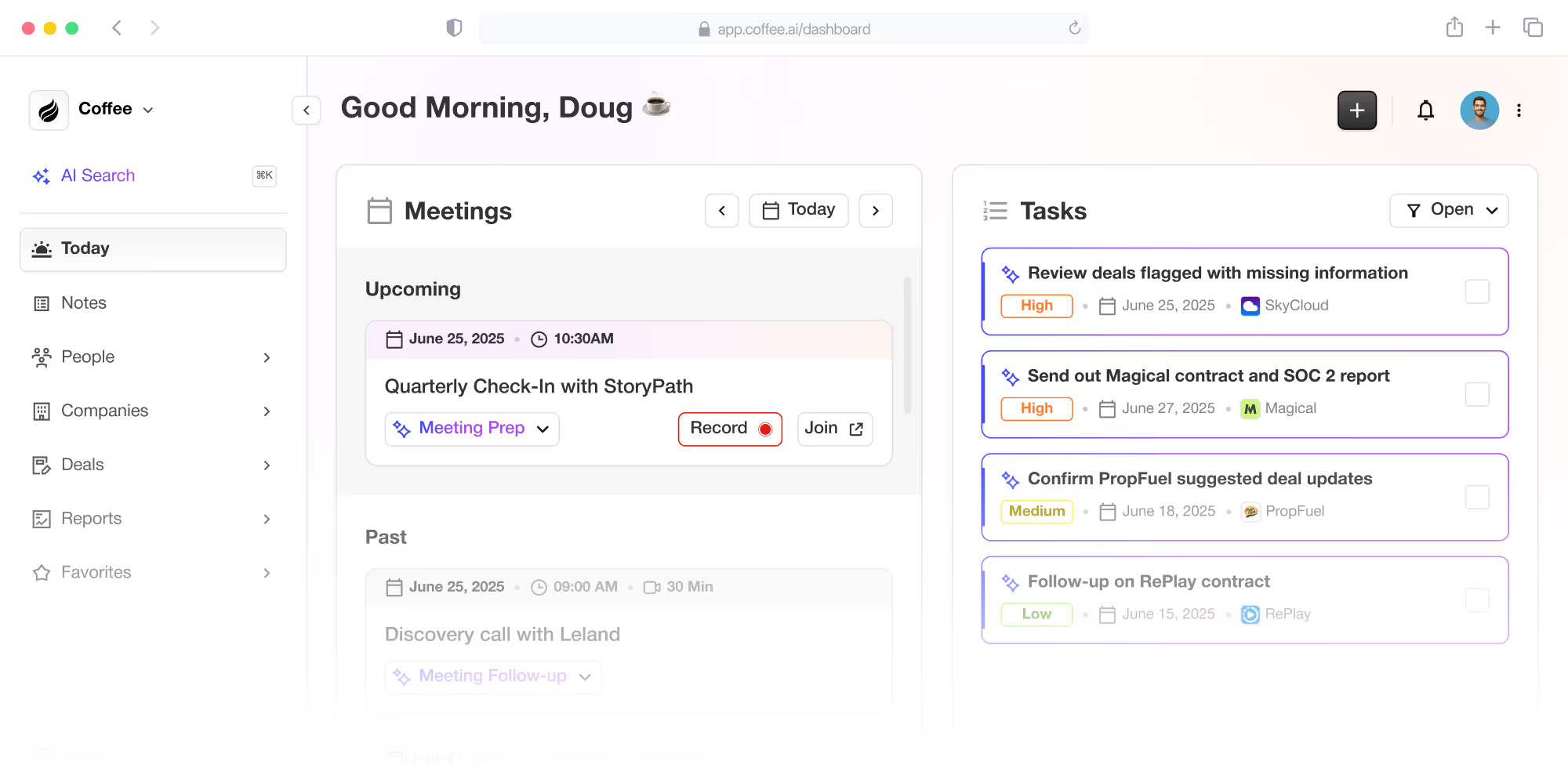
Coffee’s Pipeline Compare feature visualizes week-over-week changes automatically, highlighting progressed deals, stalled opportunities, and new additions. Because the Coffee Agent captures activity from emails, calendars, and call transcripts into a built-in data warehouse, the history it analyzes reflects ground-truth behavior, not whatever a rep remembered to type. That structural difference explains the jump from typical base accuracy in the 50–65% range to improved accuracy around 74%.

Salesforce Teams: Keep Your CRM, Fix Your Data

Teams committed to Salesforce face a specific problem. The system of record is expensive, deeply configured, and non-negotiable, yet its data quality degrades continuously. Gartner research found that only 7% of sales organizations achieve forecast accuracy above 90%, with the root cause almost always being incomplete CRM data from manual rep entry.

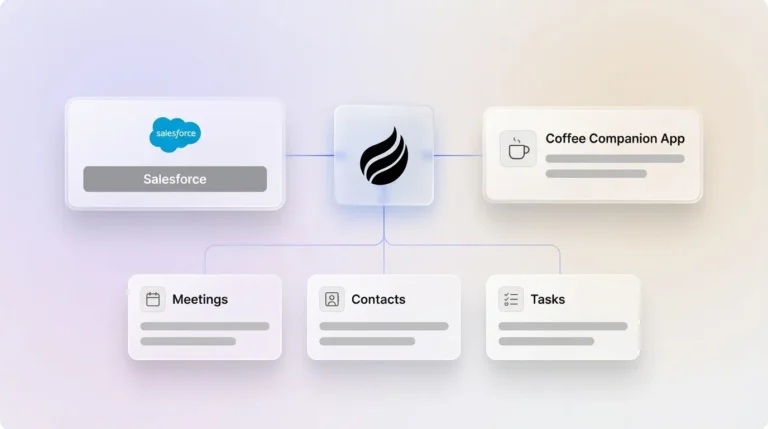
For buyers evaluating AI agents, the decisive question is whether the agent sits closer to the system of record or closer to the workflow. Coffee’s Companion App answers that question directly. It deploys the Coffee Agent as an intelligent layer on top of an existing Salesforce instance. The Agent handles all data capture, including contacts, companies, activities, call summaries, and next steps, and writes clean, enriched records back to Salesforce without replacing it.

This architecture avoids sync latency and fragile mappings. Coffee operates as an autonomous agent that ensures Salesforce receives accurate inputs so that every downstream tool, including forecasting, deal scoring, and pipeline inspection, operates on data it can trust. Agent layers deliver the best results when they enhance the system of record rather than replace it, and Coffee is built on exactly that principle. That architectural choice directly addresses the daily reality most sales teams face.

Revenue AI That Fixes CRM Data Entry at the Source

Sales reps at 20–100 person SaaS companies describe the same pattern. The CRM becomes a shadow of reality, the real pipeline lives in a spreadsheet or a Notion doc, and every Monday morning starts with a data reconciliation exercise instead of a selling conversation. Workers spend an average of 13 hours per week hunting for basic information in CRM. Sixty-eight percent of sales leaders do not trust their forecasts due to limited pipeline visibility caused by incomplete or delayed CRM data. This data fragmentation wastes time and erodes confidence in every forecast.

Coffee removes these problems at the source. Upon connection to Google Workspace or Microsoft 365, the Coffee Agent:

Build people lists automatically with Coffee AI CRM Agent
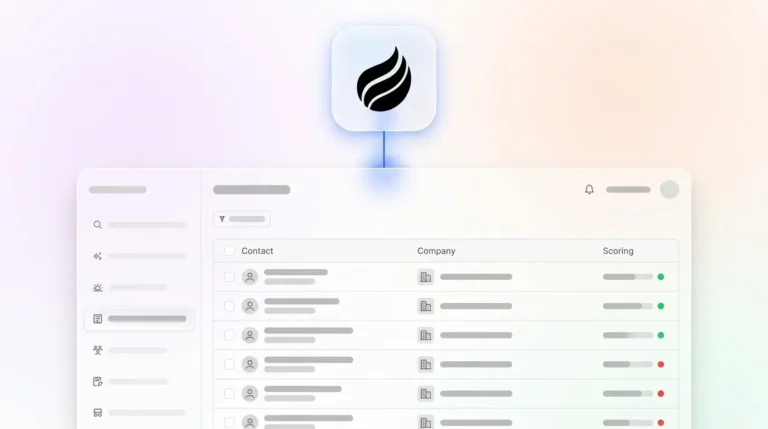
  • Auto-creates contacts and companies by scanning emails and calendars, associating every note and interaction with the correct record automatically
  • Enriches records with job titles, funding data, and LinkedIn profiles via licensed data partners, removing the need for separate tools like Apollo or ZoomInfo
  • Logs last activity and next activity autonomously so deal state is always current
  • Joins calls via AI Meeting Bot, generates post-call summaries, identifies next steps, and drafts follow-up emails for rep review
Building a company list with Coffee AI

The result is the time savings mentioned earlier, with hours previously consumed by data entry now going toward selling. A 5-person sales team losing one hour per day to manual CRM data entry loses 25 hours per week of selling time. Coffee closes that gap without adding headcount.

Create instant meeting follow-up emails with the Coffee AI CRM agent

Revenue AI Built for 20–100 Person SaaS Teams

For teams of 20–100 people, adoption rates matter more than feature comparisons because a platform that reps avoid produces worse data than no platform at all. Coffee’s dual-model strategy addresses this adoption challenge directly.

Teams without an entrenched CRM deploy Coffee as the standalone system of record, where the Agent manages all data from day one. Teams already running Salesforce or HubSpot deploy the Companion App, which layers the Agent on top of the existing investment without requiring migration or retraining. Both paths deliver the same outcome. Clean data flows in, and accurate intelligence flows out.

Companies deploying AI-powered CRM hygiene agents report a 10–15% improvement in sales productivity because reps spend less time on bad data. For a 50-person team, that productivity gain compounds across every rep, every week, without adding a single headcount. Coffee’s seat-based pricing model, where the Agent’s unlimited labor is included in the seat cost, keeps the economics straightforward at any team size in this range.

See which deployment model fits your current stack at Coffee’s pricing page.

Decision Matrix: Revenue AI Platform Comparison 2026

The key differentiator becomes clear when you compare data-entry automation side by side. Most platforms assume clean data already exists, while only one captures it autonomously. The table below compares platforms across four dimensions relevant to 20–100 person SaaS teams. CRM Fit describes native integration depth. Data-Entry Automation describes whether the platform captures data without rep input. Pipeline Intelligence Depth describes the quality of forecasting and deal-health outputs. All data points are drawn from cited sources.

Platform CRM Fit Team Size Sweet Spot Data-Entry Automation Pipeline Intelligence Depth
Gong Salesforce & HubSpot via sync Mid-market to enterprise Conversation capture only, does not repair CRM inputs Strong conversation intelligence, forecast quality depends entirely on CRM data quality
Clari Salesforce & HubSpot via sync Enterprise 100+ reps Focuses on forecast governance from existing records, does not capture or repair data Strong pipeline inspection, requires good CRM data quality to deliver full value
Revenue.io Salesforce-native Mid-market to enterprise, 20+ reps Activity capture within Salesforce, still dependent on rep-initiated interactions Real-time deal intelligence inside CRM, accuracy tied to activity completeness
Salesforce (Einstein) Native Enterprise Historically stored captured data externally on AWS but Summer ’25 updates allow optional native records with API access, retention varies by edition Dependent on underlying CRM data quality for accurate forecasting
HubSpot (Breeze AI) Native SMB to mid-market Limited automation, accumulates duplicates and field completion drift from multi-source entry Native AI tools remain dependent on underlying CRM data quality
Coffee Standalone CRM or Companion App for Salesforce & HubSpot 20–100 person SaaS teams Fully autonomous: auto-creates contacts, companies, and activities from email, calendar, and call transcripts, saves significant hours per rep each week Pipeline Compare delivers week-over-week deal tracking from agent-captured ground-truth data, agent-maintained data quality supports forecast accuracy around 74%

Addressing Common Objections About Coffee

Three objections surface consistently when revenue and RevOps leaders evaluate Coffee.

On integrations, Coffee connects to existing tools via Zapier today, with deeper roadmap integrations in development. In 2026, 68% of tech leaders planned vendor consolidation targeting approximately 20% fewer providers, and Coffee’s agent-first architecture is designed to consolidate the stack, including CRM, enrichment, prospecting, recording, outreach sequencing, and forecasting, into a single seat-based subscription rather than adding another point solution.

On security, Coffee maintains strong data security and privacy standards. Data is not used to train public models. For teams in regulated-adjacent environments, this meets the baseline requirement without a multi-year security review.

On data quality, Coffee’s enrichment data is on par with ZoomInfo for most B2B use cases and is built directly into the Agent. This eliminates the separate subscription and the manual import workflow that standalone enrichment tools require.

Frequently Asked Questions

Which revenue AI platform actually fixes CRM data entry?

Coffee is the only revenue AI platform built around autonomous data capture as its primary function. Upon connecting to Google Workspace or Microsoft 365, the Coffee Agent automatically creates contacts and companies, logs all activity, enriches records with firmographic and contact data, and generates post-meeting summaries and follow-ups, all without rep input. Other platforms such as Gong, Clari, and HubSpot Breeze AI surface intelligence from CRM data but do not autonomously capture or repair that data at the source. The result with Coffee is 8–12 hours per week returned to each rep and a CRM that stays accurate without human maintenance.

GIF of Coffee platform where user is using AI to prep for a meeting with Coffee AI
Automated meeting prep with Coffee AI CRM Agent

Gong vs. Clari vs. Coffee in 2026 for imperfect CRM data

Neither Gong nor Clari resolves the upstream data problem. Gong captures conversation intelligence from calls and meetings but depends on the CRM being populated accurately for deal-level forecasting. Clari governs pipeline inspection and forecast rollups from existing records but does not capture or repair those records. Both platforms operate on the amplification principle described earlier, where clean data produces reliable outputs and dirty data produces confident-looking errors. Coffee takes a different architectural position. The Agent captures clean, ground-truth data from emails, calendars, and transcripts before any intelligence layer runs. Because the inputs are accurate, the Pipeline Compare outputs and deal-health signals are trustworthy. For teams with imperfect CRM data, which describes most 20–100 person SaaS teams, Coffee is the only platform that addresses the root cause rather than the symptom.

How much time do B2B sales teams lose to manual data entry in 2026?

The range across published research is consistent. Sales reps spend between 8 and 13 hours per week on data entry and related administrative tasks. Salesforce’s State of Sales research found reps spend only 28–30% of their time actually selling. Validity’s 2025 State of CRM Data Management report found workers spend an average of 13 hours per week hunting for basic information in CRM. One widely cited estimate puts annual data-entry losses at 546 hours per rep. For a 20-person sales team, that represents hundreds of hours per week diverted from pipeline-generating activity. Coffee’s autonomous agent eliminates this entirely by handling all data capture in the background.

Can a companion agent improve Salesforce or HubSpot without replacing them?

Yes, and this is precisely what Coffee’s Companion App is designed to do. The Agent authenticates with an existing Salesforce or HubSpot instance, begins capturing data from connected email and calendar accounts, enriches records, logs activities, and writes clean data back to the CRM. It does this without requiring migration, retraining, or changes to existing workflows, quotas, required fields, or forecasting configurations. Newer AI CRM alternatives lack the depth of understanding required to work within Salesforce’s and HubSpot’s complex integration requirements. Coffee is built with that integration depth as a core competency, making it the practical choice for teams that have invested in these platforms and need the data quality to improve without replacing the system of record. Teams ready to see this in practice can start a Coffee trial from the pricing page.

Conclusion: Clean Data Before Scaled Revenue AI

A large majority of B2B organizations agree that clean data, defined processes, and reliable routing must come before scaling AI. The platforms that dominate the revenue AI conversation in 2026, including Gong, Clari, Revenue.io, Salesforce, and HubSpot, remain downstream consumers of the data-quality problem outlined earlier.

Coffee is the only revenue AI platform built to guarantee good data in so that good data out is structurally possible. For teams without an existing CRM, the standalone Agent manages the system of record from day one. For teams committed to Salesforce or HubSpot, the Companion App layers autonomous data capture on top of the existing investment. Both paths produce the same outcome: a CRM that stays accurate without human maintenance, forecasts that reflect reality, and reps who spend their time selling instead of entering data.

Make bad CRM data a problem your team no longer has and start your Coffee trial today.