Written by: Doug Camplejohn, CEO & Co-Founder, Coffee
Key Takeaways
- Most “HubSpot data warehouse alternatives” move CRM data into Snowflake, BigQuery, or Redshift for deeper analytics while HubSpot stays your CRM.
- Native HubSpot integrations sit behind Data Hub Enterprise and lack historical backfill, real-time sync, and true bidirectional flows.
- ELT tools like Fivetran, Airbyte, Hevo, and Stitch handle one-way HubSpot-to-warehouse pipelines with different pricing models and setup effort.
- Reverse ETL tools such as Hightouch, Census, and RudderStack send warehouse-computed insights back into HubSpot for sales and marketing activation.
- Coffee automates data quality in HubSpot before any pipeline runs, so clean records reach your warehouse. See Coffee’s pricing to plan your data quality setup.
Why Your HubSpot Stack Needs a Data Warehouse
HubSpot’s native reporting focuses on CRM-centric views like contact activity, deal stages, and pipeline summaries. HubSpot’s reporting layer struggles with complex analytics that combine CRM records with product usage data, billing systems, or customer success platforms. A cloud data warehouse solves this gap by acting as a central repository where all data sources converge.
The core benefits of pairing HubSpot with a warehouse include:
- Combining HubSpot CRM data with product telemetry, billing records, and support tickets in a single query layer
- Maintaining full historical snapshots of record changes, which HubSpot’s relational database does not preserve natively
- Running advanced SQL queries and powering BI tools like Looker, Tableau, or dbt-based semantic layers
- Enabling more accurate revenue forecasting and customer health scoring
A warehouse delivers trustworthy insights only when the data entering it is clean. Duplicate contacts, incomplete records, and inconsistent field formatting in HubSpot arrive in your warehouse unchanged. Pipeline tools cannot fix bad data at the source, so teams need to solve data quality issues before building any pipeline.
Native HubSpot Integrations vs. Third-Party Pipelines
HubSpot offers two native warehouse integrations that teams should review before considering third-party tools.
The HubSpot Snowflake Direct Sync (in beta as of July 2026) connects a Snowflake table or view directly to HubSpot CRM objects. It runs on a schedule, not in real time, and data flows one way from Snowflake to HubSpot. Filtering is not supported at the sync level, so users must create a view in Snowflake before syncing. The sync supports up to 10 GB of data and 30 million records per run, and it is available with Data Hub Enterprise (starting at $2,000/month) and Smart CRM Enterprise subscriptions.
The native BigQuery integration (also in beta) supports sync frequencies of once, every 6 hours, every 12 hours, daily, weekly, or monthly, with no real-time option. It stages Parquet files in a Google Cloud Storage bucket and requires a Super Admin to install. Like the Snowflake integration, it is gated behind Data Hub Enterprise.
The HubSpot Snowflake Data Share uses Snowflake’s Secure Data Sharing to grant read-only access to HubSpot CRM data without copying it. It provides near real-time access to current data, yet it does not support historical backfill and cannot write data back to HubSpot.
Third-party ELT and reverse ETL tools expand coverage with broader objects, historical backfill on initial sync, configurable transformation layers, and support for warehouses beyond Snowflake and BigQuery. These tools introduce extra subscription cost and integration complexity on top of your existing HubSpot spend, so teams should weigh native options first.
ELT Tools for One-Way Sync: HubSpot to Warehouse
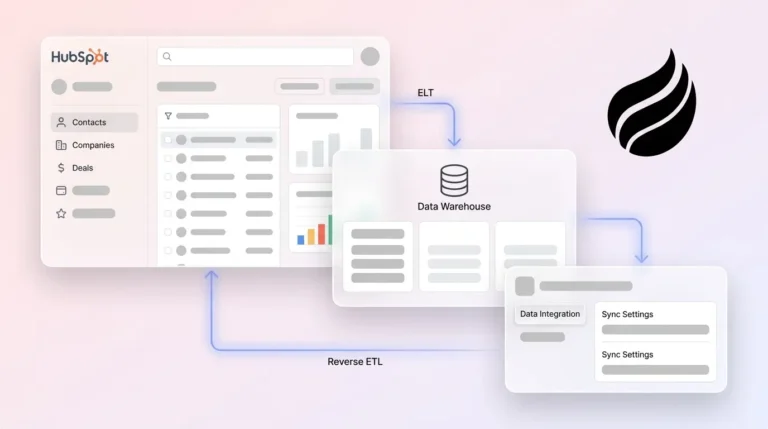
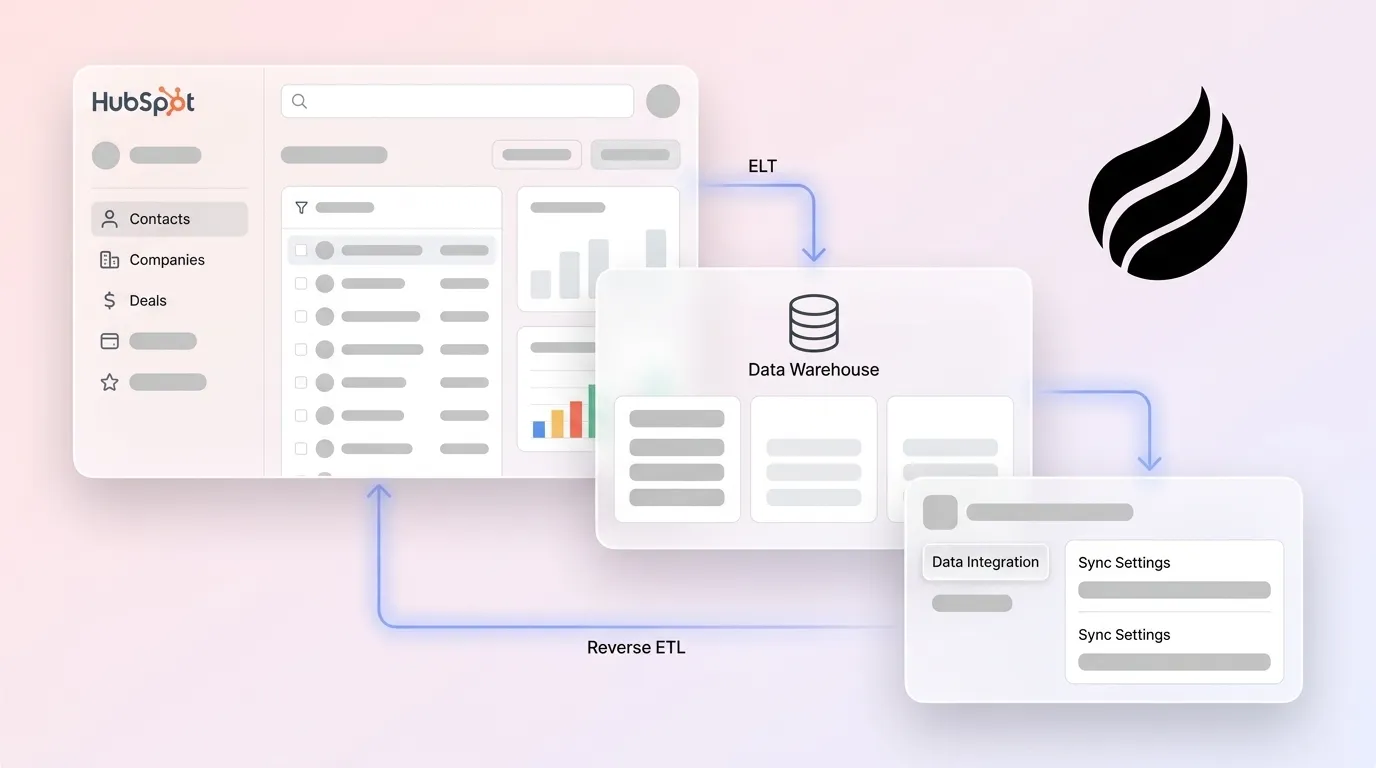
ELT (Extract, Load, Transform) tools pull data from HubSpot, load it raw into your warehouse, and then transform it using warehouse compute. This pattern dominates one-way sync because cloud warehouses provide elastic compute that scales with workload. The table below compares leading ELT tools on pricing and setup effort so you can quickly narrow options that match your team’s skills and budget.
| Tool | Best For | Pricing (Starting) | Setup Effort |
|---|---|---|---|
| Fivetran | Teams needing managed, reliable pipelines | Free tier; paid from ~$500/million MAR | Low — 10–15 min per connector |
| Airbyte | Teams wanting open-source flexibility | Free self-hosted; Cloud from ~$10/month | Medium — self-host requires DevOps |
| Hevo Data | Teams wanting predictable flat pricing | Free tier; paid from ~$239/month | Low — under 5 min to first pipeline |
| Stitch | Small teams with simple workloads | From ~$100/month | Low |
Fivetran is the most managed option in this category. Its Standard plan at $500/million MAR includes 700+ connectors, 15-minute sync frequencies, and dbt Core integration, and automatic schema drift handling is built in. The tradeoff is cost unpredictability, with pricing changes in 2025–2026 increasing costs by 40–70% for many multi-connector teams and mid-market teams often paying $3,000–$5,000+/month. A $5 minimum per active connector introduced in January 2026 adds further cost for teams with many sources.
Airbyte offers a free self-hosted Community edition and a Cloud tier starting at approximately $10/month. Cloud billing uses credits, with API sources consuming roughly $15 per million rows and database sources roughly $10 per GB. Self-hosted Airbyte often costs $500–$3,000/month in infrastructure plus 20–40 engineering hours monthly for maintenance, which can exceed the cost of a managed tool at scale.
Hevo Data uses a flat, event-based pricing model that does not re-bill on backfills or re-syncs, which helps teams with update-heavy data. Its median time-to-first-pipeline is under 5 minutes.
Stitch, now part of Talend/Qlik, offers over 140 connectors starting at ~$100/month. Its 1-hour minimum sync frequency and lack of log-based CDC make it a better fit for batch analytics workloads at smaller scale.
Reverse ETL Tools for Syncing Back to HubSpot
Reverse ETL tools send warehouse data such as product usage events, computed scores, and enriched segments back into HubSpot for sales and marketing. These tools close the loop created by ELT, so warehouse-computed intelligence reaches reps and marketers without manual exports.
| Tool | Best For | Pricing (Starting) | Setup Effort |
|---|---|---|---|
| Hightouch | Marketing teams needing self-serve audience building | Free tier; paid from ~$450–$600/month | Low — no-code friendly |
| Census | Engineering-led, dbt-native teams | From ~$800/month | Medium — SQL-first |
| RudderStack | Teams needing event collection + reverse ETL | Free tier; paid from ~$220–$500/month | High — developer-oriented |
Hightouch supports 200+ destinations including HubSpot, Salesforce, Braze, and major ad networks. Its visual audience builder lets non-technical users build segments without SQL. Standard sync frequency is every 1–15 minutes depending on plan. At 10M synced records per month, costs reach $2,800–$4,200/month.
Census works best for SQL-fluent, dbt-native teams. Its Live Syncs feature, introduced in late 2025, delivers sub-minute sync latency on Snowflake using warehouse-native change data capture. Census supports approximately 160 destinations and has the deepest dbt integration of the three tools.
RudderStack is open source (AGPL license) and handles both event collection and reverse ETL in one platform, which helps teams replacing Segment. Self-hosting requires Kubernetes expertise and 1–2 weeks of DevOps time for initial setup. For teams that prefer a managed option, its free plan covers 250,000 events per month including 10 reverse ETL connections, with paid plans starting at $220/month.
All Tools at a Glance: Master Comparison
| Tool | Type | Best For | Starting Price |
|---|---|---|---|
| Fivetran | ELT | Managed pipelines | ~$500/million MAR |
| Airbyte | ELT | Open-source flexibility | Free (self-hosted) |
| Hevo Data | ELT | Predictable pricing | ~$239/month |
| Stitch | ELT | Small teams | ~$100/month |
| Hightouch | Reverse ETL | Marketing activation | ~$450–$600/month |
| Census | Reverse ETL | dbt-native teams | ~$800/month |
| RudderStack | Reverse ETL | CDP + reverse ETL | ~$220–$500/month |
How to Choose the Right HubSpot Data Warehouse Tool
The right tool depends on five variables. Work through this checklist before evaluating vendors:
- Warehouse destination: Snowflake, BigQuery, and Redshift are all supported by Fivetran, Airbyte, and Hevo. If you are on Databricks, Hightouch has invested heavily in its Databricks connector and generally offers the smoothest experience.
- Sync direction: Teams that only need HubSpot data in the warehouse can use an ELT tool. Teams that also need to push warehouse-computed data back into HubSpot require a reverse ETL tool or a combination of both.
- SQL skills: Census and RudderStack are SQL-first and require analytics engineering capacity. Hightouch and Hevo are more accessible for non-technical users.
- Monthly budget: A basic reverse ETL stack runs at least $2,500–$4,000/month all-in, excluding dedicated data team costs. Plan for $2,500–$7,500/month for a full mid-market stack including warehouse compute, ELT, and reverse ETL.
- Data freshness: A 5–15 minute sync cadence is sufficient for nearly every marketing and sales use case. True sub-minute latency is available via Census’s Live Syncs on Snowflake.
Teams on Data Hub Enterprise ($2,000/month) often find native integrations sufficient for basic read-only analytics on Snowflake or BigQuery. Third-party tools become necessary when you need historical backfill, broader object coverage, or bidirectional sync that native integrations do not support.
Common Pitfalls and Best Practices
Several failure modes recur across HubSpot-to-warehouse implementations:
- Underestimating MAR-based pricing spikes: As noted earlier, Fivetran’s MAR-based pricing can spike unexpectedly. Model your actual row volumes before committing to a MAR-based contract.
- Ignoring data freshness requirements: Most teams do not need real-time sync. Paying for sub-minute latency when daily batch analytics is the real use case wastes budget.
- Overlooking transformation needs: ELT tools load raw data. Transformation logic such as joining objects and computing metrics requires dbt models or warehouse SQL, which adds engineering time.
- Underestimating ongoing maintenance: Ongoing maintenance for a reverse ETL setup typically requires 5–10 hours per month because schema changes ripple through ingestion pipelines, transformation logic, and field mappings.
The most consequential pitfall is skipping data quality remediation before building the pipeline. Dirty CRM data in HubSpot manifests in four failure modes: duplicate records, missing fields, inconsistent formatting, and corrupted values from connected tools. Because every ELT and reverse ETL tool moves data as-is, those same duplicates, incomplete records, and formatting inconsistencies arrive in your warehouse unchanged and corrupt every downstream model built on them.
No HubSpot-to-warehouse integration method verifies data accuracy, completeness, or currency. The fix must happen at the source. Tools like Coffee automate data entry, deduplication, and enrichment directly in HubSpot before data ever reaches a pipeline, so the warehouse receives clean, structured records from the start. Explore Coffee’s pricing to see how it fits your data stack.

Best practices for a successful implementation include:
- Starting with a narrow scope of two or three core objects before expanding to the full schema
- Monitoring sync health weekly and setting billing alerts to catch MAR spikes early
- Documenting data schemas and field mappings before the first sync
- Cleaning data at the source in HubSpot before activating any pipeline
- Using incremental sync with a cursor rather than full table reloads to cut warehouse compute costs by 60–80%
Frequently Asked Questions
What is the best way to sync HubSpot to a data warehouse?
The best method depends on your use case. Native integrations such as HubSpot’s Snowflake Data Share or BigQuery integration work for teams on Data Hub Enterprise that need simple, read-only access to current CRM data without building a pipeline. ELT tools like Fivetran, Airbyte, and Hevo are the right choice when you need historical backfill, broader object coverage, or support for warehouses beyond Snowflake and BigQuery. Reverse ETL tools like Hightouch and Census are required when you need to push warehouse-computed data such as product usage scores, enriched segments, or propensity models back into HubSpot for sales and marketing activation. Many mid-market teams run both an ELT tool and a reverse ETL tool simultaneously, creating a bidirectional data loop between HubSpot and their warehouse.
How much does HubSpot data warehousing cost?
Most mid-market stacks cost $2,500–$7,500 per month all-in. This range typically includes warehouse compute, with Snowflake often running $500–$2,000/month for a mid-sized B2B SaaS company, an ELT tool such as Hevo from $239/month or Fivetran from $500/million MAR, and a reverse ETL tool if needed, with Hightouch from $450–$600/month and Census from $800/month. Hidden costs routinely add 20–50% on top of sticker prices, including data egress fees, warehouse compute consumed during transformation, and engineering time for connector maintenance. Teams on Data Hub Enterprise at $2,000/month reduce tooling costs with native integrations but trade away flexibility. Annual prepay contracts typically save 10–20% across most vendors.
Is data warehousing dead?
Data warehousing is evolving rather than disappearing. Warehouse-native tools, AI agents, and composable data architectures are changing how data is processed and activated, yet the cloud data warehouse still serves as the system of record for analytics at mid-market and enterprise scale. The reverse ETL market alone was valued at $2.8 billion in 2025 and is projected to reach $14.7 billion by 2034. The interface layer is changing as tools like Hightouch and GrowthLoop add agentic AI capabilities on top of warehouse data and move from pure data movement toward intelligent decision-making. The warehouse is evolving into the foundation for a new generation of AI-driven revenue workflows.
Can I use reverse ETL with HubSpot?
Reverse ETL works well with HubSpot. Hightouch, Census, and RudderStack all support HubSpot as a destination, which lets you sync computed segments, lead scores, product usage signals, and enriched contact attributes from your warehouse back into HubSpot CRM objects. Hightouch supports this through a no-code audience builder accessible to non-technical marketing teams. Census offers deeper control for SQL-fluent data engineers, including native dbt model references and sub-minute sync latency via Live Syncs on Snowflake. RudderStack supports HubSpot as a destination within its broader CDP and event-streaming platform. All three tools require a warehouse as a prerequisite, so teams without a warehouse need to complete that project first.
Conclusion and Next Steps
The right HubSpot data warehouse tool depends on your use case, warehouse destination, team’s SQL skills, and monthly budget. Native integrations work for basic read-only access on Data Hub Enterprise. ELT tools handle one-way sync with historical backfill and broader object coverage. Reverse ETL tools close the loop by activating warehouse intelligence back into HubSpot for sales and marketing.

Across all three categories, data quality forms the non-negotiable foundation. As discussed, dirty data at the source will corrupt your warehouse models, segments, and forecasts. Cleaning HubSpot data at the source, before any pipeline is activated, delivers the highest leverage in any warehouse integration project.
Coffee’s Companion App for HubSpot automates data entry, deduplication, and enrichment directly inside your HubSpot instance, so every record that enters your warehouse is accurate, complete, and structured. Start your free trial with Coffee to make your HubSpot data warehouse-ready.