Written by: Doug Camplejohn, CEO & Co-Founder, Coffee
Verdict At A Glance
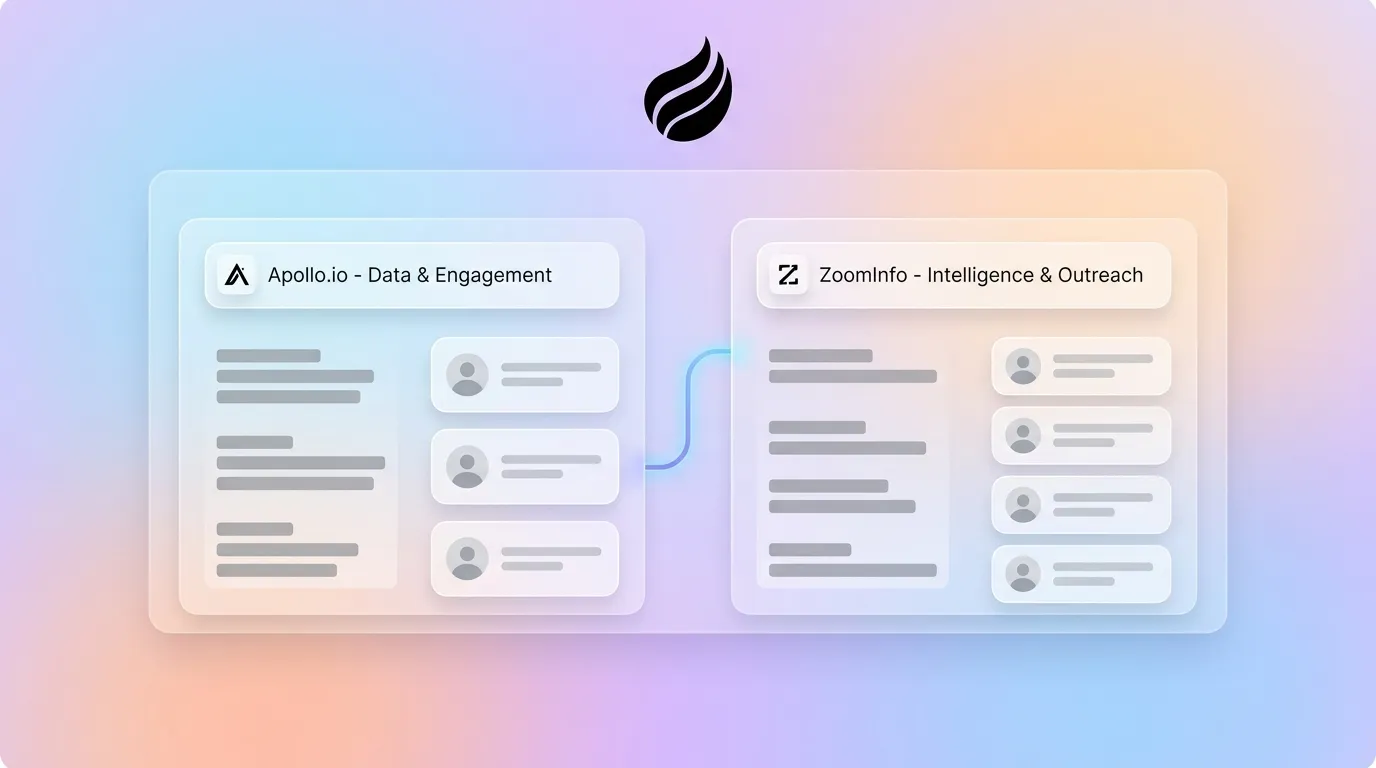
Apollo.Io fits startups and SMBs that need affordable all-in-one outbound. ZoomInfo fits enterprise teams that need deep intent data and account intelligence. Teams that want enrichment, prospecting, and outreach without a standalone data subscription should also evaluate an agent-led CRM before signing either contract.
Key Takeaways
- Apollo.Io and ZoomInfo support different sales motions. Apollo suits budget-conscious SMBs running cold email outbound, while ZoomInfo targets enterprise teams needing deep intent data and phone coverage.
- Apollo offers transparent pricing starting at $49 per seat per month on annual plans. ZoomInfo uses quote-based contracts with median annual costs around $33,500.
- Apollo bundles sequences, dialer, and enrichment into one seat. ZoomInfo’s modular approach requires separate licensing and more implementation overhead.
- Both tools add subscriptions and sync complexity while leaving CRM data-quality problems in place, including manual entry and stale contact records.
- For teams seeking enrichment, prospecting, and outreach without a standalone data subscription, Coffee provides an agent-led CRM alternative that replaces multiple tools in one platform.
Core Differences
Pricing Transparency And Cost Profile
Apollo.Io publishes its tiers openly, which makes cost comparisons straightforward. Annual billing runs $49 per seat per month (Basic), $79 (Professional), and $119 (Organization). Monthly billing runs $65, $99, and $149 respectively. The Organization tier carries a 3-seat minimum and is annual-only, so the real annual floor is $4,284 even for a two-person team. ZoomInfo does not publish pricing. According to Vendr data from 1,570 purchases, ZoomInfo’s median contract value is $33,500 per year, with annual commitments commonly starting around $15,000 per year. The table below summarizes how the two vendors compare on attributes that drive most buying decisions.
| Attribute | Apollo.Io | ZoomInfo |
|---|---|---|
| Published Entry Price | $49/seat/month (annual) | Quote-based; median $33,500/year per Vendr |
| Database Size | 230M+ contacts, 30M+ companies | 500M contacts, 100M companies |
| Named Modules | Bundled: sequences, dialer, intent, enrichment in one seat | Modular: Copilot, Engage, Chorus, Marketing Demand, ABM |
Data Depth And Coverage
Apollo publishes roughly 230M+ contacts and 30M+ companies. ZoomInfo publishes 500M contacts, 100M companies, 135M+ verified phone numbers, and 200M+ verified business emails. One important caveat on Apollo’s headline number appears when you apply verification filters. Using Apollo’s “Verified Emails” filter reduces the searchable database from 275M+ contacts to 96M contacts, so roughly 65% of Apollo’s contacts carry unverified email addresses. ZoomInfo’s coverage is deepest in North America, its founding market.
Feature Bundling Vs. Modularity
Apollo bundles its contact database, email sequences, dialer, intent data, and basic CRM pipeline tracking into a single per-seat subscription. This structure keeps procurement simple and gives SMB teams one login for most outbound work. ZoomInfo organizes its capabilities into separately licensed modules. Copilot handles AI-assisted account prioritization. Engage covers sales engagement and dialer functionality, and Chorus provides conversation intelligence. Marketing Demand and ABM products handle audience creation and campaign orchestration. ZoomInfo’s modularity increases implementation and coordination overhead because each module can require separate configuration, licensing, and integration work.
CRM Integration Maturity
Apollo confirms three native CRM integrations: Salesforce, HubSpot, and Pipedrive. Users report that initial setup can be finicky, especially around field mapping and duplicate management. ZoomInfo Operations supports Salesforce, HubSpot, and Microsoft Dynamics with native integrations for enrichment and routing. Its enterprise-tier syncs tend to be more mature for teams running complex routing logic at scale.
See how Coffee handles enrichment and prospecting inside the CRM.
Which Tool Fits Your Sales Motion?
Cold Email-Heavy Motion
Apollo fits cold email-heavy teams that want data and sequencing in one workspace. Apollo’s Basic annual plan at $49 per seat per month yields approximately $19.60 per 1,000 verified emails, which is the lowest published rate among all-in-one prospecting platforms. The tradeoff is deliverability risk. Apollo uses shared sending infrastructure, and user-reported bounce rates average 20–30%, so teams must manage domain reputation and list hygiene carefully.
Phone-Heavy Motion
ZoomInfo fits phone-heavy motions that rely on direct dials. ZoomInfo publishes 135M+ verified phone numbers and 120M+ direct-dial phone numbers, and its contact enrichment API returns a do-not-call flag on each number. The tradeoff is annual commitment and quote-based pricing. Apollo’s dialer is functional, yet phone numbers cost 8 credits each on top of the seat price, so dial-led teams burn credit allowances much faster than email-led teams.
ABM Motion
ZoomInfo fits mature ABM programs that need rich intent data. ZoomInfo’s Buyer Intent product tracks signals from 210 million IP-to-organization pairings and 6 trillion+ keyword-to-device pairings sourced monthly, and its ABM modules orchestrate account-based plays at scale. The tradeoff is cost and module sprawl. Apollo’s intent data comes from third-party partnerships with Bombora and LeadSift and provides account-level signals only. It cannot identify which specific contact at a company is showing buying behavior.
Inbound-Led Motion
Inbound-led teams still treat the CRM as the center of gravity. Apollo’s Inbound add-on identifies website visitors at the account level, and ZoomInfo’s WebSights and FormComplete provide similar capabilities. Both options sit as add-ons on top of a data subscription that may not be necessary if inbound is your primary motion. The ongoing challenge of keeping the system of record accurate as inbound leads flow in remains unsolved by either tool.
ZoomInfo Vs Apollo Pricing: The Real Math
Apollo’s published tiers make pricing math clear for most teams. Annual billing runs $49/$79/$119 per seat per month, and monthly billing runs $65/$99/$149. ZoomInfo requires a demo and an annual contract before you receive a quote, so budgeting takes longer.
Apollo’s free Starter plan functions as a sampling tier rather than a production prospecting tier. It includes 900 credits per seat per year, 2 sequences, 1 mailbox, and a 250-email daily send cap. At 75 email reveals per month, teams can test data quality but cannot run outbound at scale. Apollo no longer offers the 10,000-credit monthly free tier that made “Apollo is basically free” common advice.
The Organization tier floor also affects budgets. The 3-seat minimum at $119 per seat per month sets the real annual floor at $4,284 for teams that need SSO or advanced security. Credits reset each billing cycle, so unused credits do not roll over according to Apollo’s pricing documentation.
Data-Quality And Trust Reality Check
Pricing and features aside, buyers also weigh legality and data accuracy when they compare Apollo and ZoomInfo.
On legality, Apollo remains usable when teams have a valid Data Processing Agreement and a documented lawful basis. Apollo holds a DPA and SOC 2 certification but lacks ISO 27001, which can matter for enterprise procurement processes that require that standard. Apollo has faced two GDPR-related data incidents, in 2018 and 2021, and has since updated its security practices. Teams operating under strict GDPR requirements should review Apollo’s data handling documentation and breach history before committing.
On trustworthiness, accuracy claims differ from user experience. Apollo self-reports 97% email accuracy. User-reported accuracy runs at 65–70%, with US contact accuracy around 88% and international accuracy around 60%. ZoomInfo self-reports up to 95% accuracy on first-party data and holds ISO 27001, ISO 27701, SOC 2 Type II, and TRUSTe GDPR/CCPA certifications. Both tools primarily provide lists of contacts and accounts, while the data still goes stale once it lands in your CRM and requires ongoing maintenance.
Apollo’s own guidance recommends testing work email deliverability on a 200-record sample and using a 90%+ deliverability threshold as a pass benchmark. Applying that same standard to any vendor, including Apollo and ZoomInfo, keeps expectations grounded in your own ICP.
Can You Use Apollo As A CRM?
Apollo includes basic deal pipeline tracking and activity logging that can serve as a lightweight CRM for solo founders. For complex sales processes, it functions as a prospecting layer that syncs to Salesforce or HubSpot. ZoomInfo does not function as a CRM and instead sits alongside your existing system. For teams already on Salesforce or HubSpot, either tool adds a subscription and a sync to maintain, while the core question of who keeps the system of record accurate over time remains open.
Where Clay And Lead411 Fit In The Stack
Teams evaluating Apollo.Io and ZoomInfo often also consider Clay, Lead411, and Cognism. Clay functions as an enrichment workflow builder suited to technical RevOps teams that want to waterfall multiple data sources. Lead411 provides a lower-cost database alternative with intent data. Cognism offers strong coverage for European-first outbound. These tools still operate as standalone subscriptions and do not directly solve CRM data-quality issues.
When Neither Tool Is Right: The Agent-Led CRM Alternative
Many teams comparing Apollo and ZoomInfo eventually ask whether they need a standalone data subscription at all. For teams that want good data in and good data out without manual entry or a separate data contract, Coffee provides an agent-led CRM built for that outcome.
Coffee’s capabilities map directly onto the categories this comparison covers, replacing each standalone subscription with a function inside the CRM:

- Lead Finder: Natural-language prospecting that replaces standalone databases like ZoomInfo and Apollo.Io. A user can say “Find me VPs of Sales at SaaS companies with 50–200 employees” and the agent builds the list. Lists live in the same system that enriches them and runs outreach, so teams avoid CSV exports between tools.
- Campaigns: Native multi-step, AI-generated email sequences with stop-on-reply, replacing dedicated sales engagement tools like Outreach or Salesloft. Sequences send from the rep’s own connected mailbox with their real signature.
- Visitor Identification: Converts anonymous website traffic into named prospects. Competitors often surface only the company or an undifferentiated people list. Coffee uses your buyer persona to recommend which two or three people inside a visiting company to contact, and surfaces their LinkedIn profiles for instant outbound.
- Automatic Data Entry And Enrichment: The Coffee Agent scans emails and calendars to create and enrich contacts and companies automatically. This automation removes most manual data entry and reduces the need for a separate enrichment tool.
- Companion App For Salesforce And HubSpot: Deploys the Coffee Agent on top of an existing CRM so the system of record stays accurate without human effort. Teams gain the same enrichment and prospecting capabilities even when they are not ready to replace their CRM.
Coffee is SOC 2 Type 2 and GDPR compliant and does not train public models on customer data. Pricing is seat-based, so you pay for human seats and the agent’s work is included.

Explore Coffee’s seat-based pricing and agent capabilities.
Decision Framework: Match The Tool To Your Motion
Use this routing guide to align tools with your primary sales motion before signing a contract:
- Cold email-heavy, budget-conscious, US-focused: Apollo.Io Professional. Budget for bounce management and deliverability monitoring from day one.
- Phone-heavy, enterprise accounts, North America: ZoomInfo. Request a quote, negotiate on intent modules, and budget for a sequencing tool separately.
- ABM, enterprise, intent-driven: ZoomInfo with Copilot and ABM modules. Plan for implementation overhead and a multi-module contract.
- Inbound-led, CRM already in place, data quality is the main issue: Treat the CRM as the core system and evaluate whether a CRM agent that handles enrichment natively solves the problem without a second subscription.
- Teams that want enrichment, prospecting, and outreach in one system without a standalone data contract: Coffee’s agent-led CRM fits this motion as either a standalone CRM or a Companion App on top of Salesforce or HubSpot.
Compare Coffee’s agent-led CRM to standalone data subscriptions.

Conclusion
Apollo.Io and ZoomInfo both focus on selling access to contact and account data. Apollo delivers that access at a lower price point with bundled outreach for SMB outbound teams. ZoomInfo delivers deeper data and intent for enterprise teams that need strong phone coverage and compliance credentials. Both tools leave similar gaps: data still goes stale once it lands in your CRM, manual entry persists, and closing the loop from prospect discovery to accurate pipeline often requires additional tools and contracts.
Coffee offers an agent-led CRM for teams that want good data in and good data out without a standalone data subscription. Lead Finder replaces the database. Campaigns replaces the sequencer. Automatic enrichment replaces most manual entry. The Companion App deploys the same agent on top of Salesforce or HubSpot so the system of record you already have stays accurate with far less human effort.
Explore the agent-led CRM from Coffee and see it in action.