Written by: Doug Camplejohn, CEO & Co-Founder, Coffee
Key Takeaways for Your Sales Team
- Apollo.io works best as a contact database and sequencing tool for SMB and mid-market teams under $10M ARR that need raw prospecting data.
- Revenue.io is a Salesforce-native coaching platform that improves call execution and win rates for teams with 15 or more reps and an active Salesforce instance.
- Most 20–50-rep teams face tool sprawl and duplicate costs when they run both Apollo and Revenue.io at the same time.
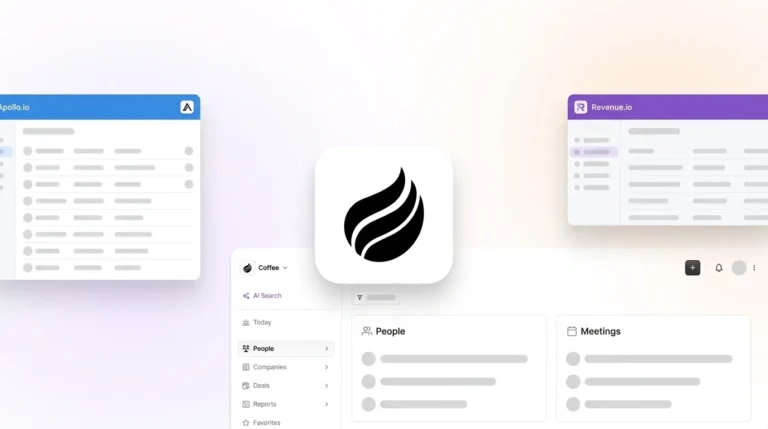
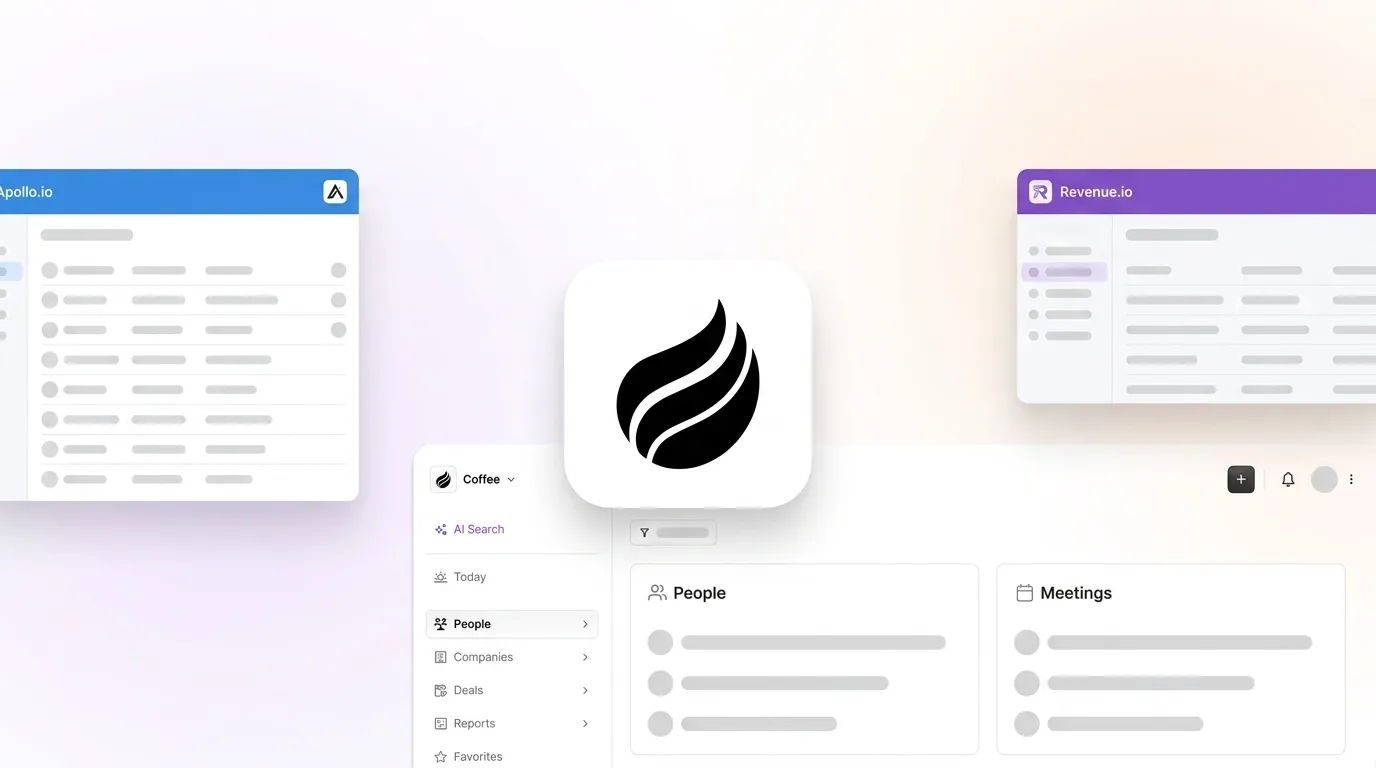
- Coffee unifies prospecting, enrichment, outreach, call intelligence, and pipeline management in a single AI agent available as a Standalone CRM or Companion App.
- Teams ready to replace fragmented stacks can explore Coffee’s unified platform to consolidate tools and reclaim selling time.
Side-by-Side Platform Comparison
| Criteria | Apollo.io | Revenue.io | Coffee |
|---|---|---|---|
| Data Quality & Enrichment | 275 million-plus contacts with 98% verified email accuracy | No proprietary contact database; relies on Salesforce records | Built-in Lead Finder plus auto-enrichment from licensed data partners; no separate subscription |
| Salesforce/HubSpot Integration | Bi-directional sync, external tool that needs ongoing integration maintenance | Fully Salesforce-native, zero ETL, zero sync delay | Companion App mode writes enriched data and call insights back to Salesforce or HubSpot natively |
| AI Feature Set in 2026 | Signal detection, buying-intent scoring, AI email generation, basic workflow automation | Real-time in-call coaching via Moments™, MEDDIC/BANT/Challenger auto-scoring, post-call workflow automation | Autonomous prospecting, AI campaign generation, meeting briefings, post-call summaries, pipeline intelligence, all in one agent |
| Pricing & TCO | $49 / $79 / $119 per user per month on annual billing, data add-ons may increase TCO | Quote-based enterprise pricing, 15-seat minimum, annual agreements | Simple seat-based pricing, agent labor included, no data add-ons required |
| Team-Size Fit | SMB to mid-market, strongest below $10M ARR | Mid-market and enterprise, requires active Salesforce instance | Small to mid-market (1–50 reps), Standalone CRM or Companion App mode |
| Automation of Manual Work | Sequence automation, manual CRM data entry still required for non-native fields | Post-call workflow automation inside Salesforce, no prospecting automation | Removes data entry entirely, auto-creates contacts, logs activities, drafts follow-ups, and runs outreach sequences |
Data Quality & Enrichment Across the Three Tools
Apollo.io maintains a database of 275 million-plus contacts with 98% verified email accuracy, so it works well for teams that need raw prospecting data. Data quality consistency still varies by industry, geography, and seniority level.
Revenue.io does not maintain a proprietary contact database. It depends entirely on the quality of records already inside Salesforce, so enrichment gaps in the CRM become gaps in coaching context.
Coffee combines a built-in Lead Finder with automatic enrichment from licensed data partners, which removes the need for a separate enrichment subscription. This setup works as a system: once you connect Google Workspace or Microsoft 365, the Coffee Agent scans emails and calendars and auto-creates contacts and companies. The agent then enriches those records with job titles, funding data, and LinkedIn profiles so every contact enters the system with complete context.
Depth of Salesforce and HubSpot Integration
Apollo.io offers bi-directional CRM sync, but it operates as an external tool. Stand-alone prospecting platforms cause teams to lose valuable time and information because prospecting is the means to closing deals, not the end goal, and that gap widens when data must travel across integration layers.
Revenue.io is fully Salesforce-native, with all conversation data, recordings, transcripts, scores, and pipeline analytics living inside the CRM with no syncing required. This architecture removes ETL, middleware, and data lag, and it enables scoring that incorporates live deal stage, account history, and CRM field values.
Coffee operates in two modes. As a Companion App, it authenticates directly with Salesforce or HubSpot and writes enriched contact data, activity logs, call summaries, and pipeline changes back to the primary CRM without manual entry. As a Standalone CRM, it replaces the system of record entirely and runs on a data warehouse that retains full historical context.
Beyond integration depth, the three platforms also differ in how they apply AI to daily sales work.
AI Capabilities in 2026
Apollo.io now includes personalized email generation and reply-likelihood prediction in its AI layer. These capabilities move Apollo closer to a full sales engagement platform, although its core strength still lies in contact data coverage.
Revenue.io focuses its AI layer on call execution rather than prospecting. Its Moments™ technology provides real-time coaching prompts during live calls, and automated scoring evaluates conversations against MEDDIC, BANT, and Challenger frameworks. Automated post-call workflows then update opportunity records and trigger follow-up tasks inside Salesforce.
Coffee applies an autonomous agent across the full sales cycle. The Lead Finder builds targeted prospect lists through natural language commands. Campaigns runs AI-generated multi-step email sequences from the rep’s own mailbox. The Meeting Bot records and transcribes calls, and post-call summaries with next steps appear automatically. The Pipeline Compare feature then visualizes week-over-week deal movement without spreadsheets.

Pricing and Total Cost of Ownership
Apollo.io publishes tiered pricing of $49 / $79 / $119 per user per month on annual billing, and data export limits plus enrichment credits can increase total cost as team size and usage volume grow.
Revenue.io uses a quote-based enterprise model with a 15-seat minimum and annual agreements. Teams that run both Apollo and Revenue.io at the same time face compounding seat costs on top of existing Salesforce licenses.
Scrut Automation cut tooling costs from over $56,000 to $22,000 annually after consolidating prospecting, enrichment, and sequencing into a single platform. Mid-market teams typically benchmark total sales tool spend at $187 to $375 per rep per month, and costs outside that range often signal inefficiency from unused licenses or stack sprawl.
Coffee uses simple seat-based pricing. The agent’s labor, including enrichment, sequencing, meeting management, and pipeline intelligence, is included in the seat cost with no separate data add-on fees.
Pricing models also reflect each platform’s target customer, which becomes clearer when you look at team-size fit.
Best Fit by Team Size and Maturity
Apollo is recommended as the primary prospecting database for SMB and mid-market teams under $10M in revenue because of its contact coverage and accessible pricing. Revenue.io requires a minimum of 15 sales users and targets mid-market and enterprise organizations with structured sales processes and an active Salesforce instance.
Coffee serves teams from 1 to 50 reps. The Standalone CRM suits early-stage teams that have outgrown spreadsheets. The Companion App targets mid-market teams committed to Salesforce or HubSpot that want an agent to handle data quality, enrichment, and outreach without adding another point solution.
Automation and Manual Work Reduction
Forty-two percent of sales reps feel overwhelmed by too many tools, and tool sprawl wastes potential selling time through bad data and constant context-switching. Apollo automates outreach sequences but still requires manual CRM updates for non-native fields. Revenue.io automates post-call workflows inside Salesforce but does not address prospecting or upstream data entry.
Teams that consolidate from multi-tool stacks to a single platform commonly reclaim 8 to 10 hours per week per rep that previously went to tool-switching, manual research, and data cleanup. Coffee’s agent removes data entry at every stage: contacts are created automatically, activities log without rep input, and follow-up emails appear post-call for one-click review.

Who Should Choose Apollo.io in 2026
Apollo fits teams whose primary bottleneck is contact coverage. Specific fit criteria include:
- Teams under $10M ARR that need a combined prospecting database and sequencing tool without enterprise pricing
- SDR-heavy organizations running high-volume outbound where contact breadth matters more than deep CRM integration
- Teams without a dedicated RevOps function that want a self-contained tool with minimal integration management
- Organizations without a mature Salesforce instance that need prospecting and sequencing in one place
When Revenue.io Wins for Salesforce Teams
Revenue.io works better when the bottleneck is call execution rather than lead volume. Best-fit scenarios include:
- Mid-market or enterprise teams with an active Salesforce instance and 15 or more sales users
- Organizations where new-hire ramp time and call quality act as the primary performance levers
- Teams that already have a contact database (ZoomInfo, Apollo, or internal) and need a coaching layer on top of existing data
- RevOps teams that require conversation analytics tied directly to Salesforce opportunity records and win-rate reporting
Replacing Both Apollo and Revenue.io with One Tool
Coffee’s AI Agent is built to replace the fragmented stack that Apollo and Revenue.io together represent. It runs on a data warehouse that ingests both structured data, such as CRM fields and contact records, and unstructured data, such as email threads and call transcripts, while retaining historical context that relational databases discard on field updates.
The agent is available in two deployment modes. The Standalone CRM replaces the system of record for teams that want a modern alternative to Salesforce or HubSpot. The Companion App deploys as an intelligent layer on top of an existing Salesforce or HubSpot instance and handles enrichment, activity logging, call intelligence, and outreach sequencing without displacing the CRM investment already in place.

Coffee is SOC 2 Type 2 and GDPR compliant, and customer data is not used to train public models. Current integrations run via Zapier, and deeper native integrations sit on the product roadmap.
Multiple tools or agents can send outreach to the same prospect in a fragmented stack, which creates a coordination failure. A single-agent platform such as Coffee removes that risk by design.
Risks and Limitations to Consider
Apollo.io: Data quality consistency varies by industry, geography, and seniority. Contact records can become stale between enrichment cycles, and teams in niche verticals or international markets may see coverage gaps. Apollo also needs integration maintenance to keep CRM records current, which adds RevOps overhead.
Revenue.io: Its Salesforce-native architecture helps Salesforce shops and creates a hard constraint for everyone else. Its minimum seat requirement and quote-based pricing make it inaccessible for smaller teams, and it provides no prospecting or enrichment capability, so teams must maintain a separate data source regardless.
Both tools together: Between 90% and 94% of sales organizations plan to consolidate their tech stack, driven by the real costs of tool sprawl. Running Apollo and Revenue.io at the same time creates duplicate seat costs and separate admin overhead, and the deeper problem is coordination risk. When nearly one in three revenue teams cannot say how many AI agents are touching their records, the same prospect can receive conflicting outreach from multiple systems, which damages credibility and wastes effort.
One-Screen Decision Matrix for Fast Selection
| Team Size | CRM in Place | Primary Bottleneck | Recommended Path |
|---|---|---|---|
| Under 15 reps | None or HubSpot free | Need contacts and outreach | Apollo.io or Coffee Standalone |
| 15–50 reps | Active Salesforce | Call quality and rep coaching | Revenue.io (if budget allows) or Coffee Companion App |
| 15–50 reps | Active Salesforce or HubSpot | Data quality, prospecting, and execution | Coffee Companion App |
| 20–50 reps | None | Full-stack: CRM, enrichment, and outreach | Coffee Standalone CRM |
| 50+ reps | Salesforce Enterprise | Enterprise compliance and deep coaching | Revenue.io plus Apollo, or evaluate Coffee roadmap |
Frequently Asked Questions
How long does implementation take for Apollo.io, Revenue.io, and Coffee?
Apollo.io can be set up within a day for small teams, since connecting a mailbox, importing a CSV, and launching a sequence requires no technical expertise. Revenue.io implementation is more involved, because it is Salesforce-native and targets mid-market and enterprise organizations, so onboarding typically includes CRM configuration, call routing setup, and coaching methodology alignment, which can take several weeks depending on contract scope and implementation services. Coffee’s Companion App activates through a simple authentication with Salesforce or HubSpot, and the agent begins auto-creating contacts and logging activities after you connect Google Workspace or Microsoft 365. The Standalone CRM is designed for teams that want to be operational the same day without complex setup.
Are there hidden fees beyond the advertised seat price?
Apollo.io’s published per-seat pricing does not include all costs at scale. Data export limits, enrichment credit caps, and premium data add-ons increase total cost of ownership as usage grows. Revenue.io does not publish list pricing, so total cost depends on seat count, contract term, scoped modules, and implementation services, all of which are negotiated. Coffee uses seat-based pricing where the agent’s labor, including enrichment, sequencing, meeting intelligence, and pipeline tracking, is included in the seat cost. There are no separate data add-on fees or enrichment credit meters.
How deeply does each tool sync with Salesforce?
Apollo.io syncs contact, account, and activity data to Salesforce bi-directionally, but it operates as an external tool that needs ongoing integration maintenance. Data written back to Salesforce reflects what Apollo captures, not the full CRM context. Revenue.io is fully Salesforce-native, so all conversation data, recordings, transcripts, AI scores, and pipeline analytics live inside Salesforce with no ETL or sync delay. Coaching prompts during live calls can use live deal stage and CRM field values in real time. Coffee’s Companion App authenticates directly with Salesforce or HubSpot and writes enriched records, activity logs, call summaries, and pipeline changes back to the CRM without manual entry. Unlike Revenue.io, Coffee also handles the upstream prospecting and enrichment that Salesforce itself does not provide.
What data-privacy certifications do these platforms hold?
Apollo.io and Revenue.io both maintain enterprise-grade security postures appropriate for mid-market and enterprise buyers, although specific certification details should be confirmed directly with each vendor during procurement. Coffee is SOC 2 Type 2 and GDPR compliant. Customer data is not used to train public AI models, which matters for teams in regulated industries or those with strict data governance requirements. Teams in healthcare or finance with multi-year security review cycles should evaluate all three vendors against their specific compliance frameworks before committing.
How much migration effort is involved in switching from Apollo or Revenue.io to Coffee?
Switching from Apollo to Coffee requires exporting existing contact lists and sequences, then connecting Coffee to the team’s email and calendar infrastructure. Because Coffee auto-enriches records on connection, the agent handles much of the data hygiene work that Apollo required manually. Switching from Revenue.io to Coffee as a Companion App does not require leaving Salesforce, since Coffee layers on top of the existing instance, so the CRM configuration, opportunity records, and historical data remain intact. Teams that replace both tools at the same time benefit from Coffee’s unified data model, which removes the coordination overhead of keeping two external systems in sync with Salesforce.
Conclusion: Choosing the Right Platform for Your Team
Apollo.io and Revenue.io solve different problems. Apollo fills the top of the funnel with contact data and sequencing. Revenue.io improves what happens on the call for Salesforce-native teams. Most 20–50-rep teams do not need both, and running both creates the tool sprawl, duplicate costs, and data fragmentation that erode selling time.
Coffee’s AI Agent unifies prospecting, enrichment, outreach, call intelligence, and pipeline management on a single data warehouse, available as a Standalone CRM or as a Companion App that sits on top of Salesforce or HubSpot. The agent handles the busywork so reps can focus on selling instead of administration.
Replace your sales stack and explore Coffee’s unified platform.