Written by: Doug Camplejohn, CEO & Co-Founder, Coffee
Key Takeaways for Dynamic Deal Scoring
- Dynamic deal scoring blends fit, engagement, and negative signals, then recalibrates weights quarterly against historical outcomes to stay predictive.
- Structured scoring models improve forecast accuracy and win rates compared to gut-based or rep roll-up forecasts, but only when CRM data is complete and current.
- Effective models start from the last 12 months of closed-won and closed-lost data, keep fit and engagement on separate axes, and apply stage-specific thresholds.
- Negative scoring rules derived from closed-lost patterns prevent inflated pipelines, while quarterly calibration and automation keep scores reliable as markets evolve.
- Teams ready to eliminate manual data entry and keep scoring signals accurate can explore Coffee pricing and start today.
Why Dynamic Deal Scoring Matters in 2026
Gut-based or rep roll-up forecasts miss revenue targets by 25–40% quarter over quarter, and 87% of enterprises missed revenue targets in 2025. The cost of inaction is measurable: poor data quality costs the average organization $12.9 million per year through wasted spend, lost deals, and reduced market share.
Structured models change those numbers materially. Teams using structured deal scoring can improve forecast accuracy compared to gut forecasts, and win rates can increase after implementing objective scoring. Adding AI-assisted scoring on top of a weighted pipeline model can further improve forecast accuracy.
Clean CRM data sits underneath every one of those gains. Improving CRM data hygiene can increase sales forecast accuracy, and AI-powered CRM data capture can improve data completeness compared to manual entry. To achieve these gains without manual overhead, automated data capture is essential.
Let Coffee’s autonomous agent handle the data entry that keeps your scoring model accurate.
How to Build a Deal Scoring Model from Outcomes
A reliable deal scoring model is built backward from outcomes, not forward from assumptions. Deal scoring models should be built from the last 12 months of closed-won and closed-lost data to identify predictive signals, and a minimum of 20 closed-won and 20 closed-lost opportunities is typically sufficient to produce reliable results for ICP or win/loss scoring models.
The construction sequence follows six steps, and each step uses the output of the previous one.
- Export all closed-won and closed-lost deals from the last 12 months with full activity history. This historical data becomes your training set for pattern analysis.
- Using that training set, identify the firmographic, demographic, and behavioral attributes that appear most frequently in closed-won deals. Attributes that appear frequently in won deals become positive signals, and applying the same approach to lost deals surfaces negative signals.
- Separate fit criteria from engagement criteria and score them on independent axes. Avoid collapsing them into a single additive number so you can see whether a deal is a strong fit, strongly engaged, or both.
- Assign point weights proportional to observed win-rate lift. Higher lift receives higher point values, while weak signals receive lower weights or no points.
- Define negative scoring rules for disqualifying attributes and behaviors, and use the closed-lost patterns to set their deductions.
- Set stage-specific thresholds so the same score carries different implications at different points in the funnel.
Automate the data capture that makes step one possible with Coffee’s CRM integration.
100-Point Deal Scorecard You Can Use Today
The table below provides a ready-to-use 100-point scorecard. Fit and Engagement categories contribute positive points, and Negative signals deduct from the total. The maximum achievable score before negative deductions is 100.
| Category | Signal | Points |
|---|---|---|
| Fit | Industry matches ICP exactly | +10 |
| Fit | Employee count in target range | +8 |
| Fit | Funding stage aligns to buying capacity | +7 |
| Fit | Geography within serviceable market | +5 |
| Fit | Tech stack confirms use-case fit | +5 |
| Fit | Economic buyer identified and confirmed | +5 |
| Engagement | Champion identified and active | +15 |
| Engagement | 3+ contacts engaged (multi-threaded) | +12 |
| Engagement | Mutual action plan agreed and active | +8 |
| Engagement | Next step scheduled within 14 days | +7 |
| Engagement | Proposal or legal/procurement engaged | +6 |
| Engagement | Executive sponsor engaged | +6 |
| Engagement | Positive conversational sentiment on calls | +6 |
| Negative | No engagement in 30+ days | −10 |
| Negative | Single-threaded (only one contact) | −10 |
| Negative | Close date slipped more than once | −8 |
| Negative | Economic buyer never engaged | −8 |
| Negative | Competitor domain or active competitive displacement | −15 |
| Negative | No defined success metrics or business case | −7 |
Scores above 75 map to Commit, 55–74 to Best Case, and below 55 to Pipeline. This bucketing approach can improve revenue forecast variance.
See how Coffee auto-populates every field in this scorecard from calls, emails, and calendar data.
Fit vs. Engagement Matrix for Clear Next Steps
Effective scoring separates fit signals from intent signals and scores them on separate axes rather than combining them into a single additive score. The resulting two-by-two matrix drives four distinct actions.
- High Fit / High Engagement: Route immediately to an AE for accelerated close. Prioritize in forecast as Commit.
- High Fit / Low Engagement: Assign to marketing nurture or SDR re-engagement. Exclude from near-term forecast.
- Low Fit / High Engagement: Route to SDR for qualification. Verify whether ICP criteria were scored correctly before advancing.
- Low Fit / Low Engagement: Place in automated nurture only. Remove from active pipeline and exclude from forecast coverage.
Hybrid scoring models that separate fit from engagement outperform single-dimension approaches by 40–60% in conversion accuracy. The matrix also surfaces coaching opportunities. A rep with a disproportionate share of High Fit and Low Engagement deals has a multi-threading or follow-through problem, not a territory problem.
Negative Deal Scoring Rules That Deflate Bloated Pipelines
Negative scoring prevents inflated pipelines and false-positive forecasts. High-performing teams rely on negative scoring rules derived from closed-lost patterns and weighted by how reliably each rule predicts non-conversion.
- No engagement in 30+ days (−10): A deal with no buyer-side activity in 30 days is statistically stalled. Opportunities closed within 50 days carry a 47% win rate, and past that threshold win rates drop to 20% or lower.
- Single-threaded contact (−10): Single-threaded deals close at roughly 17% the rate of deals with five or more stakeholders engaged (5% vs. 30%).
- Close date slipped more than once (−8): Repeated slippage acts as a leading indicator of deal risk, not a scheduling inconvenience.
- Economic buyer never engaged (−8): Missing economic buyer involvement is normal pre-discovery but critical post-proposal. The deduction should increase as the deal advances in stage.
- Competitor domain or confirmed displacement (−15): Competitor involvement warrants a significant penalty and immediate manager review.
- No defined success metrics (−7): Deals without a quantified business case often default to price conversations.
- Score decay after 60 days of inactivity (−5 per week): Applying −5 points per week of inactivity after 60 days prevents stale deals from holding forecast position.
Deal Scoring by Sales Stage with Clear Gate Criteria
Stage-based deal scoring produces forecast accuracy 18–24 percentage points lower than signal-based scoring because two deals in the same stage can have very different close probabilities. Stage-specific thresholds solve this by requiring minimum scores before a deal can advance.
| Stage | Minimum Score to Advance | Key Gate Criteria |
|---|---|---|
| Discovery | 30 | ICP fit confirmed, pain articulated, next step scheduled |
| Qualification | 45 | Economic buyer identified, budget range confirmed, champion active |
| Proposal | 60 | Multi-threaded (2+ contacts), mutual action plan in place, success metrics defined |
| Negotiation | 72 | Legal or procurement engaged, executive sponsor confirmed, close date stable |
| Commit / Forecast | 75 | All gate criteria met, no active negative signals above −10 |
Deals with multi-threading, a next step scheduled within 14 days, and executive engagement close at 2–3x the rate of deals without them. Stage gates enforce those conditions structurally rather than relying on rep judgment.
How to Calibrate Deal Scores Quarterly
Quarterly calibration keeps your scoring model aligned with current buying behavior. This process takes about four hours per quarter and requires a named Sales co-owner at every session.
- Pull closed-won and closed-lost data. Export all deals closed in the prior quarter with full activity history, stage progression timestamps, and final scores at close.
- Test score separation. Verify that the average score of closed-won deals is higher than the average score of closed-lost deals. If the gap is missing, rebuild the model.
- Identify over- and under-weighted signals. Use correlation analysis to measure how strongly each attribute predicts conversion. Signals showing strong correlation to closed-won outcomes but carrying low point values in your current model are underweighted and should receive higher scores. Signals with weak correlation but high point values are overweighted and should be reduced.
- Adjust negative scoring rules. Review closed-lost deals for new disqualifying patterns that are not yet captured in the model. Add rules and assign deductions proportional to their frequency in lost outcomes.
- Update stage thresholds. Raise the threshold if a stage’s minimum score is consistently met by deals that subsequently stall or lose. Lower it if the threshold blocks deals that go on to close.
- Validate on a holdout set. Run the updated model against a held-out validation set comprising 20% of closed-won and closed-lost deals to verify that the model correctly ranks won deals above lost deals.
- Document every change. Maintain a documented audit trail of every scoring-model change and the data-driven rationale behind it.
Calibration only works when the underlying CRM data is complete. Many teams have insufficient CRM hygiene. An agent that captures every interaction automatically closes that gap before it corrupts the next calibration cycle.
Using Deal Scores for Coaching That Actually Sticks
Dedicated sales coaches achieve 32% higher win rates and 28% higher quota attainment, while structured coaching programs improve win rates by up to 30% compared to teams that leave coaching to individual manager discretion. The win-rate improvements mentioned earlier are amplified when deal scores inform coaching. Deal scores make coaching evidence-based rather than opinion-based.
Effective score-based coaching follows three principles.
- Coach the skill, not the deal. Coaching the deal closes one instance; coaching the skill fixes fifty. Use a low score on “economic buyer identified” across multiple deals as evidence of a discovery skill gap, not a single deal problem.
- Focus on one signal per session. Scoring all 12 rows of a scorecard in one 1:1 overwhelms the rep and results in zero behavioral change. Limit each coaching session to the single lowest-scoring dimension for that rep.
- Score from recorded calls, not live observation. A manager’s presence changes rep behavior; scorecards must be scored from recorded calls. Coffee’s AI meeting bot captures and transcribes every call automatically, providing the evidence base for coaching without manual review scheduling.
AI deal scores provide high coaching utility by surfacing specific qualification gaps such as missing MEDDPICC elements, whereas traditional forecast categories are too coarse to drive targeted skill development.
Why Automation Keeps Deal Scores Reliable
Every component of a dynamic deal scoring framework degrades without clean, current CRM data. B2B contact data decays at approximately 2.1% per month, compounding to roughly 22.5% annually. Manual entry cannot keep pace. Sales reps spend an average of 5.9 hours per week on manual CRM data entry, which AI-powered automatic capture can reduce.

Automated activity capture tools improve activity completeness compared to manual entry and enable earlier visibility into stalled deals. When CRM data completeness is high, forecast accuracy improves and manager trust in the CRM increases.
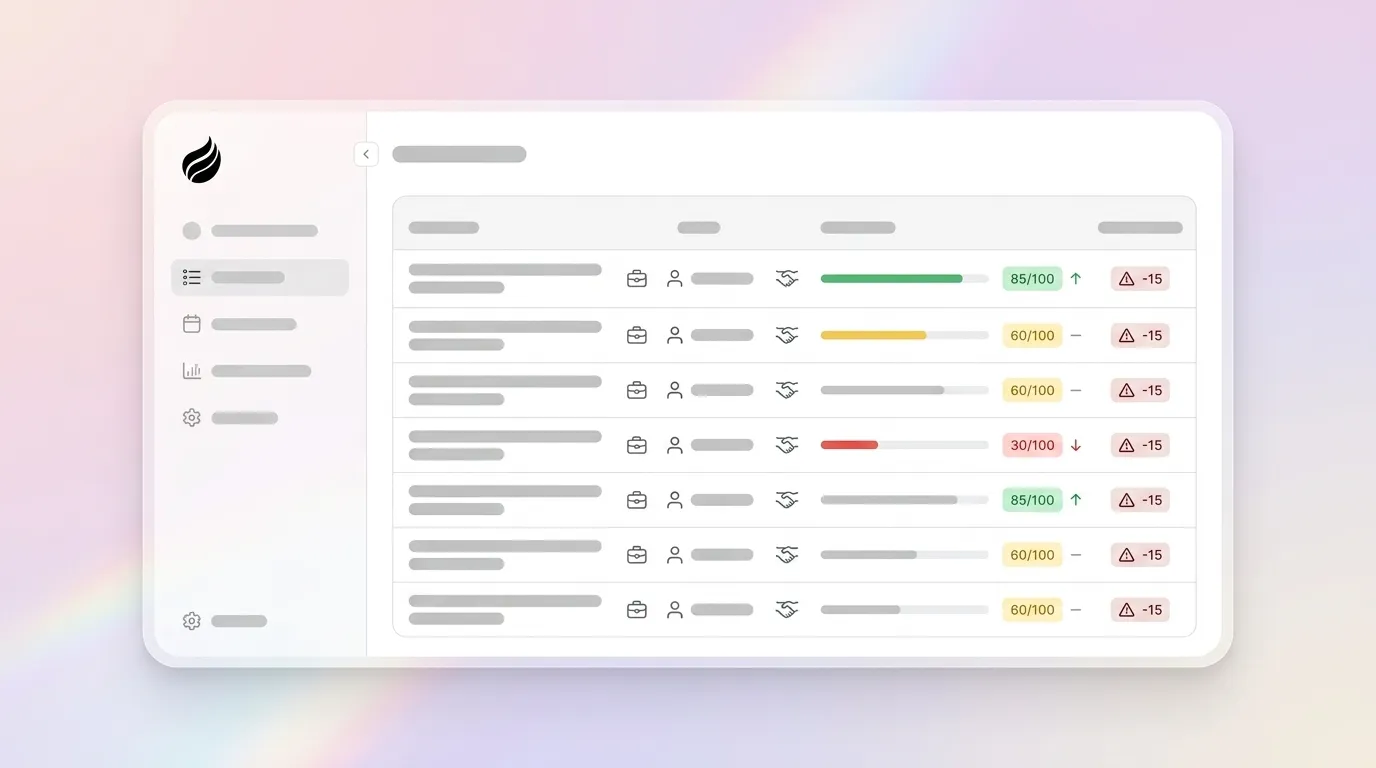
Coffee’s agent addresses this directly. After connecting to Google Workspace or Microsoft 365, the Coffee Agent scans emails and calendars to auto-create contacts and companies, logs last and next activity, joins calls via AI meeting bot to record and transcribe, and writes structured qualification data (MEDDIC, BANT, SPICED) back to CRM fields without rep input. The Pipeline Compare feature then visualizes week-over-week changes, including progressed deals, stalled opportunities, and new additions, which turns pipeline reviews from interrogation sessions into strategic discussions.

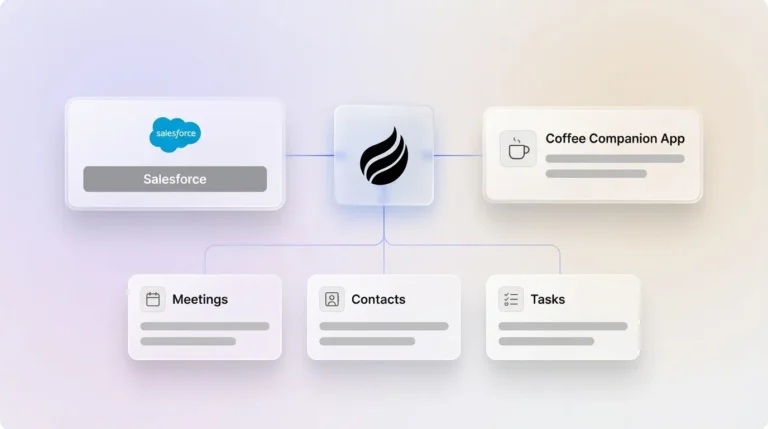
For teams already on Salesforce or HubSpot, Coffee deploys as a Companion App. A simple authentication allows the Coffee Agent to sync data, enrich it, and write valuable insights back to the primary CRM, so the scoring model always operates on ground-truth data rather than rep-recalled approximations.
Replace manual data entry with Coffee’s agent and keep every scoring signal current.
Deal Scoring Best Practice Scenarios
The following scenarios show how this framework works in practice for 20–100 person SaaS teams.
Scenario 1 — Prioritization at pipeline review: A RevOps leader runs a weekly pipeline review using Coffee’s Pipeline Compare. Two deals sit in the Proposal stage. Deal A scores 68, with a champion active, two additional contacts engaged, a mutual action plan in place, and a next step in seven days. Deal B scores 41, with a single-threaded contact, a close date that slipped twice, and no economic buyer engagement. Deal B moves to Best Case and receives a re-engagement task. Deal A advances to Negotiation review.
Scenario 2 — Forecast accuracy improvement: Before structured deal scoring, a client had low conversion from its CRM pipeline because every deal was weighted equally regardless of engagement signals. After applying a signal-based model, close rates improved within six months.
Scenario 3 — Coaching application: A Head of Sales notices that three of five reps have deals consistently scoring below 45 at the Qualification stage due to missing economic buyer identification. Rather than coaching each deal individually, she runs a single team session on economic buyer discovery using recorded call evidence surfaced by Coffee’s AI meeting bot. Standardizing on MEDDIC-based automated deal scoring can improve forecast accuracy and shows the compounding effect of consistent qualification data flowing into the model.

Scenario 4 — Negative scoring in action: A deal enters the pipeline from a company whose domain matches a known competitor. The model applies a −15 deduction automatically, which drops the deal below the Commit threshold and triggers a manager alert within 24 hours. The rep confirms the contact is evaluating the product for a separate business unit. The flag is overridden with a documented rationale, and the override is logged for the next calibration cycle.
Conclusion and Next Steps for Your Deal Scoring Framework
A dynamic deal scoring framework built on the practices in this playbook, including separated Fit and Engagement axes, explicit negative scoring rules, stage-specific thresholds, and quarterly calibration against closed-won and closed-lost data, delivers measurable improvements in forecast accuracy, win rates, and rep prioritization. AI deal scoring can predict deal outcomes with greater accuracy than manual methods, but only when the underlying CRM data is complete, current, and structured.
That data quality requirement creates a constraint that manual processes cannot satisfy at scale. An agent-based approach that captures interactions from emails, calls, and calendars automatically, writes structured qualification data to CRM fields without rep input, and surfaces pipeline changes in real time provides a scoring model that remains reliable quarter over quarter.
Give your deal scoring framework the clean, automated data foundation it needs with Coffee.
Frequently Asked Questions
What is the difference between deal scoring and lead scoring?
Lead scoring evaluates inbound contacts or accounts before they enter the sales pipeline, using firmographic fit and early behavioral signals to determine whether a prospect should be routed to sales. Deal scoring applies to open opportunities already in the pipeline and incorporates sales-stage-specific signals such as economic buyer engagement, multi-threading, mutual action plan compliance, and close-date stability that are irrelevant at the lead stage. Deal scoring supports forecast accuracy and rep prioritization, while lead scoring controls pipeline entry. Both frameworks benefit from the same underlying principle: fit and engagement should be scored on separate axes, and negative signals should carry explicit point deductions rather than being treated as the absence of positive ones.
How many closed deals do I need before building a deal scoring model?
A rule-based deal scoring model can be constructed with as few as 50–100 completed deal cycles, provided the data includes full activity history and stage progression. For a statistically reliable model, where weights are derived from logistic regression on historical outcomes rather than intuition, a minimum of 200 closed-won and 200 closed-lost opportunities is the standard threshold. Predictive or AI-assisted models require at least 500 closed deals to generate reliable conversion probability scores.
Teams below these thresholds should use a simplified rule-based scorecard anchored to ICP fit criteria and the engagement signals most commonly observed in their closed-won deals, then migrate to a data-derived model once sufficient history accumulates. Attempting to deploy a predictive model on fewer than 100 closed-won deals produces overfit results that degrade quickly and erode rep trust in the system.
How does CRM data quality affect deal scoring accuracy?
Deal scoring models are only as accurate as the data they consume. When CRM fields are incomplete, such as missing economic buyer names, unlogged call outcomes, or stale close dates, the model scores based on absence of information rather than actual deal health. This produces two failure modes. False positives occur when deals with incomplete records score high because negative signals were never captured. False negatives occur when active deals score low because engagement data was never logged.
Improving CRM data completeness from the typical 40% achieved with manual entry to over 90% through automated capture directly translates to forecast accuracy improvements. Coffee’s agent addresses this by automatically logging activity from emails, calendars, and call transcripts, writing structured qualification data to CRM fields without requiring rep input, and maintaining a data warehouse that preserves historical context rather than overwriting it.
What is the right cadence for recalibrating a deal scoring model?
Most B2B teams should recalibrate quarterly, timed to coincide with the pipeline review cycle and using the most recent quarter’s closed-won and closed-lost deals as the training set. The calibration session should take approximately four hours and require a named Sales co-owner. Models treated as a RevOps-only responsibility consistently fail because reps and managers do not trust results they had no input in producing.
In addition to the quarterly cycle, off-cycle recalibration is warranted when a score band’s rejection rate shifts sharply, when best customers consistently enter below the current threshold, or when a meaningful ICP or product change occurs. Individual deal scores should be refreshed weekly as new engagement data arrives, while the underlying model weights change quarterly. Teams using an agent-based CRM like Coffee benefit from continuous data capture that makes each quarterly calibration more accurate because the historical record is complete rather than partially self-reported.
How should deal scores be used in sales coaching without creating gaming behavior?
Gaming occurs when reps optimize for scorecard inputs rather than actual buyer movement, such as marking champion fields as confirmed based on optimism, scheduling nominal next steps that carry no buyer commitment, or logging activity volume without capturing buyer-side signals. Three structural safeguards prevent this.
First, score from recorded call data rather than rep-entered fields wherever possible. What was actually said in a call is ground truth, while a checkbox is an opinion. Second, use scores to identify skill patterns across multiple deals rather than to evaluate individual deal outcomes. A rep with five consecutive deals missing economic buyer engagement has a discovery skill gap, not five separate deal problems. Third, keep the coaching rubric stable for at least one full quarter. Frequent changes prevent reps from building habits and eliminate the ability to track improvement over time. Scores should explain why a deal is weakening and provide specific next actions, not simply rank opportunities from high to low.