Written by: Doug Camplejohn, CEO & Co-Founder, Coffee
Key Takeaways
- Gong and Chorus both add significant cost, integration work, and data fragmentation to B2B sales stacks without guaranteed adoption.
- Enterprise teams may justify Gong’s depth, while mid-market teams already in ZoomInfo may prefer Chorus, but both carry high Year 1 TCO and long contracts.
- Real-world adoption often drops after six months without a dedicated program owner, which inflates per-active-user costs.
- Teams of 10–30 reps face the weakest ROI because platform fees outweigh the call volume needed for meaningful insights.
- Consider Coffee as a CRM-native alternative that consolidates conversation intelligence without extra point solutions, and compare Coffee’s pricing to Gong and Chorus.
How This Gong vs Chorus Evaluation Works
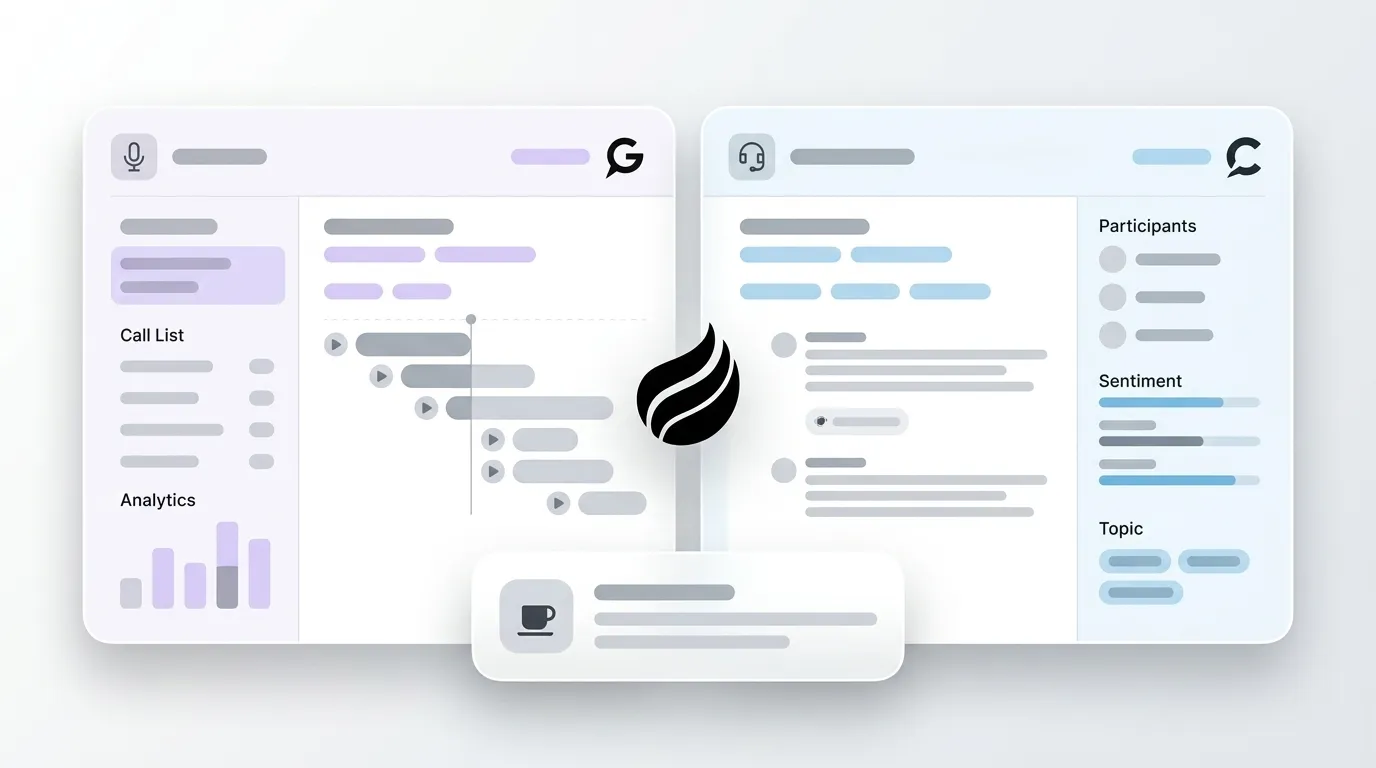
The comparison below scores both platforms across ten dimensions that matter most to scaling SaaS teams. These scores highlight a pattern: Gong delivers deeper analytics and broader integrations, while Chorus offers tighter ZoomInfo coupling at a lower entry cost, and both demand similar implementation effort and program ownership.
Side-by-Side Comparison of Gong and Chorus
| Criterion | Gong | Chorus (ZoomInfo) |
|---|---|---|
| Data quality | High deal intelligence accuracy and strong transcription accuracy | Strong emotional-cue detection and deal momentum analysis |
| Implementation effort | Gong implementation typically costs $15K–$65K with 8–24 weeks to full deployment | Chorus (by ZoomInfo) enterprise implementation fees range from $10,000–$50,000 depending on complexity |
| Workflow fit | Gong suits 25–50+ rep teams with high call volume in mid-market to enterprise organizations | Works for 10–500+ rep teams that already rely on ZoomInfo data |
| User adoption | Significant drop in active users at 6 months without change management | Same adoption risk, with better outcomes when a dedicated program owner runs enablement |
| Integration requirements | Gong has over 250 integrations, with CRM integration included in one-time implementation costs of $7,500–$28,500 | 45 integrations, with depth for ZoomInfo and major CRMs |
| Reporting visibility | Advanced forecasting, deal intelligence, benchmarking | Deal health scores and competitive tracking via ZoomInfo intent data |
| Automation depth | AI deal execution recommendations and multi-stakeholder tracking | Coaching playlists and account intelligence through the ZoomInfo loop |
| Governance | SSO, role-based access, enterprise compliance certifications | Custom, with compliance tied to ZoomInfo contract terms |
| Scalability | Gong supports teams of 1,001–10,000+ users and offers volume discounts starting at 25+ or 100+ seats | Volume discounts available for larger teams, focused on mid-market groups of 20–100 reps |
| Administrative burden | Gong requires annual or multi-year contracts, typically a minimum of 10–15 seats, and offers no self-serve pricing | Multi-year contracts with 50–100% early termination penalty, pricing by quote |
Gong vs Chorus Pricing (2026)
Gong charges a platform fee of $5,000–$50,000 per year plus $1,200–$1,600/user/year after volume discounts. Mandatory onboarding fees run $7,500–$30,000+ depending on team size and custom integrations.
Chorus starts at around $8,000/year for small teams with additional per-seat pricing and volume discounts for larger mid-market teams. Together, these structures mean both tools behave like enterprise platforms even when smaller teams buy them.
The table below summarizes typical Year 1 all-in costs so you can see how platform fees, seats, and onboarding stack up side by side.
| Team Size | Gong Year 1 (All-In) | Chorus Year 1 (All-In) |
|---|---|---|
| 10 reps | ~$28,000+ | ~$20,400 (base + 7 seats + impl.) |
| 30 reps | ~$53K | ~$40,400 |
| 50 reps | ~$106,000 | ~$64,400 (est. with volume discount) |
Teams with low adoption on Gong can face significantly higher effective costs per active user because the fixed platform fees do not shrink when usage drops.
What Sales Reps Actually Say on Reddit
Forum sentiment on both platforms stays consistent across threads. Gong users praise the UI and benchmarking depth but flag the cost as prohibitive for smaller teams. A verified Capterra reviewer summarized Chorus in one line: “Similar functionality to Gong at a fraction of the cost.” Post-acquisition, Chorus users report high-pressure sales tactics and opaque pricing from ZoomInfo’s sales team. The recurring Reddit theme states that both tools deliver value when adoption is high, but neither team hits that threshold without a dedicated program owner.
Transcription Accuracy and Performance Benchmarks (2026)
Accuracy and speed of transcription shape how much reps and managers trust the insights they see. Gong offers high transcription accuracy across multiple languages, with particular strength in technical vocabulary, and delivers transcripts within minutes of call completion. Chorus reaches 95% accuracy in emotional cue detection and is backed by 13 proprietary patents in conversation intelligence.
Leading platforms in 2026 can achieve high transcription accuracy with automatic speaker identification. Both Gong and Chorus meet or approach that threshold in controlled environments. Real-world accuracy degrades with background noise, heavy accents, and multi-speaker calls, which affects downstream analytics and coaching quality.
Is Gong Worth It?
Conversation intelligence can improve win rates and shorten onboarding when teams reach strong adoption. However, many vendor case studies overstate results for small teams and compress timelines. No reported 12-person SaaS team achieved an 18% to 26% win-rate improvement in eight weeks; the nearest cases involve a 50-rep team doubling from 18% to 36% over six months or unrelated metrics for a 12-person team.
The ROI case holds at sufficient scale and with disciplined usage. Conversation intelligence tools suit organizations ranging from as few as 3–10 reps up to enterprise sizes of 200+. Realistic time-to-ROI is 3–6 months, and smaller teams feel every month of delay more acutely.
What Happened to Chorus AI?
Chorus was acquired by ZoomInfo in 2021 and now sits inside a broader data and go-to-market bundle. Chorus is now positioned as the conversation intelligence layer for teams already invested in the ZoomInfo ecosystem, pairing call analytics with ZoomInfo’s B2B contact database. Chorus + ZoomInfo bundles can cost from $35,000 to over $60,000 per year for 10 users depending on selected tier.
Standalone Chorus pricing has become increasingly opaque, and post-acquisition users report high-pressure bundling tactics. Teams not already on ZoomInfo face a forced upsell decision at renewal, which raises long-term commitment risk.
Gong vs Chorus Alternatives: Category Analysis
Alternatives to Gong and Chorus fall into clear tiers. Enterprise replacements such as Clari and Salesloft match Gong’s depth at comparable cost. Mid-market alternatives like Jiminny, Avoma, and Fireflies.ai trade feature depth for lower TCO. Fireflies.ai delivers 95% transcription accuracy at $10–19/user/month versus Gong’s estimated $100–$150+/user/month. A fourth tier, CRM-native agents like Coffee, removes the point-solution layer entirely by handling conversation intelligence inside the CRM itself.
Best Conversation Intelligence Fit by Team Size (2026)
In 2026, Gong leads for enterprise scale and benchmarking depth, Chorus fits mid-market account-based teams inside the ZoomInfo ecosystem, and Fireflies.ai serves as the accessible entry point for smaller teams. Teams of 10–30 reps face the worst value equation because they pay enterprise-tier platform fees without the call volume to generate meaningful patterns.
Operational and Long-Term Considerations
Organizations that designate a dedicated CI program owner tend to see higher adoption rates at six months. Without that owner, a substantial portion of reps may not remain active users six months post-deployment, which weakens the coaching loop. Both Gong and Chorus require annual or multi-year contracts, so a failed adoption cycle locks teams into full contract value with no practical exit.
Risks, Limitations, and Common Misconceptions
Conversation analytics platforms often fail to push data to warehouses, forcing teams to build custom API scripts to aggregate data. This fragmentation extends beyond the warehouse because point-solution conversation intelligence tools fail to unify voice, messaging, CRM data, and workflows in a single system. The hidden cost is not just the platform fee, it is the RevOps hours spent mapping call metadata to CRM schemas, reconciling duplicate records, and maintaining integrations across tool updates to keep fragmented systems in sync.
Decision Framework: Gong vs Chorus Summary Matrix
The matrix below distills the choice into five decision factors. Teams already on ZoomInfo with flexible team size often lean toward Chorus, while organizations that need enterprise-grade forecasting and coaching at scale tend to justify Gong’s premium.
| Factor | Choose Gong | Choose Chorus |
|---|---|---|
| Team size | 25–50+ rep teams with high call volume in mid-market to enterprise | 10–500+ reps |
| Existing stack | Salesforce/HubSpot plus Zoom or Teams | Already on ZoomInfo |
| Primary use case | Coaching at scale and deal forecasting | Sentiment analysis and account-based selling |
| Budget (Year 1, 30 reps) | ~$53K | ~$40,400 |
| Contract flexibility | Annual or multi-year, minimum 10–15 seats, no self-serve | Multi-year with 50–100% ETF, custom pricing |
When to Skip Both Gong and Chorus
Both Gong and Chorus solve the call analysis problem by adding a new system outside the CRM. Every insight they generate must then be pushed back into Salesforce or HubSpot via API, webhook, or manual export. Teams must manually export call transcripts, sentiment scores, and CRM data into spreadsheets to build attribution reports, a process that is inefficient and prone to error. This pattern creates a third source of truth that RevOps must reconcile continuously.
Coffee takes the opposite approach. Instead of sitting outside the CRM and pushing data back in, the Coffee Agent operates inside Salesforce or HubSpot as a Companion App, recording calls, generating summaries, populating BANT/MEDDIC/SPICED fields, and logging activity. Teams avoid a separate platform contract, a separate integration project, and a separate adoption program. For teams not yet on a legacy CRM, Coffee’s Standalone CRM includes the same agent natively.

The consolidation math stays direct. One seat-based contract replaces the CRM data entry problem, the call recording tool, the enrichment layer, and the pipeline reporting add-on at the same time.
Get started with Coffee and eliminate the point-solution layer entirely.
Frequently Asked Questions
What is the real total cost of Gong for a 30-person sales team in 2026?
A 30-person team should budget approximately $53,000 for Gong in Year 1, as detailed in the pricing breakdown above. That figure includes the annual platform fee, per-user licensing at roughly $1,200–$1,600/user/year after discounts, and mandatory onboarding and implementation services. Year 2 costs drop as onboarding fees fall away, but the platform fee and per-user rate remain, so weak adoption still drives up the effective per-active-user rate.
Is Chorus still worth buying now that ZoomInfo owns it?
Chorus remains a capable mid-market conversation intelligence tool, particularly for teams already paying for ZoomInfo. Its emotional cue detection and sentiment analysis are genuinely differentiated. The risk is contractual, because standard deals often involve multi-year contracts with early termination penalties of 50–100% of remaining contract value, and post-acquisition pricing has become opaque. Teams not already in the ZoomInfo ecosystem face pressure to bundle, which can push 10-user costs to $35,000 or more per year depending on the ZoomInfo tier selected. Evaluate whether the ZoomInfo data layer is independently valuable before committing.
How does Coffee replace Gong or Chorus without being a conversation intelligence platform?
Coffee’s Agent handles the full meeting lifecycle. It joins calls via bot, records and transcribes, generates structured summaries aligned to sales methodologies (BANT, MEDDIC, SPICED), identifies next steps, drafts follow-up emails, and writes all of that data directly back into the CRM record, whether that CRM is Coffee’s own Standalone system or an existing Salesforce or HubSpot instance. The difference from Gong or Chorus is architectural. There is no separate platform, no separate integration project, and no data fragmentation, so conversation intelligence becomes a feature of the CRM agent rather than a point solution layered on top of it.

What adoption rate should I expect from Gong or Chorus, and how does that affect ROI?
Without a dedicated program owner, manager usage tied to 1:1 workflows, and executive sponsorship, adoption rates vary significantly six months after deployment. Teams that designate a dedicated CI program owner generally see improved adoption and more consistent coaching. ROI timelines typically run 3–6 months, and below high adoption thresholds the coaching and deal intelligence value degrades while the per-active-user cost climbs.
Conclusion: Conversation Intelligence Evaluation Checklist
Before signing any conversation intelligence contract, use this checklist to stress-test the decision.
- Does your team have 50+ reps and sufficient call volume to generate meaningful patterns?
- Do you have a dedicated program owner and manager buy-in before go-live?
- Have you calculated all-in Year 1 TCO including platform fees, onboarding, CRM integration, and internal labor?
- Are you already paying for ZoomInfo, making Chorus a natural bundle rather than a net-new cost?
- Have you modeled the ongoing RevOps cost of maintaining a separate conversation intelligence integration?
- Have you evaluated whether a CRM-native agent eliminates the need for a point solution entirely?
If the answers to the first four questions are mostly “no,” the case for adding Gong or Chorus to your stack weakens considerably. The conversation intelligence value is real, and the key decision is whether it should live in a separate platform or inside the CRM agent your team already relies on. Explore how Coffee’s CRM-native approach consolidates conversation intelligence without adding another platform to your stack.