Written by: Doug Camplejohn, CEO & Co-Founder, Coffee
Key Takeaways for Your Salesforce Integration
- Seamless Salesforce integration means every revenue system shares a single, continuously updated customer record that removes forecast errors and manual entry.
- Batch-only syncs and missing autonomous agent layers are the two main causes of data lag and revenue leakage in most organizations.
- A 7-step playbook across data modeling, governance, real-time ERP sync, CPQ standardization, billing automation, agent deployment, and intent integration delivers predictable results.
- Post-integration validation with strict KPIs for data completeness, sync latency, duplicate rates, forecast accuracy, and rep adoption confirms performance before the architecture becomes load-bearing.
- Get started with Coffee to automate data capture and keep your Salesforce stack accurate without manual effort.
Readiness Checklist Before You Start Integration Work
Confirm these prerequisites before you map a single integration.
| Readiness Area | What to Confirm | Owner | Pass Criteria |
|---|---|---|---|
| Stakeholder alignment | Sales, Finance, and RevOps agree on a single source of truth per object | Head of RevOps | Signed-off RACI matrix |
| Salesforce instance health | Duplicate rate below threshold, required fields enforced | Salesforce Admin | Data quality audit complete |
| Data-ownership mapping | Data owner, data steward, and data custodian assigned per domain | RevOps + IT | Roles documented and communicated |
| Security and compliance | PII masking rules, access controls, and audit-log requirements defined | IT / Security | Controls mapped to SOC 2 or equivalent |
| Fiscal calendar alignment | ERP fiscal periods match Salesforce Forecast Set period dates exactly | Finance + Admin | Period mapping validated in sandbox |
Once these readiness items pass, you can move into the 7-step implementation process.
7-Step Checklist for Seamless Salesforce Integration
Each step below outlines the purpose, inputs, key decisions, handoffs, and outputs.
Step 1 — Define the Single Customer Model
Purpose: Establish one authoritative account and contact record that all downstream systems reference.
Inputs: Current account hierarchies in Salesforce, ERP customer master, billing system records.
Key decision: Define a golden record as a mastered account or contact representation with stable identifiers and governed relationships that serves as the reference point across CRM, ERP, and other systems.
Handoff: RevOps delivers a field-mapping document to the Salesforce Admin.
Output: Approved single customer model schema with ID mapping between ERP customer numbers and Salesforce Account IDs documented.
Step 2 — Assign Governance Roles and a Federated Operating Model
Purpose: Keep the integration healthy over time through clear ownership and decision rights.
Inputs: Org chart, data domain inventory, compliance requirements.
Key decision: A federated governance model combines centralized standards with decentralized execution, where a central governance council sets high-level policies and domain-level data stewards handle day-to-day tasks.
Handoff: Governance council approves policies, and domain stewards own enforcement.
Output: A published RACI matrix that defines who handles each governance task, supported by documented escalation paths for cross-domain issues, plus a single intake process that routes data requests classified as break-fix, enhancement, or policy exception to the right owner.
Step 3 — Implement Real-Time Salesforce ERP Sync with a Hybrid Architecture
Purpose: Remove data lag that makes forecasts unreliable and slows revenue decisions.
Inputs: ERP event catalog, Salesforce API limits, middleware selection (MuleSoft, Boomi, or Azure Integration Services).
Key decision: A hybrid model fits most implementations, where batch ETL handles scheduled high-volume data such as monthly actuals and product master syncs, and event-driven integration manages records that must remain current such as open orders and delivery updates.
Common mistake: Relying on batch-only syncs for operational data. Batch ETL creates data lag that makes it unsuitable for operational data needed within minutes or hours.
Handoff: IT deploys event queues with retry, deduplication, and idempotency controls.
Output: Real-time Salesforce ERP sync live for open orders, delivery confirmations, and invoice postings, with batch jobs retained for actuals and product master.
Step 4 — Connect CPQ and Standardize the Product Catalog
Purpose: Align quote data and ERP fulfillment data on identical product definitions to prevent revenue leakage from mismatched records.
Inputs: Current CPQ configuration, ERP product master, pricing rules.
Key decision: Organizations that adopt unified Quote-to-Cash platforms report up to 40% faster month-end close by automating ASC 606 revenue recognition in real time.
Common mistake: When a quote is disconnected from the billing system, companies lose an average of 1–5% of total EBITDA to revenue leakage from manual re-entry errors, unbilled amendments, and incorrect tax and shipping calculations.
Handoff: RevOps validates catalog parity between CPQ and ERP before go-live.
Output: Unified product catalog, and CPQ writes approved quotes directly to Salesforce Opportunity without manual re-entry.
Step 5 — Integrate Billing and Automate Quote-to-Cash Handoffs
Purpose: Connect a closed-won opportunity to a posted invoice without human intervention or manual reconciliation.
Inputs: Billing platform (Stripe, Chargebee, Zuora, or QuickBooks), contract terms, amendment types.
Key decision: Teams choose between operating billing as the primary system owning all invoice and payment data synced to ERP, or as a sub-ledger pushing only journal entries while ERP remains system of record, and choosing poorly creates ongoing operational drift.
Agent layer: Coffee’s Stripe integration automatically imports customers and companies, enriches them, and adds paid invoices to deals as Closed Won, which removes the rep from the data-entry loop entirely. Its QuickBooks integration automatically syncs invoices and payment statuses, providing real-time visibility within the CRM.
Common mistake: Testing only the first invoice, even though selling-model misconfigurations often pass initial validation and surface months later when recurring charges fail to generate.
Output: Billing events trigger Salesforce record updates in real time, and finance and sales reference the same payment status.
Step 6 — Deploy an Autonomous Agent Layer for Data Capture, Enrichment, and Logging
Purpose: Replace human data entry with an agent that captures emails, calls, and intent signals, then writes structured data back to Salesforce continuously.
Inputs: Email and calendar connections, call recording integrations, intent tool feeds.
Key decision: AI sales agents take over repetitive sales tasks like data entry, activity logging, and routine communications that previously consumed rep time, which allows agents to serve as data-capture and record-keeping layers in integrated stacks.
Agent layer: Coffee’s Companion App connects to an existing Salesforce instance via simple authentication. It auto-creates contacts and companies from emails and calendars, enriches records with firmographic data, logs last and next activity autonomously, and writes customizable meeting summaries back to Salesforce, all without rep intervention.
Common mistake: Ignoring unstructured data. Call transcripts and email threads contain deal-critical signals that batch syncs never capture.
Output: Every interaction logged, Salesforce records enriched and current, and reps reclaim hours previously spent on manual entry.

Step 7 — Activate Intent Data and Close the Demand Signal Loop
Purpose: Bring buying signals from intent tools and website visitor identification directly into Salesforce so reps act on real-time demand instead of stale lists.
Inputs: Intent platform feeds, website visitor identification pixel, lead routing rules.
Key decision: Route intent signals through the same governed data model established in Step 1 so every signal enriches the golden record instead of creating a duplicate.
Handoff: RevOps configures routing rules, and Coffee’s visitor identification layer identifies named individuals from anonymous traffic and surfaces suggested leads matched to the buyer persona.
Output: A closed-loop demand signal architecture where anonymous site visits become named, enriched Salesforce records routed to the right rep in real time.

Validation: Data Quality, Adoption, and Pipeline Accuracy
Post-integration validation confirms the architecture works before it supports forecasts and revenue planning.
| Validation Area | Metric | Target Threshold | Owner |
|---|---|---|---|
| Data completeness | Required fields populated on new records | >95% | Salesforce Admin |
| ERP sync latency | Time from ERP event to Salesforce update | <5 minutes for operational events | IT / Integration team |
| Duplicate rate | Duplicate accounts and contacts as % of total | <2% | Data Steward |
| Forecast accuracy | Committed forecast vs. actual closed revenue | Within ±10% | Head of RevOps |
| Rep adoption | % of opportunities with logged activity in past 7 days | >90% (agent-logged) | Head of Sales |
Get started with Coffee and automate the data quality work that makes these KPIs achievable.
Variations for Different Org Stages and Architectures
New Salesforce orgs can design the single customer model from scratch. Prioritize Steps 1 and 2 before any data migration to avoid importing governance debt.

Existing Salesforce orgs with years of accumulated records need a deduplication sprint before Step 3. Run the agent layer in parallel with existing processes for 30 days to validate enrichment quality before you retire manual workflows.
SMB-to-mid-market scaling typically requires a shift from a centralized governance model to a federated one. As the organization grows, a single central team cannot make timely decisions across every data domain, which creates bottlenecks that slow revenue operations. Many organizations begin with centralized governance to establish ownership and standards, then move toward a federated structure as data teams mature and domain accountability improves.
Advanced event-driven patterns apply when operational velocity demands sub-minute data freshness. Event-driven architecture for real-time data propagation is a core capability when connecting Salesforce Revenue Cloud to ERP, CPQ, billing, and other revenue systems via middleware such as MuleSoft, Dell Boomi, and Azure Integration Services. These patterns rely on reliable queuing, retry logic, and idempotency controls to prevent duplicate records under high event volume.
Frequently Asked Questions
How long does a full Salesforce integration with ERP, CPQ, and billing typically take for a mid-market SaaS team?
For a mid-market SaaS team with 50–500 employees, a phased approach usually spans 8–16 weeks. The data model and governance steps come first, followed by ERP sync and CPQ connection, which depend on middleware complexity and data cleanup requirements. Billing integration and agent layer deployment can run concurrently. Teams that skip the governance phase early often face rework that extends timelines.
Who should own the Salesforce integration long-term, RevOps, IT, or the Salesforce Admin?
Ownership works best when split by function rather than assigned to a single role. The Salesforce Admin owns technical configuration, field mapping, and integration monitoring. RevOps owns the data model, governance policies, and KPI thresholds. IT or an integration engineer owns the middleware layer, event queues, and security controls. A monthly governance council with representatives from all three functions prevents the integration from drifting as the business changes and keeps the architecture aligned with product, pricing, and org updates.
How does an autonomous agent like Coffee’s Companion App fit into an existing Salesforce instance without disrupting current workflows?
Coffee’s Companion App connects to an existing Salesforce instance through a standard authentication flow. It operates as an additive layer that reads from and writes back to Salesforce records without replacing existing workflows, automations, or validation rules. The agent handles data capture from emails, calendars, and call transcripts, then logs structured data to the correct Salesforce objects. Because it writes data instead of replacing the system of record, RevOps teams retain full control over field-level permissions, required fields, and approval processes, while rep-facing data entry tasks disappear.
What is the most common reason Salesforce integrations fail after go-live?
The most common failure mode is governance decay, where the data model and ownership roles defined at launch are not maintained as the business evolves. New products get added to the ERP without updating the Salesforce product catalog. New billing models roll out without updating the CPQ-to-billing mapping. Reps create duplicate accounts because the duplicate-check process was never enforced. The mitigation is a standing governance cadence with weekly stewardship triage and monthly council reviews, combined with an agent layer that enforces data standards at the point of capture instead of relying on reps to follow manual procedures.
Conclusion: Turn Integration into a Revenue Advantage
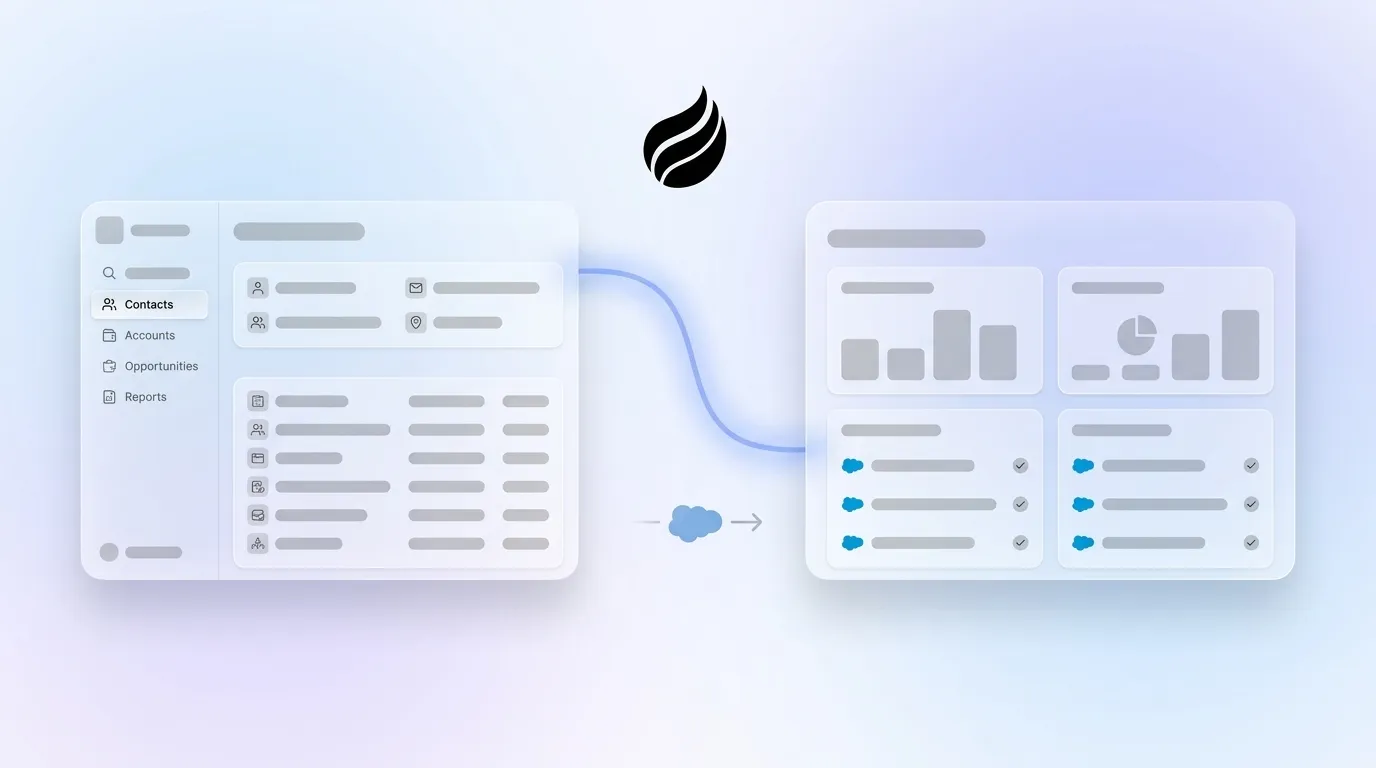
The 7-step playbook moves a revenue team from fragmented point-to-point syncs to a governed, real-time architecture where Salesforce, ERP, CPQ, billing, and intent tools share a single customer model. Steps 1 and 2 establish the governance foundation. Steps 3 through 5 connect the systems with a mix of event-driven and batch patterns. Steps 6 and 7 deploy the agent layer that keeps data current without human effort.
The agent layer is where Coffee operates. As a Companion App on top of Salesforce, Coffee handles the data-in problem autonomously by capturing interactions, enriching records, logging activity, syncing billing events, and surfacing intent signals so every downstream system stays accurate and forecasts reflect reality. The result is a revenue team where reps focus on selling and the agent handles the rest.
Get started with Coffee and build the integration your revenue team needs in 2026.