
Written by: Doug Camplejohn, CEO & Co-Founder, Coffee
Key Takeaways for Revenue Leaders
- In 2025, 87% of enterprises missed revenue targets because tools like Gong, Clari, and Chorus still relied on manual CRM data entry.
- Gong, Clari, and Chorus add conversation signals, yet they cannot overcome stale or incomplete CRM fields that reps must update by hand.
- Coffee’s agent auto-creates contacts, logs activities, and unifies structured and unstructured data so inputs stay current without rep effort.
- Teams using Coffee cut total cost of ownership by replacing multiple point solutions with a single agent layer on top of Salesforce or HubSpot.
- Remove manual data entry from your forecast process and tighten accuracy with Coffee’s agent-driven data capture.
How This Comparison Evaluates Forecasting Platforms
Six criteria structure this comparison, and together they shape forecast reliability and total cost of ownership for mid-market teams.
Data quality and automation depth measures how much human effort is required to keep the system’s inputs accurate, which forms the foundation for every forecast. Forecasting accuracy reflects the realistic precision range each platform achieves in independent or client-verified benchmarks once that data foundation is solid. Implementation and integration effort determines how quickly a team can reach that accuracy level, based on time-to-value and the technical lift to connect the platform to an existing CRM. These three criteria directly affect day-to-day forecast reliability. The remaining three focus on long-term viability: Total cost of ownership covers subscription fees, required CRM tiers, add-ons, and hidden manual-scrubbing labor. User adoption shows whether reps engage with the tool willingly or treat it as a compliance task. Long-term scalability examines whether the platform’s architecture supports growing data volumes and evolving revenue motions without a future re-platform.
Side-by-Side Comparison: Gong, Clari, Chorus, and Coffee
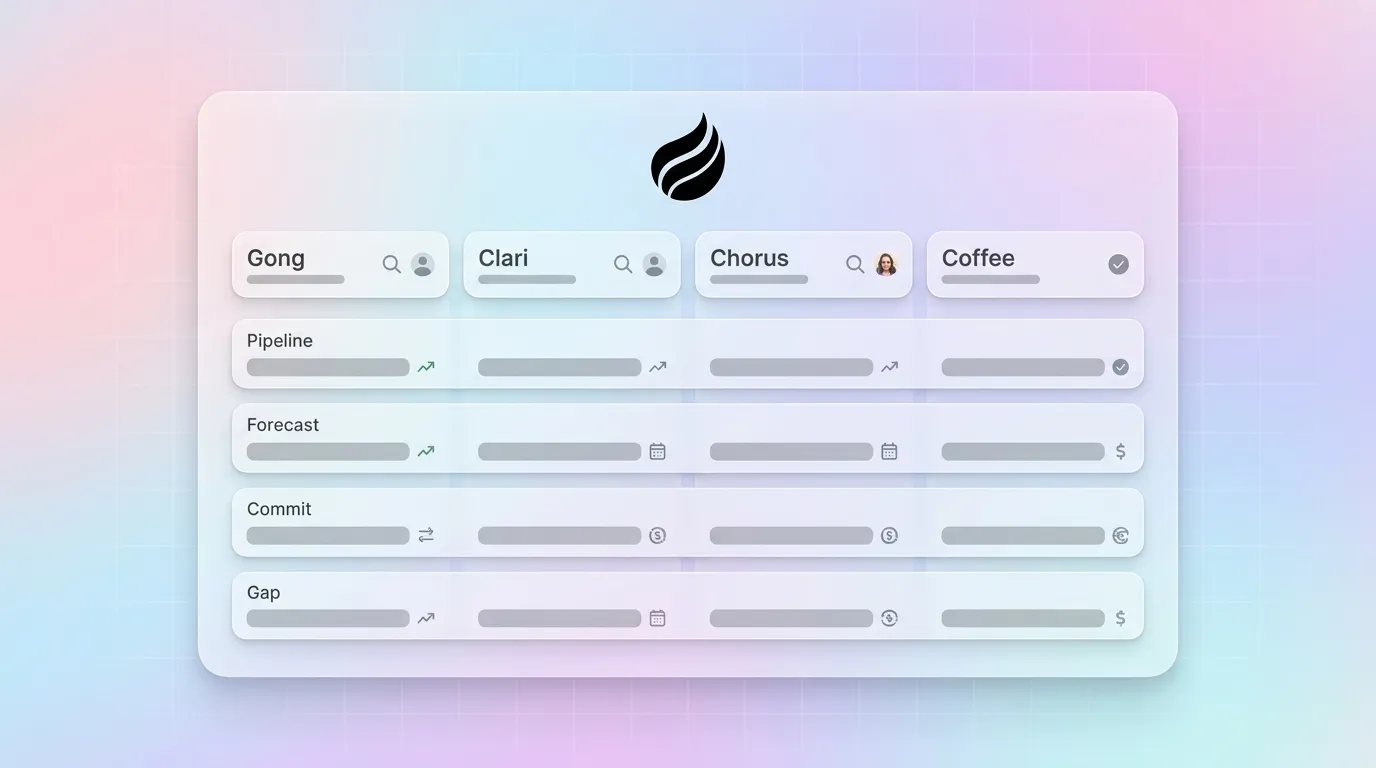
| Criterion | Gong Forecast | Clari | Chorus (ZoomInfo) | Coffee |
|---|---|---|---|---|
| Data quality & automation depth | Conversation signals from calls and emails, while CRM fields still require manual rep entry | Aggregates CRM and activity data, and accuracy depends entirely on CRM data quality | Conversation intelligence layer, with structured CRM fields still maintained manually | Agent auto-creates contacts, logs activities, and unifies structured and unstructured data without manual entry |
| Forecasting accuracy | Conversation signals combined with CRM data, with accuracy varying based on data quality | Customers report strong accuracy with clean CRM inputs, with performance tied to data quality | Conversation signals can improve forecasting when combined with CRM data | Agent-ensured data quality supports accuracy levels achievable by AI and ML ensemble models with clean data |
| Implementation & integration effort | Requires Salesforce or HubSpot, with setup measured in weeks and a dedicated admin | Enterprise deployment that typically takes weeks to months and requires CRM admin resources | Integrates with major CRMs, with a lighter lift than Clari but ongoing CRM hygiene work | Single authentication to Salesforce, HubSpot, Google Workspace, or Microsoft 365, and the agent begins populating data immediately |
| Total cost of ownership | $40,000–$120,000/year depending on seats and features | $50,000–$150,000/year for mid-market, with enterprise pricing higher | Custom pricing, bundled into ZoomInfo enterprise contracts | Seat-based pricing with agent labor included, with current tiers available on the Coffee pricing page |
| User adoption | High rep engagement on call review, while forecast submission remains a separate manual step | Manager-facing dashboards are strong, and rep-level adoption varies with the data-entry burden | Rep adoption is driven by call recording, while forecast workflows require additional training | Agent handles busywork reps resent, so CRM functions as a co-pilot instead of a compliance tool |
| Long-term scalability | Scales with seat count, and forecast quality plateaus if CRM hygiene degrades | Designed for enterprise scale, with complexity and cost increasing as the organization grows | Scales within the ZoomInfo ecosystem and remains dependent on ZoomInfo contract continuity | Data warehouse architecture retains full historical context, and the agent scales without adding manual overhead |
Data Capture: From Conversation Signals to Unified Agent Data
Gong, Clari, and Chorus each tackle the data-quality problem from the signal layer. Gong captures behavioral signals such as champion disengagement and missing next steps from conversation data alongside pipeline data. Clari aggregates those signals into rollup views. Chorus surfaces call intelligence within the ZoomInfo data ecosystem. These approaches improve on pure CRM-only forecasting, which delivers only 79% precision and 65% recall because field updates lag behind actual deal momentum.
The structural limitation none of them solve is the manual entry requirement for structured CRM fields. As noted earlier, Clari’s dependence on CRM data quality means incomplete activity logging undermines predictions regardless of how sophisticated the signal layer is. The same dependency applies to Gong and Chorus. Conversation intelligence enriches the forecast, yet it cannot compensate for stale or missing deal-stage data that reps enter, or fail to enter, in the CRM.
This is where Coffee’s agent-driven approach fundamentally differs. Coffee’s agent eliminates that dependency at the source. After connecting to Google Workspace or Microsoft 365, the agent scans emails, calendars, and call transcripts to auto-create contacts, log activities, and enrich records with job titles, funding data, and LinkedIn profiles. Structured and unstructured data flow into a built-in data warehouse that retains full historical context. The forecast model then receives continuously updated, ground-truth inputs without relying on rep discipline. Companies with clean, unified data flowing in real time see AI deliver transformational results, while fragmented systems with manually extracted data produce disappointing returns.

Teams that want unified, always-current deal data can use Coffee’s agent to remove manual entry from the forecasting workflow and keep CRM records accurate by default.

Pipeline Visibility and Week-over-Week Movement
Pipeline visibility is where the data-quality gap becomes obvious in daily operations. Gong’s Deal Board and Clari’s Waterfall chart both provide week-over-week pipeline movement, yet both depend on reps updating stage and close-date fields. When those fields are stale, the visual output reflects the last manual update instead of current deal reality.
Inconsistent pipeline stage definitions across reps are the leading cause of forecast inaccuracy, because the same stage label can represent very different deal maturity depending on individual interpretation. Chorus surfaces call-level signals that can flag stalled deals, while the pipeline view itself still depends on the underlying CRM record.
Coffee’s Pipeline Compare feature runs on the agent’s data warehouse rather than on manually updated CRM fields. It visualizes week-over-week changes such as progressed deals, stalled opportunities, and new additions automatically, without CSV exports or manual reconciliation. Pipeline reviews shift from interrogating data accuracy to focusing on strategy for specific deals.
Pricing and Contract Realities for 2026
Pricing opacity remains a consistent complaint among mid-market buyers in this category. Gong typically costs $40,000–$120,000 annually depending on seats and features, while Clari runs $50,000–$150,000 for mid-market companies, with enterprise pricing higher for both platforms. Chorus is bundled into ZoomInfo enterprise contracts, which makes standalone cost evaluation difficult. Most enterprise AI forecasting platforms use custom pricing based on user count and data volume instead of published list prices.
TCO calculations must also include the CRM tier required to unlock forecasting features. Salesforce forecasting appears in higher-tier Sales Cloud editions. HubSpot forecasting is available in Sales Hub Professional at roughly $100 per user each month. Adding Gong or Clari on top of those tiers creates the dual-tool sprawl that mid-market RevOps leaders regularly cite as a budget and complexity problem.
Coffee uses seat-based pricing with agent labor included, with no separate metering for LLM usage or automated processes. For teams already paying for Salesforce or HubSpot, Coffee’s Companion App adds the agent layer without replacing the system of record. This approach can reduce or remove the need for separate enrichment tools like ZoomInfo and standalone recording tools like Fathom, which lowers overall stack cost.
Stack Consolidation and Tool Sprawl Reduction
A 20-to-100-rep team running Salesforce or HubSpot alongside Gong, ZoomInfo, and a meeting recorder manages four or more paid contracts to support what should function as a unified workflow. Data quality and availability issues ranked as the second-largest barrier to AI adoption among 2,000 finance professionals surveyed in Q1 2026, and fragmented tool stacks drive much of that fragmentation.
Gong and Clari add intelligence layers while leaving the underlying stack intact. Chorus consolidates call recording within ZoomInfo but still requires a separate CRM. Coffee’s agent performs the roles of a CRM, enrichment tool, meeting recorder, and pipeline intelligence layer within a single product. For teams on Salesforce or HubSpot, the Companion App model keeps the system of record in place while Coffee handles data entry, enrichment, meeting management, and pipeline comparison. This consolidation removes the point solutions that create sprawl.

Best-Fit Use Cases by Team Profile
Early-stage teams with 1–20 reps that have outgrown spreadsheets but find Salesforce or HubSpot too maintenance-heavy benefit most from Coffee’s Standalone CRM. In this setup, the agent manages the entire system of record from day one.
Growing mid-market teams with 20–100 reps committed to Salesforce or HubSpot and struggling with low CRM adoption and forecast misses due to missing activity data align best with Coffee’s Companion App. Gong and Clari remain viable when the team already maintains strong CRM hygiene and has budget for a $40,000–$150,000 annual contract on top of existing CRM costs.
Teams seeking to replace a legacy CRM entirely and looking for a modern, agent-first architecture without decades of Salesforce technical debt should evaluate Coffee’s Standalone CRM against newer alternatives. Gong and Clari do not replace CRMs and therefore do not address this scenario.
Teams can explore Coffee’s pricing and deployment options to see which model fits their current stack and growth plans.
Operational Considerations and Risks
Change management often becomes the most underestimated cost in any forecasting platform rollout. Gong and Clari both require rep training on new submission workflows, and adoption rates vary widely based on manager enforcement. Rep-submitted bottom-up forecasting produces ±30–40% variance from actual results due to optimism bias and sandbagging, which conversation intelligence layers reduce but do not fully remove when reps still control stage updates.
Data-hygiene ownership remains a persistent risk for Gong and Clari customers. Both platforms surface the quality of whatever data exists in the CRM, and neither writes clean data back automatically. Teams that deploy these tools without first solving the data-entry problem will see forecast accuracy plateau at the level their CRM hygiene allows. Forecast accuracy depends entirely on the quality and completeness of Salesforce data, with inconsistent data entry creating noise in predictions.
Enterprise feature overbuying creates real risk for mid-market teams evaluating Clari. The platform is built for large organizations with complex rollup hierarchies, so a 30-rep team may pay for capabilities it will not use for years. Gong carries similar risk when the primary use case is forecasting rather than call coaching.
Decision Framework: Matching Tools to Your Team
Use the following logic to narrow your evaluation based on three variables: team size, current CRM, and tolerance for manual processes.
Teams with strong CRM hygiene and budget for a standalone forecasting layer can treat Gong Forecast or Clari as defensible choices. Gong fits best when call coaching and forecasting share equal priority. Clari fits best for organizations with complex multi-segment rollup requirements.
Teams with incomplete CRM data and forecast misses tied to missing activity logs should not expect Gong or Clari to solve the root problem. The first step is an agent layer that writes clean data into the CRM. Coffee’s Companion App addresses this directly for Salesforce and HubSpot users.
Teams evaluating a full CRM replacement will find Coffee’s Standalone CRM as the only option in this comparison that replaces the system of record with an agent-first architecture. Gong, Clari, and Chorus all operate as add-on layers that require an existing CRM.
Teams with total cost of ownership as the primary constraint should focus on data quality automation. Generic AI forecasting models improve accuracy by 5–15% over manual forecasting, while custom models built on a company’s own clean data improve accuracy by 20–35%. The highest ROI path is investing in automated data quality first, then layering forecasting intelligence on top of reliable inputs. Coffee’s agent delivers both capabilities in a single product, which simplifies buying and deployment.
Frequently Asked Questions
How long does implementation typically take for each platform?
Gong and Clari deployments for mid-market teams usually take several weeks when you factor in CRM integration, admin configuration, and rep onboarding. Both platforms require a dedicated CRM administrator to map fields and validate data flows before forecasting outputs can be trusted. Chorus, bundled within ZoomInfo, follows a similar timeline and often moves faster for teams already in the ZoomInfo ecosystem. Coffee’s Companion App connects through a single authentication to Salesforce, HubSpot, Google Workspace, or Microsoft 365, and the agent begins populating data immediately after connection. The Standalone CRM can be operational within days for teams starting from scratch, since no legacy data migration is required unless the team chooses to import historical records.

What migration effort is required when moving from Gong or Clari to an agent-based CRM?
Migration effort depends on whether the team replaces the CRM or only the forecasting layer. Teams moving from Gong or Clari to Coffee’s Companion App keep their existing Salesforce or HubSpot instance, so the migration is additive rather than a full replacement. The Coffee agent authenticates, reads existing records, and starts enriching and logging new activity automatically. Teams moving to Coffee’s Standalone CRM from a legacy system need to export and import contact, company, and deal records. Coffee’s agent handles enrichment and activity logging from the import date forward, while historical call recordings stored in Gong remain there or must be exported separately before contract termination.
How do security and compliance compare across these forecasting solutions in 2026?
Gong, Clari, and Chorus all hold SOC 2 Type 2 certifications and support standard enterprise security requirements such as SSO, role-based access controls, and data residency options for enterprise contracts. Coffee is SOC 2 Type 2 and GDPR compliant. A key differentiator for teams focused on AI model training is that Coffee does not use customer data to train public models, and data processed by the Coffee agent remains within the customer’s environment. Teams in heavily regulated industries such as healthcare or financial services should still conduct a full security review for any platform, since multi-year compliance certifications and custom data processing agreements are typically required before deployment.
Does agent-driven data quality outperform ZoomInfo-level enrichment for forecast accuracy?
ZoomInfo enrichment and agent-driven data quality address different needs. ZoomInfo provides firmographic and contact data such as company size, industry, job titles, and direct dials from its proprietary database. That data is accurate at the point of enrichment but does not capture deal-level activity, such as whether a rep sent a follow-up email, whether a champion attended the last call, or whether a close date slipped. Coffee’s agent captures both layers. It enriches records with firmographic data via licensed data partners at roughly the same quality level as ZoomInfo for most use cases, and it continuously logs deal-level activity from emails, calendars, and call transcripts. For forecasting, activity and engagement data carry more predictive power than firmographic enrichment alone, because forecast accuracy depends on knowing what is happening inside active deals, not just who the prospect is.
How can I evaluate forecasting accuracy in my own environment?
The most reliable evaluation method is a parallel-run test over one full quarter. Run your existing forecasting process alongside the new platform, then compare each platform’s week-four-of-quarter prediction against actual closed revenue. Ask every vendor for client-verified accuracy data instead of vendor-reported benchmarks, since independent benchmarks often show more realistic accuracy in the 80–85% range compared with vendor claims that can reach 98%. Before starting any evaluation, audit your CRM data quality. Calculate the percentage of deals with complete activity logs, current close dates, and accurate stage assignments. If that number falls below 70%, the evaluation will measure data-quality problems more than platform capability differences. Fixing data entry first, or deploying an agent that fixes it automatically, produces a cleaner signal for any accuracy comparison.
Conclusion: Why Agent-Driven Data Wins in 2026
The 2026 forecasting platform market offers plenty of signal intelligence, rollup dashboards, and AI-generated predictions. It still rarely solves the root problem. Thirty-six percent of organizations cite data quality as their top barrier and opportunity for AI in finance, and that barrier persists because nearly every platform in this comparison still relies on humans to enter the data those models consume.
Gong Forecast and Clari remain mature, capable platforms for teams with strong CRM hygiene and budget for a dedicated forecasting layer. Chorus adds conversation intelligence within the ZoomInfo ecosystem. None of these tools remove the manual entry requirement that causes forecast misses in the first place. Coffee’s agent does. By automating data capture across structured and unstructured sources, Coffee keeps the inputs to any forecast model accurate, current, and complete without adding to the rep’s administrative burden. That capability ultimately determines who delivers the most accurate forecast in 2026.

