Written by: Doug Camplejohn, CEO & Co-Founder, Coffee | Last updated: August 8, 2026
Key Takeaways
- Claude connects to external apps like Gmail, GitHub, Notion, HubSpot, and Salesforce through the Model Context Protocol (MCP) or no-code platforms such as Zapier.
- Teams typically follow three main paths to connect Claude to tools: installing MCP servers, configuring credentials securely, and registering servers with Claude Desktop or API hosts.
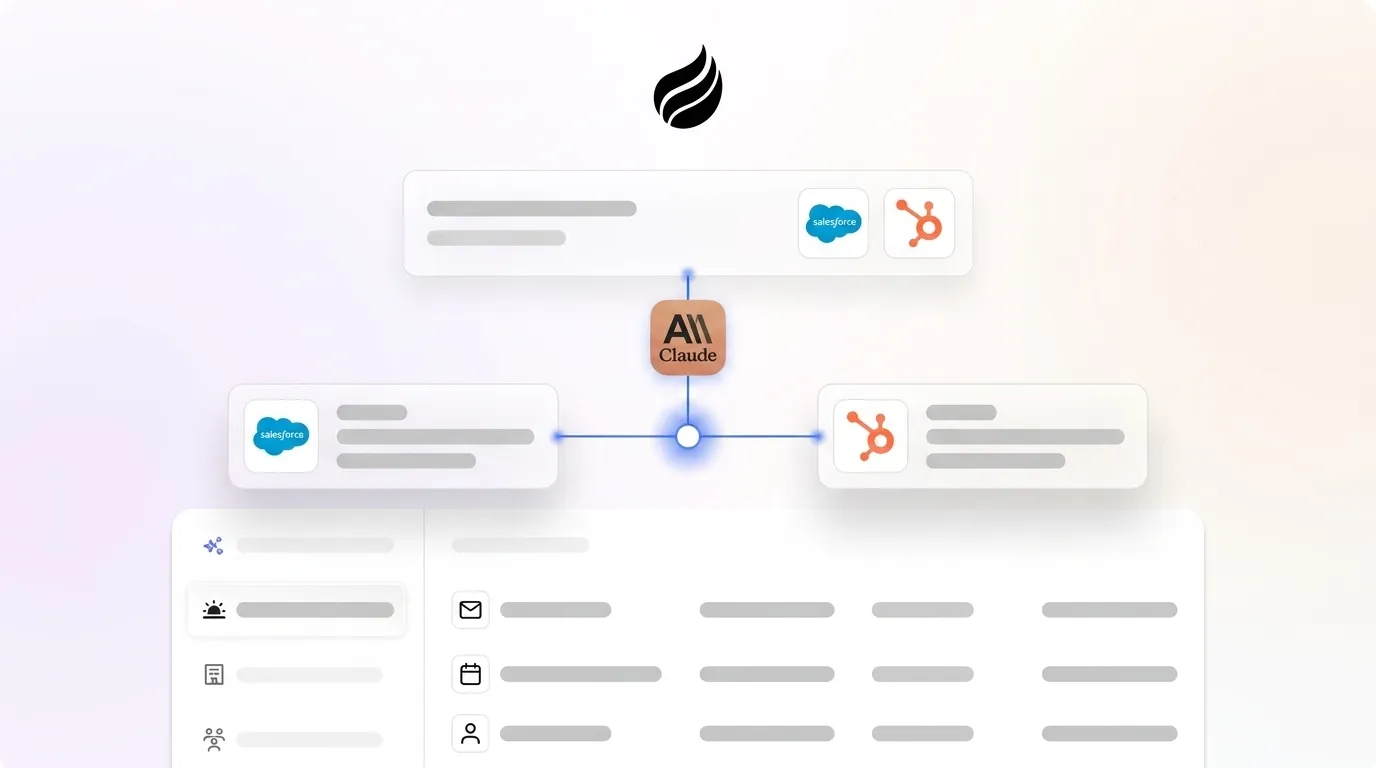
- Structured JSON outputs from Claude enable reliable two-way CRM sync so summaries, next steps, and field updates flow directly into Salesforce or HubSpot.
- Coffee replaces multiple point solutions with a single autonomous CRM agent that handles data entry, enrichment, activity logging, and pipeline updates without custom integrations.
- Turn every Claude output into a structured CRM record with Coffee’s autonomous agent and remove manual data entry from your team’s workflow.
Connecting Claude to Your Revenue Stack
Claude connects to almost any app your team uses by following a clear MCP setup flow. These steps build on each other so Claude can discover tools, call them safely, and return structured results.
- Install an MCP server. Clone or install a community or vendor-built MCP server for your target tool, such as GitHub, Notion, or HubSpot. The server exposes Resources for read-only data, Tools for actions, and Prompts for reusable templates that Claude can discover at runtime.
- Configure credentials. After installation, pull secrets from a manager such as AWS Secrets Manager or HashiCorp Vault so the server can authenticate to the external tool. Avoid storing API keys in environment variables for production deployments.
- Register the server with Claude Desktop or your API host. With credentials in place, add the server entry to
claude_desktop_config.jsonor your API host configuration so Claude knows where to reach the MCP server. - Define tool schemas. For each action the server exposes, write JSON Schema definitions that describe the expected inputs and outputs. Use
strict: trueon tool definitions and add a Pydantic validation layer to keep Claude’s outputs aligned with the schema. - Test tool discovery. After registration, prompt Claude to list available tools. Claude detects the server’s capabilities and can invoke them in a single call, which removes the need for custom integration code on the client side.
- Add a no-code fallback with Zapier. When a tool does not yet have an MCP server, send Claude’s structured JSON output to a Zapier webhook. Zapier then pushes that payload into any connected app using its own connectors, without extra code.
- Deploy as a containerized service. For production, run each MCP server as a containerized process with health checks and restart policies. Apply rate limiting at the MCP layer so Claude cannot accidentally exhaust external API quotas.
A minimal MCP server configuration for Claude Desktop looks like this:
{ "mcpServers": { "hubspot": { "command": "npx", "args": ["-y", "@hubspot/mcp-server"], "env": { "HUBSPOT_ACCESS_TOKEN": "${HUBSPOT_ACCESS_TOKEN}" } }, "github": { "command": "npx", "args": ["-y", "@modelcontextprotocol/server-github"], "env": { "GITHUB_PERSONAL_ACCESS_TOKEN": "${GITHUB_TOKEN}" } } } }Skip the MCP configuration entirely, because Coffee’s autonomous CRM agent connects to your stack and writes structured data directly into Salesforce or HubSpot from day one.
The next ten sections show how these connection patterns power specific RevOps and sales workflows. Each use case highlights the integration pattern, the JSON schema Claude uses, and how Coffee automates the same workflow without custom code.
1. Gmail & Calendar Automation for Activity Logging
Use case: Automatically log emails and meetings as activities in Salesforce or HubSpot.
Google’s Gmail MCP server exposes tools for thread search, draft creation, and label management, which suits interactive workflows where Claude reads, summarizes, or drafts emails for human review. For autonomous background logging, where Claude sends emails or performs incremental sync without a user present, teams rely on the Gmail REST API with service-account domain-wide delegation.
Use this prompt template to generate a HubSpot-ready activity payload from an email thread:
You are a CRM data extraction agent. Given the email thread below, return ONLY valid JSON matching this schema: { "engagement_type": "EMAIL", "subject": "string", "body_preview": "string (max 500 chars)", "contact_email": "string", "company_domain": "string", "direction": "INBOUND | OUTBOUND", "timestamp_utc": "ISO 8601 string", "next_step": "string | null" } Email thread: {{EMAIL_THREAD}}Workers in one study toggled between apps roughly 1,200 times each day, adding up to just under four hours each week reorienting themselves after toggling. Automating Gmail-to-CRM logging removes one of the most frequent and costly of those switches.
Coffee’s agent handles this end to end. After you connect Google Workspace, it scans emails and calendars, auto-creates contacts and companies, and logs every interaction as a structured activity without any prompt engineering.
2. GitHub PR Review with Structured CRM Notes
Use case: Summarize PRs and push review notes plus risk flags directly into linked HubSpot or Salesforce opportunities.
Connect Claude to GitHub through the MCP server for GitHub and trigger reviews on PR creation with GitHub Actions. A lightweight Python or Node.js webhook app on a stable HTTPS endpoint orchestrates the flow, fetching the diff and repo metadata, building a structured prompt, calling Claude, and writing the output back to GitHub as a comment and to your CRM opportunity as a note.
Use this prompt template for a structured PR verdict:
Analyze the following GitHub PR diff and repository context. Return ONLY valid JSON: { "pr_title": "string", "summary": "string (max 300 chars)", "risk_level": "LOW | MEDIUM | HIGH", "risk_reasons": ["string"], "action_items": ["string"], "linked_opportunity_id": "string | null" } PR diff: {{DIFF}} Repo context: {{CONTEXT}}This approach replaces freeform PR comments with structured outputs including ownership details, readiness status, deployment context, risk assessment, and action items. When the linked opportunity ID is present, a Zapier step or direct API call writes the summary and risk flag to the corresponding Salesforce or HubSpot record.
3. Notion Sync for Shared Project and Deal Notes
Use case: Keep project notes and meeting outcomes synchronized as notes or tasks inside Salesforce or HubSpot records.
Two-way Notion sync relies on two MCP servers running in parallel, one for Notion and one for your CRM. Claude reads a Notion page through the Notion MCP server’s Resources primitive, extracts structured fields such as deal name, next steps, owner, and due date, and then writes that data to the linked CRM record through the HubSpot or Salesforce MCP server’s Tools primitive.
On CRM update, a webhook triggers the reverse flow and writes updated field values back to the Notion page as a synced property block. MCP enables composability: once an MCP server exists for a tool, every AI application in the organization can reuse the same tested, maintained server instead of rebuilding the integration for each new agent. Your Notion MCP server therefore serves Claude, future agents, and any other LLM host your team adopts.
While Notion sync shows two-way data flow between a knowledge base and CRM, the next two use cases focus on bidirectional sync inside the CRM itself, where Claude writes structured outputs directly into Salesforce and HubSpot records.
4. Two-Way HubSpot Sync via Coffee
Use case: Write Claude-generated summaries, next steps, and field updates back to HubSpot without manual entry.
Structured JSON output forms the foundation for reliable two-way CRM sync. Anthropic’s Structured Outputs reached general availability on February 4, 2026 for Claude Sonnet 4.5, Opus 4.5, and Haiku 4.5, using constrained decoding that compiles your JSON Schema into a grammar so Claude cannot emit tokens that violate the schema.
Use this HubSpot deal update payload template:
{ "deal_id": "string", "deal_stage": "appointmentscheduled | qualifiedtobuy | presentationscheduled | decisionmakerboughtin | contractsent | closedwon | closedlost", "next_step": "string", "close_date": "YYYY-MM-DD | null", "ai_summary": "string (max 500 chars)", "amount": "number | null" }Coffee acts as the autonomous layer that consumes Claude’s structured outputs and writes them into your existing HubSpot instance. The agent updates stages, summaries, and amounts without custom sync code or manual entry.
5. Two-Way Salesforce Sync via Coffee
Use case: Write Claude-generated summaries, next steps, and field updates back to Salesforce without manual entry.
Salesforce follows the same pattern, with a schema tailored to Opportunity fields. Use this Salesforce Opportunity update payload template:
{ "opportunity_id": "string", "stage_name": "Prospecting | Qualification | Needs Analysis | Value Proposition | Id. Decision Makers | Perception Analysis | Proposal/Price Quote | Negotiation/Review | Closed Won | Closed Lost", "next_step": "string", "close_date": "YYYY-MM-DD", "description": "string (max 500 chars)", "amount": "number | null", "probability": "integer 0-100 | null" }Coffee applies the same autonomous sync model to Salesforce. It takes Claude’s structured outputs, respects Salesforce validation rules and stage logic, and keeps Opportunity records current without manual updates.
Turn every Claude output into a clean CRM record by letting Coffee handle the write-back to Salesforce or HubSpot for you.
6. RAG Over Company Data for Accurate Forecasts
Use case: Ground Claude answers in live CRM data so pipeline intelligence and forecasts remain accurate.
Retrieval-Augmented Generation pipelines pull relevant CRM records such as open opportunities, recent activities, and contact history at query time and inject them into Claude’s context window before response generation. RAG pipelines ground LLM outputs in a company’s current CRM history at query time without storing that data or using it to train external models, under zero-retention agreements with LLM providers.
Coffee’s built-in data warehouse captures every interaction in structured history, which makes it a strong retrieval layer. Because the agent ensures high-quality data enters the system, pipeline intelligence queries return accurate forecasts instead of hallucinated summaries built on stale or missing records.
7. Visitor Identification to Named Leads
Use case: Convert anonymous website visitors into enriched, routed leads inside the CRM.
Add a tracking pixel to your site’s <head> tag and Coffee identifies the visitor with name, title, email, LinkedIn profile, company, pages visited, and time on site. The agent surfaces real-time Slack notifications for high-fit prospects, and with one click the enriched record enters the CRM and joins an outreach campaign.

Many visitor identification tools reveal only the company or broad people lists. Coffee’s Suggested Leads feature uses your buyer persona to recommend the two or three specific individuals inside the visiting company to contact, which closes the loop from pixel hit to LinkedIn outreach without leaving the agent.
8. Automated Pipeline Updates from Calls and Notes
Use case: Trigger deal-stage changes and activity logging from Claude outputs or meeting transcripts.
In this pattern, Claude processes a meeting transcript, extracts deal-stage signals with a structured tool call, and writes the updated stage, next step, and close date to the linked opportunity through the CRM API. Coffee’s agent handles this natively by joining calls with its AI Meeting Bot, generating BANT, MEDDIC, or SPICED-structured summaries, and writing every field update back to Salesforce or HubSpot without human intervention.

9. Automated Meeting Briefings for Reps
Use case: Prepare reps with AI-generated pre-meeting context pulled from live CRM records.
Before each meeting, Claude queries the CRM for the contact’s history, open opportunities, last activity, and any linked notes. It then generates a structured briefing with attendee roles, past context, open action items, and suggested talking points, which arrives in the rep’s inbox or Slack channel before the call.

Teams automating Google Workspace with AI agents typically save 8–12 hours per person each week, with inbox triage usually dropping by half in the first week. Coffee’s Today page delivers this briefing automatically so reps walk into every call prepared without spending time on manual research.
10. Stack Consolidation with a Single CRM Agent
Use case: Replace fragmented point solutions such as enrichment, sequencing, recording, and forecasting with one autonomous agent.
Sales reps spend only about 35% of their time actively selling, while the rest goes to data entry and other administrative tasks. Each additional point solution adds another login, another data silo, and another manual sync for RevOps to maintain.
Coffee consolidates the work of a CRM, enrichment database, prospecting tool, meeting recorder, outreach sequencer, and forecasting layer into a single agent. Lead Finder builds targeted prospect lists through natural language search, Campaigns runs multi-step AI-generated email sequences from the rep’s own mailbox, and Pipeline Compare visualizes week-over-week deal changes without CSV exports. One agent, one subscription, and one source of truth replace a scattered stack.
Consolidate your revenue stack around Coffee’s agent so your team can focus on selling instead of managing tools.
Frequently Asked Questions
What security and compliance considerations apply when connecting Claude to a CRM like Salesforce or HubSpot?
Security evaluation should cover five areas. First, data access controls must enforce object-level, row-level, and field-level permissions so Claude only sees records the authenticated user can view. Second, credential management requires that API keys and OAuth tokens live in a secrets manager, not environment variables, and rotate on a defined schedule.
Third, audit logging should capture every tool call Claude makes through a logging layer so you maintain a full audit trail of reads and writes to the CRM. Fourth, data retention policies must confirm that your LLM provider operates under a zero-retention agreement so prompts containing CRM data are discarded after inference and never train external models. Fifth, compliance certifications matter: for most RevOps teams, SOC 2 Type II is the minimum bar, while regulated industries also check GDPR, HIPAA BAA availability, and ISO 27001.
Coffee is SOC 2 Type II and GDPR compliant, and its data never trains public models.
How does Coffee’s pricing compare to paying for individual MCP connectors or building custom integrations?
Coffee uses straightforward seat-based pricing where you pay for human seats and the agent’s unlimited labor is included. The platform does not meter LLM usage, API calls, or automated processes. By comparison, assembling a similar stack from individual point solutions such as a CRM, enrichment tool, sequencing platform, meeting recorder, and forecasting add-on usually means five separate subscriptions plus engineering time to build and maintain MCP servers or custom API integrations for each.
Coffee’s Companion App model deploys the agent on top of your existing Salesforce or HubSpot instance through a simple authentication. You keep your system of record and remove the surrounding tool sprawl.
How much implementation effort and time-to-value should a RevOps team expect?
For Coffee’s Companion App, setup involves authenticating your Google Workspace or Microsoft 365 account and your Salesforce or HubSpot instance. The agent immediately begins scanning emails and calendars, auto-creating contacts, logging activities, and enriching records without field mapping or workflow configuration.
Most teams see clean, structured data flowing into their CRM during the first session. For teams building custom MCP integrations, timelines depend on the number of tools, the CRM’s required fields and validation rules, and whether the team has microservices deployment experience. Production MCP deployments require containerization, secrets management, health checks, rate limiting, and per-server CI/CD pipelines, which Coffee’s agent-based approach removes.
Can Claude reliably produce structured JSON output for CRM field mapping without errors?
As of early 2026, Anthropic’s Structured Outputs are generally available across Claude Sonnet 4.5, Opus 4.5, and Haiku 4.5, using constrained decoding that compiles your JSON Schema into a grammar and guarantees schema-valid output at the token level. For production CRM pipelines, the recommended reliability stack adds a Pydantic validation layer as L1 and an Instructor retry layer with error feedback as L2 on top of native structured outputs.
This combination reduces format-drift failures to near zero. One important caveat remains: constrained decoding guarantees output shape and type correctness but not semantic accuracy, so values can still be incorrect when the source data is ambiguous or incomplete. Coffee addresses this by grounding every extraction in high-quality source data such as emails, transcripts, and calendar events instead of asking Claude to infer missing context.
Conclusion
Claude integrations through MCP connectors and no-code tools give RevOps and sales teams a way to read, reason over, and act on data across Gmail, GitHub, Notion, HubSpot, and Salesforce. Structured JSON output and MCP tool calls cover only part of the problem, because teams still need a reliable layer that writes those outputs into clean, validated CRM records.
Without that layer, Claude’s intelligence remains outside the system of record and cannot support accurate reporting. Coffee fills this gap as an autonomous CRM agent that handles the entire data-in process, capturing emails, transcripts, and calendar events, enriching contacts and companies, logging activities, updating pipeline stages, and writing AI-generated summaries and next steps directly into Salesforce or HubSpot.
The result is good data in and good data out, with accurate forecasts, reliable pipeline intelligence, and a CRM that reps actually trust. Turn Claude’s outputs into structured, accurate CRM records by letting Coffee handle the heavy lifting automatically.