Written by: Doug Camplejohn, CEO & Co-Founder, Coffee
Why Forecast Inaccuracy Still Hurts Revenue Teams
- Gong excels at conversation intelligence but does not fix the CRM data quality issues that keep forecasts unreliable.
- Clari, Aviso, BoostUp, and Salesforce Einstein add predictive features yet still depend on disciplined CRM hygiene.
- Coffee’s agent automatically captures emails, calendars, and calls so CRM records stay clean and current without rep effort.
- Teams of 1–200 employees on Salesforce or HubSpot gain the most from Coffee’s low-friction Companion App that enriches their existing CRM.
- Teams ready to remove manual data entry and tighten forecast accuracy can start a Coffee trial today.
Side-by-Side Comparison: Clari, Aviso, BoostUp, Salesforce Einstein, and Coffee
The table below compares how each platform improves forecast accuracy and how much data-entry automation it actually provides. Focus on the “Data-Entry Automation” column. Tools that only read existing CRM data inherit every stale close date and missing activity, while tools that auto-capture activity at the source keep the system of record current.
| Tool | Forecast Accuracy Drivers | Data-Entry Automation | Salesforce / HubSpot Fit | Pricing Model | Team-Size Suitability |
|---|---|---|---|---|---|
| Clari | Aggregates CRM, email, and calendar into a predictive engine with rep-, team-, and company-level confidence intervals | Automated activity capture from connected sources, requires CRM as source of truth | Strong Salesforce integration, post-merger with Salesloft (Dec 2025) adds engagement execution layer | Enterprise contract, not publicly listed | Mid-market to enterprise, 1,500+ organizations managing $5 trillion of revenue use Clari |
| Aviso | Claims 98% forecast accuracy | Agentic workflows automate deal activity capture and CRM updates | Salesforce and HubSpot connectors available, enterprise configuration required | Enterprise contract, not publicly listed | Mid-market to enterprise, heavy implementation overhead for small teams |
| BoostUp (Terret) | Predictive analytics, deal inspection, pipeline change tracking, and risk alerts for stalled or regressed opportunities | Automated signal capture from CRM and communication channels | Salesforce-native, HubSpot integration available | Per-seat, mid-market pricing tier | Mid-market teams of 20–200, less suited to sub-20-person teams |
| Salesforce Einstein | ML surfaces deals with stronger buyer engagement and uses historical patterns to predict conversion likelihood | Native to Salesforce, no additional sync required but depends on rep-entered data quality | Native Salesforce only, no HubSpot path | Add-on to existing Salesforce licenses, tiered by edition | Salesforce-committed teams of any size, accuracy limited by underlying CRM hygiene |
| Coffee | Agent automatically captures emails, calendar events, and call transcripts to keep CRM data current, Gartner reports that 30% of CRM data is outdated within 12 months | Fully automated: contacts, activities, next steps, and deal state logged without rep input, saves 8–12 hours/week per rep | Companion App writes enriched data back to existing Salesforce or HubSpot, no CRM replacement required | Simple seat-based pricing, agent labor included | 1–200 employees, Standalone CRM for 1–20, Companion App for 21–200 on Salesforce/HubSpot |
See how Coffee’s agent maintains your CRM automatically by starting a free trial.
How Each Tool Handles Data Capture and Maintenance
Forecast accuracy rises or falls with how completely each tool captures deal activity. Manual data entry usually records only a fraction of real interactions, while automated capture can cover almost everything. Clari and Aviso both automate activity ingestion, yet they still sit on top of whatever CRM data already exists, so any stale records flow straight into the forecast model. Salesforce Einstein faces the same constraint because it only reads the Salesforce instance in front of it. BoostUp takes a slightly different approach by adding pipeline change tracking, yet it still depends on reps updating stages and close dates, which means tracking is automated but data entry is not.
Coffee’s agent takes a different approach and treats data capture as the core problem. After connecting to Google Workspace or Microsoft 365, it scans emails and calendars to auto-create contacts, log activities, and update deal state without rep input. It also joins calls via an AI meeting bot, generates post-call summaries, and writes structured notes (BANT, MEDDIC, SPICED) back to the CRM record. The result is a continuously maintained system of record instead of a periodically refreshed one.

Pipeline Visibility and Week-over-Week Change Tracking
Once deal data stays current, the next step is surfacing meaningful patterns from it. A deal sitting in the Proposal stage for 45 days is statistically less likely to close than one that arrived there yesterday, yet most teams lack tooling that highlights this automatically. The deal slippage problem mentioned earlier, where many forecasted deals push to the next quarter, is exactly what Clari’s revenue leak detection and confidence intervals aim to flag at scale.
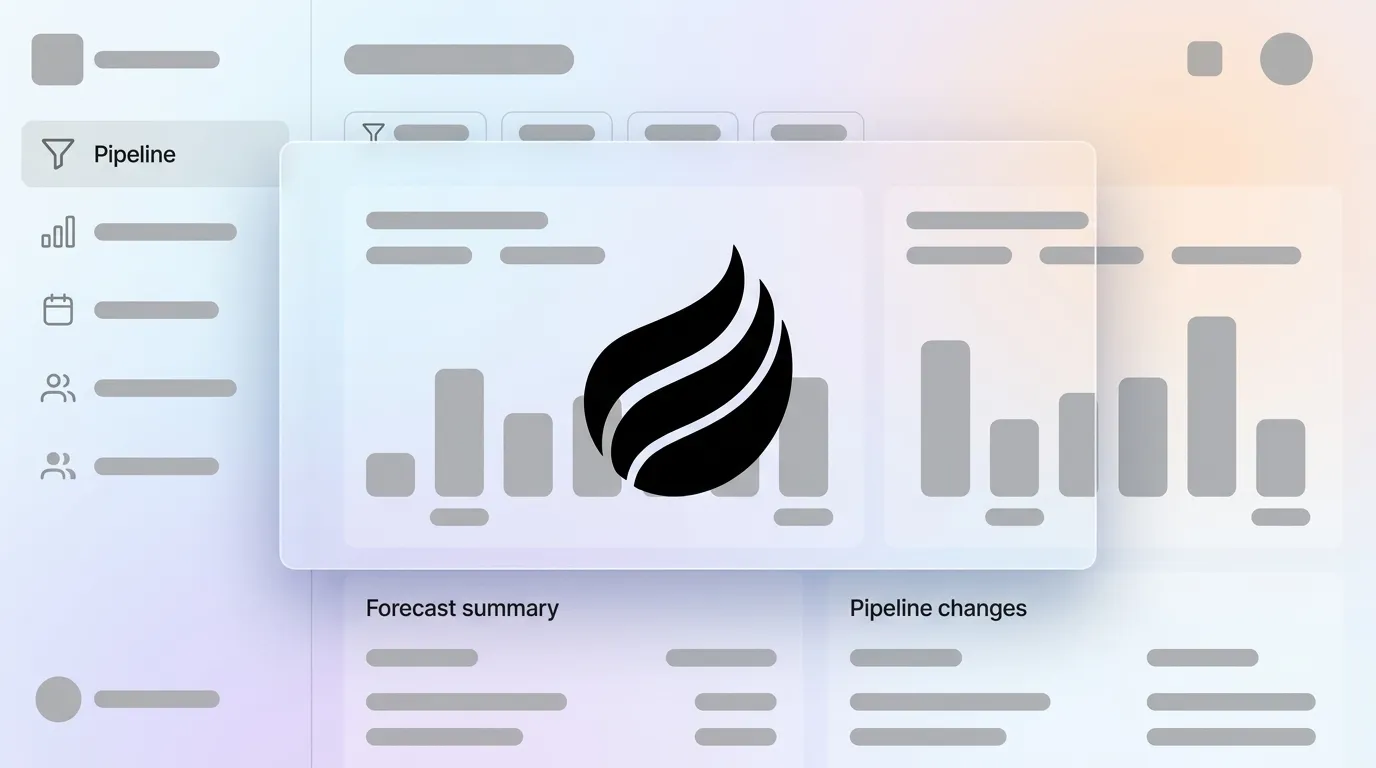
Coffee’s Pipeline Compare feature visualizes week-over-week changes such as progressed deals, stalled opportunities, and new additions without CSV exports or manual rollups. Because the agent has been logging activity continuously, the comparison reflects real deal movement instead of rep-reported stage changes. BoostUp offers comparable pipeline change tracking for mid-market teams. Aviso’s agentic workflows surface similar signals at enterprise price points. Salesforce Einstein provides deal health scoring natively but still needs clean underlying data to generate reliable alerts.
Integration Complexity and CRM-Native Fit
Forecast quality in Salesforce depends on disciplined pipeline management, and any tool that adds a separate data layer without writing back to the CRM creates reconciliation work. Native bi-directional CRM sync matters because one-way export drifts as soon as reps miss logging steps.
Clari and Aviso both offer deep Salesforce integrations but usually require enterprise implementation cycles. Salesforce Einstein is embedded natively yet remains locked to Salesforce, so HubSpot teams cannot use it. BoostUp supports both CRMs but needs configuration effort that grows with team complexity. Coffee’s Companion App authenticates through a simple OAuth flow and then syncs enriched data bidirectionally into the existing Salesforce or HubSpot instance. Teams keep one system of record, avoid a parallel database, and can start without a professional services project.
Long-Term Scalability and Administrative Burden
Organizations using fragmented revenue systems often maintain five to ten separate platforms, which creates ongoing overhead for CRM cleanup, manual tagging, workflow configuration, weekly rollups, and report building. Consolidating those functions can cut software costs and reduce RevOps workload.
Clari and Aviso are built for teams with dedicated RevOps headcount that can manage configuration, maintain integrations, and run quarterly reviews. For teams of 1–20, that overhead is prohibitive, not only in labor cost but also in the attention required to keep everything running. Coffee’s seat-based pricing includes the agent’s labor, so administrative burden does not scale with team size, with no metering on LLM usage or automation runs and no need to hire a RevOps admin just to maintain the system. As teams grow from 20 to 200 employees, the Companion App scales with them because the agent continues to handle data maintenance in the background.
Best-Fit Guidance by Company Size and CRM Stack
1–20 employees: Teams that have outgrown spreadsheets but find Salesforce or HubSpot too maintenance-heavy usually fit Coffee’s Standalone CRM best, since the agent manages the entire system of record from day one. Salesforce Einstein is not realistic at this size. Clari and Aviso carry enterprise pricing and implementation complexity that do not match a sub-20-person team.
21–200 employees on Salesforce or HubSpot: Coffee’s Companion App offers the lowest-friction path to better forecast accuracy because teams keep their existing CRM investment while gaining automated data maintenance, with no rip-and-replace and no second system to reconcile. BoostUp (Terret) works well for teams that already have reasonably clean pipeline data and mainly need deal inspection tooling. Clari fits when the team has dedicated RevOps capacity and an enterprise budget. Salesforce Einstein suits Salesforce-committed teams that want native forecasting without another vendor, as long as they address data hygiene separately.
Risks and Limitations Across These Platforms
Clari’s post-merger integration with Salesloft creates product roadmap uncertainty for teams evaluating it in mid-2026. Aviso’s 98% accuracy claim comes from its own published benchmarks and assumes enterprise deployments with full historical data. BoostUp needs meaningful pipeline volume to generate statistically reliable risk alerts, so very small teams may not reach that threshold. Salesforce Einstein’s forecast quality remains bounded by the quality of the Salesforce instance it reads, echoing the earlier point that untrusted pipeline data produces untrusted forecasts, as Salesforce experts have documented. Coffee’s broader integrations beyond Google Workspace, Microsoft 365, and Zoom currently route through Zapier, and deeper native connectors sit on the product roadmap.
Decision Framework for Fast Vendor Shortlisting
| Constraint | Recommended Option |
|---|---|
| 1–20 employees, no CRM yet | Coffee Standalone CRM |
| 21–200 employees, Salesforce or HubSpot committed, limited RevOps headcount | Coffee Companion App |
| 21–200 employees, Salesforce committed, existing RevOps team, mid-market budget | BoostUp (Terret) or Coffee Companion App |
| 200+ employees, Salesforce committed, dedicated RevOps, enterprise budget | Clari or Aviso |
| Salesforce-only, want native forecasting without a new vendor | Salesforce Einstein (with separate data hygiene investment) |
Frequently Asked Questions
How long does implementation typically take?
Coffee’s Companion App connects to an existing Salesforce or HubSpot instance through standard OAuth authentication. The agent begins capturing emails, calendar events, and call data immediately after connection, and most teams see the CRM filling with enriched, current data within 24 to 48 hours. No professional services engagement is required. Enterprise platforms like Clari and Aviso usually need multi-week implementation cycles that include data mapping, integration configuration, and user training before forecasts become reliable.
What migration effort is required when switching forecasting tools?
Coffee’s Companion App writes data back into the existing Salesforce or HubSpot instance instead of creating a parallel system of record, so teams avoid migrating historical pipeline data. The CRM remains the source of truth while Coffee enriches and maintains it. Teams moving from a standalone forecasting platform to Coffee do not need to export, transform, or re-import deal history because existing CRM records become the starting point. For teams adopting Coffee’s Standalone CRM from spreadsheets or a legacy CRM, the agent can ingest historical contact and company data through CSV import.

How directly does improved data quality affect forecast accuracy?
Improved data quality affects forecast accuracy directly and consistently. Forecast models, whether rule-based, weighted pipeline, or AI-driven, only perform as well as the inputs they receive. Stale close dates, missing next-step fields, and unlogged activities introduce systematic error that no algorithm can fully correct. Companies that implement automated data capture and pipeline hygiene workflows have reported forecast accuracy gains of 15–30 percentage points. Coffee’s agent addresses this at the source by logging every interaction, stage change, and contact update automatically, which removes rep discipline as a major variable in forecast quality.

Which options meet SOC 2 and GDPR requirements for U.S. mid-market teams?
Coffee is SOC 2 Type 2 certified and GDPR compliant, and customer data does not train public AI models. Clari, Aviso, and Salesforce Einstein also maintain enterprise-grade security certifications suitable for U.S. mid-market teams. BoostUp (Terret) publishes SOC 2 compliance documentation. Teams in regulated industries such as healthcare or financial services should still run vendor-specific security reviews, since implementation scope and data residency requirements vary by organization.
How should teams evaluate fit before committing?
The most reliable evaluation method connects the tool to a live CRM instance and measures data completeness before and after a two-to-four-week pilot. Teams can track the percentage of open opportunities with a logged next step, a current close date, and at least one activity in the past 14 days before and after the agent runs. For forecasting tools that do not automate data capture, teams should check whether forecast output changes materially when reps update their records versus when they do not, since that gap reveals the tool’s dependency on human compliance. Coffee’s agent removes that dependency, so the key evaluation metric shifts from rep adoption rate to data completeness rate.
Conclusion: Choosing the Right Forecasting Approach in 2026
Forecast inaccuracy in 2026 usually stems from data quality problems rather than modeling gaps for small-to-mid-market teams. Over 50% of revenue leaders missed their forecast at least twice in the past year, and fewer than 50% of sales leaders have high confidence in their forecasts. Adding conversation intelligence on top of a poorly maintained CRM does not change those numbers. The tools that actually improve forecast accuracy automate clean data capture at the source before the forecast model runs.
For Salesforce and HubSpot teams with 1–200 employees, Coffee’s agent-driven approach targets the root cause directly. It keeps the CRM current without relying on rep discipline, surfaces week-over-week pipeline changes automatically, and works alongside the existing CRM instead of replacing it. Ready to eliminate manual data entry and see accurate pipeline data in real time? Start your Coffee trial.