Written by: Doug Camplejohn, CEO & Co-Founder, Coffee
Key Takeaways
- ZoomInfo and Clay solve different problems. ZoomInfo is a proprietary enterprise database. Clay is a flexible multi-source orchestration layer.
- Choose ZoomInfo for mainstream US SaaS ICPs when non-technical reps need self-serve prospecting and you want a single vendor-managed contract.
- Choose Clay when you have a dedicated RevOps engineer, need niche signal sources, and can invest six-plus weeks building custom workflows.
- Both platforms leave a critical gap. Once data enters your CRM, neither maintains records, logs activity, or delivers pipeline intelligence without manual rep effort.
- Teams that want to remove that data entry gap can get started with Coffee.
Two Competing Philosophies: ZoomInfo’s Database vs Clay’s Orchestration Layer
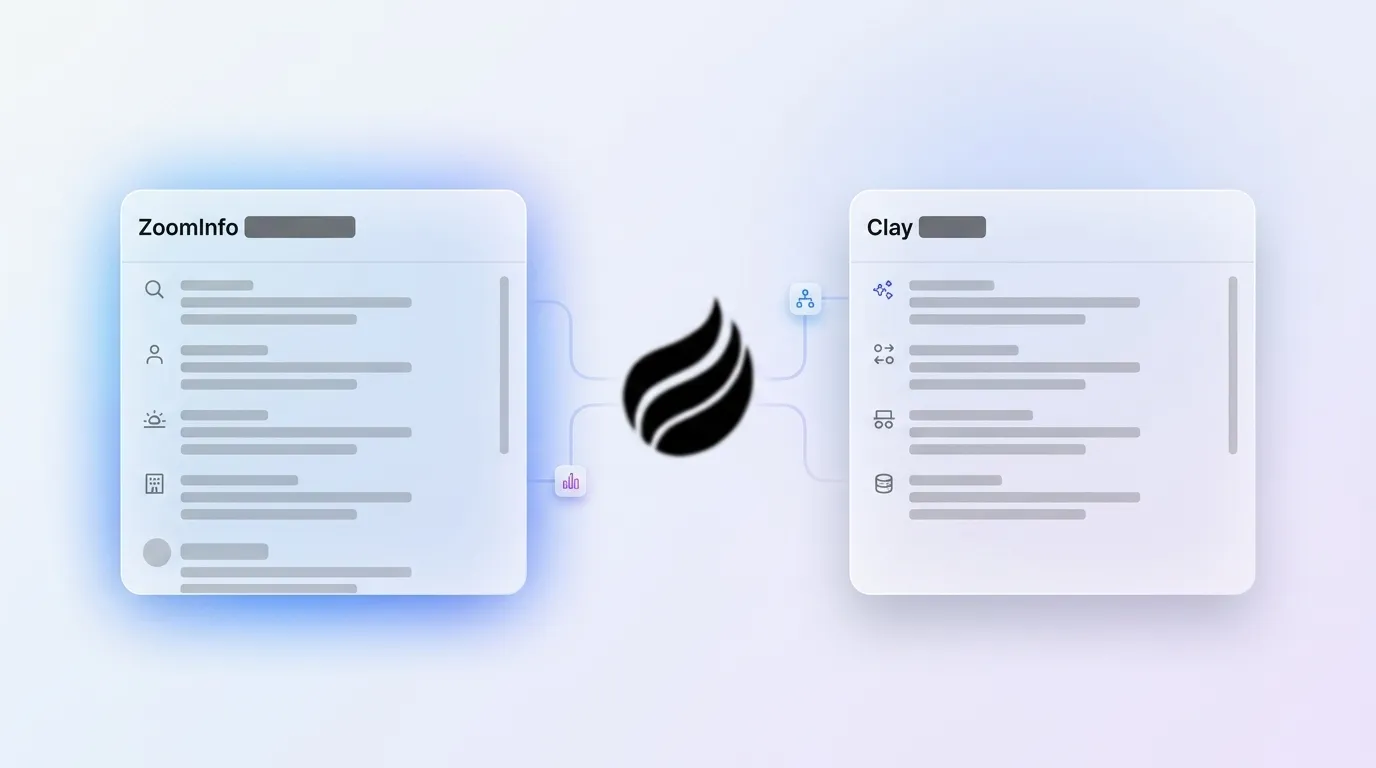
ZoomInfo owns its data. It maintains a proprietary graph of hundreds of millions of verified contacts and companies fused with buyer intent signals. The value proposition is turnkey depth: one contract, one login, one vendor to call when data is wrong.
Clay owns no data. It is a workflow builder that routes records through whichever enrichment APIs you configure, such as Clearbit, Apollo, LinkedIn, Hunter, and dozens more, then applies AI to research and personalize at scale. The value proposition is flexibility. You assemble the data stack you need instead of accepting one vendor’s coverage gaps.
This philosophical gap shapes every downstream tradeoff. It affects cost predictability, ICP coverage, setup effort, and who on your team can operate the platform day to day.
How to Evaluate ZoomInfo vs Clay for a 20–80 Person SaaS Team
Teams should define decision criteria before comparing features. For a 20–80 person SaaS company in 2026, the choice between a proprietary database and an orchestration layer surfaces eight critical tradeoffs: data quality and freshness for your specific ICP, implementation effort and required technical skill, workflow fit for signal-driven prospecting, usability for non-technical reps, integration depth with Salesforce or HubSpot, reporting and pipeline visibility, automation ceiling, and total cost of ownership over 24 months.
Each dimension shows whether your team can support a flexible platform or needs a more turnkey solution.
Side-by-Side Comparison: ZoomInfo vs Clay (2026)
| Criterion | ZoomInfo | Clay |
|---|---|---|
| Data quality and freshness | Proprietary verified graph with broad contact coverage | Aggregated from 50+ third-party providers, freshness varies by source |
| Implementation effort | Moderate, CRM and sequencer integrations require initial setup time | High, needs a dedicated builder or RevOps engineer to configure tables and waterfalls |
| Signal-driven prospecting | GTM Context Graph fuses intent, behavioral, and conversation data natively | Signals wired in manually via API or Zapier, highly customizable but not pre-built |
| Usability for non-technical reps | High, point-and-click search and export UI | Low, table-based builder interface requires workflow literacy |
| Salesforce/HubSpot integration | Native connectors, full feature value requires CRM and sequencer activation | Pushes enriched data via API or Zapier, shallow API connections differ from native data model alignment |
| Reporting and pipeline visibility | Built-in dashboards tied to ZoomInfo data, limited cross-tool visibility | No native reporting, outputs feed downstream tools |
| Automation depth | Automated outreach drafting and account prioritization via AI | Extensive automation logic, constrained only by builder skill |
| Ongoing admin burden | Vendor-managed data, internal admin for CRM sync and seat management | High, waterfall logic, API keys, and enrichment credits need continuous maintenance |
Setup and Onboarding Time for Each Platform
ZoomInfo onboarding for a 20-person sales team typically spans two to four weeks. Teams configure the CRM connector, select intent topics, and train reps on search filters. Full feature value still depends on connecting CRM and sequencer integrations, which adds setup time.
Clay onboarding has no fixed ceiling. A simple enrichment table can be live in a day. A production-grade signal-driven prospecting workflow that pulls funding data, LinkedIn headcount changes, and technographic signals through a waterfall can take six to twelve weeks to build, test, and stabilize. That build requires someone who treats Clay as a primary job function, not a side project.
How Each Platform Handles Data Capture and Maintenance
ZoomInfo maintains its own data graph, so coverage updates happen on ZoomInfo’s schedule. For mainstream ICPs such as SaaS, financial services, and enterprise tech, coverage is strong. Clay’s coverage is only as current as its underlying providers. When a provider’s data is stale, Clay exposes that staleness instead of fixing it.
Teams using Clay must audit provider quality by ICP segment and swap sources when accuracy degrades.
Frontline Usability and Rep Adoption
ZoomInfo’s search-and-export interface is accessible to most reps after an hour of training. Clay is not a rep-facing tool. It functions as a back-office automation platform.
Reps consume Clay’s outputs, such as enriched lists and personalized email drafts, but they do not operate Clay directly. This distinction matters for adoption planning. Clay needs a dedicated operator, while ZoomInfo spreads access across the team.
Manager Visibility and Reporting Tradeoffs
Neither platform serves as a full reporting layer. ZoomInfo surfaces intent dashboards and account engagement signals, but pipeline visibility still depends on your CRM. Clay produces no native reports and only outputs structured data to the tools you choose.
Buyers should assess integration depth rather than just the existence of a connector, because a shallow API connection is not the same as native data model alignment. Managers who rely on either platform for forecast accuracy will struggle without a separate intelligence layer.
Integration Realities with Salesforce and HubSpot
ZoomInfo offers native Salesforce and HubSpot connectors that sync contact and account data bidirectionally. Clay pushes enriched records via API or Zapier. As noted earlier, this API-based approach creates the integration depth problems that require specialized expertise and longer implementation times.
Teams with required fields, custom objects, or complex validation rules in Salesforce often see Clay’s API-based push create data hygiene problems that need manual remediation.
Customization Power and Long-Term Flexibility
Clay’s ceiling is higher than ZoomInfo’s for teams with the technical resources to reach it. Custom waterfall logic, AI research prompts, and multi-provider enrichment sequences are powerful for niche GTM motions. ZoomInfo’s customization stays bounded by its own data model and feature roadmap.
Teams that must orchestrate signals from sources ZoomInfo does not cover, such as niche trade publications, custom web scraping, or proprietary intent data, usually find Clay the only viable path.
ZoomInfo vs Clay Cost and Total Cost of Ownership
ZoomInfo uses a consumption-credit pricing model that scales with usage rather than seat count. This structure makes contract negotiations complex and renewal costs hard to predict. Published estimates for a mid-market team of 10–20 seats range from $30,000 to $60,000+ annually, and add-ons for Chorus, intent data, and advanced features increase total cost of ownership.
Clay’s published pricing starts at paid tiers (Launch at $185/month billed annually) and scales through credit-based plans using Actions and Data Credits. True TCO also includes enrichment provider costs, since each API call to Clearbit, Apollo, or Hunter carries its own credit cost, plus the fully loaded salary or contractor cost of the RevOps engineer who runs the platform. Teams also absorb the opportunity cost of the six-to-twelve-week build period before workflows generate pipeline. SaaS finance executives often cite unpredictability as a top worry with usage-based pricing models, and that concern applies directly to Clay’s credit consumption model at scale.
See Coffee’s transparent pricing, with no consumption credits and no usage surprises
Clay vs ZoomInfo for Niche ICP Coverage
The following table shows how coverage shifts across segments. It highlights where both platforms struggle and where Clay’s multi-provider architecture can help if configured well.
| ICP Segment | ZoomInfo Coverage | Clay Coverage |
|---|---|---|
| Enterprise SaaS (US, 500+ employees) | Strong, deep verified contact graph | Strong, multiple providers overlap on this segment |
| Mid-market SaaS (US, 50–500 employees) | Moderate to strong | Moderate, provider quality varies |
| SMB / founder-led companies | Weak, sparse verified data at this tier | Weak to moderate, scraping and LinkedIn enrichment partially compensate |
| Niche verticals (e.g., specialty manufacturing, regional healthcare) | Weak, proprietary graph skews toward tech and finance | Variable, depends on whether a provider covers the vertical |
| International (non-US) | Moderate, strongest in English-speaking markets | Variable, provider selection determines coverage |
For niche ICPs, neither platform delivers reliable out-of-the-box coverage. Clay’s multi-provider architecture gives it a theoretical advantage, because you can route niche segments through specialized providers. Realizing that advantage still requires knowing which providers cover your segment and building waterfall logic to test and validate them.
Best-Fit Use Cases by Size, Skills, Process, and GTM Motion
Choose ZoomInfo if your ICP is mainstream US SaaS or enterprise tech, your reps need self-serve prospecting without RevOps involvement, and you have budget for a multi-year contract with a single vendor managing data quality.
Choose Clay if you have a dedicated RevOps engineer or technical founder who will own the platform, your GTM motion requires signal sources ZoomInfo does not cover, and you are willing to invest six-plus weeks in workflow construction before seeing production output.
Operational and Long-Term Considerations for Signal-Driven Prospecting
B2B sales prospecting in 2026 has shifted from volume-based cold outreach to signal-driven targeting, where reps prioritize accounts showing active buying signals such as funding rounds, leadership changes, or technology adoption, achieving response rates 5x above the industry average when combined with AI-generated personalization. Both platforms support this motion, but neither fixes the downstream problem. Once a signal-qualified prospect enters your CRM, someone still has to ensure the record is accurate, the activity is logged, and the pipeline is current.
That burden falls on your reps or your RevOps team regardless of which data platform you choose.
Risks and Limitations of ZoomInfo and Clay
ZoomInfo’s primary risks include cost lock-in, data staleness for niche segments, and the gap between what the platform promises and what a 30-person team can operationalize. Clay’s primary risks include builder dependency, because workflows degrade if your Clay operator leaves, credit cost unpredictability, and the lack of any native CRM hygiene or pipeline intelligence layer.
Decision Framework: When ZoomInfo, Clay, or Neither Makes Sense
Teams with mainstream ICPs, non-technical reps, and a need for a vendor-managed data source with a single contract usually fit ZoomInfo best. Teams with signal-driven GTM motions, a dedicated technical operator, and ICPs that require multi-source enrichment often fit Clay better.
Teams whose core problem is that good data never reaches the CRM, reps spend more time on admin than selling, and pipeline reviews still rely on spreadsheet exports will not see that solved by either platform. Both ZoomInfo and Clay focus on data acquisition. Neither acts as a data maintenance agent.
Coffee’s agentic CRM closes that gap. Coffee automatically captures contacts, logs activity, enriches records, and delivers pipeline intelligence without asking reps to act as data entry clerks. As a Companion App, it layers on top of your existing Salesforce or HubSpot instance and writes clean data back to the system of record without displacing your current stack.
Let Coffee’s agent handle CRM maintenance automatically
Does Clay Integrate with ZoomInfo?
Clay can pull ZoomInfo data as one of its enrichment sources if you have an active ZoomInfo contract and API access. Some teams run both platforms at once, using ZoomInfo as the primary verified data source and Clay as the orchestration layer that routes ZoomInfo data alongside other signals into automated workflows.
The combined total cost of ownership of running both platforms is substantial and needs careful evaluation against the actual pipeline lift produced.
Is Clay a Competitor of ZoomInfo?
Clay and ZoomInfo are partial competitors and partial complements. They compete for budget in the “data and prospecting” line item. They are complementary in architecture, because ZoomInfo provides data and Clay orchestrates it.
Whether they compete or complement depends on how your team uses them. Teams that use ZoomInfo primarily as a list-building tool can often replace that use case with Clay by aggregating multiple cheaper providers. Teams that rely on ZoomInfo’s intent data and Chorus integration cannot fully replicate those proprietary signals with Clay.
What Is ZoomInfo’s Biggest Competitor?
ZoomInfo’s most direct competitors in the verified B2B database category are Lusha and Cognism. Apollo competes most aggressively on price for mid-market teams. In the broader GTM platform category, LinkedIn Sales Navigator competes on social graph depth.
Clay is not a direct database competitor but increasingly captures budget that might otherwise go to ZoomInfo for teams that prioritize workflow flexibility over data ownership.
Frequently Asked Questions
How long does it realistically take to get value from each platform?
ZoomInfo can produce usable prospect lists within the first week of onboarding for teams with a clear ICP and basic CRM integration. Clay’s timeline to production-grade output is longer, typically six to twelve weeks for a signal-driven workflow that includes waterfall enrichment, AI research steps, and CRM push logic.
Teams that underestimate Clay’s build time often pay for credits before the workflow is stable enough to generate pipeline.
What internal expertise does each platform require?
ZoomInfo requires a sales operations administrator who can manage seat assignments, intent topic configuration, and CRM sync settings. Most RevOps generalists can handle this work.
Clay requires someone who thinks in workflow logic, including API authentication, conditional branching, prompt engineering for AI research steps, and credit cost management. This role looks closer to a technical RevOps engineer or a dedicated Clay specialist than a generalist admin.
How does data quality hold up for niche or non-US ICPs?
Both platforms degrade meaningfully outside mainstream US SaaS and enterprise tech segments. ZoomInfo’s proprietary graph is strongest in North America and English-speaking markets. Clay’s quality for niche segments depends entirely on whether a provider in its ecosystem covers that segment.
Teams targeting specialty verticals, regional markets, or SMB-tier companies should run a structured data audit against their actual ICP before committing to either platform’s contract.
Can either platform replace a CRM?
Neither ZoomInfo nor Clay functions as a CRM. ZoomInfo is a data source. Clay is a workflow automation layer. Both require a CRM such as Salesforce, HubSpot, or an alternative to serve as the system of record.
The data each platform produces must flow into a CRM to support pipeline management, forecasting, and rep activity tracking. If your CRM data quality is poor, adding ZoomInfo or Clay upstream will not fix the downstream hygiene problem.
What happens to my workflows if I cancel one of these platforms?
Canceling ZoomInfo removes access to its contact database and intent signals, although any lists already exported remain usable. Canceling Clay is more disruptive. Every automated workflow built on the platform stops functioning immediately, and rebuilding equivalent logic in another tool requires significant engineering time.
This builder dependency is one of Clay’s most underappreciated operational risks for teams without dedicated technical resources.
Conclusion: Moving Beyond Two Imperfect Platforms
The ZoomInfo vs Clay decision is real, but it remains incomplete. ZoomInfo delivers verified data with a high price tag and limited flexibility. Clay delivers orchestration power with a high skill requirement and unpredictable credit costs. Both leave the same gap. Once data enters your CRM, no one maintains it, logs activity against it, or turns it into pipeline intelligence without manual effort from your reps.
Coffee’s agentic CRM closes that gap. The Coffee Agent automatically captures contacts from email and calendar, enriches records, logs every interaction, and delivers week-over-week pipeline intelligence without asking reps to serve the software. For teams already on Salesforce or HubSpot, Coffee deploys as a Companion App that writes clean, enriched data back to your existing system of record. For teams ready to move off legacy CRMs, Coffee’s Standalone CRM replaces the passive database with an active agent.
The real question is whether your current stack, whatever mix of data, enrichment, and CRM tools you run, delivers the pipeline visibility and rep efficiency your business needs in 2026. If it does not, another data contract will not solve the problem.
See how Coffee delivers the pipeline intelligence both platforms miss