Written by: Doug Camplejohn, CEO & Co-Founder, Coffee | Last updated: September 2, 2026
Key Takeaways
- Salesforce adoption after migration is measured by logins, data entry completeness, and feature usage.
- Low adoption leads to poor data quality and diminished ROI.
- The first 90 days post-go-live are critical because new habits take about 66 days to form.
- This 90-day window is the most important period for establishing durable usage patterns.
- Adoption drops primarily due to system design problems, manual data entry burdens, and the “garbage in, garbage out” cycle.
- When reps skip data entry and managers lose trust in Salesforce, the entire revenue process suffers.
- A structured 90-day roadmap with hypercare support and role-based training creates a clear path to adoption.
- Eliminating spreadsheet workarounds and enforcing data standards builds trust in Salesforce data.
- Automation tools stabilize adoption by reducing manual work and keeping data current.
- Eliminate manual data entry with Coffee’s automation tools to turn Salesforce into a system reps rely on every day.
Why Adoption Drops After Migration: Human Behavior and Data Friction
Low Salesforce adoption is usually driven by system design problems rather than resistance to change. The real causes cluster around three failure modes.
The Human Factor. Reps often see Salesforce as a surveillance tool for management instead of a productivity tool for themselves. When reps hear “enter your data so we can track you,” they avoid the platform until it clearly saves time and makes their job easier. Forrester Research found that 49% of CRM projects fail to achieve their planned objectives, with 22% of those failures directly linked to people-related issues including poor user adoption.
The Data Factor. Coffee’s manifesto identifies manual data entry as a primary cause of CRM adoption failure. Salesforce’s seventh State of Sales report found that sales reps spend 60% of their time on non-selling tasks, including manually entering data into the CRM. Research from Clari found that 72% of salespeople spend up to one hour per day on CRM data entry alone.
The “Garbage In, Garbage Out” Cycle. Reps skip data entry and data quality degrades. Managers stop trusting Salesforce and ask for spreadsheets. Reps learn that Salesforce is optional, so data quality degrades further. When leaders review performance outside Salesforce, users learn that the CRM is optional. This shadow CRM problem compounds every day.
Field Ownership Conflicts. Undefined ownership breaks routing, forecasting, and trust faster than any missing feature. When Salesforce and ERP field ownership is unclear after a migration, data conflicts arise and destroy trust in the new platform before adoption can take hold.
The 90-Day Roadmap: Week-by-Week Actions
Phase 1: Stabilize (Days 1–30) — Stop the Bleeding
Days 1–7: Hypercare and Quick Wins
Hypercare is intensive post-go-live support during which adoption issues, data anomalies, and integration edge cases that did not surface in testing are caught and resolved before becoming embedded problems. Set up a dedicated support channel in Slack or a dedicated email with a four-hour response SLA.
Identify two to three quick wins such as slow page loads, broken automations, or confusing required fields. Fix them visibly and tell users what changed. Trust is rebuilt through fixes delivered on time as promised, transparency about what will not be done, and credit given to whoever raised the issue.
Recruit your champion network early. Vantage Point recommends building a champion network with one to two champions per department or team of 15–20 people, selecting respected peers who are comfortable with technology and enthusiastic about the CRM.
Milestone: 100% of critical bugs reported are resolved or have a documented workaround.
Days 8–14: Role-Based Training and Feedback Loops
Deliver role-specific training sessions under 45 minutes each that focus on daily tasks. Day-one Salesforce training should cover only what each role does daily; for sales reps, that means logging calls, updating stages, and creating tasks.
Launch a structured feedback loop immediately. Ask each team for one thing in Salesforce that takes longer than it should. HPI Pro’s Rule of Return test asks what the user gets in 30 seconds from the system that they would not get without it. If the answer is “nothing, they just enter data,” abandonment is logical.
Milestone: 80% of the sales team completes role-based training.
Days 15–30: Eliminate Workarounds and Enforce Data Standards
Make Salesforce the only source of truth for pipeline reviews. Eliminating Excel as a legitimate source for management discussions is a management decision, not a technical one. Run pipeline reviews only from Salesforce dashboards and stop using emailed spreadsheets.
Clean up migrated data by deduplicating records, fixing ownership, and archiving stale data. This cleanup is essential because unresolved data conflicts destroy trust in the new platform. Enforce clear field ownership between Salesforce and ERP, and document who owns what so conflicts do not recur. Review required fields every quarter, set smart default field values, and remove any that do not serve an active report or workflow.
Milestone: Data completeness on key fields such as Stage, Close Date, and Next Steps reaches 80% or higher.
Phase 2: Enable (Days 31–60) — Build Momentum
Days 31–45: Advanced Training and Gamification
Deliver advanced, role-specific training so managers learn to run pipeline reviews and forecast calls from dashboards, and reps learn pipeline management and forecasting. HubSpot’s guide to sales training effectiveness notes that training retention drops to 10% within a week if there is no on-the-job reinforcement. Reinforce with 20-minute weekly team check-ins for the first month and refresher sessions at 30, 60, and 90 days.
Introduce gamification with leaderboards for activity logging, data quality scores, and deal progression. Celebrate wins publicly in Chatter. Managers should post deal updates and celebrate closed wins inside Chatter to create a daily reason to open Salesforce for something beyond data entry.
Milestone: Weekly active users reach at least 75% of the sales team.
Days 46–60: Integrate Automation Tools
This period is the critical inflection point because manual data entry, the primary cause of CRM adoption failure, must now be addressed structurally. Salesforce data quality does not degrade because reps are careless but because the update requires them to leave the work to feed the database, and every human takes the path of lower friction. Training and gamification cannot solve this structural issue alone.
Evaluate and deploy automation tools that eliminate manual data entry. Enable Einstein Activity Capture for email and calendar logging, and deploy a dedicated CRM Agent like Coffee to handle data entry automatically.

Milestone: Activity logging rate reaches at least 60% without manual rep effort.
Phase 3: Optimize (Days 61–90) — Scale What Works
Days 61–75: Review Metrics and Optimize Dashboards
Review adoption metrics against benchmarks and compare them with the metrics table below. Segment results by role, team, and tenure. When the gap between the leading team and the lagging team is greater than two-fold, the problem is managerial, not systemic.
Milestone: At least 90% of open opportunities have a next step, and forecast variance trends below 15%.
Days 76–90: Scale Best Practices and Institutionalize
Codify best practices into your sales playbook and new-hire onboarding. Establish a monthly steering group covering Sales, Marketing, IT, and Finance to review adoption metrics and prioritize fixes.
Milestone: Leadership runs forecast calls entirely from Salesforce dashboards, and pipeline reviews no longer rely on spreadsheets.
7 Practical Steps to Lift Adoption After Migration
- Launch hypercare support in week one with a four-hour response SLA.
- Deliver role-based training in under 45-minute sessions focused on daily workflows.
- Eliminate spreadsheet workarounds by making Salesforce the single source of truth for pipeline reviews.
- Clean up migrated data and enforce field ownership between Salesforce and ERP.
- Automate manual data entry to remove the main adoption barrier.
- Track behavioral metrics such as data completeness and activity logging in addition to logins.
- Build a champion network and celebrate wins publicly.
Role-Specific Training Plans: Tailor Salesforce to Each Team
Sales Reps
Salesforce training should be built around real sales activities such as creating and updating opportunities, tracking customer interactions, scheduling follow-ups, and using reports that help reps manage their pipeline. Show reps how Salesforce makes their job easier by enabling call logging in under 30 seconds, quick stage updates, pipeline views, and meeting preparation. Frame Salesforce as a productivity tool that protects their deals and commissions.
Sales Managers
Train managers to run pipeline reviews and forecast calls entirely from Salesforce dashboards. A manager who asks for spreadsheets signals that Salesforce data does not matter and undoes months of training and configuration work. Manager behavior is the single biggest adoption lever in the organization.
Service Teams
Focus training on case management, resolution tracking, and customer history. Role-specific training is critical: frontline managers need coaching on behaviors like call logging and stuck opportunities, and reps need training that removes friction from record creation while reinforcing why data quality protects them.
Executives
Train executives to read dashboards, spot data quality issues, and ask “what does Salesforce say?” in every meeting. If the CRO runs pipeline reviews from spreadsheets instead of Salesforce, reps learn that Salesforce data does not matter. Visible executive use sets the expectation for the entire organization.
Automating Data Entry to Boost Adoption: Meet Coffee
Even the strongest training program struggles when manual data entry dominates a rep’s day. Manual CRM data entry alone costs nearly six hours per rep per week, and training, gamification, or management pressure cannot fully solve that structural burden. The most effective approach removes the burden entirely.
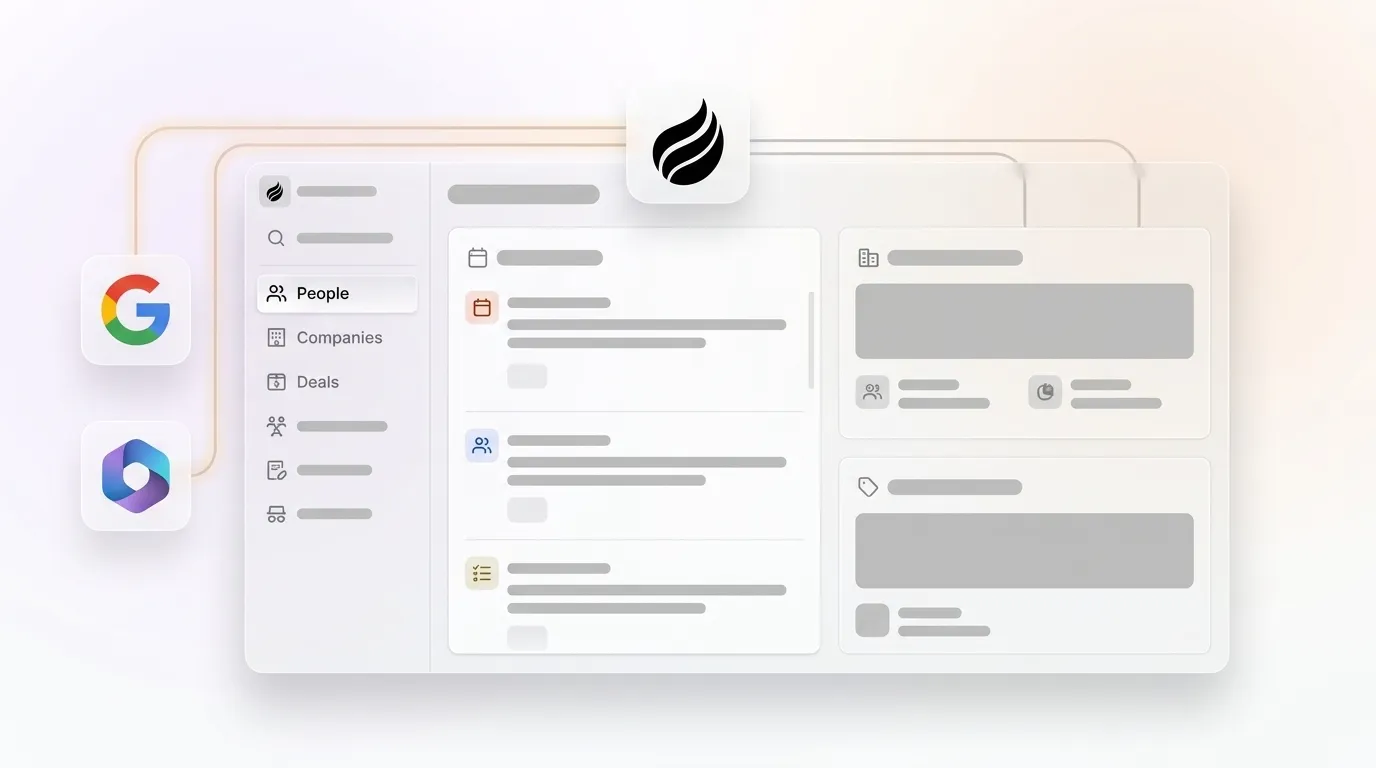
Coffee is described as the world’s best CRM Agent. It is available as a Standalone CRM or as a Companion App on top of Salesforce or HubSpot. Coffee’s Companion App deploys as an intelligent layer on top of Salesforce, keeping the system of record accurate without human effort.

Coffee’s agent handles data entry through capabilities including auto-creating contacts and companies, logging activities, enriching records, AI Meeting Bot, and Pipeline Compare:

- Auto-creates contacts and companies: Scans emails and calendars to populate Salesforce with people and organizations, ensuring every interaction is associated with the right record automatically.
- Logs activities automatically: Records “last activity” and “next activity” without a single manual click, keeping deal state current at all times.
- Enriches records: Augments data with job titles, funding information, and LinkedIn profiles via licensed data partners, removing the need for separate enrichment tools.
- AI Meeting Bot: Joins calls on Zoom, Teams, and Meet to record, transcribe, and generate summaries, action items, and follow-up emails structured around BANT, MEDDIC, or SPICED.
- Pipeline Compare: Tracks all pipeline changes automatically, highlighting progressed deals, stalled opportunities, and new additions, so teams no longer rely on manual CSV exports.
Coffee saves reps 8–12 hours per week by handling the repetitive work. When Salesforce updates itself, reps stop resenting it and start relying on it. Coffee is SOC 2 Type 2 and GDPR compliant, and your data is never used to train public models. A simple authentication connects Coffee to your existing Salesforce instance, so teams avoid complex implementation projects.

Ready to make Salesforce a tool your reps enjoy using every day? See how Coffee automates data entry.
Measuring Adoption: Metrics That Matter
An organization reporting 92% logins while managing forecasts in Excel has not truly adopted Salesforce and has only opened it. Behavioral adoption metrics, in addition to login counts, determine whether your migration investment is paying off. The table below summarizes the key metrics to track, along with healthy targets and warning signs that signal trouble.
| Metric | Definition | Healthy Target | Warning Sign |
|---|---|---|---|
| Weekly Active Users | % of licensed sales team logging in weekly | 75–85%+ | Below 60% |
| Opportunity Field Completeness | % of open opportunities with Stage, Close Date, Amount, and Next Steps filled | 85–90%+ | Below 70% |
| Activity Logging Rate | % of meetings and calls logged within 48 hours | 60–85%+ | Below 40% |
| Stale Deals | % of open opportunities with no activity in 14+ days | Under 10% | Above 20% |
| Forecast Accuracy | Variance between forecast and actual closed revenue | Within 10–15% | Above 25% |
Segment adoption data by role, team, and tenure because an organizational average hides wide variation. Pair every quantitative metric with a qualitative check. Confirm that logged activities are substantive and linked to opportunities instead of checkbox-clicking to satisfy a validation rule.
Building a Champion Network
Prosci’s research shows that active, visible executive sponsors can increase the likelihood of CRM project success by up to 72%, and peer champions amplify that effect at the team level. Recruit one to two respected peers per team of 15–20 people who are comfortable with technology and enthusiastic about Salesforce.
Champions provide peer-to-peer support, model best practices, gather feedback, and celebrate wins. Motivate them through recognition such as public acknowledgment in company meetings, a direct line to the RevOps team for prioritization, and visible credit when their feedback leads to fixes.
FAQ
Why is Salesforce adoption low after migration?
Low adoption after a migration is rarely a training problem. The root causes usually include a system configured for managers rather than daily users, with too many required fields and irrelevant page layouts, combined with reps seeing no personal benefit and heavy manual data entry. When the system demands more from users than it gives back, abandonment becomes the logical outcome. Field ownership conflicts between Salesforce and ERP after a migration add another layer of friction, as data conflicts destroy trust in the new platform before adoption can stabilize.
How long does it take to improve Salesforce adoption after migration?
Meaningful adoption typically takes 60–90 days with active management support. Full adoption usually takes 6–12 months. Teams that run structured onboarding and hold weekly pipeline reviews from Day 1 tend to reach adoption maturity 30–40% faster. The first 90 days form the critical window, because entrenched habits like spreadsheet workarounds become very difficult to displace. The single most powerful accelerator is making Salesforce the mandatory source of truth for all pipeline and forecast discussions from the first week post-go-live.
What are the best Salesforce adoption metrics to track after migration?
Track behavioral metrics in addition to logins. Across multiple sources, key Salesforce adoption metric targets include weekly active users at 75–90% or higher depending on source, opportunity field completeness at 80–90% or higher, activity logging rate at 60–85% or higher, stale deal rate under 10% of open pipeline, and forecast accuracy with variance within 10–15%. Segment every metric by role, team, and tenure. When the gap between your best-performing and worst-performing team exceeds two-fold, the problem is managerial and the intervention should target the management layer instead of configuration or training.
Can automation really improve Salesforce adoption?
Automation improves Salesforce adoption by removing the data entry problem discussed earlier. When you automate activity capture, record creation, and data enrichment, you remove the friction that drives reps to spreadsheets. The update becomes a byproduct of the work instead of a separate chore. Teams that automate data entry report saving 8–12 hours per rep per week, and that time goes back to selling. When Salesforce updates itself, reps start relying on it, which reflects genuine adoption.
Is Coffee secure for our Salesforce data?
Coffee is SOC 2 Type 2 and GDPR compliant. Your data is encrypted in transit and at rest and is never used to train public models. Coffee’s Companion App integrates with Salesforce via simple authentication, though heavily regulated industries may still require security reviews. It is designed for small to mid-market teams and operates as a Companion App on top of your existing Salesforce instance, so your system of record and its permissions remain fully intact.
Conclusion: Win the 90-Day Window
The first 90 days after a Salesforce migration determine whether your team embraces the platform or retreats permanently to spreadsheets. The week-by-week roadmap above gives you the structure to stabilize in the first 30 days, build momentum through the second month, and institutionalize best practices by day 90.
The core insight is simple: adoption fails when data entry feels like a chore. Training, gamification, and mandates cannot solve a structural problem on their own. You need to remove the burden. Coffee is the CRM Agent that eliminates manual data entry, delivering the hours saved mentioned earlier and turning Salesforce from a system reps resent into a tool they want to use.
Do not let your migration investment go to waste. Start your free trial of Coffee.