Written by: Doug Camplejohn, CEO & Co-Founder, Coffee
Key Takeaways
- Automated CRM data entry captures contacts, activities, emails, and call transcripts in the background, freeing reps from manual logging and reclaiming 8–12 hours per week.
- Manual data entry drives annual data decay, significant productivity loss, and hidden costs that can reach 12% of annual revenue.
- AI-native tools like Coffee automate contact creation, enrichment, activity logging, and post-call summaries while preserving human oversight for complex or regulated scenarios.
- Hybrid models combine automated capture with brief rep review, delivering complete, accurate records without the administrative burden of traditional CRMs.
- Teams ready to eliminate manual data entry can see Coffee’s pricing and start a trial today.
Pros and Cons: Automated vs Manual CRM Data Entry
The following comparison shows how automated CRM data entry outperforms manual logging across five critical dimensions: time cost, accuracy, scalability, cost, and human control.
| Factor | Manual Data Logging | Automated CRM Data Entry |
|---|---|---|
| Time cost | Several hours per week on post-meeting admin and email documentation | Saves 8–12 hours per rep per week on data entry |
| Accuracy | Data decay of 20–30% per year | Removes typos, forgotten fields, and incomplete records at the source |
| Scalability | Labor cost scales linearly with headcount, and many reps report operational drag | Manages high interaction volumes without added headcount |
| Cost | Significant wasted capacity per AE at $150K fully loaded cost | Automated CRM tools for small teams typically cost $0–$49/month total, with many free tiers and per-user rates under $50. |
| Human control | Full control, with a high compliance burden on the rep | Human-in-the-loop review preserved, and governance controls required for regulated contexts |
How to Automate CRM Data Entry
Teams of 5–50 people can follow a clear sequence to roll out AI CRM automation in 2026.

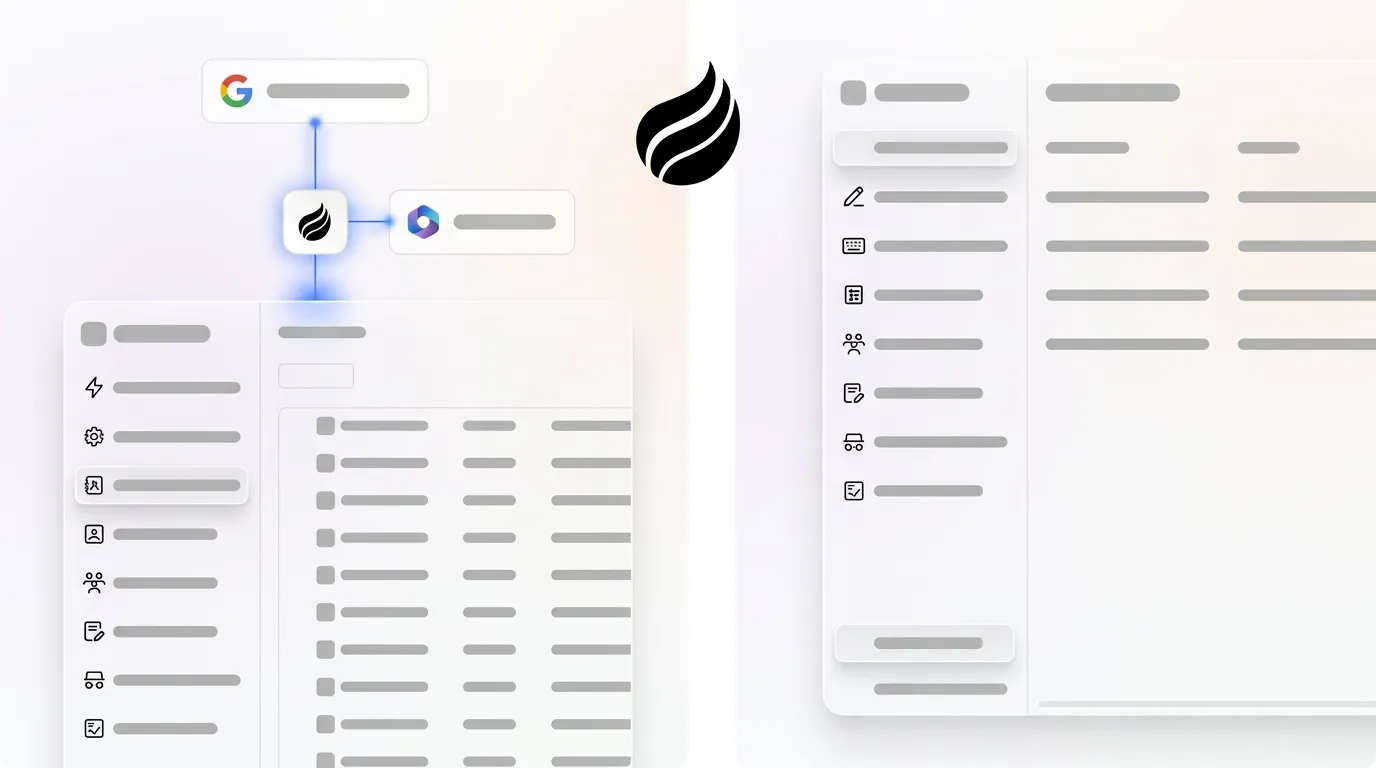
- Connect Google Workspace or Microsoft 365. Authenticate your email and calendar. The agent immediately scans for contacts, companies, and scheduled meetings.
- Enable auto-contact and company creation. The system populates records from inbound and outbound email threads with no manual input.
- Activate data enrichment. Job titles, LinkedIn profiles, and funding data are appended automatically via licensed data partners, replacing separate tools like Apollo or ZoomInfo.
- Configure activity logging. Last activity and next activity fields update autonomously after every touchpoint. Email and calendar automation can eliminate a substantial portion of manual data entry at this step alone.
- Deploy a meeting bot. The agent joins Zoom, Teams, or Meet calls to record and transcribe in real time.
- Review automated post-call summaries. Summaries, action items, and follow-up drafts appear immediately after each call. Conversational AI interfaces reduce per-update time from several minutes of data entry to a quick review, which improves both compliance and data quality.
Once automation is in place, the focus shifts from how to implement it to when manual input still makes sense.
When Manual CRM Logging Still Makes Sense
Automation handles the majority of structured and unstructured data capture reliably. Manual input remains appropriate in specific, bounded scenarios.
- Complex negotiations with sensitive terms. Deal-specific pricing, legal carve-outs, or confidential commitments may require deliberate human judgment before a record is written.
- Regulated industries with strict audit requirements. Healthcare and financial services contexts may require human attestation on certain record types.
- Strategic context and relationship nuance. Notes on stakeholder dynamics, political considerations, or off-the-record conversations belong in a rep’s own words.
These three scenarios represent the narrow boundary where human judgment adds value that automation cannot match. Outside these cases, manual logging introduces more risk than it removes. Manual CRM updates can take several minutes per call and produce the data decay rates mentioned earlier, while automated updates help maintain higher data accuracy.
CRM Data Entry Time Savings in 2026
Multiple industry sources show the same pattern: manual CRM entry consumes hours each week, and automation consistently returns that time to selling.
| Source | Manual Baseline | Automated Outcome |
|---|---|---|
| Salesforce 2026 State of Sales | Reps lose several hours per week to manual entry | AI agents can cut prospect research and email drafting time |
| monday.com CRM Data Management | Reps spend significant time on duplicate detection, enrichment, and record updates | AI automation can cut manual data work substantially, and reps can reclaim several hours per week |
| AskElephant | Several minutes per call logged manually | Several hours per rep per week can be saved when updates are automated from call content |
Sales professionals using AI save an average of 4.8 hours per week, yet 72% of sales organizations fail to reinvest that time in high-value activities. Across a 10-person team, that reclaimed time compounds into a meaningful pipeline capacity gain every week.
Hybrid CRM Data Entry Models That Reps Actually Use
A hybrid model pairs automated background capture with brief human review. AI drafts notes and captures basics in 2–3 minutes per meeting, and reps add strategic context in 1–2 minutes. The result is complete records without the clerk burden.

Kyle Dorman, Department Manager – Operations at Ray White, reported increased efficiency after removing and automating admin tasks.
Coffee operationalizes this hybrid model through two deployment paths.

- Coffee Standalone CRM for 1–20 person teams that have outgrown spreadsheets. The Coffee Agent becomes the system of record and handles data capture, enrichment, and pipeline tracking autonomously.
- Coffee Companion App for Salesforce & HubSpot for teams committed to a legacy CRM. The agent writes clean, enriched data back to Salesforce or HubSpot with no rep involvement. Both models deliver the time savings described earlier and are SOC 2 Type 2 and GDPR compliant.
Understanding why Coffee’s hybrid model works starts with the underlying CRM architecture.

Agent vs Passive CRM Architecture
Legacy CRMs such as Salesforce, HubSpot, and Pipedrive act as passive relational databases. They store structured data in fields, and when a field is overwritten, the historical context disappears. They cannot ingest unstructured data like email threads or call transcripts without expensive add-ons. They were architected before large language models existed, and that constraint is structural, not cosmetic.
That structural limitation created an opening. AI-native startups have captured significant market share by automating fragmented data workflows that incumbents could not iterate on quickly enough, directly addressing the inconsistent human data entry problem that passive CRMs were built around.
Coffee’s architecture takes an active approach. The Coffee Agent operates on a built-in data warehouse that preserves history. It ingests both structured fields and unstructured content such as emails, transcripts, and calendar events, then writes coherent, enriched records back to the system of record. The agent behaves actively, not passively. It does not wait for a human to log a call. It captures the call, transcribes it, structures it against BANT, MEDDIC, or SPICED, and updates the pipeline automatically.
Cost of Manual CRM Data Entry
The direct labor cost of manual logging is only the visible portion of the expense. The hidden costs compound quickly.
- Rep productivity loss: High-drag sellers spend a large portion of their time on non-selling tasks, and operational drag costs an average AE significant wasted capacity.
- Data decay: Contact data decays at 30% per year, and a CRM left without hygiene for two years loses roughly 51% of its accuracy, turning a 50,000-contact database into 25,000 reachable records while incurring full licensing costs. At the upper end of that decay rate, the compounding loss becomes hard to ignore.
- Cleanup debt: One documented example shows 101 hours of cleanup work across missing contacts, activity logs, and close dates, equaling $7,575 in labor at a $75/hour fully loaded rep rate. That cleanup work exists because the earlier decay and productivity loss were not addressed.
- Revenue impact: Dirty CRM data costs companies an estimated 12% of revenue annually through wasted sales effort, failed campaigns, and poor customer experiences.
- IBM data quality research identifies four primary cost categories that stack on top of each other: sales productivity loss, email deliverability damage, duplicate outreach costs, and compliance penalties.
These costs do not appear on a CRM license invoice. They appear in missed quota, inaccurate forecasts, and RevOps hours spent on cleanup instead of analysis. These compounding costs also explain why the market is moving decisively toward AI-native architectures in 2026.
What Reps Actually Say
Forum threads and sales community discussions in 2025–2026 surface the same complaints repeatedly. Reps describe manual CRM logging as “the most boring task in the job,” a “time sink that adds zero value to the customer,” and “doing it wrong in 2026 if you’re still typing this stuff in yourself.” The sentiment reflects a rational response to a system that demands clerk behavior from people hired to sell.
Pipeline Intelligence Without Spreadsheets
When the Coffee Agent handles data entry, pipeline intelligence becomes a byproduct of normal work rather than a separate reporting exercise. Coffee’s Pipeline Compare feature visualizes week-over-week changes automatically, including progressed deals, stalled opportunities, and new additions, by pulling from the agent’s built-in data warehouse. Pipeline reviews shift from interrogation sessions, where managers ask reps to explain missing fields, to strategic discussions grounded in complete, current data.
2026 Outlook for AI-Driven CRM
AI initiatives show strong adoption and conversion to production, and companies that implement AI sales tools effectively can achieve revenue increases and higher sales ROI. The direction of the market is clear. Passive CRMs that rely on human data entry will continue to produce bad data. Active agent architectures that remove the clerk role will produce the pipeline intelligence that revenue teams need to forecast, hire, and spend accurately.
See how Coffee’s agent architecture eliminates manual data entry for your team.
Decision Framework: Choosing the Right Coffee Model
Use the following framework to match your company profile, current stack, and primary pain with the Coffee deployment model that fits best.
| Company Profile | Current Stack | Primary Pain | Recommended Coffee Model |
|---|---|---|---|
| 1–20 employees, early sales team | Spreadsheets, Notion, or no CRM | No system of record, and manual entry not happening | Coffee Standalone CRM |
| 10–50 employees, committed to Salesforce or HubSpot | Salesforce or HubSpot + point solutions | Low adoption, dirty data, fragmented stack | Coffee Companion App |
| 5–50 employees, evaluating first real CRM | Outgrown spreadsheets and rejected legacy CRMs as too manual | Wants automation without setup complexity | Coffee Standalone CRM |
| RevOps leader at 20–50 person team | HubSpot with Gong, ZoomInfo, and manual logging | Stack cost, missing call data in CRM, forecast inaccuracy | Coffee Companion App |
Frequently Asked Questions
How long does it take to implement Coffee and see results?
Setup can take a few weeks. You authenticate Google Workspace or Microsoft 365, and the Coffee Agent begins capturing contacts, activities, and meeting data immediately. Teams often see improvements in CRM data completeness within the first few months. The Companion App for Salesforce and HubSpot follows the same timeline, because a simple authentication allows the agent to start syncing and enriching records without a lengthy implementation project.
How difficult is data migration when switching to Coffee?
For teams moving from spreadsheets or Notion, Coffee’s agent handles contact and company creation automatically from your connected email and calendar, so no manual import is required for active relationships. For teams using the Companion App, there is no migration at all, because Coffee writes enriched data into your existing Salesforce or HubSpot instance rather than replacing it. Historical records in your current CRM remain intact.
Does Coffee integrate with tools outside Salesforce and HubSpot?
Coffee currently supports integrations via Zapier, which connects it to hundreds of tools in a typical sales stack. Deeper native integrations are on the product roadmap. For teams with standard tooling such as email, calendar, and video conferencing, the core agent functionality operates without additional integration work.
How does Coffee handle data security and compliance?
Coffee is SOC 2 Type 2 and GDPR compliant. Data processed by the Coffee Agent is not used to train public AI models. For teams in lightly regulated industries evaluating whether an AI agent meets their security bar, Coffee’s compliance posture covers the requirements of the overwhelming majority of 5–50 person U.S. companies. Heavily regulated sectors such as healthcare and finance with multi-year security review requirements fall outside Coffee’s current target profile.
Will Coffee scale as the sales team grows?
Coffee uses straightforward seat-based pricing. You pay for human seats, and the agent’s labor is included without usage metering. As headcount grows, the agent’s capacity scales with it. The Standalone CRM is designed for teams up to approximately 20 people. Teams growing beyond that threshold or already committed to Salesforce or HubSpot move to the Companion App model, which is built for small to mid-market organizations.
Conclusion
The comparison between automated CRM data entry and manual data logging resolves clearly in 2026. Manual logging produces decaying, incomplete records that cost revenue teams quota attainment, forecast accuracy, and rep morale. Passive legacy CRMs cannot fix this because they were architected to store data, not capture it. Active AI agent architectures remove the clerk role entirely, ensuring good data enters the system so accurate pipeline intelligence comes out.
Coffee is the only CRM agent that operates as both a standalone system of record and a companion layer over Salesforce or HubSpot, meeting teams where they are regardless of their current stack. The agent handles data entry, enrichment, meeting management, and pipeline tracking autonomously, with human oversight preserved at every step.
Let Coffee’s agent handle your data entry, see pricing and start your trial.