Written by: Doug Camplejohn, CEO & Co-Founder, Coffee | Last updated: August 9, 2026
Key Takeaways
- Lusha’s credit model charges 1 credit per email and 10 credits per phone, so SDR costs climb quickly when teams pull both at scale.
- Single-source architecture caps coverage. Lusha typically reaches 70–80% verified email and 30–60% phone coverage versus 98% and 85% with multi-provider waterfall enrichment.
- Workflow friction is high. Users stitch together Lusha, a separate CRM, a sequencer, and a LinkedIn tool, which adds manual data entry and sync lag.
- Accuracy and compliance risks remain with the buyer. No refunds for invalid data, 2.1% monthly contact decay, and GDPR/CCPA liability sit with the purchasing company.
- Teams that want to remove credit spend and manual stitching can use Coffee’s agent-driven CRM, which consolidates enrichment, sequencing, and CRM logging at flat seat pricing.
Lusha Pros and Cons for 2026 Buyers
Pros:
- Fast, extension-based contact reveal directly on LinkedIn profiles with minimal setup.
- Direct-dial connect rates from verified contacts can exceed baseline connect rates.
- Simple credit model that small teams running low-volume prospecting can understand quickly.
- Built-in Lusha Engage provides basic email sequencing without a separate tool.
Cons:
- Phone reveals cost 10 credits versus 1 credit for email, so SDR teams pulling both data types at scale see costs rise rapidly.
- No refunds are issued for invalid data even when a number is found but out of service.
- Lusha Engage does not support LinkedIn automation, which forces teams to add a separate tool for multichannel outreach.
How Lusha Sources and Maintains Its Data
Lusha combines data from public sources, business records, and its contributor network, then verifies contact details before revealing them to users. This community co-op model, where users share contacts in exchange for credits, is one of several common sourcing approaches used by B2B data providers, alongside web crawling, AI inference, and publisher co-ops.
The single-source architecture creates a coverage ceiling. Single-source B2B data providers in the Cleanlist 500-Lead Enrichment Benchmark, 2026, achieved 70–80% verified email coverage and 30–60% phone coverage on the same 500 leads where a managed waterfall across 15+ providers returned verified emails for 98% of leads and direct-dial or mobile numbers for 85%. B2B contact data decays at roughly 2.1% per month, compounding to about 22.5% per year, so any static single-source database accumulates meaningful staleness between refresh cycles.
Lusha Pricing Plans and Credit Math in 2026
Lusha’s credit system charges 1 credit per email and 10 credits per phone number, which creates significant monthly spend for SDR teams that rely on phone numbers before they add sequencing, CRM, or other enrichment tools.
A complete outbound total cost of ownership calculation requires more than the Lusha subscription. A full outbound software TCO includes base subscription, data credit spend, warmup costs, and domain infrastructure costs, and domain registration alone runs $15 per domain per year. Teams that exhaust Lusha credits mid-cycle face overage exposure with no rollover mechanism.
Lusha Chrome Extension in Daily SDR Work
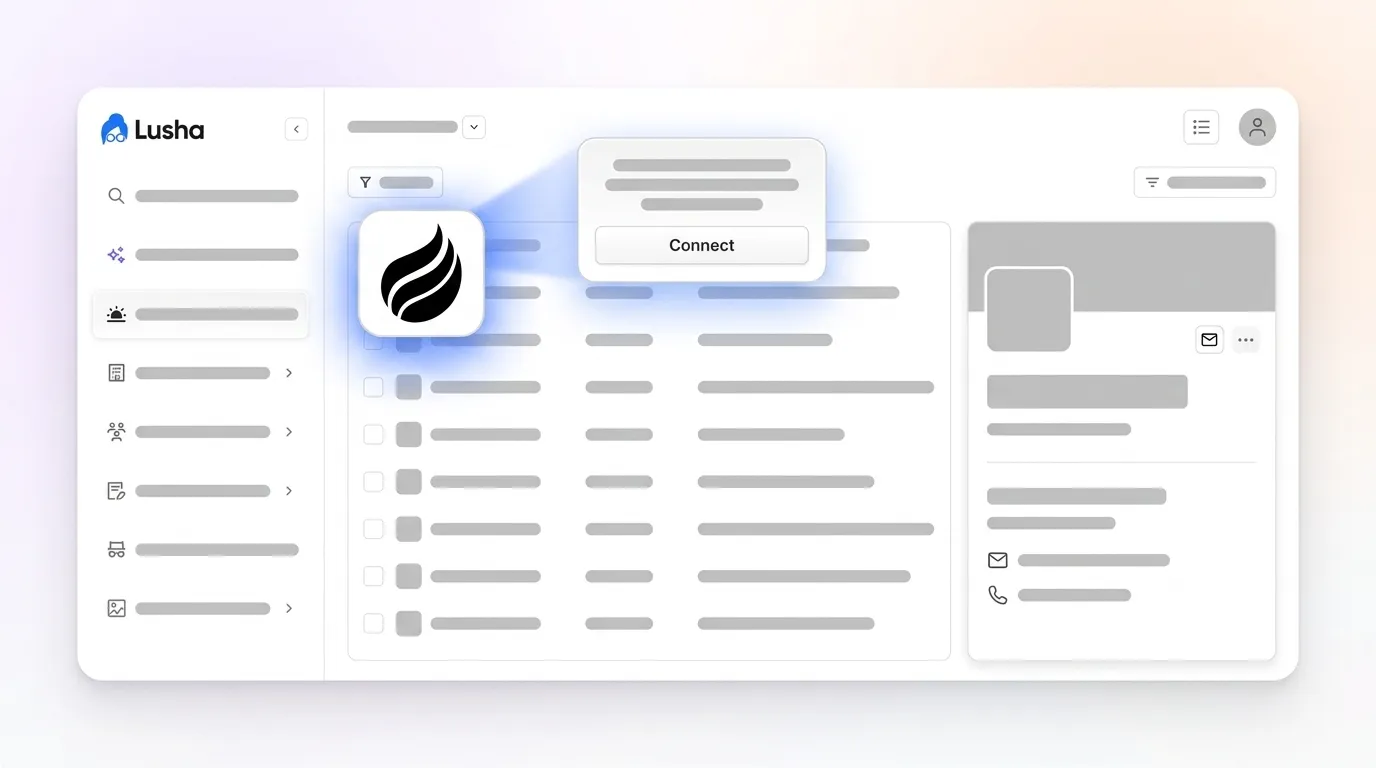
Credit consumption in practice becomes clear when you look at Lusha’s primary interface, the Chrome extension. Lusha provides direct dial and mobile phone number enrichment alongside business email finding through its Chrome extension for LinkedIn and web prospecting, with basic firmographic data append for company size and industry. The extension is Lusha’s main differentiator for individual SDRs who prospect directly on LinkedIn profiles and want point-in-time lookups without leaving the browser.
The extension covers only part of the workflow. It surfaces a contact record but does not log that activity to a CRM, enrich the full account, trigger a sequence, or capture unstructured context from the interaction. Each of those steps requires a separate tool, which creates the manual stitching problem that mid-market RevOps teams consistently cite as a core operational cost.
Lusha vs Apollo for Outbound Teams
Apollo is the closest functional competitor to Lusha for mid-market outbound teams. Apollo’s Basic plan costs $49/user/month (annual) with an 8-credit phone multiplier.
Apollo and Lusha both have G2 ratings for contact data accuracy, which gives buyers a public benchmark.
Apollo extends beyond contact lookup into sequencing. Apollo’s Professional plan combines contact data access with built-in email, LinkedIn, and phone sequencing, eliminating the need for a separate sequencer when replacing Lusha for teams building outbound motions. However, Apollo relies on a single contact database rather than multi-provider waterfall enrichment, which caps its coverage at the same ceiling as other single-source tools. Apollo’s data accuracy on direct dials varies by territory and segment, while Lusha positions verified direct dials as its core strength; Apollo uses per-seat pricing and Lusha uses a credit-based model.
Lusha Competitors and Alternative Categories in 2026
The competitive set for Lusha outbound sales data in 2026 spans four functional categories: single-source contact databases, multi-provider waterfall platforms, GDPR-specialist tools, and integrated agent CRMs.
Single-source databases:
- ZoomInfo provides a B2B sales intelligence platform with more than 200 million profiles, real-time updated contact information, intent signals, and sales automation tools, with enterprise pricing starting around $14,995/year.
- Apollo.io maintains a contact database of over 240 million profiles and offers AI-driven lead scoring, multi-channel engagement, and automated outreach sequences.
Waterfall enrichment platforms:
- Clay performs waterfall enrichment across 150+ data providers, with Launch plans starting at $185/month.
- FullEnrich performs waterfall enrichment by automatically checking 20+ data providers in sequence, achieving 80%+ match rates, starting at $29/month for 500 credits.
GDPR-specialist tools:
- Cognism provides prospecting with human phone-verified Diamond Data contacts.
- Kaspr offers real-time verification from over 150 sources and strong European data coverage, with pricing starting at $49–65/user/month depending on billing cycle.
Integrated agent CRMs: Coffee removes the need for a separate enrichment category by embedding lead discovery, enrichment, sequencing, and CRM logging inside one agent-driven system at flat seat pricing, with no credits and no stitching.

Side-by-Side Comparison Table
The table below compares Lusha, Apollo, ZoomInfo, and Coffee across six operational dimensions that shape total cost of ownership and workflow efficiency. Focus on Implementation Effort and Ongoing Administrative Burden, because these rows highlight hidden operational costs that credit-based pricing alone does not reveal.
| Criteria | Lusha | Apollo | ZoomInfo | Coffee |
|---|---|---|---|---|
| Data Quality (G2 Accuracy Score) | Rated on G2 | Rated on G2 | Rated on G2 | Built-in enrichment via licensed data partners; accuracy on par with Apollo for most mid-market use cases |
| Implementation Effort | Low for Chrome extension, additional tools required for full workflow | Moderate, native sequencing reduces tool count but credit management adds admin | High, enterprise onboarding, custom contracts, and field mapping required | Low, single authentication to Google Workspace or Microsoft 365 activates the agent across CRM, enrichment, and outreach |
| Workflow Fit | Provides buyer signals and intent data to support outbound workflows | Data and sequencing in one platform, no native CRM agent | Broad GTM platform, strongest for high-volume enterprise SDR orgs | End-to-end: Lead Finder, enrichment, Campaigns, CRM logging, and pipeline intelligence in one agent |
| Integration Requirements | Requires separate CRM, sequencer, and enrichment tool, no native bi-directional agent sync | Bi-directional sync with Salesforce, HubSpot, and Pipedrive | Deep Salesforce integration, additional connectors for HubSpot and Outreach | Standalone CRM or Companion App layer on top of existing Salesforce or HubSpot, agent writes enriched data back automatically |
| Automation Depth | Basic email sequencing via Lusha Engage, no LinkedIn automation | Multi-step email, phone, and LinkedIn sequences with A/B testing | Intent-triggered workflows, conversation intelligence via Chorus, and ABM tooling | AI-generated multi-step Campaigns, visitor identification, meeting briefings, automated summaries, and pipeline compare, all agent-driven |
| Ongoing Administrative Burden | High, credit tracking, tool stitching, and manual CRM logging required | Moderate, credit overage monitoring and sequence management across separate CRM | High, enterprise admin, field mapping maintenance, and contract renewals | Low, agent handles data entry, enrichment, logging, and sequencing autonomously at flat seat pricing |
Lusha Outbound Sales Data Review: Workflow Realities
The practical workflow for a Lusha-based outbound motion in 2026 involves at minimum Lusha for contact reveal, a CRM for record storage, a sequencer for email execution, and a separate tool for LinkedIn outreach. Lusha provides buyer signals and intent data to support outbound workflows, which adds context but not orchestration. Each handoff between tools introduces data loss, sync lag, and manual re-entry.
This stitching cost is not trivial. Sales reps already spend only 35% of their time selling due to administrative overhead, and that baseline assumes a single, integrated system. Adding credit management, CSV exports between tools, and manual CRM logging on top of that existing burden pushes actual selling time even lower. The workflow friction is structural, not a configuration problem that better onboarding resolves.
Accuracy and Compliance Considerations for Lusha Buyers
Cognism publishes GDPR compliance documentation and DPAs by default, which sets a clear benchmark. For teams prospecting into the EU or UK, this distinction carries legal weight. GDPR fines for non-compliant use of B2B sales data can reach €20 million or 4% of global annual turnover, while CCPA penalties are adjusted periodically for inflation and reached at least $2,663 per violation (or higher for intentional) as of 2025.
Under GDPR and CCPA, the purchasing company acts as Data Controller and holds primary liability for non-compliant data even when sourced from third-party vendors. Requesting a signed DPA and documented data provenance from any enrichment vendor functions as a baseline compliance control, not an optional step.
Total Cost of Ownership and Credit Modeling
A five-person SDR team running phone reveals on Lusha Starter generates meaningful monthly costs for phone-reveal credits alone. When you add a sequencer at $50–$100 per seat per month, a CRM at $25–$75 per seat per month, and domain infrastructure at $15 per domain per year, the all-in monthly cost for a five-person team becomes substantial before any overages.
Apollo charges overages at $0.20 per credit with a 250-credit minimum purchase when teams exceed allocated credits, and Apollo has tiered credit allocations per seat with policies on rollover of unused credits. The 2.1% monthly decay rate mentioned earlier means that credit expiration and overage charges create structural TCO risks that flat-seat pricing models avoid entirely.
Coffee’s seat-based pricing includes the agent’s labor across enrichment, sequencing, CRM logging, and pipeline intelligence without a separate credit meter. For mid-market teams running five or more seats, consolidating four tools into one agent typically produces a net cost reduction and a simpler workflow.

Operational Risks and Limitations of Standalone Enrichment
Three operational risks are specific to standalone enrichment tools like Lusha:
- Data decay exposure: The 2.1% monthly decay rate mentioned earlier means single-source databases without continuous re-verification accumulate staleness silently, and US job separation rates above 3% accelerate that degradation each quarter.
- Credit burn on bad data: Lusha issues no refunds for invalid data even when a number is found but out of service, so teams pay full credit cost for contacts that cannot be reached.
- CRM data gaps: Because Lusha operates outside the CRM, contact enrichment and activity data remain only as complete as the manual sync discipline of each rep. Poor data quality is estimated to cost the average organization $12.9 million per year.
Decision Framework: Matching Tools to Team Constraints
The right tool depends on team size, CRM commitment, and geographic focus:
- Early-stage teams (1–10 reps, no CRM): Coffee’s Standalone CRM delivers enrichment, sequencing, and pipeline management in one agent at flat seat pricing, so leaders avoid assembling a complex stack.
- Growing teams (10–50 reps) on Salesforce or HubSpot: Coffee’s Companion App deploys the agent as an enrichment and automation layer on top of the existing CRM, preserving the system of record while removing manual data entry and separate enrichment subscriptions.
- Teams with heavy EU/UK prospecting: Cognism’s Diamond Data provides human phone-verified contacts and the strongest GDPR compliance framework for European outbound.
- Enterprise teams (100+ reps) with Fortune 1000 targets: ZoomInfo maintains the strongest US direct-dial coverage at scale for Fortune 1000 enterprise contacts, which makes it a defensible choice for high-volume calling motions at that segment.
- Teams needing maximum enrichment coverage: Clay performs waterfall enrichment across 150+ data providers and is the strongest option when fill rate across diverse ICP segments is the primary constraint.
Frequently Asked Questions
How long does Lusha implementation typically take?
The Lusha Chrome extension can be installed and used within minutes for individual SDRs prospecting on LinkedIn. Full implementation, which includes CRM integration, team credit allocation, sequence setup in a separate tool, and admin configuration, typically takes one to two weeks for a mid-market team. The more significant time investment is ongoing, because credit management, tool synchronization, and data quality audits require recurring RevOps attention that a standalone enrichment tool does not remove. An integrated agent platform like Coffee reduces implementation to a single authentication step, after which the agent begins auto-creating contacts, logging activity, and enriching records without additional configuration.
What internal expertise is required to manage Lusha credits and data quality?
Managing Lusha at scale requires a RevOps owner who monitors credit consumption per rep, audits data quality against bounce rates, coordinates CSV exports between Lusha and the CRM, and manages renewal and overage exposure. Teams without a dedicated RevOps function often find that credit management falls to the Head of Sales, which consumes strategic time on administrative tasks. Data quality audits, such as checking current employment status on LinkedIn for a sample of exported contacts, should occur quarterly given the 2.1% monthly decay rate for B2B contact data. Coffee’s agent handles enrichment and data quality autonomously, which removes the need for manual audit cycles.
How does migration effort compare between Lusha and an integrated agent platform?
Migrating away from Lusha involves three workstreams: exporting historical contact data, re-mapping enrichment fields to the new system, and retraining reps on a new prospecting workflow. For teams that have built sequences in a separate tool and enrichment workflows in Lusha, migration also requires consolidating those tools. Coffee’s Companion App model reduces migration friction significantly for Salesforce and HubSpot teams because the agent layers on top of the existing CRM rather than replacing it. The system of record stays intact, and the agent begins handling enrichment, logging, and sequencing that previously required manual effort or separate subscriptions. For teams moving to Coffee’s Standalone CRM, the migration is a standard CRM import plus a Google Workspace or Microsoft 365 authentication.
Which platform offers stronger CRM integration depth for Salesforce or HubSpot teams?
ZoomInfo and Apollo both offer bi-directional sync with Salesforce and HubSpot that covers contacts, activities, and deal updates. Both operate as external data sources that push records into the CRM through a sync layer, which introduces API rate limits, field-mapping maintenance, and sync lag. Coffee’s Companion App is architecturally different. The agent authenticates directly to the Salesforce or HubSpot instance and writes enriched data, call summaries, meeting notes, and activity logs back to the CRM in real time without a separate sync configuration. For teams with complex Salesforce setups that include custom objects, required fields, quota management, and forecasting, Coffee’s deep understanding of those integration requirements becomes a meaningful differentiator over newer AI CRM tools that lack that integration depth.
Conclusion: When Lusha Fits and When Coffee Replaces It
Lusha remains a practical tool for individual SDRs running low-volume LinkedIn prospecting in 2026. For mid-market sales leaders and RevOps teams, the credit math, single-source coverage ceiling, and workflow stitching requirements make it an incomplete solution. Alternatives like Apollo reduce per-credit cost and add native sequencing, Cognism delivers stronger European compliance and phone accuracy, and Clay maximizes enrichment coverage through waterfall architecture. None of these tools, however, address the core issue that outbound data still lives outside the CRM and requires manual effort to connect prospecting activity to pipeline intelligence.
Coffee’s agent-driven CRM closes that gap. Lead Finder builds targeted prospect lists in natural language. Enrichment appends firmographic and contact data automatically. Campaigns run multi-step sequences from the rep’s own mailbox. Every interaction logs back to the CRM without human data entry. For Salesforce and HubSpot teams, the Companion App delivers all of this as an agent layer on top of the existing system of record, with no migration, no credits, and no stitching.
See how Coffee replaces your enrichment stack with one agent at flat seat pricing.