Written by: Doug Camplejohn, CEO & Co-Founder, Coffee | Last updated: August 29, 2026
Key Takeaways for Free Snitcher Alternatives
- Free tiers from RB2B, Leadfeeder Lite, and Warmly cap monthly resolutions at 150 companies, 100 companies, or 500 visitors. These limits restrict how far they can support a growing B2B site.
- Person-level identification on these free plans is mostly US-only. International visitors usually appear as company-level data at best.
- CRM exports and automation are restricted or unavailable on free tiers. Teams often fall back to manual Slack alerts and copy-paste workflows.
- Once monthly traffic passes roughly 8,000 visitors, free-tier caps are exhausted quickly. Manual research then consumes 30 or more minutes every week.
- Coffee’s pixel removes these limits and delivers person-level Suggested Leads that sync directly into your CRM. Install the Coffee pixel free today.
What “Free Snitcher Alternative” Means in 2026
A “free Snitcher alternative” is a B2B website visitor identification tool that reveals which companies or individuals browse your site without a paid subscription. In 2026, three tools offer genuinely usable free tiers: RB2B, Leadfeeder Lite (Dealfront rebranded to Leadfeeder on March 24, 2026), and Warmly. Each caps monthly resolutions, restricts person-level data to US traffic, or limits CRM exports. These are constraints that Snitcher’s paid plans remove. This article is not about Little Snitch, the macOS firewall application.
The practical differences between these free tiers become clear when you line them up against your actual traffic volume and geography. Each monthly cap hits at a different point depending on how many visitors you get and how much of that traffic comes from the US versus other regions.
Traffic-Volume Decision Table for Free Tiers
The table below maps each free tier against the metrics that matter most for a lean B2B SaaS team. If your traffic is primarily US-based and under 8,000 monthly visitors, focus on the Monthly Traffic Allowance column to see which tool lasts longest before hitting its cap. If you have meaningful international traffic, use the US-Only Restriction column to see where EU and non-US visitors drop from person-level to company-level data.
| Tool | Data Granularity | Monthly Traffic Allowance | US-Only Restriction |
|---|---|---|---|
| RB2B Free | Company-level only (150 resolutions), person-level is paid | ~36 person-level reveals at 2k visitors/mo, cap hit at ~8k visitors/mo | Yes, person-level is US-only, international traffic gets company-level at best |
| Leadfeeder Lite | Company-level only, no person-level on any free tier | Last 100 companies/month, 7-day data history, pay-per-action credits | No, company-level IP matching works globally and is GDPR-compliant by default |
| Warmly Free | Company level, no automation features | 500 visitors/month | Person-level match rate 10–20% for US traffic, EU falls back to company-level |
Best Free Visitor Tracking for Small Traffic: RB2B
RB2B’s free tier caps at 150 company-level resolutions per month with no credit card required. Person-level identification, including name, LinkedIn profile, and work email, is available only on paid plans. Setup follows a simple sequence that moves from tracking to alerts to manual research.
- Create an account at rb2b.com and copy the tracking pixel.
- Paste the script into the
<head>tag of every page you want to track. - Connect your Slack workspace. Slack and Microsoft Teams are the only integrations on the free plan, while CRM push and Zapier require Pro at $149/month or higher.
- Monitor the Slack channel for incoming company-level alerts that show which accounts visited.
- Research individual contacts at each identified company using LinkedIn or a prospecting tool before outreach.
The math on cap exhaustion is concrete. A site with 8,000 monthly unique visitors, a 3% ICP match rate, and 60% US traffic produces roughly 144 person-level reveals per month. That volume exceeds the 100-reveal cap even before you factor in the shift to company-only on the free tier.
Company-Level Focused Free Tool: Leadfeeder Lite
Leadfeeder Lite is a permanent free tier that identifies the last 100 companies per month via reverse-IP lookup, with 7-day data retention and unlimited users. It functions as a company-level tool. Individual visitors are not shown by default and appear only if they self-identify through a form submission or email integration. Setup moves from account creation to tracking, then to filtering and manual contact discovery.

- Sign up at leadfeeder.com with no card required for the Lite plan.
- Install the Leadfeeder tracker script in your site’s
<head>tag, or connect via Google Analytics 4 data import. - Set up company filters such as industry, size, and location to surface the highest-fit accounts first.
- Use the pay-per-action credit model to enrich, export, or sync a subset of those accounts.
- Identify and verify individual contacts at each company manually using LinkedIn or a prospecting database.
Leadfeeder misses remote workers, home-network users, and VPN traffic because its methodology relies on IP-to-company matching. This limitation affects any reverse-IP tool regardless of plan tier.
Best Free Visitor Tracking for Mid-Volume Traffic: Warmly
Warmly’s free tier reveals up to 500 visitors per month at company level, but automation features are excluded. Paid plans start at approximately $700–$900 per month for core visitor identification features, while real-time sales orchestration is available only in higher-tier plans starting around $1,250–$1,500 per month. Setup follows a path from pixel installation to ICP filters, then to manual review and export.
- Create a Warmly account and generate your tracking pixel from the dashboard.
- Add the pixel to your site’s
<head>tag and verify installation in the Warmly UI. - Configure your ICP filters such as industry, company size, and job title to prioritize the 500 monthly reveals on the highest-fit visitors.
- Review the visitor feed manually, because automated Slack or CRM routing requires a paid plan.
- Export or copy contact details manually for outreach once the 500-visitor cap is reached.
Warmly achieves 30–65% company-level and 5–20% person-level match rates on US traffic. The 500-visitor cap is a ceiling on raw reveals, not on ICP-matched leads, so the number of actionable contacts is only a fraction of that figure.
Side-by-Side Feature Comparison for Free Plans
This second table compares how each free plan handles output type, monthly allowance, and CRM export. Use it when you already know your traffic volume and now want to see which tool fits your workflow and CRM process.
| Tool | Company vs. Person Output | Monthly Free Allowance | CRM Export on Free Tier |
|---|---|---|---|
| RB2B Free | Company-level only, person-level requires paid plan at $79+/mo | 150 company-level resolutions | No, Slack only, CRM push requires Pro ($149/mo+) |
| Leadfeeder Lite | Company-level only, person-level not available on any Leadfeeder tier without self-identification | 100 companies/month, pay-per-action credit model, 7-day history | Limited, credits are consumed by enrichment, exports, and CRM syncs |
| Warmly Free | Company level, no automation on free tier | 500 visitors/month | No automated CRM routing, manual copy-paste only on free tier |
| Coffee Free Pixel | Person-level identification and Suggested Leads | The free tier of FreePixel has a published monthly cap of 250 downloads. | One-click add to Coffee CRM, Companion App syncs to existing Salesforce or HubSpot |
When to Outgrow Free Visitor Identification Tiers
Three signals show that a free tier has stopped working for your pipeline.
- Your site crosses the monthly resolution cap. For RB2B, that happens around the 8,000-visitor threshold discussed earlier.
- You spend more than 30 minutes per week manually researching individual contacts at company-level-only identified accounts.
- Your team has international traffic that person-level tools cannot resolve. RB2B sidesteps GDPR through geographic ringfencing rather than compliance mechanisms, which makes its person-level product effectively unavailable for EU traffic.
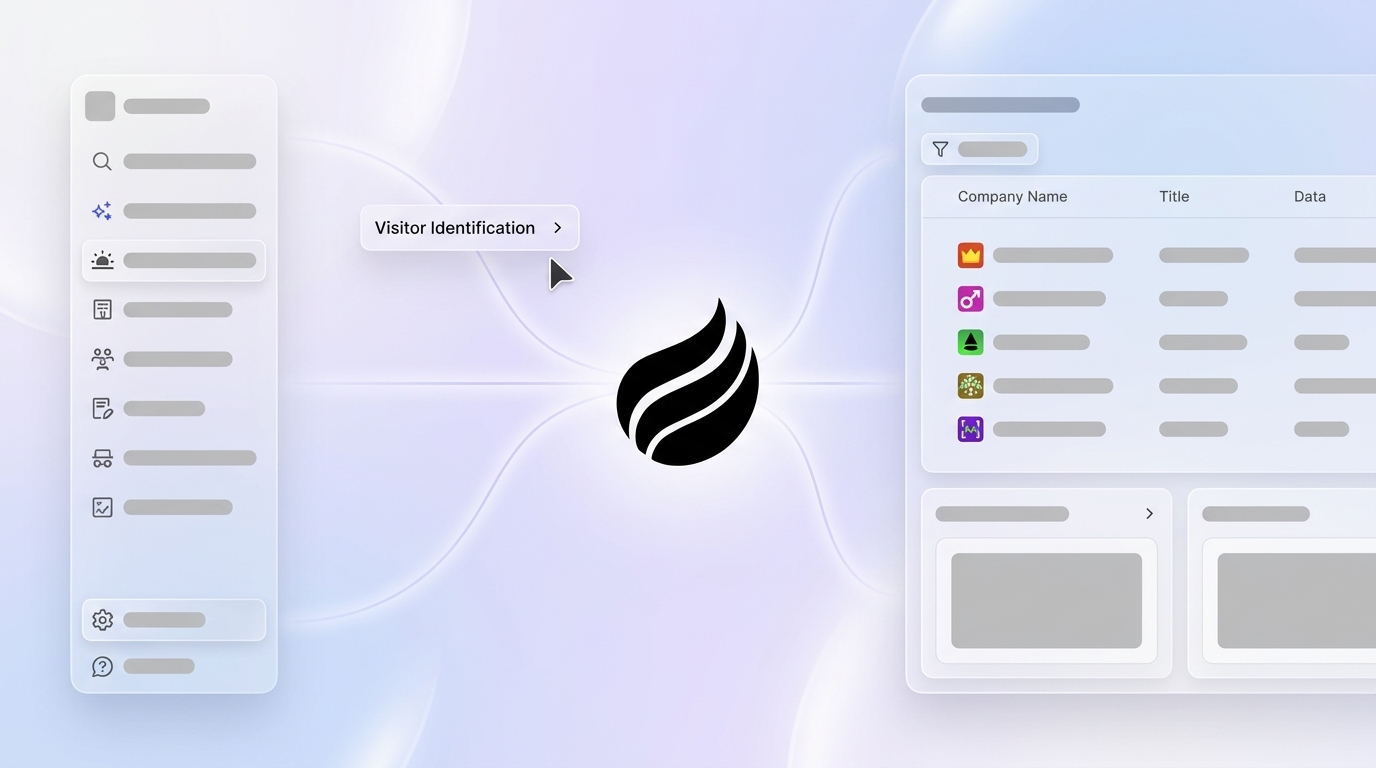
At any of those trigger points, Coffee’s pixel is the logical next test. Drop a single script into your site’s <head> tag and Coffee immediately begins resolving anonymous visitors to named individuals, including name, title, email, LinkedIn profile, pages visited, and session duration. Raw visitor data still requires manual triage to decide who deserves outreach. Suggested Leads solves that problem by using your buyer persona to recommend the two or three specific humans inside each visiting company you should contact, with their LinkedIn profiles pre-loaded for instant outreach. Roughly 97% of B2B website visitors leave without filling out a form, and Suggested Leads converts that anonymous majority into a prioritized outreach queue without manual research.

Coffee is also the only free-to-test option here that grows with you inside the same system. The pixel feeds directly into Coffee’s Standalone CRM for teams under 20, or into the Companion App that writes enriched data back to your existing Salesforce or HubSpot instance. You avoid CSV exports and tool-switching as your volume increases.
Start identifying your anonymous visitors and see your first named visitors in minutes.
Frequently Asked Questions About Coffee’s Pixel and Free Tiers
How long does pixel implementation take?
For most sites, pixel implementation takes under five minutes. You copy a single script tag from Coffee’s dashboard and paste it into the <head> section of your site or tag manager. Coffee verifies installation automatically and begins identifying visitors immediately. No developer involvement is required for standard CMS platforms like WordPress, Webflow, or Framer. If your site uses a custom build, the implementation still involves a single script insertion, the same process used by Google Analytics or any other tracking pixel.
Is visitor data GDPR-compliant on free tiers?
Compliance varies by tool and data type. Company-level identification tools like Leadfeeder are generally GDPR-safe because revealing that a business visited a site is not considered personal data under most interpretations of the regulation. Person-level identification tools face stricter requirements because they resolve data to a named individual. RB2B handles this by geofencing, so it does not attempt person-level identification for EU traffic, which means EU visitors produce no actionable lead data on any RB2B plan. Coffee is SOC 2 Type 2 and GDPR compliant, and visitor data is not used to train public AI models. For any tool, teams with significant EU traffic should review the vendor’s data processing agreement before deployment.
Can identified leads flow into existing Salesforce or HubSpot without CSV exports?
On the free tiers of RB2B, Leadfeeder Lite, and Warmly, direct CRM sync is either absent or severely credit-limited. RB2B’s free plan is restricted to Slack notifications only, and CRM push requires the Pro plan at $149 per month or higher. Leadfeeder Lite uses a pay-per-action credit model rather than providing a fixed monthly allocation of credits. Warmly’s free tier has no automated routing at all. Coffee’s pixel is built into the same agent that powers the Standalone CRM and the Companion App, so identified leads flow directly into Coffee or sync back to Salesforce and HubSpot without any manual export step.
What happens when a free tier’s monthly cap is reached?
Each tool handles cap exhaustion differently. Leadfeeder Lite stops showing new company identifications once the 100-company monthly limit is reached, and visitors identified after that point are not stored or surfaced until the next billing cycle. RB2B stops processing new resolutions once the 150-company-level cap is hit. There is no overage option on the free plan, and data from capped visitors is not retroactively recovered. Warmly limits identifications to 500 visitors per month on the free tier. In all three cases, traffic that arrives after the cap is reached generates zero actionable lead data for that month. This behavior creates the core operational risk of free tiers for any site growing past a few thousand monthly visitors.
Conclusion: Moving Beyond Free Visitor Identification Caps
Free tiers of RB2B, Leadfeeder Lite, and Warmly each deliver real value up to a hard ceiling of 150 company-level resolutions, 100 identified companies with limited export credits, or 500 visitors per month. Person-level identification on free tiers is mostly US-only, with GDPR risk causing most vendors to geofence EU traffic and fall back to company-level reveal. Manual research then fills the gap between a company name and a named contact, and that gap compounds every week your traffic grows.
Coffee’s pixel removes those ceilings, delivers person-level Suggested Leads matched to your buyer persona, and routes identified prospects directly into the same agent that later runs your campaigns, manages your pipeline, and writes data back to Salesforce or HubSpot. There is no separate tool to buy and no CSV to export.
Turn your anonymous traffic into a named, prioritized outreach queue and keep that workflow inside one system as you scale.