Written by: Doug Camplejohn, CEO & Co-Founder, Coffee
Key Takeaways
- Attio supports flexible customization for complex workflows but requires weeks of setup and ongoing manual data entry that consumes 71% of sales reps’ time.
- Coffee’s AI agent automates data capture from Gmail, calendars, and meetings, saving 8-12 hours per week on CRM maintenance.
- Attio pricing starts free for 3 users but scales to $3,480-8,280/year for 10 reps, plus $1,100-5,200/month for integrations.
- Coffee fits 1-20 person startups that prioritize automation over customization, with hours-to-days setup and consistently high adoption rates.
- Switch to Coffee’s agent-driven CRM today to eliminate manual workflows and increase selling time.
How Attio Works for Startup Sales Teams
Attio positions itself as a Notion-like CRM with flexible custom objects, relational data modeling, and modern UI design. Recent 2026 updates include AI attributes for automatic data enrichment and real-time Gmail/Outlook sync, which appeal to seed-stage teams that outgrew spreadsheets and now need agile customization.
Attio still operates as a fundamentally passive system that relies on humans for data quality. Coffee’s autonomous agent captures activities and enriches contacts automatically, while Attio’s flexibility introduces setup complexity and ongoing maintenance work that can overwhelm lean teams focused on growth.

To see how this plays out in daily operations, it helps to look at Attio’s strengths and weaknesses side by side.
Attio Pros and Cons for Startup Workflows
| Aspect | Pros | Cons |
|---|---|---|
| Customization | High flexibility with custom objects and views | Setup requires weeks, not quarters |
| Data Management | Modern UI with Gmail integration | Manual entry consumes 71% of rep time |
| User Adoption | Free tier supports 3 users | Many teams cite admin tasks as productivity blockers |
Real user feedback captures this tradeoff clearly. Founders often say, “Great flexibility, but data entry kills velocity,” which reflects the common startup experience with customizable CRMs that demand constant human maintenance.
Attio Pricing and Fit for Different Startup Stages
Attio’s 2026 pricing structure includes a Free plan at $0/month for 3 seats, Plus at $29/user/month annually, Pro at $69/user/month annually, and custom Enterprise pricing. For a 10-person sales team, this translates to $3,480/year on Plus or $8,280/year on Pro.
Attio can work for startups that accept setup complexity as the tradeoff for deep customization. Expert-led Attio implementation takes 1-2 weeks for seed-stage companies (1-3 reps, simple flow) and 2-4 weeks for early-growth companies (3-10 reps, initial custom objects). This initial investment is only the beginning, because sales reps spend only 28% of time actively selling once manual administrative work, including CRM updates, takes over their schedules.
The hidden cost appears in ongoing maintenance, specifically the need for additional tools to fill Attio’s functionality gaps. A 10-person SDR team requires additional tools costing $1,100-5,200/month for complete functionality, which typically covers enrichment, sequences, and dialing capabilities. These add-ons push total stack costs to $21,480-70,680/year when you include the base CRM subscription.
With these cost and time tradeoffs in mind, it becomes easier to compare Attio with Coffee and other CRM options across the factors that matter most to startup teams.
Side-by-Side CRM Comparison for Startup Teams
| Criteria | Attio | Coffee (Wins) | Pipedrive/HubSpot |
|---|---|---|---|
| Data Automation | Manual sync required | Agent auto-entry saves 8-12 hours/week | Basic, human-reliant |
| Setup Effort | 1-2 weeks for seed teams and 2-4 weeks for early-growth implementations | Hours to days setup | 1+ weeks configuration |
| Cost/Seat (10 reps) | Attio Pro tier costs $86 per user per month when billed monthly ($69 per user per month equivalent when billed annually) | Simple seat-based pricing | $15-100/user/month |
| Selling Time | Low selling time, with only 28% of rep hours spent on active selling as noted earlier | High adoption with automated workflows | Moderate, with spreadsheet fallbacks common |
| Unstructured Data | Limited AI attributes | Full Gmail and Meet bot integration | Poor email and call processing |
Coffee’s autonomous agent architecture fundamentally differs from Attio’s manual approach. The agent automatically captures meeting notes, enriches contacts, and logs activities without human intervention.
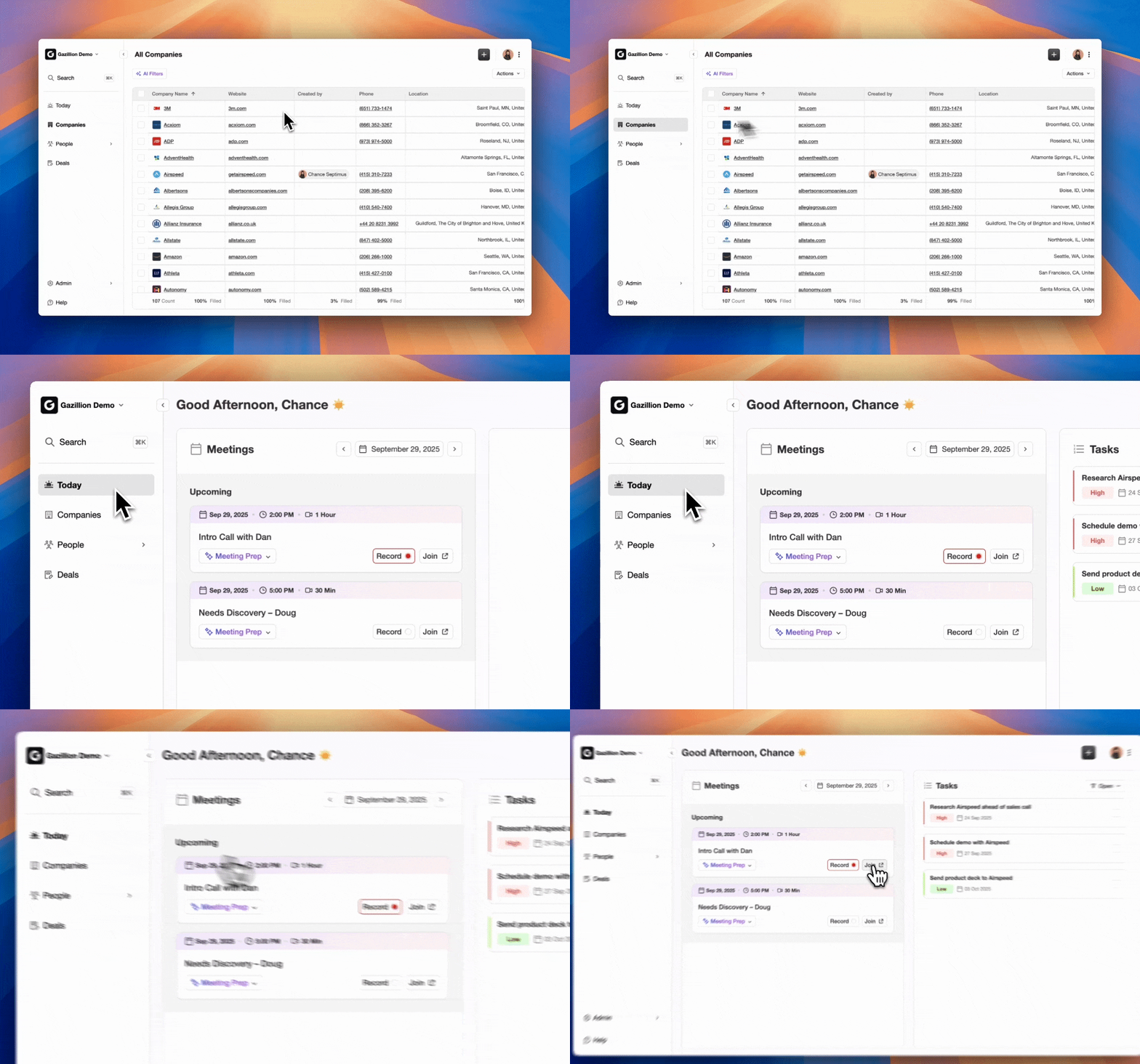
This architectural difference creates clear advantages for teams that value automation more than deep customization. The next section explains how those advantages show up in real startup environments.
Why Coffee Wins for Automation-First Startup Teams
Coffee operates as a standalone AI-first CRM built for 1-20 person teams that prioritize automation over customization. The platform’s agent handles data entry, meeting intelligence, and pipeline tracking autonomously, which directly addresses the core problem that turns traditional CRMs into productivity drains.

A real-world case study shows how this works in practice. A company generating tens of millions in revenue replaced spreadsheets with Coffee, which automatically created contacts from Google Workspace and kept records current without manual updates. The team used the Pipeline Compare feature for weekly reviews, then relied on API access to generate custom briefings for leadership. Together, these capabilities extended the team’s reach without adding headcount or manual CRM maintenance.

Attio requires ongoing human input to maintain data quality, while Coffee follows a “good data in, good data out” philosophy. Automated capture from emails, calendars, and call transcripts keeps records accurate without extra effort from reps. See Coffee’s pricing to understand how this automation can replace manual data entry for your team.

Choosing Between Attio and Coffee for Your Use Case
Choose Attio if: Your startup needs heavy customization for complex workflows such as VC relationship management, fundraising tracking, or multi-entity sales processes where flexibility matters more than efficiency.
Choose Coffee if: You prioritize automation over customization, want to eliminate manual data entry, and need a CRM that works immediately without weeks of configuration. Given the administrative overhead discussed earlier, with reps spending just 28% of time selling, automation-first approaches deliver measurable ROI for lean teams.
Addressing Common Concerns About Coffee
Integration Worries: Coffee provides SOC 2 Type 2 compliance, Zapier connectivity, and straightforward API access. Unlike Attio’s complex webhook setup, Coffee’s integrations work out of the box and connect cleanly to existing tools.
Beyond integration simplicity, security usually comes next on the evaluation checklist. Data Security: Both platforms offer enterprise-grade security, but Coffee’s agent architecture removes the shadow CRM problem that appears when manual systems fail to gain adoption and reps move back to spreadsheets.
Finally, teams want clarity on total cost of ownership. Pricing Transparency: Coffee’s simple seat-based model contrasts with Attio’s tiered complexity and hidden integration costs that can surprise growing teams.
Final Verdict and Next Steps for Startup CRMs
Attio serves startups that need extensive customization and accept longer setup timelines. For teams that prioritize growth velocity over workflow complexity, Coffee’s AI agent delivers stronger automation and higher adoption rates.
The 2026 CRM landscape favors agentic AI over manual workflows. Coffee leads this transition by removing the data entry grind that drains startup resources. Join the automation revolution with Coffee’s AI-first CRM.
Frequently Asked Questions
Is Attio a good CRM for startups?
Attio works well for startups that require extensive customization and complex relationship modeling. Its manual data entry requirements, however, can overwhelm lean teams that lack operations support. Coffee offers stronger automation for startups that prioritize growth velocity over workflow customization and removes much of the administrative overhead that typically reduces selling time to just 28% of a rep’s day.
What are the best Attio CRM alternatives in 2026?
Top Attio alternatives include Coffee for AI automation, Pipedrive for simple pipeline management, and HubSpot for comprehensive marketing integration. Coffee stands out by providing autonomous data capture and enrichment, while traditional alternatives still rely on manual maintenance. Your choice depends on whether you value customization flexibility more than operational automation.
Which CRM is best for small startups with limited resources?
Coffee leads for resource-constrained startups because its autonomous agent handles data entry, meeting intelligence, and pipeline tracking without human intervention. This approach removes the 8-12 hours per week that teams typically spend on CRM maintenance and frees founders to focus on selling and growth instead of administrative tasks.
How much does Attio CRM cost in 2026?
Attio’s 2026 pricing includes a free plan for 3 users, Plus at $29/user/month annually, Pro at $69/user/month annually, and custom Enterprise pricing. For a 10-person team, expect the Plus or Pro tier costs mentioned earlier, along with additional expenses for enrichment tools, email sequences, and integrations that can push total annual spend to $21,480-70,680.
How does Attio compare to Coffee for startup teams?
Attio offers strong customization with flexible objects and workflows but requires weeks of setup and ongoing manual maintenance. Coffee provides autonomous automation that captures data, enriches contacts, and manages pipelines without human intervention. For startups that prioritize growth over customization, Coffee’s agent-driven approach delivers better ROI through reduced administrative overhead and faster implementation.