Written by: Doug Camplejohn, CEO & Co-Founder, Coffee
Key Takeaways
- BANT fits SMB deals under $50k ACV with short cycles under 60 days, using 4 core questions and 6–12 hours of training.
- MEDDICC fits enterprise deals over $100k ACV with complex multi-stakeholder processes, using 6–7 elements for stronger forecast accuracy and close rates.
- BANT delivers speed but can create shallow qualification, while MEDDICC delivers depth but demands more training and can overwhelm simple sales.
- Manual data capture weakens both frameworks, and Coffee’s AI Agent automates note-taking from calls and emails for consistent CRM data.
- Supercharge BANT or MEDDICC qualification with Coffee’s AI Agent, saving reps 8–12 hours weekly and strengthening pipeline intelligence.
How This Comparison Works
This comparison evaluates BANT for SMB speed and MEDDICC for enterprise qualification depth. The evaluation focuses on how each framework performs in real sales environments.
Key evaluation criteria include:
- Ease of adoption and rep training requirements
- Deal size fit, including ACV ranges and sales cycle length
- Data consistency and capture requirements
- Disqualification power and accuracy
- Scalability across different team sizes
- Implementation effort and management overhead
- AI automation potential heading into 2026
MEDDICC vs BANT: Key Differences at a Glance
The table below summarizes how BANT and MEDDICC differ across these core dimensions, highlighting the tradeoff between simplicity and depth.
| Criteria | BANT | MEDDICC |
|---|---|---|
| Acronym Breakdown | Budget, Authority, Need, Timeline | Metrics, Economic Buyer, Decision Criteria, Decision Process, Identify Pain, Champion, Competition |
| Questions Required | 4 core questions | 6–7 detailed elements |
| Best For | SMB deals <$50k ACV, <60 days | Enterprise deals $100k+ ACV, 90+ days |
| Training Time | Initial BANT training requires 6–12 hours | MEDDPICC Masterclass training takes 5–8 hours of online video lessons and coaching |
| Forecast Accuracy | Lower accuracy for complex deals | Higher forecast accuracy due to structured approach |
| Win Rate Impact | Faster qualification | Higher close rates |
| Coffee AI Automation | Auto-structures BANT checklist from call transcripts | Auto-captures MEDDICC scorecard elements from emails and calls |
See Coffee demo qualification in action. Watch a demo of automated qualification

Now that the high-level differences are clear, the next sections walk through how BANT and MEDDICC compare in each category.
How BANT and MEDDICC Perform by Category
Rep Training and Ease of Adoption
BANT wins on simplicity, with 6–12 hours of initial training focused on a straightforward 4-question framework. Reps need minimal coaching, which makes BANT ideal for high-velocity SDR teams that handle many short calls. MEDDICC requires deeper training on stakeholder mapping and decision process analysis, and new reps often face a steep learning curve.
Fit by Deal Size, ACV, and Sales Cycle
BANT fits deals under $50k ACV with sales cycles under 60 days and 1–2 stakeholders. MEDDICC fits complex B2B sales above roughly $75k–$100k ACV with 6+ month cycles and 5+ stakeholders. These thresholds reflect buying complexity more than pure dollar amounts, because BANT handles straightforward procurement while MEDDICC supports multi-stakeholder decisions.
Data Capture and Consistency Challenges
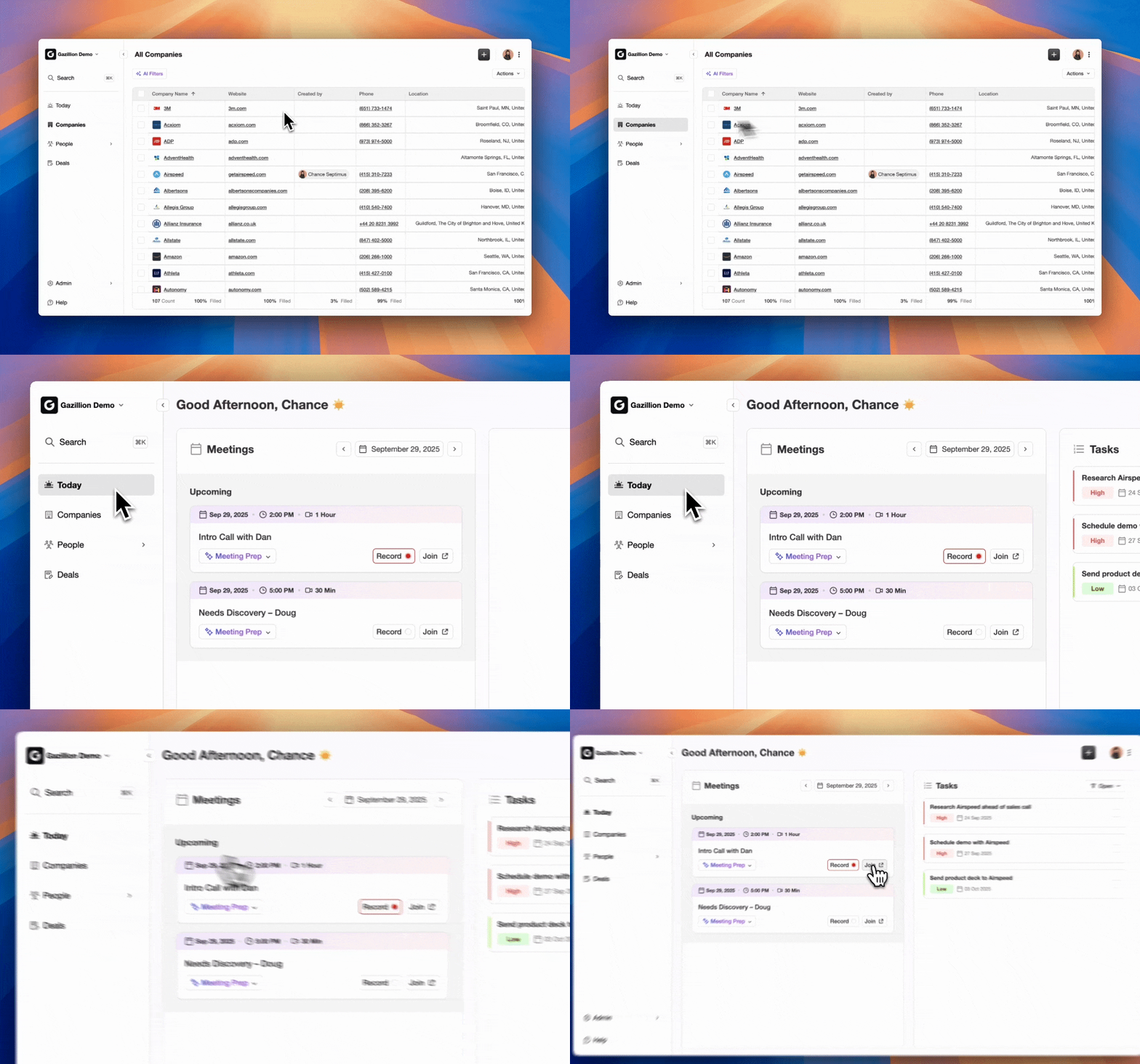
Manual qualification creates gaps in both frameworks because reps struggle to capture every required data point during live conversations. This inconsistency appears in practitioner feedback, as sales reps on r/sales report BANT feeling rigid while MEDDICC overwhelms SMB teams. The result is that much CRM data ends up outdated, incomplete, or inaccurate, which makes manual MEDDICC updates unreliable for forecasting.
Disqualification Pitfalls in Real Deals
BANT’s budget-first approach can disqualify promising leads that lack allocated budgets but still have strong pain and urgency. MEDDICC can become overkill for simple deals, and reps may spend too much time mapping stakeholders for low-complexity purchases under $75k ACV.
Best-Fit Use Cases and a Hybrid Playbook
The table below maps common deal profiles to the framework that fits best, including a hybrid approach for teams selling into both SMB and enterprise.
| Deal Type | Framework | Why |
|---|---|---|
| SMB/Short-cycle (<$50k, <60 days) | BANT | Speed filter for high-volume qualification |
| Enterprise/Long-cycle ($100k+, 90+ days) | MEDDICC | Maps complex stakeholder decisions |
| Mixed Portfolio ($25k–$100k) | Hybrid BANT-to-MEDDICC | BANT first call, MEDDICC pipeline progression |
Quick qualification quiz: ACV under $50k with 1–3 stakeholders and founder-level decisions means BANT fits. Multi-department buying committees with procurement involvement call for MEDDICC. Whichever framework fits your deal profile, Coffee’s AI Agent adapts to it and auto-captures qualification data for both SMB speed and enterprise depth.
Automate your framework with Coffee’s Standalone CRM or Companion App. Choose your Coffee deployment
Operational Considerations and the 2026 AI Upgrade
Traditional qualification struggles with manual CRM hygiene and inconsistent forecasting. Coffee’s AI Agent transforms both frameworks by auto-capturing qualification elements from emails and call transcripts. For BANT, it identifies budget mentions and timeline commitments, while for MEDDICC, it handles the more complex work of mapping economic buyers and logging decision criteria discussions. By eliminating this manual data entry across both frameworks, the automation returns nearly a full workday to each rep while ensuring consistent data quality. Teams that adopt MEDDICC with strong data capture often report higher close rates and more accurate forecasting.

Risks, Limitations, and the Verdict Matrix
BANT risks shallow qualification for complex deals, while MEDDICC creates overkill for simple SMB sales, so each framework fails when applied to the wrong deal type. Even when matched correctly to deal complexity, both frameworks still depend on consistent data capture, which remains the fundamental challenge that automation solves.
Use this verdict matrix to match your team profile with the right framework and the most effective Coffee deployment model.
| Team Profile | Recommendation |
|---|---|
| 1–20 reps, <$50k ACV | BANT + Coffee Standalone CRM |
| 20–100 reps, $50k–$500k ACV | Hybrid BANT-to-MEDDICC + Coffee Companion |
| Enterprise, $100k+ ACV | MEDDICC + Coffee Salesforce or HubSpot integration |
Coffee’s AI Agent strengthens either framework by ensuring qualification data gets captured and structured the same way every time.
Try Coffee free to supercharge MEDDICC or BANT today. Start your free trial
Frequently Asked Questions
BANT vs MEDDICC: Which qualification framework should I use?
Choose BANT for SMB deals under $50k ACV with simple buying processes and short sales cycles under 60 days. Select MEDDICC for enterprise deals exceeding $100k ACV that involve multiple stakeholders and complex 6+ month procurement cycles. The key differentiator is deal complexity, not just size, because a $75k deal with one decision-maker fits BANT, while a $40k deal that needs IT, Finance, and Legal approval benefits from MEDDICC depth.
Can Coffee automate MEDDICC qualification?
Yes, Coffee’s AI Agent automatically captures MEDDICC elements from call transcripts and email conversations. It identifies when prospects mention metrics, flags economic buyer discussions, logs decision criteria requirements, maps decision processes, captures pain point descriptions, and tracks champion interactions. The Agent structures this unstructured data into consistent MEDDICC scorecards inside your CRM, which removes manual note-taking and keeps qualification complete.
How does MEDDICC vs BANT work for Salesforce and HubSpot users?
Coffee’s Companion App supports both frameworks on existing Salesforce or HubSpot instances. It automatically populates BANT fields from conversation analysis or builds comprehensive MEDDICC records without disrupting your current system of record. The Agent handles the “data in” process so your CRM contains accurate qualification information without asking reps to update fields after every interaction.
What is the implementation timeline difference?
As noted in the comparison above, both frameworks require similar initial time investments, with BANT training at 6–12 hours and MEDDICC training at 5–8 hours. BANT focuses that time on a simple 4-question framework, while MEDDICC training covers complex stakeholder mapping, decision process analysis, and champion development techniques. While these training investments are comparable, the ongoing implementation burden differs, because MEDDICC needs continuous coaching to maintain data quality. Coffee’s AI Agent reduces this ongoing learning curve by automatically structuring qualification data in either framework, which lets teams focus on selling instead of administrative qualification tasks.
What win rate improvements can I expect from each framework by 2026?
MEDDICC can deliver higher win rates than unstructured qualification approaches, and teams often report more accurate forecasting when they apply it consistently. BANT provides faster qualification but lower win rates in complex deals because of its simplified approach. Consistent application matters most, and Coffee’s automation ensures qualification data gets captured reliably in either framework, which unlocks the full win rate potential of your chosen methodology.
Coffee’s AI Agent upgrades either framework by solving the fundamental data quality problem that undermines manual qualification efforts. Whether you choose BANT’s SMB speed or MEDDICC’s enterprise depth, Coffee ensures your qualification data gets captured, structured, and maintained for accurate forecasting and pipeline intelligence.
Hire Coffee’s Agent for MEDDICC vs BANT qualification that works, Standalone or Companion. Hire your AI qualification agent