Written by: Doug Camplejohn, CEO & Co-Founder, Coffee
Key Takeaways
-
Tracking MEDDPICC metrics like Days to Economic Buyer (<30 days) and ROI targets (25%+) reveals deal health and significantly improves win rates.
-
Champion urgency (8-10/10) and full decision process mapping (100% stakeholders) strongly predict whether complex deals close.
-
Organizations adopting MEDDPICC achieve 18% higher win rates, 24% larger deals, and 26% shorter sales cycles.
-
Scoring matrices and dashboards with CRM fields create consistent commit criteria and automated pipeline visibility.
-
Automating MEDDPICC tracking with Coffee removes manual entry and can double forecast accuracy.
Top 10 MEDDPICC Metrics at a Glance
The following table highlights ten high-impact KPIs across MEDDPICC. Use the target benchmarks and red flags to quickly judge deal health and decide where to coach, where to commit, and where to disqualify.
|
KPI |
MEDDPICC Element |
Target Benchmark |
Red Flag |
|---|---|---|---|
|
Days to Meet Economic Buyer |
Economic Buyer |
<30 days |
>60 days |
|
Quantified ROI Target (%) |
Metrics |
25%+ improvement |
No $ value |
|
Champion Urgency Score |
Champion |
8-10/10 |
<6/10 |
|
Decision Process Mapped (%) |
Decision Process |
100% stakeholders |
<70% mapped |
|
Pain Urgency Rating |
Identify Pain |
8-10/10 |
<6/10 |
|
Evaluation Criteria Defined |
Decision Criteria |
Weighted scorecard |
Vague requirements |
|
Procurement Contact Identified |
Paper Process |
Direct contact |
Unknown process |
|
Competitive Vendors Named |
Competition |
2-3 alternatives |
Status quo only |
|
MEDDPICC Total Score |
Overall |
70%+ (commit) |
<50% |
|
Deal Health Multiplier |
Execution |
0.8-1.0 |
<0.5 |
The 8 MEDDPICC Elements: Track These KPIs Per Component
1. Metrics: Quantifiable Business Impact
Good metrics have clear alignment on success and customer-defined outcomes. They act as a first filter that separates real opportunities from casual interest.
The table below focuses on four core metrics that anchor your business case and keep value front and center throughout the deal.
|
KPI |
Target |
Why Track |
Red Flags |
|---|---|---|---|
|
ROI Percentage |
25%+ improvement |
Justifies investment |
No $ quantification |
|
Cost Reduction Target |
Specific $ amount |
Budget validation |
Vague percentages |
|
Time-to-Value |
<6 months |
Implementation urgency |
>12 months |
|
Baseline Measurement |
Current state defined |
Progress tracking |
No baseline data |
2. Economic Buyer: Budget Authority Access
Early economic buyer involvement boosts win rates by 55%, while delayed engagement reduces win rates by 113%. Direct access to the person who owns the budget changes both strategy and forecast confidence.
Use the KPIs below to see how quickly you reach the economic buyer and how engaged they stay during the cycle.

|
KPI |
Target |
Why Track |
Red Flags |
|---|---|---|---|
|
Days to First Meeting |
<30 days |
Access validation |
>60 days |
|
Budget Discussion |
Range confirmed |
Financial qualification |
Budget avoided |
|
Decision Authority |
Final approver |
True buyer power |
Influencer only |
|
Meeting Frequency |
Bi-weekly minimum |
Engagement level |
One-time meeting |
After you secure economic buyer access, you need clarity on how that buyer and their team will judge your solution.
3. Decision Criteria: Evaluation Requirements
Decision Criteria include technical requirements, business requirements like ROI timeline, and personal requirements including career risk. Clear criteria reduce surprises late in the cycle.
The KPIs here show whether the buying team has defined a structured way to compare vendors and measure success.
|
KPI |
Target |
Why Track |
Red Flags |
|---|---|---|---|
|
Weighted Scorecard |
Priorities ranked |
Competitive positioning |
Equal weighting |
|
Technical Requirements |
Must-haves defined |
Solution fit |
Vague needs |
|
Evaluation Timeline |
Specific dates |
Process urgency |
Open-ended |
|
Success Metrics |
Measurable outcomes |
Value demonstration |
Subjective goals |
4. Decision Process: Buying Committee Steps
Enterprise sales involve up to 7-10 stakeholders in purchasing decisions, so a mapped process becomes essential for predictable progression.
The table below helps you confirm that you know who is involved, which steps remain, and how the final decision will be made.

|
KPI |
Target |
Why Track |
Red Flags |
|---|---|---|---|
|
Stakeholder Mapping |
100% identified |
Complete coverage |
<70% mapped |
|
Approval Stages |
All steps documented |
Process clarity |
Unknown stages |
|
Meeting Schedule |
Calendar confirmed |
Timeline commitment |
TBD meetings |
|
Voting Mechanism |
Consensus/majority |
Decision method |
Unclear process |
5. Paper Process: Legal and Procurement
28% of deals fail when buyers cannot secure internal approval. Legal and procurement steps often create that hidden risk.
These KPIs reveal how well you understand the paperwork path from verbal yes to signed contract.
|
KPI |
Target |
Why Track |
Red Flags |
|---|---|---|---|
|
Procurement Contact |
Direct relationship |
Process navigation |
Unknown contact |
|
Contract Template |
Reviewed/approved |
Legal alignment |
Standard terms only |
|
Security Review |
Requirements shared |
Compliance readiness |
Unknown requirements |
|
Approval Timeline |
Specific duration |
Close date accuracy |
Estimated timeframe |
6. Identify Pain: Urgent Business Problems
40-60% of the average sales pipeline stalls due to buyer indecision. Weakly defined pain often sits at the center of that stall.
The KPIs below show whether the problem feels urgent enough, expensive enough, and visible enough to drive change.
|
KPI |
Target |
Why Track |
Red Flags |
|---|---|---|---|
|
Pain Urgency Score |
8-10/10 |
Change motivation |
<6/10 |
|
Cost of Inaction |
$ quantified |
Status quo risk |
No financial impact |
|
Executive Sponsorship |
C-level champion |
Organizational priority |
Mid-level only |
|
Current Workarounds |
Documented failures |
Solution necessity |
Acceptable alternatives |
7. Champion: Internal Advocate
The Champion is the most predictive MEDDPICC element in complex B2B buying groups. A strong champion drives internal momentum when you are not in the room.
Use these KPIs to gauge how committed your champion is and how much influence they actually hold.

|
KPI |
Target |
Why Track |
Red Flags |
|---|---|---|---|
|
Personal Motivation |
8-10/10 urgency |
Advocacy strength |
<6/10 |
|
Economic Buyer Access |
Direct relationship |
Influence validation |
No access |
|
Internal Coaching |
Weekly guidance |
Deal progression |
Passive support |
|
Competitive Intelligence |
Active sharing |
Positioning advantage |
Limited insights |
8. Competition: Alternative Solutions
Competitive insight helps you position against rivals and judge whether the deal is truly winnable in a crowded evaluation.
The KPIs below clarify which alternatives you face, how far the evaluation has progressed, and where you stand.
|
KPI |
Target |
Why Track |
Red Flags |
|---|---|---|---|
|
Vendors Identified |
2-3 alternatives |
Competitive landscape |
Status quo only |
|
Evaluation Status |
Active comparison |
Buying momentum |
Early exploration |
|
Differentiation Points |
Clear advantages |
Win strategy |
Feature parity |
|
Incumbent Relationship |
Switching motivation |
Displacement opportunity |
Strong loyalty |
Knowing each MEDDPICC element in isolation helps, but qualification decisions improve when you roll everything into a single, consistent score.
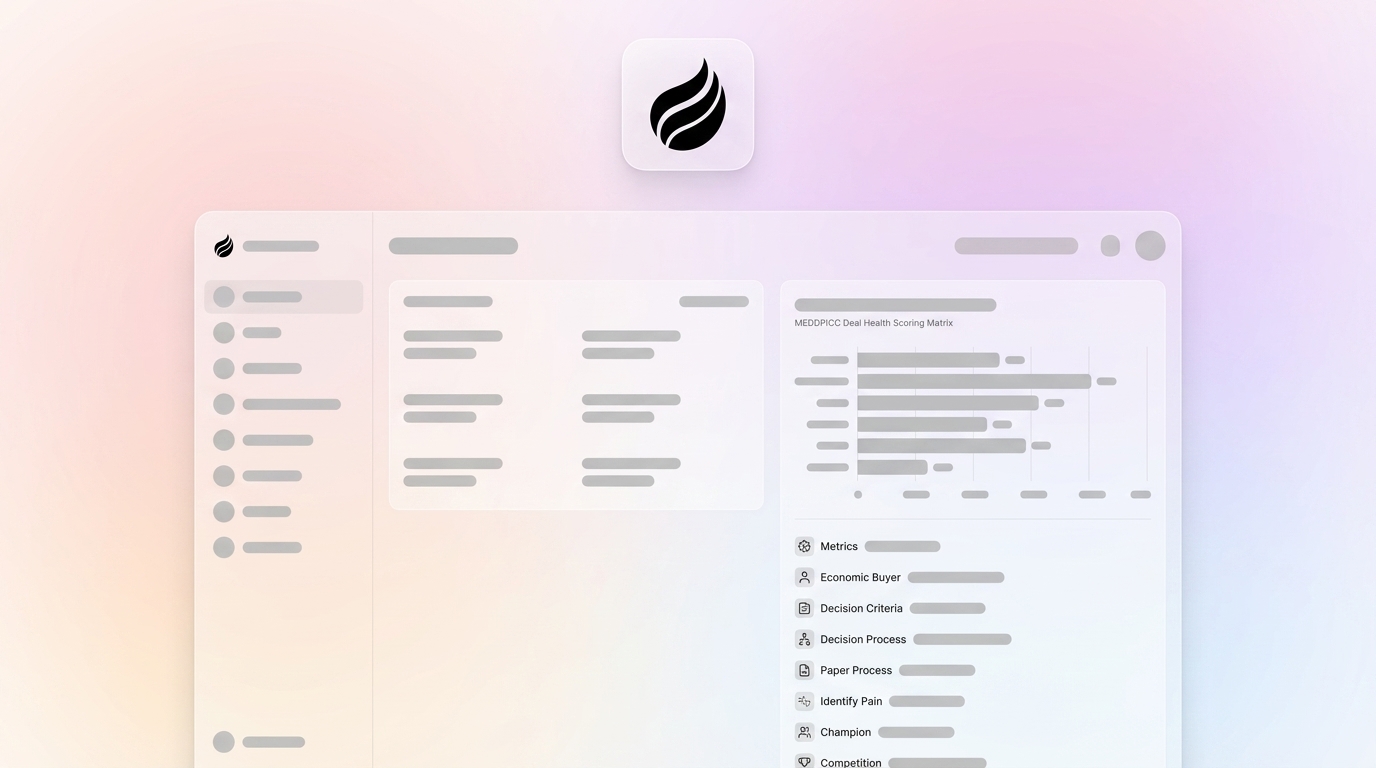
MEDDPICC Deal Health Scoring Matrix
Kalungi’s MEDDPICC scoring uses a 1-4 scale per element: 1 (Not Met), 2 (Partially Met), 3 (Strongly Met), 4 (Outstanding). Many sales leaders require a strong MEDDPICC score before deals enter commit forecast.
The example below scores three deals across all eight elements. Deal B reaches a healthy score and qualifies for commit, while Deal C falls into clear disqualification territory.
|
Deal |
M |
E |
D |
D |
P |
I |
C |
C |
Total |
Status |
|---|---|---|---|---|---|---|---|---|---|---|
|
Deal A |
3 |
3 |
3 |
3 |
2 |
3 |
3 |
2 |
22/32 (69%) |
Yellow |
|
Deal B |
4 |
3 |
3 |
4 |
3 |
4 |
3 |
3 |
27/32 (84%) |
Green |
|
Deal C |
2 |
1 |
2 |
1 |
1 |
2 |
2 |
1 |
12/32 (38%) |
Red |
Scoring thresholds: 75%+ (Green, Commit), 50-74% (Yellow, Coaching), <50% (Red, Disqualify).
Top B2B Sales KPIs Through a MEDDPICC Lens
Structured qualification processes like MEDDPICC lead to 41% higher win rates and noticeably shorter sales cycles. The KPIs below connect your operating dashboard to the MEDDPICC work your reps do in each deal.
-
Pipeline Velocity: Days to progress between stages (target: <30 days per stage)
-
Win Rate by Element: Deals with Economic Buyer access compared to those without
-
Forecast Accuracy: Commit vs. actual close rate (target: 85%+)
-
Deal Size: Average contract value with full MEDDPICC coverage
-
Sales Cycle Length: First contact to close, reduced significantly with structured qualification
-
Champion Engagement: Frequency of internal advocate interactions
-
Competitive Win Rate: Success against named competitors
-
Qualification Score: Average MEDDPICC percentage across pipeline
MEDDPICC Metrics vs MEDDIC: How the Framework Evolved
MEDDPICC is a modern evolution of MEDDIC that adds Paper Process and Competition to address enterprise complexity. The comparison below shows how each element expanded, with the two new components closing gaps around approvals and competitive positioning.
|
Element |
MEDDIC |
MEDDPICC Expansion |
Key Metric |
|---|---|---|---|
|
Metrics |
Basic ROI |
Quantified business case |
$ value defined |
|
Economic Buyer |
Budget authority |
Access + engagement |
Days to meeting |
|
Decision Criteria |
Requirements |
Weighted scorecard |
Criteria influence |
|
Decision Process |
Steps |
Stakeholder mapping |
Process completion |
|
Paper Process |
Not included |
Legal/procurement |
Approval timeline |
|
Identify Pain |
Pain points |
Quantified urgency |
Pain score (1-10) |
|
Champion |
Internal support |
Active advocacy |
Engagement frequency |
|
Competition |
Not included |
Competitive landscape |
Win positioning |
Build MEDDPICC Dashboards Fast
CRM fields around MEDDPICC elements use Yes/No dropdowns, picklists, and 0-2 scoring per element for mobile-friendly updates. You can mirror that approach with a focused set of fields grouped by purpose.
Start with quantitative business justification:
-
Metrics: ROI Percentage (number), Business Case Status (picklist: Defined/Rough/Not defined)
Then track access to decision-makers and how they evaluate options:
-
Economic Buyer: EB Name (text), Access Level (picklist: Met/Identified/Not identified)
-
Decision Criteria: Scorecard Complete (Yes/No), Top 3 Criteria (text)
-
Decision Process: Stakeholders Mapped (percentage), Next Approval Stage (text)
Next capture approval risk and problem urgency:
-
Paper Process: Procurement Contact (text), Legal Review Status (picklist)
-
Identify Pain: Pain Urgency (1-10 scale), Cost of Inaction ($)
Finally, measure advocacy strength and competitive context:
-
Champion: Champion Name (text), Motivation Score (1-10 scale)
-
Competition: Competitors Named (text), Competitive Status (picklist)
Coffee’s AI agent automatically populates these CRM fields from email and call data with structured notes aligned to MEDDPICC. Get started with Coffee to build automated sales dashboards without extra admin work.
Automate MEDDPICC Tracking in Your CRM with Coffee
Coffee’s AI agent turns sales qualification into always-on intelligence instead of a manual chore. The agent captures structured and unstructured data from emails, calendars, and call transcripts, then logs interactions and organizes notes according to MEDDPICC.

AI sales co-workers improve CRM hygiene from 80% to 98% and achieve 20% higher win rates on deals over €10k. Coffee’s agent delivers similar gains by connecting clean data with consistent qualification.
-
Auto-capturing sales data from every customer interaction
-
Structuring notes using sales methodologies like MEDDPICC
-
Providing pipeline intelligence based on reliable inputs
-
Automating meeting summaries and follow-ups
-
Tracking all interactions for accurate forecasting
A case study shows Coffee doubled forecast accuracy for a growing B2B company by automating data capture, saving 8-12 hours per week of manual data entry while improving pipeline visibility.
Frequently Asked Questions
What are the top MEDDPICC KPIs to track?
The top 10 MEDDPICC KPIs include Days to Meet Economic Buyer (<30 days target), Quantified ROI Target (25%+ improvement), Champion Urgency Score (8-10/10), Decision Process Mapped (100% stakeholders), Pain Urgency Rating (8-10/10), Evaluation Criteria Defined (weighted scorecard), Procurement Contact Identified, Competitive Vendors Named (2-3 alternatives), MEDDPICC Total Score (healthy percentage for commit), and Deal Health Multiplier (0.8-1.0 range).
How do you track champion engagement effectively?
Track champion engagement through Personal Motivation Score (8-10/10 urgency), Economic Buyer Access (direct relationship), Internal Coaching frequency (weekly guidance), and Competitive Intelligence sharing (active insights). Coffee’s AI agent automatically logs champion interactions from email threads and call transcripts with structured notes according to sales methodologies like MEDDPICC, which removes the need for manual tracking.
What makes a good MEDDPICC template?
A good MEDDPICC template includes scoring fields for all 8 elements (1-4 scale), specific KPI tracking per element, automated calculation of total scores and health percentages, stage gate requirements for commit forecast, and integration with CRM workflows. The template should support both structured data entry and unstructured note capture from sales conversations.
How does MEDDPICC differ from MEDDIC?
MEDDPICC expands MEDDIC by adding Paper Process (legal/procurement workflows) and Competition (alternative solutions assessment). This expansion addresses enterprise sales complexity where procurement delays and competitive evaluations significantly impact deal outcomes. MEDDPICC provides more comprehensive qualification for complex B2B sales cycles with multiple stakeholders and extended approval processes.
How does AI automate MEDDPICC tracking?
AI automates MEDDPICC tracking by analyzing email content, call transcripts, and meeting notes to extract qualification data. It scores each element based on conversation content, flags missing information or qualification gaps, generates business cases when sufficient data exists, and updates CRM records without manual data entry. This automation improves data quality while reducing administrative burden on sales teams.
Conclusion: Scale MEDDPICC with Coffee’s AI Agent
Manual MEDDPICC tracking limits your sales potential through inconsistent data quality and heavy administrative overhead. Coffee’s AI agent unifies qualification tracking across all customer interactions and automatically captures the metrics that matter for accurate forecasting and deal risk detection.
Transform your pipeline intelligence with automated MEDDPICC tracking that saves time while improving win rates.
Get started with Coffee today to experience significantly higher forecast accuracy through intelligent deal qualification.