Written by: Doug Camplejohn, CEO & Co-Founder, Coffee
Key Takeaways for AI-Native CRM Agents
-
AI-native CRM autonomous agents replace manual data entry with intelligent workflow orchestration, saving sales reps 8–12 hours each week by automating updates from emails and meetings.
-
Core capabilities span real-time forecasting, custom meeting briefings, pipeline intelligence, and multi-agent collaboration, which together remove constant tool switching.
-
Key 2026 debates focus on native versus bolt-on AI, SMB accessibility, human-in-loop controls, and security, and Coffee’s dual-model approach addresses all four areas with SOC2 compliance.
-
Top players such as Coffee, Salesforce Agentforce, and Attio compete in this space, and Coffee stands out with flexible integrations and no-rip-and-replace options for SMBs and enterprises.
-
Adopt Coffee’s autonomous agents today to transform RevOps and start your free Coffee trial for immediate pipeline accuracy and time savings.
1. AI-Native CRM Autonomous Agents Explained
AI-native CRM autonomous agents create a foundational shift where artificial intelligence shapes data storage, learns from patterns, orchestrates workflows, and guides human action at the core of the system. AI-native systems create dynamic “customer twins” from continuous learning of conversations, meetings, signals, behaviors, and outcomes.
The core distinction comes from autonomous execution capabilities. Agentic AI in CRM enables independent thinking, learning, and acting in contrast to traditional reactive trigger-based automation. These agents handle unstructured data such as email text and call transcripts through RAG (Retrieval-Augmented Generation) warehouses, which removes the manual entry bottleneck that plagues legacy systems.
The industry debate focuses on bolt-on versus native approaches. Salesforce Agentforce layers autonomous capabilities onto existing infrastructure, while platforms such as Clarify and Coffee build agent-led intelligence from day one. AI-native CRMs provide flexible data models that adapt to a business’s actual needs.
2. Core Agent Capabilities Reshaping CRM in 2026
Autonomous agents in AI-native CRM systems now deliver sophisticated capabilities that reshape daily sales workflows. Core autonomous agent capabilities include autonomous task execution for full workflows like lead-to-opportunity conversion, real-time predictive sales forecasting at deal, territory, and company levels, AI-driven customer segmentation that evolves hourly on behavioral signals, self-optimizing workflows, and multi-agent collaboration.
Data entry automation creates the fastest and most visible value. Coffee’s agent automatically creates and enriches contacts from Gmail and calendar interactions, logs activities, and maintains deal states without human intervention.

Meeting orchestration capabilities now extend far beyond basic recording. Coffee.ai launched Custom Meeting Briefings and Summaries in February 2026, enabling users to define exact formats and focuses, such as high-level executive summaries or granular technical breakdowns. The agent prepares briefings with attendee context, joins calls for transcription, and generates structured follow-ups aligned with methodologies such as BANT or MEDDIC.

Pipeline intelligence upgrades forecasting from spreadsheet exports to real-time insights. Coffee.ai’s AI search on deals, released in January 2026, answers natural-language questions such as “Which deals are stuck in negotiation?” or “What’s closing this month?” The Pipeline Compare feature then visualizes week-over-week changes, highlights progressed deals, and flags stalled opportunities so teams can react quickly.
3. Key Trends and Debates Shaping Autonomous CRM
The autonomous CRM landscape in 2026 revolves around three critical debates: vertical specialization versus horizontal platforms, human-in-loop versus full autonomy, and multi-agent orchestration strategies. Memory-driven agentic AI agents recall previous conversations, track user preferences, and maintain contextual understanding for applications such as sales follow-ups and tailored customer support.
These debates have particular implications for SMB adoption. SMB scaling represents a major opportunity, as by 2026, agentic AI will be as user-friendly as website builders like WordPress or Shopify, accessible even to those without technical backgrounds, including small business owners. Coffee supports this shift through its dual-model strategy, which offers a standalone CRM for companies with 1–20 employees and companion apps for existing Salesforce or HubSpot installations.
Multi-agent orchestration now emerges as the next competitive frontier. In 2026, multi-agent systems enabling orchestrated digital workforces will dominate. Coffee.ai introduced an Intelligence layer that allows users to define and store deep context on business models, product specifics, ICP, and competitors for tailored AI suggestions and insights in February 2026, which prepares organizations for this orchestrated future.
The human-in-loop debate intensifies as organizations balance autonomy with control. Trust in data has become the number one bottleneck preventing leaders from fully adopting autonomous agent strategies. Coffee responds with SOC2 compliance and transparent decision logging so teams can audit agent actions.
Explore Coffee’s transparent agent architecture to experience this balance of autonomy and control in your own sales workflow.
4. Top Players and How Coffee Compares
The AI CRM agents landscape now includes several distinct approaches to autonomous functionality.
Salesforce Agentforce illustrates the bolt-on approach and requires existing Salesforce infrastructure. Salesforce Einstein’s Agentforce provides autonomous AI agents for customer and employee workflows, including sales, with add-on pricing starting at $550 per user per month for Agentforce 1 editions on Enterprise or Unlimited Salesforce licenses.
However, Salesforce Agentforce requires historically clean CRM data for reliable predictions from tools like Einstein, and most organizations lack such data cleanliness, which makes predictions unreliable.
Coffee differentiates through its dual-model strategy that serves both standalone SMB needs and companion functionality for legacy systems. The agent handles structured and unstructured data through native integrations with Gmail, Zoom, and Zapier, which delivers 8–12 hours per week in time savings without rip-and-replace migrations. The following comparison shows how Coffee’s flexible integration approach and dual-model strategy address SMB needs more effectively than competitors.
|
Feature |
Coffee |
Clarify |
Salesforce Agentforce |
|---|---|---|---|
|
Data Handling |
Structured/unstructured |
Unstructured only |
Bolt-on, legacy rigid |
|
Integrations |
Zapier, Gmail/Zoom native |
Limited |
Enterprise-heavy |
|
ROI (SMB) |
8–12hr/wk savings |
Productivity focus |
$550+/user/mo add-on |
|
Rip/Replace |
Dual-model no-ripo |
Standalone only |
Requires Salesforce |
See how Coffee fits your current stack and deploy autonomous agents without disrupting existing tools.
5. Adoption Risks and Realities for Autonomous CRM
Autonomous CRM deployment brings real challenges around trust, security, and over-automation. In 2025, businesses encountered “workslop,” low-quality, hallucinated AI output that forced employees to spend hours auditing agents meant to save time. This experience underscores how crucial high-quality, grounded data sources have become.
Security concerns intensify as agents gain autonomous capabilities, and risk perceptions now shift accordingly. Nearly half of cybersecurity professionals identify agentic AI and autonomous systems as the single most dangerous attack vector. This heightened risk profile makes strong compliance frameworks essential rather than optional. Coffee addresses these concerns through SOC2 Type 2 and GDPR compliance, which delivers enterprise-grade security for autonomous operations.
Data quality bottlenecks remain the primary adoption barrier and reinforce the trust concerns mentioned earlier. Leaders hesitate to fully embrace autonomous agents when they doubt the underlying data. Coffee’s “good data in, good data out” philosophy ensures agents work with clean, structured information from email and calendar sources.
Governance frameworks now emerge as essential infrastructure that supports this trust. Companies are implementing AI governance tools for autonomous AI agents, including real-time dashboards to monitor activities, flags to alert compliance officers if agents exceed boundaries, and detailed decision logs for every action to ensure trustworthiness and compliance. These practices complement Coffee’s logging and compliance posture.
6. 2026 Predictions for Agent-Led Revenue Teams
The autonomous agent inflection now accelerates toward full workflow ownership by 2027. Sisgain forecasts that by 2027–2028, fully orchestrated multi-agent CRM ecosystems will emerge, with a “Revenue CEO” agent coordinating specialized agents across sales, marketing, customer success, finance, and partners. This shift turns software tools into digital workforce members.
SMB transformation will likely lead enterprise adoption. Revenue teams using orchestration-based agent systems generate 31% more pipeline per rep, while organizations adopting agentic AI report up to 70% cost reduction versus equivalent SaaS spend. Coffee’s focus on small to mid-sized businesses positions it at the front of this transformation.
Multi-agent orchestration becomes the standard architecture across modern revenue teams. Companies will rapidly transition to an “orchestrator” agent directing smaller, expert agents, ensuring humans remain in control as high-level supervisors. This structure enables specialized agents for research, compliance, finance, and support to collaborate smoothly.
The dashboard era now gives way to agent-driven experiences. Reddit’s r/SaaS community is calling 2026 “The Death of the Dashboard,” with users preferring AI agents that work in the background over additional tabs to manage. Coffee reflects this shift through autonomous pipeline management that removes the need for manual reporting.
Case Study: AI Firm Scales Revenue Without Manual Grind
A company generating tens of millions in revenue from custom AI solutions faced a critical scaling challenge. The team managed sales through spreadsheets, rejected Salesforce and HubSpot because of manual overhead, and needed automated workforce capabilities without complex setup.
Coffee’s agent delivered immediate value through automated contact creation from Google Workspace, which removed manual data entry. The Pipeline Compare feature automated weekly reviews, and API access enabled custom briefing scripts tailored to their workflows. This seamless integration allowed the team to scale revenue operations without adding administrative burden and showed that agent-led CRM can support high-growth technology companies.
Common Concerns in Agent Conversations
Integration Capabilities Across Your Stack
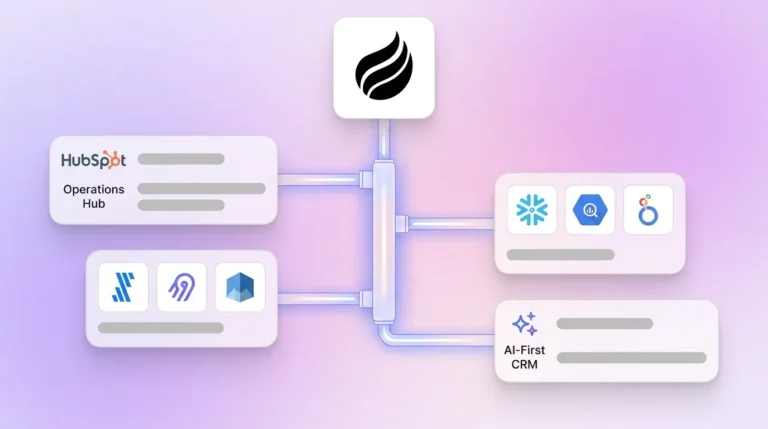
Coffee integrates natively with Gmail, Zoom, and Google Workspace, and uses Zapier for broader connectivity to tools outside this core stack. As customer usage patterns reveal which integrations deliver the most value, the roadmap prioritizes deeper native connections for those high-impact tools.

Data Security and Compliance Standards
Coffee maintains SOC2 Type 2 and GDPR compliance with enterprise-grade security measures across the platform. Customer data never trains public models, which protects privacy and keeps sensitive sales information confidential.
Data Quality and Built-In Enrichment
Coffee’s agent provides data enrichment roughly on par with ZoomInfo for most use cases and delivers this capability directly inside the platform. The agent then improves data quality over time through automated validation and cross-referencing of contact and account details.

Implementation Timeline and Setup Effort
Coffee’s dual-model approach supports rapid deployment without rip-and-replace requirements for your current CRM. Standalone implementations typically complete within days, while companion app integrations sync with existing Salesforce or HubSpot instances with minimal disruption.
ROI Measurement and Time Savings
Coffee customers typically achieve the time savings mentioned earlier, freeing up 8–12 hours weekly per rep while also gaining improved pipeline accuracy and reduced administrative overhead. The agent’s autonomous data management maintains consistent CRM hygiene without human intervention.
The AI-native CRM autonomous agent landscape of 2026 signals a fundamental transformation in how sales teams operate. Coffee leads this evolution by proving that good data in produces good data out through tireless agent capabilities that remove manual drudgery.
Hire your autonomous Coffee agent and transform your sales workflow today.