![How to Improve Data Completeness in Salesflare CRM [2026]](https://blog.coffee.ai/wp-content/uploads/sites/10/2026/04/1776054499571-73a289362ce0.jpeg)
Written by: Doug Camplejohn, CEO & Co-Founder, Coffee | Last updated: July 31, 2026
Key Takeaways for Salesflare Data Completeness
- A data completeness score measures the percentage of required CRM fields with valid data across a record set, with 90%+ as the target for forecasting-grade data.
- Most organizations struggle with CRM accuracy, and poor data quality drives an average of $12.9 million in annual losses.
- A structured weekly audit with nine clear steps can lift Salesflare data completeness by at least 10 percentage points within 30 days.
- High-impact steps include calculating baseline scores, enforcing email and calendar sync, requiring company websites, trimming custom fields, and automating enrichment via Zapier.
- Let Coffee handle data completeness automatically and eliminate this weekly process entirely.
Why Salesflare Data Completeness Drives Revenue
Validity’s 2025 State of CRM Data Management report shows a widespread CRM data quality crisis, and 37% of organizations lost revenue as a direct result. The financial impact is significant. Gartner research attributes an average of $12.9 million in annual losses to poor data quality. At the same time, Salesforce’s State of Sales 2026 report finds B2B reps spend 60% of their time on non-selling tasks such as admin, data entry, and CRM upkeep.
For Salesflare users, incomplete records make pipeline stages unreliable and forecasts drift from reality. Reps then spend time hunting for information instead of closing deals. Effective CRM hygiene improves forecast accuracy by 22%, according to Salesforce State of Sales research. The solution is a systematic nine-step weekly audit that addresses these failure points and raises your completeness score without adding heavy manual work.
Readiness Checklist for the Weekly Audit
Confirm a few prerequisites before you run the audit. Salesflare admin access must be available to view and export field-level data. Google Workspace or Microsoft 365 needs to be connected so email and calendar sync stays active for every seat. A Zapier account or a native enrichment integration should be enabled to support automated field population. Without these three elements, several steps in the audit will be blocked.
Once these prerequisites are confirmed, you can start the weekly audit. The nine steps below work best in sequence, with each step building on the previous one to improve your data completeness score.
How to Audit Salesflare Data Quality Weekly
-
Calculate your baseline completeness score. Export all active contact, company, and opportunity records from Salesflare. For each object, count the records where every essential field is populated. Divide by total records and multiply by 100. Target thresholds for contacts, companies, and opportunities usually sit above 90%. Record this number as your week-zero baseline.
Common mistake: Counting fields that contain placeholder text like “N/A” or “Unknown” as populated. When reps face too many required fields, 37% admit using placeholder values to satisfy the system. This behavior inflates apparent completeness while destroying data utility.
-
Force email and calendar sync for every user. In Salesflare settings, verify that every active user has a connected inbox and calendar. Disconnected accounts are often the largest source of missing activity data. Re-authenticate any broken connections. Confirm that “last activity” and “next activity” fields auto-populate on contact records.
Common mistake: Assuming sync is active because it was set up at onboarding. Many businesses report that their most valuable customer data sits outside their CRM in email and other tools. Broken sync is the primary reason.
-
Require company website on every new record. Set the company website field as required in Salesflare before any new company record can be saved. The website domain acts as the anchor field that enrichment tools use to auto-populate industry, employee count, and other firmographic data. Without it, downstream automation cannot run.
Common mistake: Treating website as optional. Critical fields like company name, industry, company size, and website are revenue drivers, not hygiene metrics. Their absence directly reduces deal close probability.
-
Reduce custom fields and move ad-hoc data to tags. Export your full Salesflare field list and apply a three-question test to each field. Ask whether it appears in a report or dashboard. Ask whether it is used to filter or segment records. Ask whether any workflow or automation depends on it. If the answer to all three is no, the field should not exist. It creates data entry burden without delivering value.
For fields you remove, check whether the underlying need was ad-hoc grouping such as event attendance, campaign membership, or persona labels. Move those use cases to Salesflare tags instead, which provide flexible labeling without the overhead of structured fields. One documented SaaS team achieved a CRM adoption increase from 40% to 85% within a month by cutting custom fields from 80 to 22.
Common mistake: Archiving fields without checking automation dependencies first. Always map downstream workflows before removing a field to avoid breaking enrichment triggers or Zapier steps.
-
Define minimum opportunity standards by stage. Document the exact fields required before an opportunity can advance past each pipeline stage. Minimum required opportunity fields are name, stage, and close date. Make close date and amount required at opportunity creation. Make next step required before moving to any stage beyond initial qualification. This approach prevents phantom pipeline from inflating forecasts.
Common mistake: Requiring all fields at record creation. Stage-based requirements prevent garbage data. A field that feels unreasonable at lead capture may be essential before closed-won handoff.
-
Run a weekly incomplete-record review. Create a saved Salesflare filter that surfaces all records missing two or more essential fields and added in the past seven days. Assign ownership of this review to a RevOps lead or Salesflare admin. Aim for a review that takes no more than 30 minutes. Weekly completeness scans on recent records catch gaps early before they compound.
Common mistake: Running this review monthly instead of weekly. CRM data quality degrades at 2–3% per month without active management, so a monthly cadence allows compounding decay between cycles.
-
Configure Zapier enrichment workflows. Connect Salesflare to an enrichment source via Zapier, such as Clearbit, Apollo, or a similar provider. Set the trigger to fire on new company record creation and populate industry, employee count, and LinkedIn URL automatically. Teams that use enrichment tools to auto-populate firmographic fields reduce manual data entry time while improving accuracy.
Common mistake: Triggering enrichment only on contact creation and skipping company records. Company-level firmographic gaps are a common source of failed lead routing and segmentation errors.
-
Automate follow-up reminders inside Salesflare. Use Salesflare workflow automation to send an in-app reminder to the record owner whenever an opportunity has no “next step” date within the next 14 days. Add a second rule for contacts with no logged activity in 21 days. These reminders keep pipeline data current without requiring managers to chase reps for updates.
Common mistake: Setting reminders too frequently. Daily nudges create alert fatigue. A 14–21 day threshold surfaces genuinely stale records without generating noise that reps learn to ignore.
-
Track week-over-week score improvement. Re-run the completeness calculation from Step 1 every Monday morning. Log the score for each object in a shared spreadsheet or dashboard. CRM data quality frameworks often track high field completion rates, low duplicate rates, and high email deliverability as benchmarks for sustained quality. A rising score over four consecutive weeks confirms the process is working. A plateau signals a field or sync issue that needs investigation.
Common mistake: Measuring only total record completeness rather than per-object scores. A high contact score can hide a critically low opportunity score, which is the object most directly tied to forecast accuracy.
Try Coffee’s autonomous data management and eliminate this weekly process entirely, while the agent handles completeness automatically.
Salesflare Data Completeness Scorecard Template
Use this scorecard to define which fields matter most for your business and to track fill rates against target thresholds. The “Weight” column shows how each field contributes to your overall completeness score. The “Target Fill Rate” column sets the benchmark you should aim for during weekly audits.
| Field | Status | Weight | Target Fill Rate |
|---|---|---|---|
| Contact: Email | Required | High, 10 pts, absolute requirement for routing | >95% |
| Contact: Job Title | Required | High, 5 pts, drives segmentation | >90% |
| Contact: Phone | Required | High, direct phone can boost close probability | >95% |
| Company: Website | Required | High, anchor for enrichment automation | >90% |
| Company: Industry | Required | Medium, 5 pts, drives routing and ICP scoring | >90% |
| Company: Employee Count | Required | Medium, ICP qualification signal | >90% |
| Opportunity: Amount | Required | High, required for 90+ forecasting score threshold | >98% |
| Opportunity: Close Date | Required | High, forecast integrity field | >98% |
| Opportunity: Next Step | Required at stage 2+ | Medium, pipeline momentum signal | >95% |
| Contact: LinkedIn URL | Optional | Low, 3 pts, enrichment-populated | >60% |
How to Read the Scorecard and Confirm Success
Compare each object’s weekly fill rate against its target to read the scorecard. An overall completeness score above 80% is the minimum viable threshold. Scores below 60% mean the team is constantly working around missing information instead of selling. Within 30 days of implementing the nine-step audit, expect the following KPI movements to confirm success:
- Overall completeness score rises by at least 10 percentage points from baseline
- Opportunity completeness reaches 90%+ on amount and close date fields
- Enrichment automation fires on 80%+ of new company records
- Misrouted leads drop as completeness thresholds gate routing
- Weekly review time stabilizes below 30 minutes as prevention reduces the volume of incomplete records
If scores plateau after week four, likely causes include a broken enrichment Zap, a user with disconnected email sync, or a required field generating placeholder entries. All three issues are diagnosable through Salesflare’s field-level fill rate report.
Scaling the Audit for Different Sales Team Sizes
Teams of one to five reps can run the full nine-step audit in under an hour weekly, with the founder or sales lead owning the review. Teams of six to twenty should assign a dedicated RevOps admin and automate the completeness score calculation using a connected spreadsheet or BI tool that pulls from Salesflare’s API. Prevention via validation rules and required fields is ten times more efficient than cleanup, so larger teams should prioritize stage-gated field requirements over expanding the weekly review scope. At twenty-plus reps, add a monthly duplicate scan and a quarterly full audit alongside the weekly new-record review to cover the full decay cycle.
Frequently Asked Questions
How long does it take to set up the weekly audit process in Salesflare?
The initial setup, which includes exporting fields, configuring required fields, connecting enrichment via Zapier, and building the incomplete-record filter, takes about three to four hours for a Salesflare admin with Google Workspace or Microsoft 365 already active. The ongoing weekly review, once the process is established, runs in 20 to 30 minutes. The largest time investment is the one-time field reduction audit in Step 4, which requires mapping each custom field to its downstream dependencies before archiving.
Who should own the Salesflare data completeness process?
Ownership works best when split between a Salesflare admin who runs the weekly technical review and a sales manager or RevOps lead who holds reps accountable for field completion during pipeline reviews. Without a named owner on both sides, the process degrades within weeks. If neither role exists, the founder or head of sales should own it directly until the team grows large enough to delegate. The key accountability mechanism is visibility. Publishing the weekly score in a shared Slack channel or dashboard creates natural peer pressure without requiring manager intervention on every record.
What is a realistic completeness score target for a small Salesflare team in the first 30 days?
Most small teams start with a baseline completeness score between 45% and 65% on contact records and lower on opportunities. A realistic 30-day target is 75% overall completeness across all objects, with opportunity amount and close date fields hitting 90% or higher. Teams that connect enrichment automation in the first week usually see the fastest gains because firmographic fields on company records fill automatically without rep effort. Completeness above 80% is considered minimum viable for reliable pipeline reporting. A 90%+ score supports trustworthy AI-assisted forecasting.
Can tags fully replace custom fields in Salesflare?
Tags replace custom fields only for unstructured, ad-hoc grouping needs such as event attendance, campaign membership, and persona labels where strict reporting is not required. The distinction comes down to structure and usage. As outlined in Step 4, fields that drive workflows, appear in dashboards, or gate stage transitions must remain structured. Tags work for everything else and act as flexible labels that do not require defined data types. Most Salesflare teams find they can convert 20–30% of existing custom fields to tags without losing reporting capability.
Does the weekly audit process work if the team uses Salesflare alongside other tools?
The audit process works regardless of the surrounding stack, but data completeness degrades faster when activity occurs in tools that do not sync back to Salesflare. Sales reps using an average of ten tools to close deals generate activity outside the CRM that never gets logged, which creates structural incompleteness that no audit cadence can fully fix. The practical fix is to reduce the number of tools that generate customer-facing activity and ensure each remaining tool has a Zapier or native integration that writes activity back to Salesflare automatically. Without that, the weekly review surfaces symptoms rather than addressing the root cause.
The Zero-Effort Alternative: Let Coffee Handle Data Completeness
The nine-step process above improves unmanaged Salesflare data and creates a repeatable system. It also introduces a recurring tax. Every week, someone must run the review, chase the broken sync, re-fire the enrichment Zap, and update the scorecard. A 25-rep team losing 12 hours per rep per week to admin work represents 300 weekly hours of selling capacity lost. Even a lean weekly audit adds to that burden instead of removing it.
Coffee is an autonomous CRM agent built on a different premise. The agent handles data completeness so the team never has to. After you connect Google Workspace or Microsoft 365, Coffee’s agent scans emails and calendars to auto-create contacts and companies, logs every interaction against the correct record, enriches firmographic fields via licensed data partners, and tracks last activity and next activity without any rep input. The fields that the nine-step audit tries to enforce through process and reminders are populated automatically, in real time, from ground-truth sources.
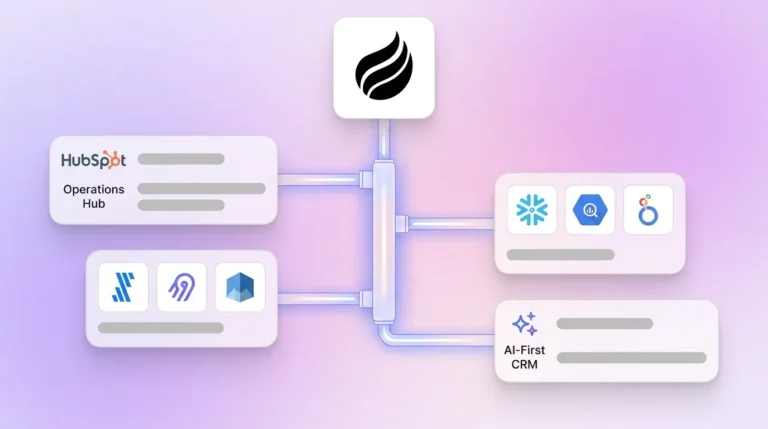
For teams already on Salesforce or HubSpot, Coffee deploys as a Companion App, an intelligent layer that writes clean, enriched data back to the existing system of record. The CRM stays current without human effort. For teams evaluating a full switch, Coffee’s Standalone CRM replaces Salesflare with an agent-first architecture where data completeness is a default state, not a weekly project.
Many sales professionals do not fully trust the accuracy of their CRM data. The manual audit process described above improves that trust gradually. Coffee closes the gap by removing the human from the data entry loop.
See how Coffee’s agent delivers clean data automatically and replace your weekly audit process with always-complete CRM data, no manual work required.