Written by: Doug Camplejohn, CEO & Co-Founder, Coffee
Key Takeaways
- SPICED sales methodology (Situation, Pain, Impact, Critical Event, Decision) gives SaaS teams a clear, customer-focused way to qualify deals.
- Use Situation questions to understand context, Pain and Impact to expose and quantify challenges, and Critical Event and Decision to create urgency and map buying processes.
- Coffee’s AI Agent automates SPICED by transcribing calls, structuring notes, tracking stakeholders, and generating insights that save significant weekly admin time.
- SPICED works especially well in mid-market SaaS deals, while MEDDIC fits complex enterprise cycles; combine SPICED with the 7-day plan for fast adoption.
- Implement SPICED successfully with Coffee’s automation—see Coffee plans and features to start improving your sales process today.
Module 1: SPICED Framework Breakdown for SaaS Sales Teams
Winning by Design’s SPICED sales methodology stands for Situation, Pain, Impact, Critical Event, and Decision, the five elements teams must understand to guide meaningful progress and align execution across the revenue organization. This customer-centric framework helps sales teams diagnose needs, align solutions with business value, and understand decision timing.
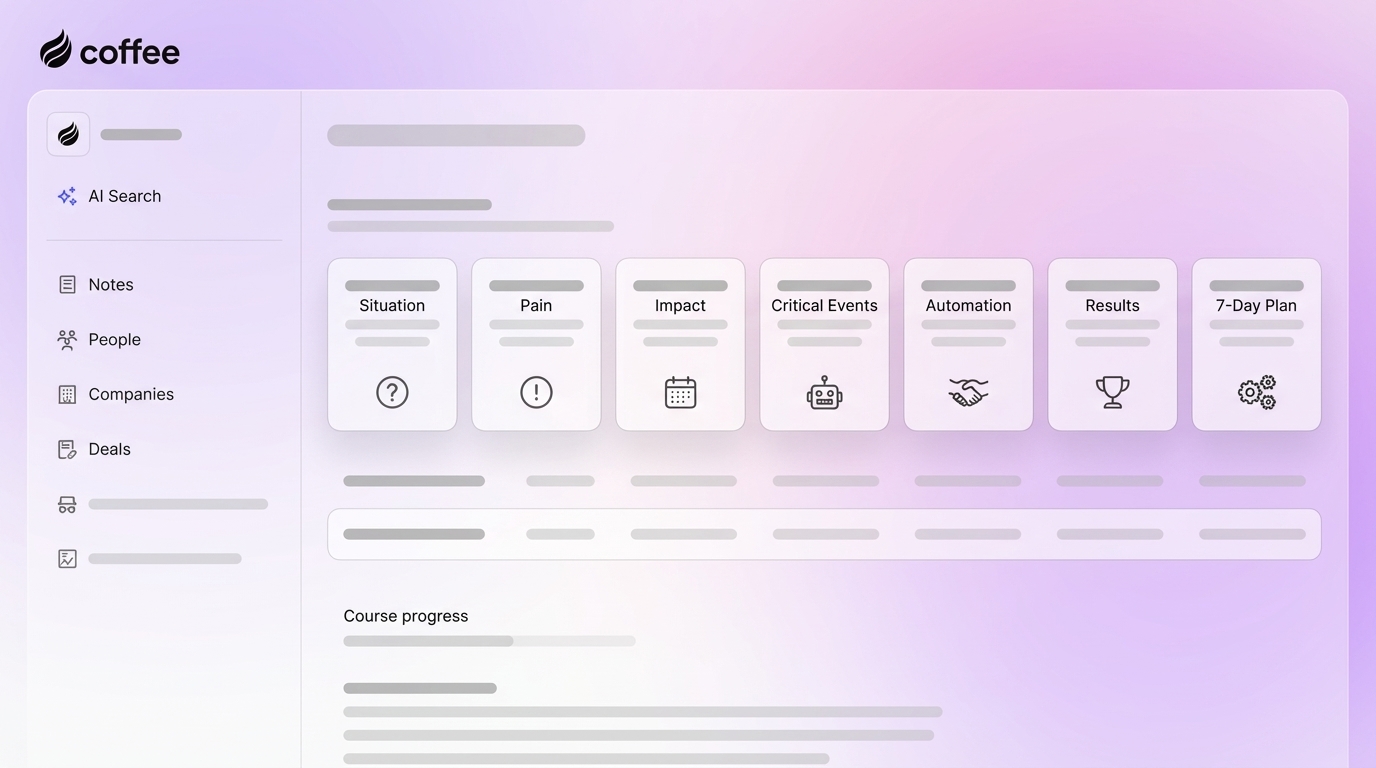
The SPICED framework breaks down as: Situation (prospect’s current business context), Pain (specific challenges causing friction), Impact (meaningful consequences of solving problems), Critical Event (deadlines creating urgency), and Decision (stakeholders and buying process).
Unlike MEDDIC’s deal-control emphasis or BANT’s transactional approach, SPICED provides a customer-centric, conversational approach to uncover pain points, emotional drivers, and customer needs across the full journey.
For SaaS sales teams, SPICED means understanding a prospect’s current tech stack (Situation), identifying workflow bottlenecks (Pain), quantifying lost productivity costs (Impact), linking to upcoming product launches (Critical Event), and mapping who approves new tools (Decision).
Capturing all five elements consistently across every call creates heavy admin work, so automation becomes essential. Coffee’s Agent structures its notes according to SPICED, which keeps qualification data consistent in your CRM.
Explore Coffee’s SPICED-ready Agent to see automated qualification in action.
Module 2: Situation Questions That Reveal Real Prospect Context
Strong Situation discovery uses targeted questions that reveal business context without turning the call into an interrogation. In Winning by Design’s SPICED methodology, the Situation step gathers comprehensive information about the prospect’s company and current situation by tracking strategic moves such as recent announcements, press releases, and event participation.
Useful Situation questions include: “What’s your current tech stack for [relevant process]?”, “How has recent funding or growth changed your team structure?”, “What tools are you using today, and where do you see gaps?”, and “Tell me about your team’s priorities this quarter.” These questions create a clear baseline and help you confirm ideal customer profile fit.
Coffee’s Agent automatically pulls Situation context from emails, calendars, and previous interactions, then pre-populates discovery calls with relevant background. The Agent identifies company news, recent hires, and technology changes, so reps can focus on deeper strategic questions instead of basic research.
See how Coffee gathers Situation intelligence for your team.

Module 3: Pain and Impact Questions That Build Urgency
Pain discovery moves beyond surface complaints and reveals root causes with measurable business impact. In Winning by Design’s SPICED methodology, the Pain step identifies specific challenges hindering the prospect’s success through active listening to concerns, asking open-ended questions such as “What are your biggest frustrations with [current process]?”
Effective Pain questions include: “What’s the most frustrating part of your current process?”, “Where do you lose the most time or money with existing tools?”, and “What keeps you up at night about [relevant challenge]?” Follow with Impact questions such as: “How much revenue or time does this cost monthly?” and “What opportunities are you missing because of this problem?”
The Pain step in Winning by Design’s SPICED framework uncovers specific customer challenges, including qualitative frustrations (for example, bottlenecks and workflow issues) and quantitative pains (for example, lost revenue and low productivity), to build urgency. Coffee’s conversation intelligence automatically extracts pain points from call transcripts, categorizes them by severity, and suggests follow-up questions that help you quantify impact.
Consider a role-play scenario. A marketing director says “our lead scoring is broken.” You dig deeper with “What does ‘broken’ look like day-to-day?”, “How many qualified leads are you missing monthly?”, and “What is the revenue impact of those missed opportunities?” Coffee’s Agent captures these details and organizes them for fast CRM entry.
Automate your pain discovery and impact follow-up with Coffee.
Module 4: Critical Events and Decision Criteria That Drive Deals Forward
Critical Event discovery reveals time-sensitive drivers that create real urgency without artificial pressure. In Winning by Design’s SPICED framework, the Critical Event step identifies time-sensitive drivers for change, such as contract expirations, budget cycles, or regulatory changes, to position solutions as timely without forcing artificial deadlines.
Helpful Critical Event questions include: “What is driving the timing for this decision?”, “Is there a specific deadline or event creating urgency?”, “What happens if you do not solve this by [timeframe]?”, and “Are there budget cycles or contract renewals that affect timing?” Listen for natural urgency signals such as fiscal year-end, product launches, compliance deadlines, or competitive pressure.
Decision process mapping clarifies stakeholders, evaluation criteria, and approval workflows. Ask questions like: “Who else is involved in evaluating solutions?”, “What criteria matter most in your decision?”, “Who ultimately signs off on purchases like this?”, and “What is your typical evaluation timeline?” In Winning by Design’s SPICED framework, Decision refers to how the customer will make the choice, including stakeholders involved, success criteria, tradeoffs, and the process required to move forward.
Coffee’s Agent tracks decision stakeholders mentioned across calls and emails, maps their roles and influence levels, and alerts reps when new decision-makers appear. The system maintains a dynamic stakeholder map that updates as deals progress.
Try Coffee’s automated stakeholder and decision mapping to keep every deal aligned.

Module 5: Coffee Automation That Brings SPICED to Life
SPICED works best when reps can focus on conversations instead of admin work. Manual implementation often creates heavy data entry, so many teams struggle to apply the framework consistently. Coffee’s Agent supports SPICED execution by automating data capture and note-taking, then applying the SPICED structure for reliable qualification.
Coffee’s Agent automatically joins discovery calls and transcribes conversations, then applies the SPICED structure introduced earlier. This automation saves 8 to 12 hours each week and improves data quality at the same time.
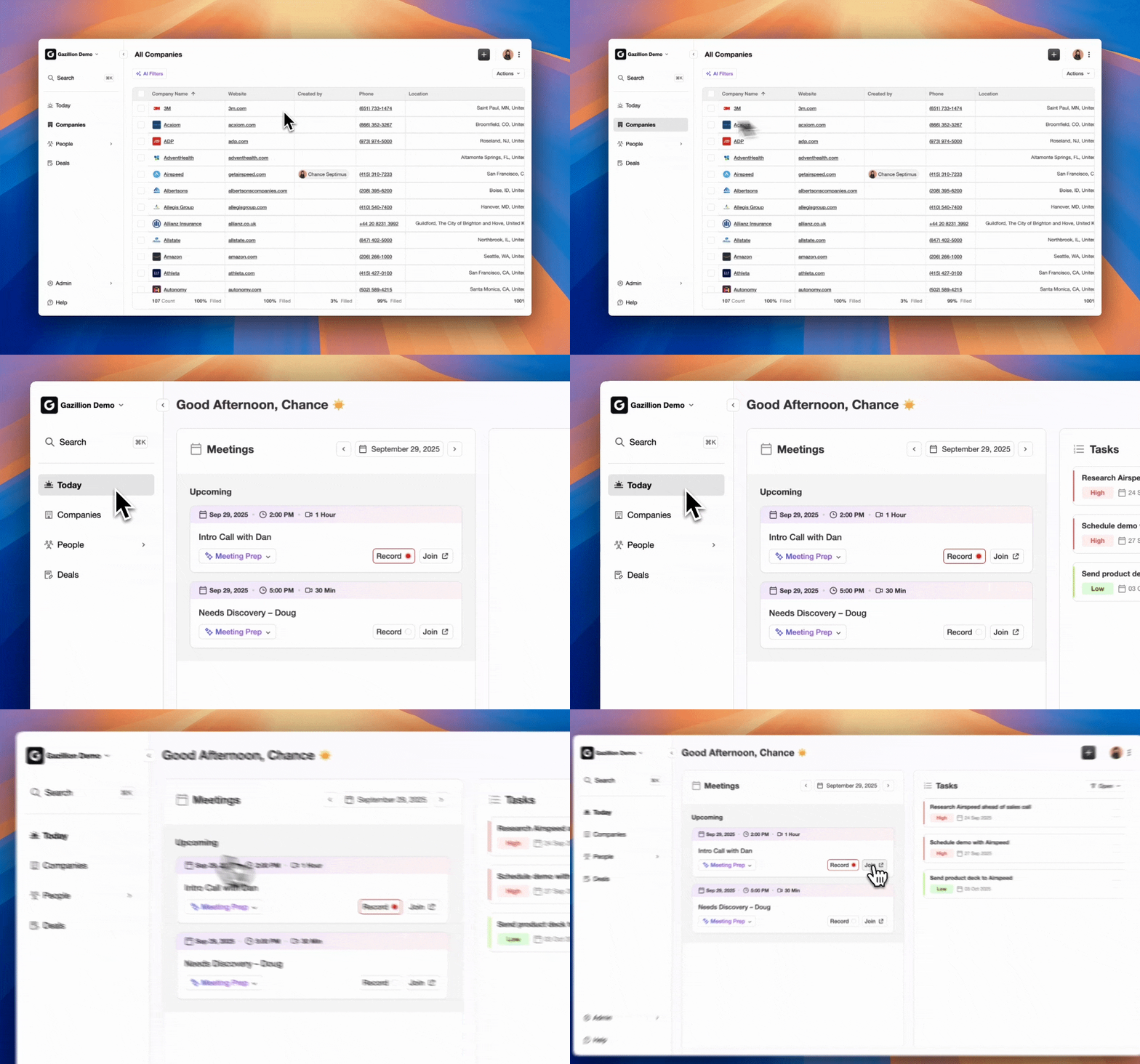
The Agent also generates post-call summaries and action items. The system connects to existing Salesforce or HubSpot instances as a Companion App, or it can operate as a complete Standalone CRM for growing teams.
Coffee’s automation includes automatic contact and company creation from email signatures, which removes manual data entry before calls even start. During conversations, real-time transcription captures every detail, and that content flows into activity logging that maintains a complete interaction history.
This capture extends to stakeholder tracking, which identifies every decision-maker mentioned across touchpoints. Together, these capabilities ensure “good data in” through accurate capture and “good data out” through reliable forecasting and pipeline insights.
Transform your SPICED workflow with Coffee automation.

Module 6: Real SPICED Results and When to Use MEDDIC
Cuebiq decreased sales cycle length by 50% after implementing Winning by Design’s SPICED framework, which shows the impact of pairing methodology with consistent execution. Coffee customers report similar gains when they combine SPICED mastery with AI automation.
MEDDIC brings rigor to lead qualification in complex sales by mapping decision criteria, identifying champions, and focusing on organizational mechanics and quantified value, while SPICED provides a customer-centric, conversational approach to uncover pain points, emotional drivers, and customer needs across the full journey. SPICED fits SaaS environments with shorter, discovery-driven cycles, while MEDDIC suits complex enterprise deals with formal procurement processes.
Use SPICED for mid-market SaaS deals in the $10k to $75k ACV range, 1 to 6 month sales cycles, director-level buyers, and consultative selling environments. Use MEDDIC for enterprise deals above $100k ACV, 6 month or longer cycles, multiple stakeholders, and formal RFP processes. Many high-performing teams blend both, using SPICED for early discovery and MEDDIC for late-stage qualification.
See how Coffee supports SPICED, MEDDIC, or hybrid approaches across your pipeline.
Module 7: 7-Day Plan to Build SPICED Habits with Coffee
This 7-day implementation plan builds SPICED skills step by step so your team gains muscle memory without disrupting current workflows. Each day focuses on one part of the framework or one core behavior, which keeps practice focused and manageable.
Day 1: Connect Coffee Agent and practice Situation questions on existing prospects. Day 2: Focus on Pain discovery using Coffee’s conversation intelligence. Day 3: Practice Impact quantification on recent calls. Day 4: Work on Critical Event identification using Coffee’s activity tracking. Day 5: Map Decision processes with Coffee’s data enrichment. Day 6: Review your pipeline with SPICED fields in mind. Day 7: Refine your approach based on Coffee’s pipeline insights and call summaries.
Daily practice prompts include “Review my recent calls,” “Show me activity across my active deals,” and “Which opportunities need follow-up?” Coffee surfaces pipeline intelligence and next steps so reps can act quickly.
Begin your 7-day SPICED ramp with Coffee and turn the framework into a daily habit.

Master SPICED Today with Coffee as Your Co-Pilot
This free SPICED sales methodology online course gives you proven frameworks, practical exercises, and implementation strategies used by top-performing SaaS sales teams. Coffee’s Agent automates the SPICED process so you can apply the methodology consistently while focusing on relationships and closing deals.
Start using Coffee for SPICED-driven selling and bring AI support into every discovery call.
SPICED Sales Methodology FAQ
What is the SPICED sales methodology?
SPICED is a customer-centric sales qualification framework developed by Winning by Design that stands for Situation, Pain, Impact, Critical Event, and Decision. This methodology helps sales teams understand prospects’ current business context, identify specific challenges, quantify the impact of problems, uncover urgency drivers, and map decision-making processes.
Unlike transactional frameworks like BANT, SPICED emphasizes consultative discovery that builds trust while gathering qualification intelligence. The framework works particularly well for SaaS and recurring revenue businesses with complex buying processes.
Is there a free SPICED course available?
Yes. This comprehensive free SPICED sales methodology online course provides 7 interactive modules that cover theory, practical exercises, templates, and Coffee AI demonstrations. While Winning by Design offers paid training programs, this course delivers hands-on SPICED mastery without cost barriers.
Each module includes downloadable resources, role-play scenarios, and real-world examples designed for SaaS sales teams. The course also shows how Coffee’s Agent automates sales processes, saving time while improving qualification consistency.
How does SPICED compare to MEDDIC?
SPICED and MEDDIC serve different sales environments and deal complexities. SPICED emphasizes customer-centric discovery through conversational questioning, which makes it ideal for mid-market SaaS deals with shorter cycles and fewer stakeholders. MEDDIC focuses on deal control and metrics-heavy qualification, which suits enterprise sales with formal procurement processes.
SPICED typically takes 30 to 60 days for team adoption, while MEDDIC often requires more extensive training. Many high-performing teams use hybrid approaches, applying SPICED for early discovery and MEDDIC rigor for late-stage qualification in complex deals.
How does Coffee apply SPICED methodology?
Coffee’s Agent supports SPICED methodology by transcribing sales calls and applying the framework’s elements, including Situation, Pain, Impact, Critical Event, and Decision. The system captures conversation context, identifies key points, and logs activities. Coffee generates post-call summaries and suggests action items.
This automation ensures consistent data entry while delivering the time savings mentioned earlier on manual note-taking and CRM updates.
What is the SPICED deal qualification?
SPICED deal qualification is the process of evaluating sales opportunities with the five-element framework to understand deal viability, timing, and closing probability. An effective SPICED qualification uncovers the prospect’s current business context (Situation), identifies specific problems causing friction (Pain), quantifies the business impact of those problems (Impact), discovers time-sensitive drivers that create urgency (Critical Event), and maps the decision-making process and stakeholders (Decision).
This comprehensive approach helps sales teams prioritize winnable opportunities, allocate resources effectively, and improve forecast accuracy by understanding the complete buyer context instead of surface-level interest.