Written by: Doug Camplejohn, CEO & Co-Founder, Coffee | Last updated: July 10, 2026
Key Takeaways
- Conversational intelligence platforms analyze past human conversations to extract sentiment, objections, and coaching insights, instead of automating live responses like chatbots.
- Purpose-built platforms automatically ingest calls, emails, and chats and sync structured data directly to CRMs, so teams avoid manual entry.
- Small teams usually gain more value from seat-based pricing models that include unlimited agent labor and avoid unpredictable per-minute transcription fees.
- Platforms differ widely in CRM integration depth, and only a few write enriched, queryable insights back to contact and deal records automatically.
- Start using Coffee today to eliminate data-clerk work and unlock full pipeline intelligence — get started with Coffee.
Why conversational intelligence matters for small business support
Conversational intelligence platforms help small teams understand what actually happens in customer calls, emails, and chats. They turn unstructured conversations into searchable data, coaching insights, and clear next steps. Instead of hiring more people to listen to calls or read transcripts, teams use these tools to spot patterns, fix bottlenecks, and improve customer outcomes faster.
Unlike chatbots that focus on replying to customers in real time, conversational intelligence tools focus on learning from past interactions. They reveal which objections block deals, which support issues repeat, and which reps need coaching. That context sets the stage for evaluating where tools like ChatGPT fit and where dedicated platforms are a better choice.
ChatGPT’s role in customer support analysis
ChatGPT can draft responses and summarize text, but it is not a conversational intelligence platform. It does not automatically ingest phone call recordings, sync transcripts to a CRM, or analyze patterns across hundreds of interactions without manual prompting. Every insight requires a human to copy, paste, and query, which keeps your team stuck in data-clerk work that purpose-built platforms remove.
For phone-based support, ChatGPT has no native call recording or telephony integration. It cannot pull sentiment trends across a week of calls, flag at-risk accounts, or write structured notes back to HubSpot or Salesforce. Post-call analysis tools that deliver transcripts, summaries, and sentiment tagging automatically provide far more operational value for small teams than a general-purpose language model used ad hoc.
CRM integration remains the sharpest gap. Manual data input is still a major challenge for many businesses using CRMs, and ChatGPT does not close that gap. A dedicated platform that writes insights directly to contact and deal records removes that friction and keeps the CRM accurate.
Eliminate data-clerk work with Coffee — the autonomous agent that ingests calls, emails, and calendars automatically.

Best platforms for automating customer support
The platforms below address the gaps that general-purpose tools like ChatGPT leave open. They focus on automatic ingestion of calls and emails, native CRM sync, and structured data write-back without manual prompting. Each option is evaluated on setup speed, pricing model, analytics depth, and how much manual work remains after implementation.
- Coffee — Setup: connect Google Workspace or Microsoft 365 in minutes. Cost: seat-based, agent labor unlimited. Analytics: full pipeline intelligence, sentiment, call transcripts, automated summaries, BANT/MEDDIC/SPICED note structuring. Phone depth: AI meeting bot joins Zoom, Teams, and Meet, with transcripts written back automatically. Manual entry: zero, because the agent auto-creates contacts, logs activities, and enriches records from emails, calendars, and transcripts. As a Companion App, Coffee layers directly onto existing HubSpot or Salesforce instances and writes enriched data back without disrupting the system of record.
- monday CRM — AI implementation in 2–4 weeks using no-code configuration. Plans from $12/seat/mo. Delivers sentiment analysis, AI meeting summarization, and automated task creation. Phone depth is limited, so it fits best for teams already in the monday ecosystem. Some manual configuration is required for custom workflows.
- Fireflies.ai — Fast setup via Zoom, Teams, or Meet. Business plan is $19/user/month when billed annually. Logs action items and deal data to HubSpot and Salesforce. Less suited to high-volume outbound call teams and performs best for AE demo and discovery calls. Human review is still required to act on flagged items.
- HubSpot Conversation Intelligence — Available in Sales Hub Professional plans. Provides automatic call transcription, AI-generated summaries, and workflow triggers inside HubSpot CRM. Strong for teams already on HubSpot, with limited value for teams on other CRMs. Manual field updates remain necessary for non-call data.
- CallRail — SMB-oriented call tracking with Premium Conversation Intelligence that transcribes and analyzes every call, providing sentiment analysis, keyword spotting, and lead scoring. Combines marketing attribution with AI analysis. Avoids the enterprise complexity and high costs of tools like Invoca. Best for marketing-led teams, with CRM sync that still requires configuration.
- Gong — The enterprise benchmark. Charges a mandatory platform fee starting at $5,000/year (scaling up to $50,000) plus custom per-user pricing. Delivers deep deal risk signals and coaching recommendations. Overkill for teams under 10 reps or with infrequent calls. Requires a significant onboarding investment.
- Fathom — Free forever plan; paid plans from $15/user/mo; G2 rating of 4.8/5. Provides automated meeting transcription and summaries. Scope is narrow, focused on meeting notes only, with no pipeline intelligence or autonomous CRM enrichment.
- Quo — Integrates with HubSpot, Salesforce, Slack, Zapier, Claude, and ChatGPT for automatic logging of phone interactions and plain-English queries across call and text history. Fits small teams that want call intelligence inside their phone system. Limited AI analysis capabilities compared with dedicated platforms.
- Contentsquare Conversation Intelligence — Uses 14+ proprietary AI models trained on over 1 billion real customer interactions to deliver contact driver hierarchy, churn signal detection, and quality assurance scoring. Offers enterprise-grade depth, with pricing and setup complexity that exceed typical SMB budgets and timelines.
Choosing between phone and chat for small teams
Phone calls generate the richest conversational data, including tone, pacing, and objection language, but they create the highest analysis burden without automation. AI transcription reduces agent wrap-up time by up to 50%, which makes phone-first platforms viable for small teams only when transcription and logging are fully automated. Manual post-call note-taking quickly erases those time savings.

Chat and email channels are easier to log but produce shallower signals. Platforms that analyze 100% of omnichannel interactions, including email, live chat, voice, and AI agent interactions, using NLP and ML deliver the most complete picture. For teams under 20 employees handling mixed channels, the priority is a platform that ingests all channel types without forcing separate tools for each.
42% of customers switch channels because it is not convenient, while 44% abandon a request when response times lag. Those behaviors mean small teams cannot afford to analyze only one channel. Coffee’s agent ingests emails, calendar events, and call transcripts in a single unified view, which removes the tool-switching that fragments data across phone and chat stacks.
2026 pricing reality checks for small teams
Dedicated platforms like Gong or Chorus are typically priced for teams with 10+ sales reps and dedicated sales managers, so they rarely fit sub-20-employee businesses. Hidden costs compound quickly, because implementation fees, per-minute transcription charges, and CRM connector licenses often double the advertised seat price.
A single contact center agent generates substantial conversational data annually, often hundreds of hours of call time. That volume becomes a cost liability on platforms that charge per minute, such as Google Customer Experience Insights, where a busy quarter can double your bill without warning. Coffee’s seat-based model includes unlimited agent labor, so monthly costs stay predictable even as interaction volume grows.
Reducing integration friction with HubSpot and similar CRMs
AI features are enabled in 38% of CRM systems (17% using more than two) as of late 2025, with lead scoring adoption reaching 79% among B2B teams by early 2026, but adoption does not guarantee value. The quality of the CRM sync varies sharply. Most platforms write a transcript link or a summary field, which still requires a human to read and act on the content. Few platforms write structured, queryable data back to contact and deal records, so the CRM remains incomplete unless someone manually fills the gaps.
Traditional analytics tools cannot effectively process unstructured qualitative conversation data, which keeps many CRM records thin and unreliable. Coffee’s Companion App authenticates directly with HubSpot or Salesforce and writes enriched insights, including summaries, next steps, and sentiment flags, back to the correct records automatically. That flow works without middleware or manual field mapping.

Connect Coffee to your CRM in minutes and start writing enriched insights back to HubSpot or Salesforce automatically.
Decision matrix: mapping your team to the right platform
The right platform depends on three variables: your team size, how much manual work you accept, and your primary communication channel. The table below maps common small-business profiles to the platform that best fits each scenario.
| Team Profile | Manual-Work Tolerance | Primary Channel | Best-Fit Platform |
|---|---|---|---|
| 1–20 employees, no CRM yet | Zero — needs full automation | Email + calls | Coffee Standalone CRM |
| 1–20 employees, on HubSpot/Salesforce | Zero — wants agent on top of existing CRM | Mixed omnichannel | Coffee Companion App |
| 5–15 employees, budget-first | Low — willing to review AI summaries | Meetings/demos | Fireflies.ai or Fathom |
| 5–20 employees, marketing-led | Medium — manual CRM sync acceptable | Phone/inbound calls | CallRail |
| 10+ employees, enterprise trajectory | High — dedicated RevOps resource available | High-volume calls | Gong |
Frequently Asked Questions
How long does implementation typically take for teams under 20 employees?
Implementation timelines vary by platform architecture. Coffee connects to Google Workspace or Microsoft 365 through a simple authentication flow and begins ingesting emails, calendar events, and call transcripts immediately, so most teams are operational the same day. No-code platforms like monday CRM typically require two to four weeks of configuration. Legacy enterprise tools like Gong or Salesforce-native solutions can take three to six months, which makes them impractical for small teams that need value quickly. The key variable is whether the platform needs humans to map fields, configure integrations, and clean data before insights appear, or whether an autonomous agent handles that work from day one.
What security and compliance standards apply to conversational intelligence platforms in 2026?
The baseline expectation for any platform handling customer call recordings and CRM data is SOC 2 Type 2 certification and GDPR compliance. Platforms that process voice data must also address state-level call recording consent laws in the United States, which vary by jurisdiction. Coffee is SOC 2 Type 2 and GDPR compliant, and customer data is never used to train public models. Teams in regulated industries such as healthcare or financial services should verify HIPAA or FINRA alignment separately, because most conversational intelligence platforms, including Coffee, are not designed for those compliance environments. Always request a Data Processing Agreement before connecting any platform to live customer interaction data.
How do these tools scale when phone volume increases?
Platforms with per-minute pricing models become expensive as call volume grows, because costs scale directly with usage. Seat-based models like Coffee’s include unlimited agent processing regardless of how many calls, emails, or meetings the team generates, which keeps cost predictable as the business grows. For platforms that charge per transcription minute or per API call, a doubling of phone volume can double the monthly bill without any change in team size. Small businesses evaluating platforms this quarter should model their expected 12-month call volume against each pricing structure, not just the current baseline, to avoid budget surprises at scale.
Which platforms still require humans to act as data clerks?
Most platforms on this list reduce manual work but do not eliminate it. Gong surfaces insights and flags coaching moments, but a human must still update CRM fields, create follow-up tasks, and reconcile data across tools. HubSpot Conversation Intelligence transcribes calls but does not automatically enrich contact records or log non-call activity. Fathom produces strong meeting notes but does not write structured data back to a CRM without manual export. Fireflies.ai logs action items but requires a human to verify and assign them. Coffee is the only platform on this list where an autonomous agent handles the full data-in cycle, including contact creation, activity logging, enrichment, summary generation, and CRM write-back, without requiring a human to review and re-enter information.
Conclusion: putting an autonomous agent at the center of support
The Global Conversational Intelligence Software Market size is projected at USD 14001.94 Million in 2025 and is expected to reach USD 44211.21 Million in 2033, growing at a CAGR of 15.46% from 2025 to 2033. Most of that growth will flow to platforms that still treat humans as the last mile of data entry. Legacy tools flag insights, and humans still log them. That model works for enterprises with dedicated RevOps teams, but it fails a 10-person support team where every hour spent on data entry is an hour not spent on customers.
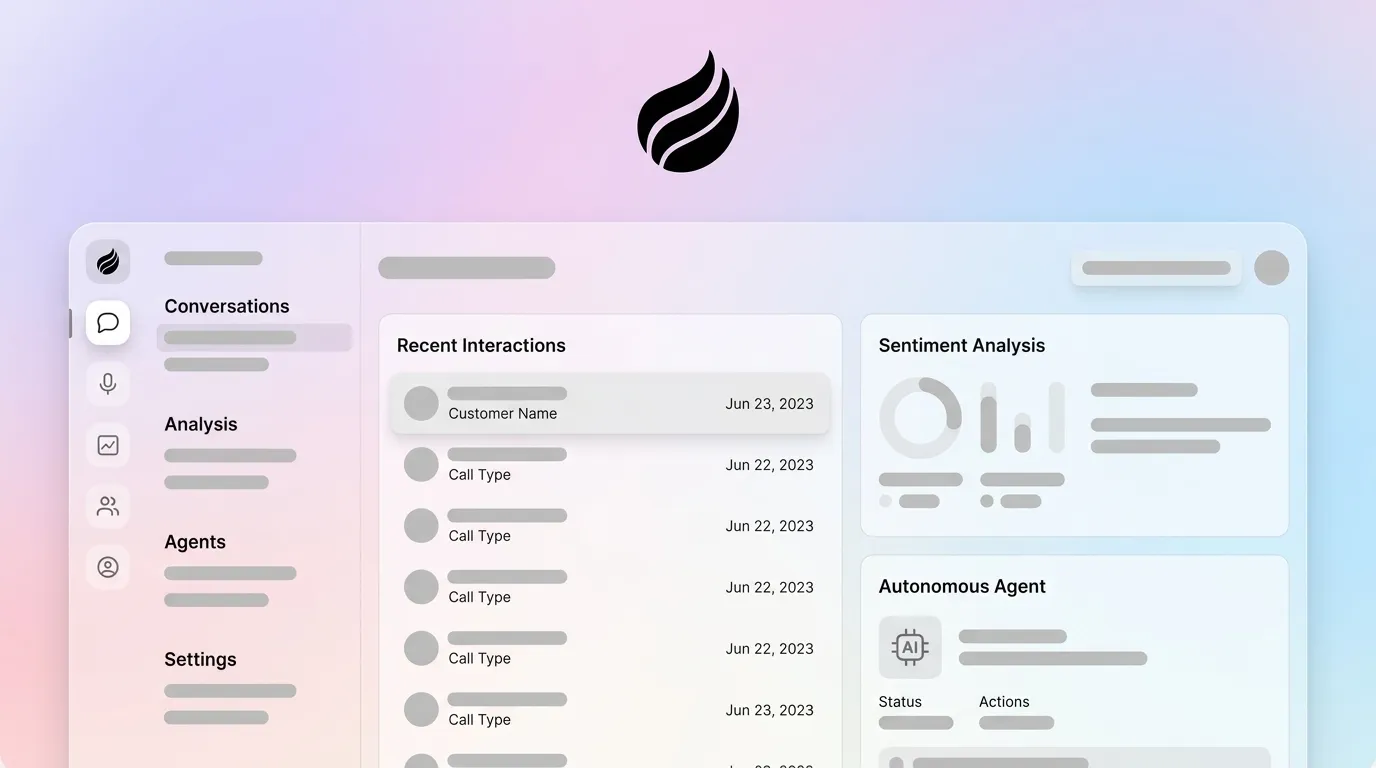
That data-clerk burden, the one highlighted in the ChatGPT section, is what Coffee’s autonomous agent removes. It ingests every interaction, structures the data, enriches contact records, and writes insights back to your CRM without requiring human review at any step. Small teams get accurate coaching signals and resolution intelligence from day one, with no manual setup, no per-minute billing surprises, and no shadow spreadsheets filling the gaps left by a passive CRM.
Put an autonomous agent to work today and stop treating your team as data clerks.