Written by: Doug Camplejohn, CEO & Co-Founder, Coffee | Last updated: August 28, 2026
Key Takeaways for Fast-Growing Sales Teams
- Agent-led CRMs automate data capture, enrichment, and logging so reps spend more time selling instead of manual entry.
- Seed-stage teams using Coffee cut data-entry time by up to 50% and convert anonymous traffic into enriched leads automatically.
- At 50–100 reps, Coffee combines CRM, sequencing, enrichment, and forecasting in one agent, reclaiming about 10 hours per rep weekly.
- Teams already invested in Salesforce or HubSpot can use Coffee’s Companion App to add autonomous data capture without migrating systems.
- Start a free trial of Coffee today and automate your revenue workflow from day one.
Seed–50 Reps: Coffee vs Attio for PLG and Light Outbound
At the seed stage, every hour a rep spends on CRM admin is an hour not spent closing. Sales reps spend an average of 5.9 hours per week on manual CRM data entry, and for a five-person team that is nearly 30 hours of lost selling time every week. The two tools best suited to this stage are Coffee and Attio.
1. Coffee (Standalone AI-First CRM) connects to Google Workspace or Microsoft 365 and immediately auto-creates contacts, logs every email and calendar event, enriches records with job titles and funding data, and generates post-meeting summaries with next steps. Nucleus Research found that AI-powered CRM data capture delivers up to 50% reduction in data entry time and raises data completeness from below 40% to above 80%. Coffee’s Visitor Identification pixel also converts anonymous website traffic into named, enriched leads, which is a critical PLG capability at this stage.
2. Attio offers a modern, flexible data model that improves on Salesforce’s rigid object structure. It is a capable passive database for small teams that prefer manual control, but it lacks an autonomous agent layer, so reps still carry the data-entry burden.
For seed-stage teams, the gap is clear. Coffee’s agent removes the manual logging loop entirely, while Attio still depends on human input to keep records current. As these teams grow, that manual gap compounds across every new rep.
Start your free trial and let Coffee’s agent handle data entry from day one.
50–100 Reps: Coffee vs HubSpot for High-Volume Outbound
At 50–100 reps, outbound volume grows faster than headcount, and admin work scales with it. Sales reps in 2026 spend approximately 8 hours per week on CRM logging and data entry before AI automation, which is the single largest category of non-selling time. The two tools best suited to this stage are Coffee and HubSpot.
1. Coffee (Standalone or Companion App) uses its Campaigns feature to run multi-step, AI-generated email sequences natively from the rep’s own mailbox with stop-on-reply logic, which replaces a dedicated sales engagement tool. The Lead Finder builds targeted prospect lists via natural language search, which replaces a standalone prospecting database. The typical revenue team reclaims 10 hours per rep per week from AI automation, equating to more than 60 days of selling time per rep per year. Coffee combines CRM, enrichment, sequencing, and forecasting in one agent, which cuts both cost and tool sprawl.
2. HubSpot is a capable mid-market option with strong inbound marketing integration. HubSpot targets mid-market companies (typically in the 20–500 or 51–200 employee range) that prioritize fast time-to-value and ease of use over deep customization. Its AI features sit on top of a 2006-era data model, so data entry remains a human responsibility unless teams add external tools.
For high-volume outbound teams, Coffee’s agent handles data entry so reps can focus on selling. Coffee’s native sequencing, enrichment, and pipeline intelligence also remove the need for a fragmented five-tool stack, which simplifies both operations and reporting.

Scaling on Salesforce or HubSpot: Coffee Companion App vs monday.com
Many scaling teams have invested heavily in Salesforce or HubSpot with custom fields, approval workflows, quota structures, and forecasting hierarchies that they cannot abandon. These teams need augmentation instead of replacement. The two tools best suited to this path are Coffee (Companion App) and monday.com.
1. Coffee (Companion App) deploys the Coffee Agent as an intelligent layer on top of an existing Salesforce or HubSpot instance. A simple authentication lets the agent sync data, enrich records, log call transcripts and meeting summaries, and write clean, structured data back to the primary CRM automatically. AI auto-capture eliminates approximately 70% of manual entry in CRMs by handling activity logging, contact association, and field population from emails, calendar events, and call recordings. Coffee also understands Salesforce and HubSpot’s quota, forecasting, and required-field logic, which newer alternatives like Clarify and Day.ai have not matched.
2. monday.com provides workflow automation and CRM-adjacent project tracking that can complement Salesforce for teams managing complex deal processes. It does not provide an autonomous data-capture agent, so CRM hygiene in the system of record still depends on human effort.
The surround-and-supercharge approach builds an intelligence layer around legacy systems that reads from the existing system, applies AI reasoning, and feeds outputs back into workflows without modifying the core application. Coffee’s Companion App follows this surround-and-supercharge model for Salesforce and HubSpot.
Pipeline Intelligence and Forecasting: Why Coffee Improves Accuracy
Forecast accuracy rises when data quality improves. 79% of B2B sales organizations miss their forecast by more than 10%, primarily due to rep optimism bias and stage inflation, with CRM data gaps (76% of records incomplete) also a major factor, and 47% of organizations cite rep subjectivity as a top issue. The root pattern is consistent: bad data in leads to bad data out.
Coffee’s built-in data warehouse captures every pipeline change historically, including deal progression, stage movement, close-date shifts, and activity gaps, without CSV exports or expensive add-on tools like Clari or Gong. The Pipeline Compare feature then visualizes week-over-week changes automatically, which turns pipeline reviews from interrogation sessions into strategic discussions.
Nucleus Research found that predictive scoring and real-time pipeline visibility in SFA platforms increased forecast accuracy by 18 to 22 percent. Gartner’s research on data hygiene suggests the ceiling is even higher, with up to 30% improvement when CRM data quality is addressed at the root. Coffee delivers both effects at once. The agent ensures good data in, and the data warehouse ensures good data out.
Legacy CRMs use basic relational databases where historical context disappears when fields are updated. Coffee’s architecture preserves that history, which makes it an agent-led solution that delivers genuine pipeline intelligence without extra infrastructure.
Motion-by-Stage Comparison: How Coffee’s Agent Scales With You
The table below shows a consistent pattern across growth stages. At every stage, Coffee’s agent architecture removes manual work that passive database CRMs still require humans to complete. This architectural difference, not feature count, determines whether a CRM only saves time or actively creates more of it.
| Growth Stage & Motion | Coffee (Agent-Led) | Passive Database Alternative | Key Agent Differentiator |
|---|---|---|---|
| Seed–50 Reps / PLG or Light Outbound | Standalone CRM, auto-creates contacts, logs activity, enriches records, identifies website visitors | Attio: flexible data model, manual entry required | Agent removes manual logging, Visitor ID converts anonymous traffic to named leads |
| 50–100 Reps / High-Volume Outbound | Standalone CRM, native Campaigns sequencing, Lead Finder prospecting, pipeline intelligence | HubSpot: strong inbound, AI features on a 2006 data model | Agent combines CRM, enrichment, sequencing, and forecasting in one platform |
| Committed to Salesforce or HubSpot | Companion App, agent writes enriched, structured data back to existing system of record | monday.com: workflow automation, no autonomous data-capture agent | Agent handles data-in for existing CRM, deep Salesforce and HubSpot quota and forecasting logic |
| Pipeline Intelligence / Forecasting | Built-in data warehouse, Pipeline Compare tracks week-over-week changes automatically | Legacy CRMs: relational databases lose historical context on field updates | Agent preserves full pipeline history, no CSV exports or add-on tools required |
How Coffee’s Agent Reclaims Selling Time Across the Workflow
Sales Management Association research states that manual CRM data entry alone costs nearly 6 hours per rep per week. HubSpot’s 2024 Sales Trends Report indicates that sales reps spend just 33% of their time actively selling, with the remainder on administrative tasks and similar activities. Coffee’s agent is built to reclaim that time by closing the loop from first touch to closed deal across five core functions.

- Automatic Data Entry and Enrichment: The agent scans emails and calendars to auto-create contacts and companies, augments records with job titles, funding data, and LinkedIn profiles, and logs last and next activity autonomously. This reduces manual CRM data entry time from 5.9 hours to 1.8 hours per rep per week while improving data completeness from 40% to over 92%.
- Meeting Intelligence: The agent joins calls via Zoom, Teams, or Meet, transcribes and summarizes the conversation, identifies next steps, and drafts follow-up emails for rep review. Outreach’s 2026 Agent Productivity Impact Report measured that AI reduces account research and meeting preparation time by 23–26 minutes per meeting, which represents roughly a 50% reduction.
- Pipeline Intelligence: The built-in data warehouse tracks all pipeline changes historically, and Pipeline Compare surfaces progressed deals, stalled opportunities, and new additions week over week without spreadsheets.
- Lead Discovery and Outreach: Lead Finder builds targeted prospect lists via natural language, and Campaigns runs multi-step email sequences natively from the rep’s own mailbox with stop-on-reply logic.
- Visitor Identification: A single tracking pixel converts anonymous website traffic into named, enriched leads with Suggested Leads that match the buyer persona, which closes the loop from pixel hit to LinkedIn outreach inside one agent.
Outreach’s 2026 Agent Productivity Impact Report found that sales reps save 4–7 hours per week using AI-powered tools by automating research, content creation, and administrative work including CRM updates. Teams running a fully integrated agent across CRM logging, meeting intelligence, and outreach sequencing consistently reach the 8–12 hour weekly savings range discussed earlier, a benchmark that single-tool pilots cannot match. Teams using three or fewer well-integrated AI tools typically achieve 3–6 hours of weekly time savings, while using five or more tools often reduces productivity due to context-switching overhead.
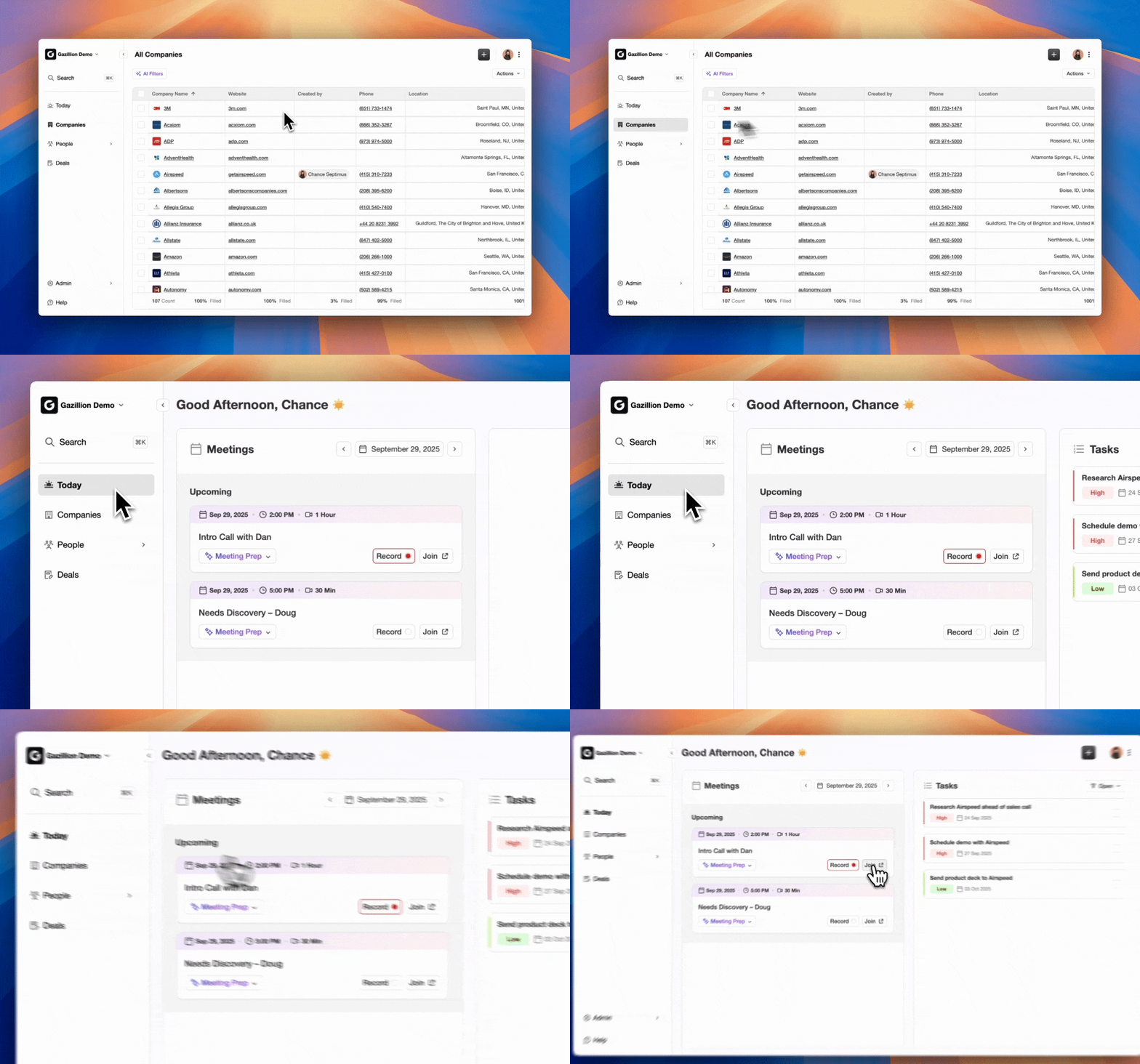
See how much time your team can reclaim, and start your free trial today.
Frequently Asked Questions
What is the difference between an agent-led CRM and a traditional CRM?
A traditional CRM acts as a passive database that stores only what humans manually enter and offers no way to capture unstructured data like email text or call transcripts. An agent-led CRM deploys an autonomous AI agent that reads from emails, calendars, and call recordings, enriches records automatically, logs every interaction, and writes clean, structured data back to the system of record without human input. Reps then work from an always-current pipeline instead of a stale database that reflects only what they remembered to log.
How much time can an agent-led CRM actually save per rep per week?
Time savings depend on how much of the data-entry process is automated and how many functions the agent covers. CRM logging automation alone saves approximately 6 hours per rep per week, which is usually the single largest time sink. Meeting note automation recovers another 3 hours by removing post-call summarization and follow-up drafting. Outreach sequencing adds roughly 2 more hours by removing the manual work of tracking who to email next and when. Together, these three categories, logging, meeting prep, and outreach, support the 8–12 hour weekly savings range that fully integrated agents deliver, while single-tool pilots that automate only one function typically deliver 3–5 hours saved per week.
Can Coffee work with an existing Salesforce or HubSpot investment?
Coffee works alongside existing Salesforce or HubSpot deployments through its Companion App model. A simple authentication lets the Coffee Agent connect to the existing instance, capture activity from emails, calendars, and call transcripts, enrich records, and write structured data back to the primary CRM automatically. Coffee understands Salesforce and HubSpot’s quota structures, forecasting hierarchies, and required-field logic, which newer agent-CRM alternatives have not yet matched. The Companion App requires no migration and no disruption to current workflows.
Why does forecast accuracy improve with an agent-led CRM?
Forecast accuracy improves when CRM data is complete, current, and consistent across reps. An agent-led CRM addresses the root cause by capturing every interaction automatically, maintaining a historical record of every pipeline change, and ensuring that the data feeding the forecast reflects ground truth rather than rep recollection. Coffee’s built-in data warehouse preserves this history, while relational database CRMs overwrite field values and lose prior context. When the data going into the forecast is complete and accurate, the forecast output improves in line with that quality.
Is Coffee secure, and does it use customer data to train AI models?
Coffee is SOC 2 Type 2 and GDPR compliant, and customer data is not used to train public AI models. For teams evaluating the Companion App path, Coffee’s agent operates with scoped access to the specific CRM objects and fields required, which aligns with least-privilege access principles recommended for AI agents layered on legacy systems. Integration is currently available via Zapier, with deeper native integrations on the product roadmap.
Conclusion: Build an Agent-Led CRM That Scales With Your Team
Passive database CRMs create a predictable failure loop where reps skip manual logging, data quality degrades, forecasts miss, and leadership loses visibility. The structural fix is not a better dashboard, but an agent that handles data entry so reps can sell.
Coffee is an agent-led CRM that supports every growth stage in two main models. For seed-to-50-rep teams, the Standalone CRM gives the agent full control of the system of record from day one. For teams at 50–100 reps running high-volume outbound, Coffee combines CRM, enrichment, sequencing, and pipeline intelligence in one platform. For teams committed to Salesforce or HubSpot, the Companion App deploys the same agent as an intelligent layer that writes clean data back to the existing system without migration, disruption, or the fragmented five-tool stack that currently costs teams about 8 hours of selling time per rep per week.
Only 7% of sales organizations achieve 90%+ forecast accuracy (Gartner). The teams that reach that level share one characteristic: good data in and good data out. Coffee’s agent is built to deliver exactly that across every stage and every stack.
Build the agent-led revenue stack your team deserves, and start your free trial.