Written by: Doug Camplejohn, CEO & Co-Founder, Coffee | Last updated: August 29, 2026
Key Takeaways for Mid-Market Sales Teams
- Mid-market teams are reevaluating Gong in 2026 because of high per-seat pricing and underused analytics depth.
- Passive note-takers like Avoma, Fireflies, Fathom, and Chorus deliver transcripts but do not autofill structured CRM fields such as MEDDIC criteria or deal-stage updates.
- Five evaluation criteria determine which Gong alternative best preserves data quality: CRM write-back depth, total cost of ownership, implementation time, data-model flexibility, and compliance.
- AI-automated CRM updates can raise data completeness above 80% in the first quarter while freeing reps to generate 41% more revenue.
- See agent-native write-back in your own Salesforce or HubSpot instance with a 14-day Coffee pilot.
How to Evaluate Gong Alternatives for AI Sales Meeting Notes Automation
Tool choice should focus on whether a platform writes critical insights back into existing Salesforce or HubSpot fields automatically after each call. Five criteria clarify that decision.
- CRM write-back depth: The strongest tools populate structured deal fields such as next steps, qualification scores, and stakeholder roles instead of attaching a single text block to the activity record.
- Total cost of ownership: Software licenses represent only 40–55% of TCO for CRM automation, while implementation, integrations, and admin time account for the rest.
- Implementation time: CRM automation integrations that use pre-built connectors typically take one to four weeks to connect AI tools to existing workflows.
- Data model: Strong candidates map AI-extracted fields to custom CRM fields without ongoing manual rep entry and handle unstructured data like transcripts alongside structured records.
- Compliance: SOC 2 Type 2 certification and GDPR compliance form the baseline, while HIPAA support matters for regulated verticals.
These five criteria directly determine whether a tool improves forecast accuracy and reduces wasted spend. When a platform meets all five requirements, the results are measurable. AI-automated CRM updates improve data completeness from below 40% to above 80% within the first quarter of deployment. That cleaner data enables AI-augmented reps to generate 41% more revenue per rep while running 18% fewer activities per month, because saved time shifts from data entry to selling. The following comparison section applies these criteria to six platforms to show which options best fit mid-market needs.
Product-by-Product Comparison of Gong Alternatives
- Coffee
Overview: Coffee is an agent-native CRM platform that runs as either a standalone CRM or a Companion App on top of Salesforce or HubSpot. The Coffee Agent actively writes structured data back to the CRM after every call instead of acting as a passive recorder.

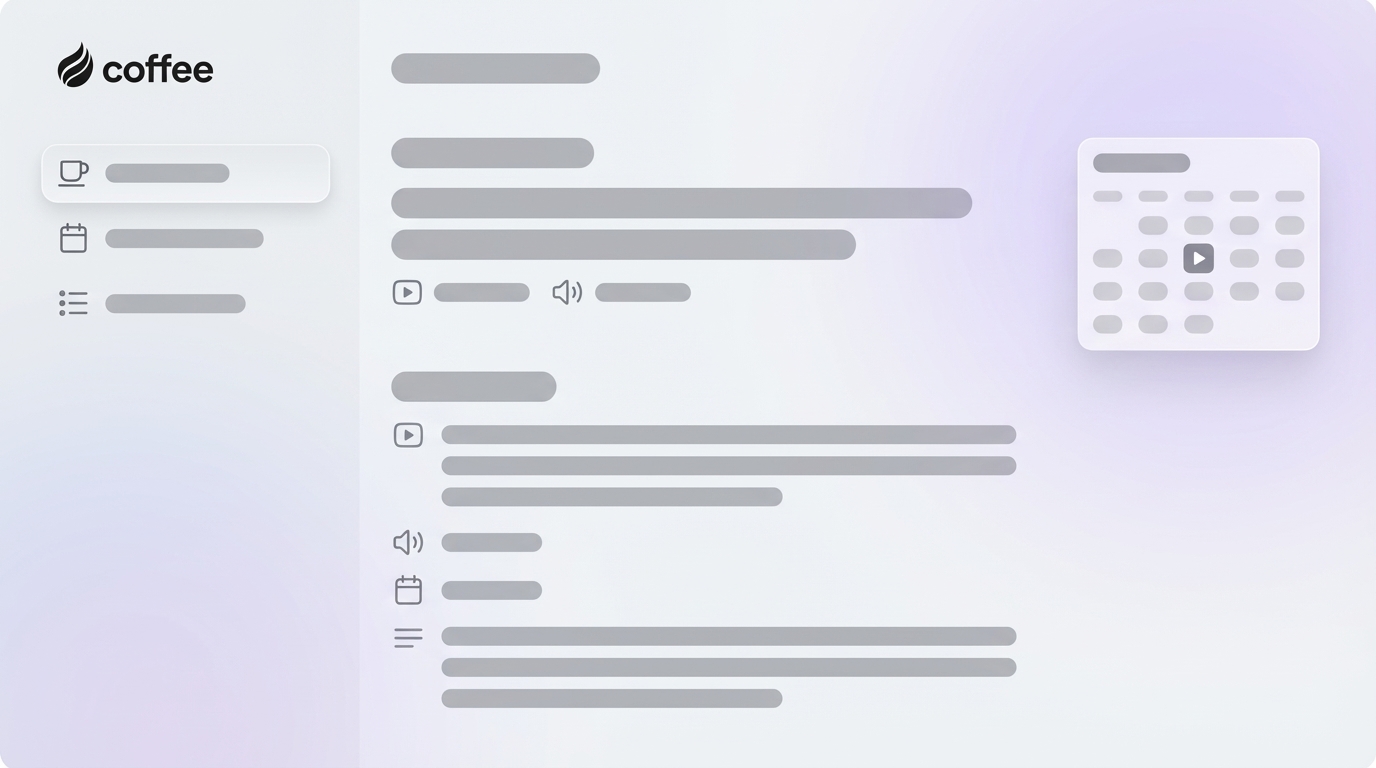
Join a meeting from the Coffee AI platform Strengths: Coffee released improved summary templates in November 2025, customizable to match workflows and writable back to Coffee, HubSpot, or Salesforce. Custom Meeting Briefings and Summaries launched in February 2026, giving teams exact control over formats from executive summaries to granular technical breakdowns. The Agent structures notes according to BANT, MEDDIC, or SPICED, logs activity autonomously, and removes manual CRM entry. Coffee expanded call recording options in January 2026 via Zapier integration with Fathom, Gong, Fireflies, and a desktop app for MacOS, Windows, and Linux, so teams migrating from Gong can ingest existing recordings without data loss.

Automated meeting prep with Coffee AI CRM Agent Limitations: Deeper third-party integrations beyond Zapier remain on the roadmap and are not yet native. Coffee does not suit large enterprises with complex custom workflows or heavily regulated industries that require multi-year security reviews.
Ideal fit: Mid-market teams with 21–200 reps on Salesforce or HubSpot that want automated field-level write-back, pipeline intelligence, and lower TCO than Gong.
Pricing overview: Coffee uses simple seat-based pricing, and the Agent’s labor is included with no complex LLM metering. See current pricing tiers for details.
Implementation & integrations: Salesforce and HubSpot connect through authentication, and the Agent begins syncing, enriching, and writing back immediately. Google Workspace and Microsoft 365 are supported. Coffee is SOC 2 Type 2 and GDPR compliant.

Create instant meeting follow-up emails with the Coffee AI CRM agent Overview: Avoma combines meeting recording, transcription, and conversation intelligence with optional revenue intelligence add-ons.
Strengths: Avoma offers solid transcription accuracy on clean audio, deal risk scoring, and competitor mention tracking.
Limitations: Avoma requires a Premium plan or higher for Salesforce and HubSpot CRM integrations. It pushes notes and competitor mentions to Salesforce and HubSpot but does not autofill structured deal fields at the depth offered by agent-native tools. Conversation intelligence and revenue intelligence are sold as separate add-ons at $29 per seat per month each when billed annually, which brings full sales functionality to around $77 per seat per month or more.
Ideal fit: Teams that want conversation intelligence and accept note-level CRM sync instead of field-level autofill.
Pricing overview: Base plans start lower, while full functionality reaches about $77 or more per seat each month with add-ons.
Implementation & integrations: Native Salesforce and HubSpot integrations are available on the Premium plan. Lower tiers still require manual CRM entry.
Overview: Fireflies is a widely adopted AI note-taker with integration support across more than 200 tools.
Strengths: Fireflies offers fast setup, a generous free tier, and a broad connector library through native integrations and Zapier.
Limitations: Fireflies.ai pushes notes and activity records to Salesforce and HubSpot but does not autofill structured deal fields such as MEDDPICC criteria, competitor fields, stakeholder properties, or deal stage updates. Its Salesforce integration logs activity but does not connect conversation data natively to pipeline, deals, or opportunity records the way a CRM-native platform does.
Ideal fit: Teams that prioritize broad tool coverage and low cost over structured CRM field automation.
Pricing overview: The Business plan at $19 per user per month billed annually delivers Salesforce and HubSpot CRM sync but does not include deal risk scoring or pipeline forecasting.
Implementation & integrations: Setup is quick, and CRM sync becomes available on the Business plan.
Overview: Fathom is known for a generous free tier and fast AI summaries that arrive in under 30 seconds after each call.
Strengths: Fathom delivers an excellent individual rep experience with free unlimited recordings and transcription.
Limitations: The free individual plan caps advanced AI summaries at five calls per month and requires the $25 per user per month Business plan for CRM field sync with Salesforce or HubSpot. Even on the Business plan, Fathom produces note-level output rather than structured autofill of MEDDPICC or BANT fields.
Ideal fit: Individual reps or small teams that need fast summaries and do not require structured CRM field automation at scale.
Pricing overview: Fathom offers a free individual plan and a Business plan at $25 per user per month for CRM sync.
Implementation & integrations: Individual setup is fast, while team-level CRM configuration requires the Business plan.
Overview: Chorus is an enterprise conversation intelligence platform that now ships as part of the ZoomInfo suite.
Strengths: Chorus provides a deep call library, coaching workflows, and integration with ZoomInfo’s data layer for enrichment.
Limitations: Conversation intelligence platforms such as Gong and Chorus record and transcribe calls and surface keywords and sentiment but leave qualification, deal review, forecasting, and asset creation to human reps. Chorus pricing is bundled with ZoomInfo contracts, which makes standalone cost comparison difficult and total cost of ownership high for many mid-market teams.
Ideal fit: Teams already in the ZoomInfo ecosystem that want call recording and coaching and do not require deep automated CRM write-back without a large data contract.
Pricing overview: Chorus is bundled with ZoomInfo and is not independently priced for mid-market evaluation.
Implementation & integrations: Salesforce and HubSpot integrations are available, and implementation complexity scales with the broader ZoomInfo contract.
Overview: Gong is the market-leading revenue intelligence platform and serves here as the cost and capability benchmark.
Strengths: Gong offers deep pipeline forecasting, rep coaching, AI-driven deal risk scoring, and a large call library.
Limitations: Gong charges $1,200–$2,400 per seat annually plus a mandatory platform fee starting at $5,000 per year, which brings first-year total cost per seat to $3,600–8,400, with a median of about $5,640 for a typical 50-rep team when implementation and services are included. Gong connects to Salesforce and HubSpot but focuses more on analytics and call recording than on automating CRM execution.
Ideal fit: Large sales organizations with dedicated RevOps teams and budget for enterprise analytics. Most mid-market teams find the cost prohibitive.
Pricing overview: See the Limitations description for the full total cost of ownership breakdown.
Implementation & integrations: As noted above, Gong’s first-year TCO reaches a median of $5,640 per seat for mid-market teams once implementation and services are included.
Side-by-Side Comparison & Tradeoffs
The table below compares tools across five dimensions. All pricing figures come from cited sources, and qualitative dimensions are explained in prose where direct unit comparison is not possible.
Dimension Coffee Avoma Fireflies / Fathom Gong Price band (per seat/month) Seat-based; see current Coffee pricing around $77+/seat with full add-ons $19–$25/seat (Business) $200–250/seat + platform fee Native Salesforce/HubSpot write-back Field-level; writable back to HubSpot or Salesforce via summary templates Note-level; no structured field autofill Note-level text blocks; no MEDDIC/BANT autofill Analytics-oriented; not execution-focused Sales methodology support BANT, MEDDIC, SPICED (agent-structured) Conversation intelligence add-on required Not supported at field level Supported via coaching dashboards Implementation time Authentication and immediate sync, live in days Days to weeks; CRM configuration on Premium plan 1–4 weeks with pre-built connectors Weeks with added change management Rep time saved (weekly) 8–12 hours with full CRM sync Partial savings; manual entry remains on lower plans Up to 5 hours on transcription alone Post-call notes reduced from 18 minutes to under 4 minutes The core tradeoff sits between breadth and depth. Fireflies and Fathom offer the lowest entry cost and fastest individual setup but still require manual effort to complete structured CRM records. Avoma adds conversation intelligence but gates full CRM sync behind higher tiers. Gong delivers the deepest analytics at a total cost of ownership that reaches $3,600–8,400 per seat in year one, with a median of about $5,640, for a 50-rep team. Coffee sits at the intersection of agent-native automation and CRM execution depth without requiring a separate analytics contract.
Compare Coffee’s agent-native automation to passive note-takers and start your pilot today.
Choosing the Right Solution for Your Organization
Tool selection should map directly to team size, CRM commitment, budget, and data-quality requirements. Use the following framework.
- Teams of 1–20 reps without an existing CRM: Coffee’s Standalone CRM deploys the Agent as the system of record and removes the need to buy and configure Salesforce or HubSpot separately.
- Teams of 21–200 reps on Salesforce or HubSpot: Coffee’s Companion App writes structured data into existing fields without replacing the CRM. Mid-market teams typically lack a five-person RevOps team to manage data hygiene manually, so agent-native automation delivers outsized impact.
- Teams needing only clean shareable notes: Fathom’s free tier or the Fireflies Business plan cover this use case at low cost, with CRM field completion remaining a manual task.
- Teams already in the ZoomInfo ecosystem: Chorus provides call intelligence through an existing vendor, though structured CRM write-back remains limited.
Total cost of ownership also matters. Mid-market HubSpot implementations typically cost $5K–$60K while Salesforce implementations cost $30K–$150K+ for proper configuration, and cheaper projects often require $40K–$80K replatforming within 18 months. A 14-day pilot on a live deal from the team’s own Salesforce or HubSpot instance offers the most reliable way to verify write-back depth before committing. Teams that score vendors on a structured evaluation framework before purchase are nearly twice as likely to sustain 80%+ active platform usage at six months compared to teams that select based on demo performance alone.
Data portability should also factor into the decision. Confirm before signing that call transcripts, CRM-mapped fields, and historical activity logs are exportable in a standard format, because this represents the primary migration risk when leaving Gong.
Implementation, Migration, and Common Pitfalls
Switching from Gong usually follows a predictable sequence. A structured rollout follows a 30-60-90 day phased plan: Days 1–30 for a controlled pilot with baseline metrics, Days 31–60 for team expansion including CRM integrations and role-specific templates, and Days 61–90 for org-wide deployment.
The most common migration mistakes include several avoidable patterns.
- Under-testing CRM write-back: Test shortlisted tools on a real deal from the team’s own Salesforce or HubSpot instance to see how each processes a call and performs field-level CRM updates. A demo environment rarely mirrors production field configurations, required fields, or quota objects.
- Ignoring rep adoption: Only 40–60% of reps remain active users of conversation intelligence tools six months after deployment without deliberate change management. Assign a rollout decision owner and define pass or fail metrics before the pilot starts to avoid pilot purgatory.
- Moving messy data without cleaning it: Approximately 90% of CRM launches fail, primarily because teams move messy data without cleaning it and fail to assign ongoing system ownership.
- Treating rollout as a single training event: Pilot programs should start with 10–20 users for 30 days, with success criteria defined upfront and feedback collected at two-week and four-week marks.
- Underestimating the planning phase: Sixty percent of AI project delays stem from unclear requirements rather than technical challenges.
For historical Gong data, export call recordings and transcripts before canceling the contract. Coffee’s Zapier integration with Gong, released in January 2026, allows ingestion of existing recordings into the Coffee Agent so teams maintain continuity.
Frequently Asked Questions
How do I verify that a Gong alternative actually writes back to Salesforce or HubSpot fields, not just attaches a note?
Run a live call through the tool on a real opportunity in your production Salesforce or HubSpot instance, not a sandbox. After the call, check whether the tool populated discrete fields such as Next Step, Close Date, MEDDIC criteria, or custom qualification fields, or whether it only created an activity record with a text block attached. Field-level write-back makes the data queryable, reportable, and usable in forecasting. A text attachment does not. Coffee’s Agent writes structured data into mapped fields automatically after every call, including BANT, MEDDIC, and SPICED frameworks, and the output appears immediately in existing CRM views.
What happens to my historical Gong data when I migrate?
Gong allows export of call recordings and transcripts before contract termination, so initiate this request at least 30 days before your renewal date to avoid data loss. CRM activity records logged by Gong, including call notes and activity history, remain in Salesforce or HubSpot after disconnecting the integration, because Gong already wrote them to your CRM. The gap affects future calls, since no new data flows in once Gong is disconnected. Coffee’s January 2026 Zapier integration with Gong lets teams route existing Gong recordings into the Coffee Agent during the transition period and maintain continuity of conversational intelligence.
How long does implementation take, and what internal resources are required?
For Coffee’s Companion App on an existing Salesforce or HubSpot instance, implementation starts with a simple authentication that allows the Agent to start syncing immediately. Most teams go live within days instead of weeks. A 30-day pilot with 10–20 reps works well as a starting point, with full team rollout in Days 31–60 and optimization in Days 61–90. Internal resource requirements stay light, usually a RevOps lead to confirm field mapping and a sales manager to monitor adoption metrics. This contrasts with a full Gong implementation, which typically involves weeks of onboarding, change management overhead, and first-year costs that reach $3,600–8,400 per seat, with a median of about $5,640, for a 50-rep team.
Does Coffee support MEDDIC and BANT qualification frameworks?
Coffee supports MEDDIC, BANT, and SPICED. The Coffee Agent structures post-call summaries and CRM write-back according to the team’s configured methodology. After each call, the Agent extracts qualification signals from the transcript and populates the corresponding CRM fields automatically, without rep input. This approach keeps qualification data consistent across every deal, rep, and call, which supports accurate pipeline forecasting and deal review. Teams can also configure Custom Meeting Summaries, launched in February 2026, to define the exact format and focus of post-call output.
When does it make sense to keep Gong rather than switch?
Gong remains a strong option for large enterprise sales organizations with more than 200 reps, a dedicated RevOps team, and budget for the $200–250 per seat per month price point. These teams often center their use case on rep coaching, call library management, and enterprise-grade forecasting analytics. If the primary bottleneck involves manual CRM data entry, incomplete deal records, or the cost of maintaining Gong alongside a separate CRM, Coffee’s agent-native approach addresses those problems more directly at lower total cost of ownership. The decision comes down to whether the team needs a coaching and analytics platform or an automation agent that removes the data entry burden.
Conclusion: Matching Gong Alternatives to Your Sales Workflow
The 2026 market for Gong alternatives splits into two categories. Passive note-takers produce transcripts and summaries but leave CRM field completion to reps, while agent-native platforms remove that manual step entirely. Seventy percent of CRM data is incomplete or outdated because updating meeting notes takes time reps do not have, and transcription accuracy alone cannot close that gap without structured write-back. For mid-market teams on Salesforce or HubSpot, the evaluation criteria stay clear: field-level CRM automation, TCO below Gong’s $200–250 per seat threshold, fast implementation, and rep adoption that does not require a heavy change management program.
The right choice depends on the team’s specific bottleneck. Teams that need only clean notes can start with Fathom or Fireflies at low cost. Teams that need structured CRM execution, including qualification scores, next steps, stakeholder fields, and pipeline intelligence written automatically after every call, need an agent rather than a recorder.
Ready to cut Gong spend while keeping clean CRM records? Get started with Coffee.