Written by: Doug Camplejohn, CEO & Co-Founder, Coffee | Last updated: July 20, 2026
Key Takeaways
- An AI-first CRM interaction history automatically captures and enriches every interaction from emails, calendars, and calls without manual rep input.
- The system replaces passive databases with a living memory layer that extracts sentiment, commitments, and next-best actions in real time.
- Structured enrichment enables reliable semantic search and accurate pipeline forecasting that legacy CRMs cannot deliver.
- Coffee offers both standalone CRM and companion-app deployments to improve data quality on top of Salesforce or HubSpot.
- Teams ready to eliminate manual CRM entry can get started with Coffee today.
Why Legacy CRMs Struggle With Reliable Interaction History
Legacy CRMs like Salesforce and HubSpot operate as passive databases that store whatever a human decides to enter. Salesforce launched Einstein GPT in March 2023, followed by Agentforce in September 2024 and Agentforce 2.0 in December 2024. These releases add AI features on top of a 25-year-old relational architecture, but they do not replace the underlying memory layer. The system still depends on human entry to populate the records that AI then analyzes.
The cost of that dependency is measurable. Field sales reps spend five or more hours per week on manual CRM data entry alone according to field sales research. The Salesforce State of Sales report shows that reps spend a large portion of their time on non-selling tasks, including manually entering customer notes. Agent-driven systems invert this model by making the software responsible for data quality rather than the rep. This inversion becomes real through a different approach to building interaction history.
AI-First CRM Interaction History Timeline
An AI-first interaction history timeline is built through three sequential operations that run without rep involvement.
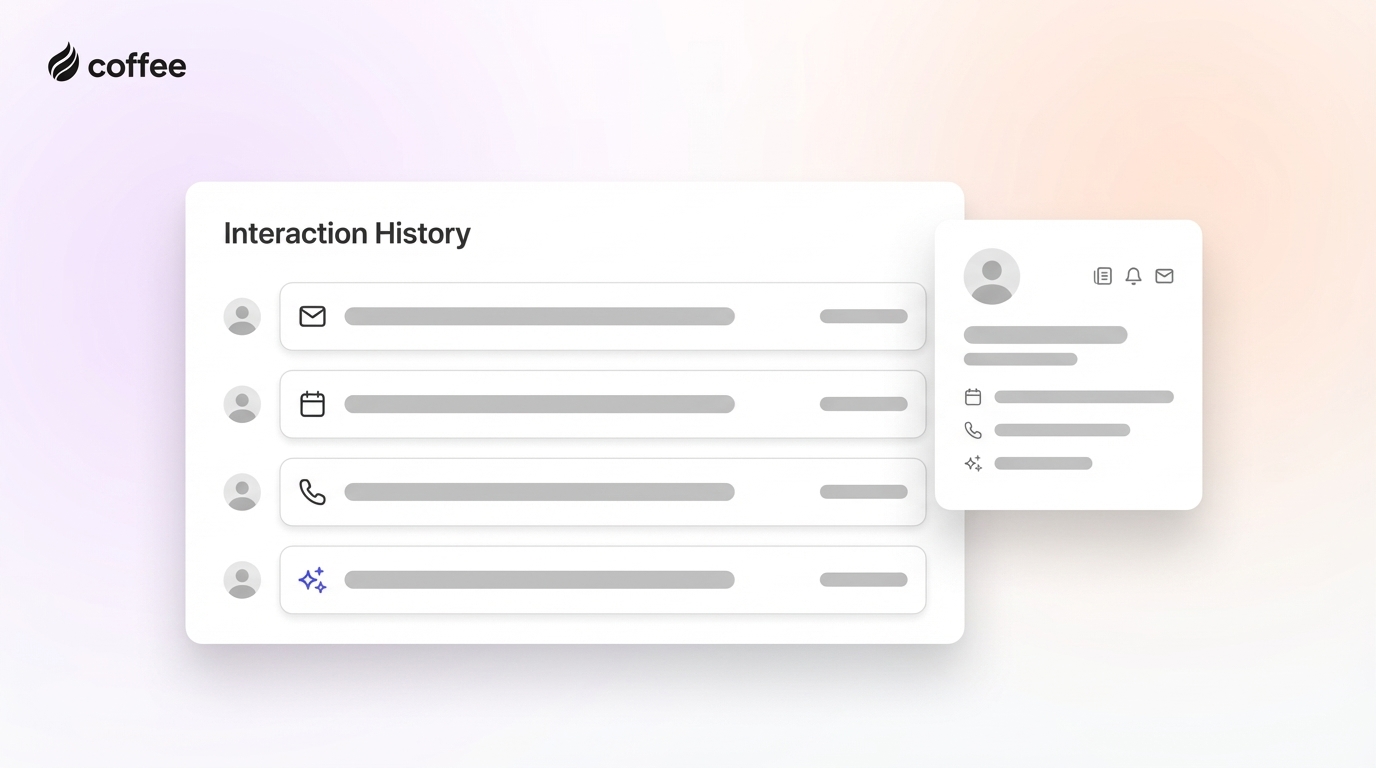
Automatic capture begins the moment a rep connects their Google Workspace or Microsoft 365 account. The agent scans emails and calendar events to create contact and company records, logs last and next activity autonomously, and joins calls via Zoom, Teams, or Meet to record and transcribe in real time. According to Gong, AI-extracted meeting data is 3.2x more complete than rep-entered notes. Automatic capture removes recall bias and omission that limit manual logging.
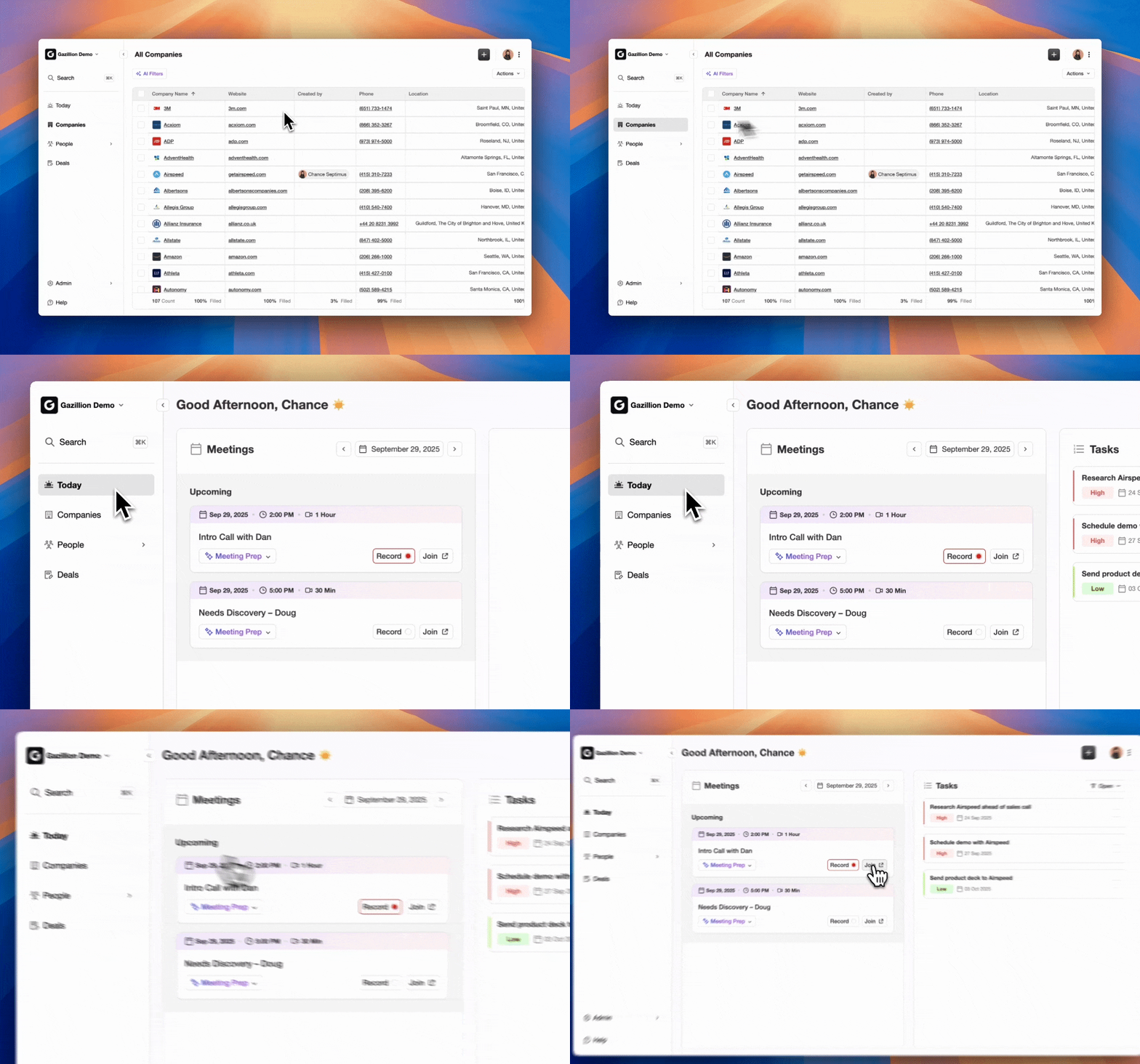
Enrichment converts raw transcripts into structured fields. The agent extracts sentiment, explicit commitments (“I’ll send the pricing sheet by Tuesday”), competitive mentions, budget ranges, and buying stage. Each item is stored as a typed property with a confidence score instead of free text. Automated extraction from call transcripts improves capture rates of key information like budget in structured CRM fields.

Semantic search makes the enriched timeline queryable in plain English. A rep or manager can ask for enterprise deals that mentioned API reliability as a blocker in the last 30 days. The system returns a ranked list of relevant records instead of a keyword-matched log dump.
How Coffee’s AI Agent Handles Every Interaction
The Coffee Agent follows a four-step operational loop for every interaction.

- Pre-meeting briefing: The agent surfaces a Today page with attendee roles, funding context, and a summary of prior interactions drawn from the structured memory layer.
- Live capture: The agent joins the call, records, and transcribes. No rep action is required.
- Post-call enrichment: Within minutes of call end, the agent generates a structured summary, identifies next steps with named owners and dates, extracts sentiment signals, flags competitor mentions, and drafts a follow-up email in Gmail for rep review. This approach reduces per-interaction logging time because reps review and correct instead of writing from scratch.
- CRM write-back: All enriched fields are written directly to the system of record, whether Coffee’s own data warehouse, Salesforce, or HubSpot. These entries appear as logged activities that power reports, dashboards, and automations instead of sitting unused in a sidebar.
Structured Memory Compared With Traditional Call Logs
The table below contrasts a traditional manually logged interaction record with an AI-enriched record produced by the Coffee Agent. All data points reflect capabilities described in the background research.
| Attribute | Traditional Manual Log | AI-Enriched Coffee Record | Business Impact |
|---|---|---|---|
| Data source | Rep memory, typed after the call | Live transcript, email, calendar | Eliminates recall bias and omission |
| Completeness | Limited fields populated | Most fields populated | Can improve forecast accuracy |
| Sentiment captured | None (or informal rep note) | Structured sentiment score per interaction | Flags at-risk deals before stage change |
| Commitments tracked | Buried in free-text notes | Typed field with owner, date, confidence score | Enables automated follow-up triggers |
The following table shows a single enriched interaction record as the Coffee Agent structures it.
| Field | Extracted Value | Confidence | AI-Generated Next Action |
|---|---|---|---|
| Sentiment | Cautiously positive; concern flagged on implementation timeline | 0.87 | Address timeline objection in follow-up email within 24 hours |
| Commitment | Prospect to share security questionnaire by Friday | 0.93 | Auto-reminder task created for rep on Thursday |
| Budget range | $80,000–$100,000 annually | 0.91 | Update deal value field, flag to manager for forecast inclusion |
| Competitive mention | Evaluating one incumbent vendor | 0.88 | Surface competitive battlecard, log to deal intelligence layer |
These structured fields, such as sentiment scores, commitments with confidence levels, and budget ranges, improve more than record completeness. They also unlock a new way to query and understand your pipeline.
Semantic Search Across Structured Sales History
Clean structured memory is the prerequisite for reliable semantic search. When interaction records contain typed fields such as sentiment scores, budget ranges, buying stage, and named commitments, a natural language query can traverse the entire pipeline instead of scanning unstructured notes. A manager can ask which deals in the enterprise segment have an unresolved security objection and a close date this quarter. The system returns a deterministic answer drawn from schema-enforced fields instead of a probabilistic match against free text.
Schema-enforced memory enables non-LLM systems to filter entities by memory content and aggregate across entities via direct database queries rather than semantic search or additional LLM processing. This distinction matters for teams that need forecasting outputs they can audit. Deals with more structured enrichment fields in their CRM records at the time of proposal tend to achieve higher win rates.
Pipeline Intelligence and Next-Best Actions From One Memory Layer
The Coffee Agent captures history in a built-in data warehouse, so pipeline intelligence flows directly from the memory layer instead of a separate analytics product. The Pipeline Compare feature visualizes week-over-week changes such as progressed deals, stalled opportunities, and new additions. Managers no longer need CSV exports or manual review sessions.
Next-best-action recommendations use the same structured memory. When the agent detects that a commitment deadline has passed without a response, or that sentiment has shifted negative across two consecutive interactions, it surfaces a recommended action with the relevant context already attached. This completeness gap in captured data directly determines whether next-best-action outputs are trustworthy or speculative.
Assess your current CRM data quality and get started with Coffee.
Choosing Between Coffee Companion App and Standalone CRM
Coffee offers two deployment models that align with different team sizes and CRM maturity.
The Standalone CRM serves companies with 1–20 employees that have outgrown spreadsheets but view legacy CRMs as expensive maintenance burdens. The Coffee Agent powers the entire system of record, managing contacts, activities, and pipeline from a single interface. Teams do not need separate Salesforce or HubSpot licenses.
The Companion App deploys the Coffee Agent as an intelligent layer on top of an existing Salesforce or HubSpot instance. A simple authentication allows the agent to sync data, enrich it, and write structured fields back to the primary CRM. This model fits teams of 10–50 that remain committed to their existing system of record but struggle with low adoption and poor data quality. Newer AI-native CRM alternatives like Day.ai and Clarify lack the depth required for Salesforce and HubSpot integrations, including required fields, quota management, and forecasting sync. Coffee’s Companion App treats those integration realities as first-class constraints, not afterthoughts.
Management-level respondents often cite ensuring high-quality data for AI as a key challenge when adopting AI features. The Companion App addresses this challenge by making the agent responsible for data quality rather than the rep.
Implementation Checklist for Sales Teams
Teams of 10–50 evaluating an AI-first interaction history system should assess readiness across four dimensions before deployment.
- Current stack audit: Identify all tools generating interaction data, including email, calendar, call recording, and enrichment. Confirm whether each tool can be replaced or connected through the agent. This audit reveals which data sources the agent can consolidate and which integration points need attention.
- Data quality baseline: Measure current CRM field completion rates using the tools identified in your stack audit. No figure for the percentage of opportunity data that never enters the CRM appears in the SPOTIO Field Sales Report 2026, so a baseline measurement becomes the first diagnostic step.
- Deployment model selection: Decide whether the team needs a full system-of-record replacement through the Standalone CRM or an enrichment layer on an existing Salesforce or HubSpot instance through the Companion App. This decision should reflect both stack audit findings and internal appetite for change.
- Change-management capacity: Confirm that the Head of Sales or RevOps manager has bandwidth to run a 30-day parallel period. They also need time to communicate the shift from manual logging to agent-driven capture to the rep team and reinforce new habits.
Common Pitfalls When Improving CRM Interaction History
Several failure modes recur when teams attempt to improve interaction history quality without an autonomous agent.
Manual workarounds create the same data-quality problem they aim to solve. 37% of staff admit to fabricating CRM data when facing too many required fields, according to a Validity report. Fabricated data makes forecasting outputs unreliable regardless of the AI layer applied on top.
Shadow CRMs appear when reps find the primary system too burdensome. Spreadsheets and Notion documents become the real workspace, and the CRM turns into a compliance artifact instead of a strategic tool. The agent model removes the incentive for shadow systems by eliminating the data-entry burden.
Integration gaps undermine structured memory when interaction data from calls, emails, and calendars flows into separate point solutions that never write back to the system of record. Many sales leaders with AI report that tech silos delay or limit their AI initiatives, according to industry reports. Consolidating capture, enrichment, and write-back into a single agent closes the same reliability gap created by fabricated or missing data.
Frequently Asked Questions
Is Coffee secure, and does it meet compliance requirements?
Coffee is SOC 2 Type 2 certified and GDPR compliant. Interaction data captured by the agent is not used to train public AI models. The platform supports profile-level data deletion and retention policies to meet GDPR and CCPA requirements. Every observation the agent stores is traceable to its source conversation, which provides the auditability that compliance teams and customers exercising data rights require.
How does Coffee’s enrichment data quality compare to dedicated tools like ZoomInfo or Apollo?
Coffee’s agent provides enrichment data roughly on par with dedicated enrichment tools for most use cases. Data is sourced through licensed data partners and augmented by extraction from internal signals such as call transcripts and emails. Because the agent extracts structured fields continuously from live interactions instead of relying on periodic bulk imports, the data reflects current reality. Traditional bulk enrichment data decays at an industry-estimated 2–3% per month, reaching roughly 25% staleness after one year. AI-extracted data from ongoing transcripts shows significantly lower staleness because it updates in real time as prospects share new information.
Does Coffee integrate with tools outside of Salesforce and HubSpot?
Coffee currently supports integrations via Zapier, which connects the agent to a broad range of third-party tools. Deeper native integrations are on the product roadmap. For teams running Google Workspace or Microsoft 365, the agent connects directly upon authentication and begins capturing interaction data immediately without additional configuration.
How is Coffee priced?
Coffee uses seat-based pricing. You pay for the human seats on your team, and the agent’s labor, including unlimited data capture, enrichment, meeting management, and pipeline intelligence, is included in the seat cost. There is no complex metering on LLM usage or automated processes, so the cost structure stays predictable for teams of 10–50.
How long does it take to see value after deploying Coffee?
The agent begins capturing and enriching interaction data immediately after connecting email and calendar accounts, so CRM records start populating within the first session. Teams typically see measurable improvements in data completeness and rep time savings within the first week. The Pipeline Compare feature becomes meaningful once the agent has tracked at least one week-over-week pipeline cycle, giving managers a structured view of deal movement without manual review preparation.
Evaluation Criteria and Next Steps
Teams evaluating an AI-first CRM interaction history system should assess four criteria:
- The completeness of automatic capture across email, calendar, and calls
- The structure and queryability of enriched records
- The depth of integration with existing Salesforce or HubSpot instances, including required fields and forecasting sync
- The security and compliance posture of the memory layer
Coffee meets each criterion through its dual deployment model, schema-enforced enrichment, and SOC 2 Type 2 and GDPR compliance. The starting point for any evaluation is an honest assessment of current CRM data quality, including field completion rates, forecast accuracy, and rep time spent on manual entry. Teams can then measure the impact of any new system against that baseline.
Assess your current CRM data quality and get started with Coffee.