Written by: Doug Camplejohn, CEO & Co-Founder, Coffee
Key Takeaways for Coffee, DeckRobot, and Lightfield
- Sales teams lose 71% of time to data entry. Coffee’s autonomous agent saves 8–12 hours weekly through full CRM automation.
- DeckRobot excels at automated pitch deck generation with about 60% prep time reduction but offers only shallow CRM integrations.
- Lightfield delivers immersive VR sales narratives but requires dedicated hardware and lacks comprehensive data management.
- Coffee unifies data automation, meeting briefings, and pipeline intelligence, outperforming specialized tools in ROI and scalability for SMB and mid-market teams.
- See how Coffee’s agent-powered CRM unifies your stack beyond DeckRobot or Lightfield and improves ROI from your existing tools.
How DeckRobot and Lightfield Support Modern Sales Teams
DeckRobot specializes in automated pitch deck generation and customization, pulling data from CRM systems to create personalized presentations. The platform targets sales teams that need high-volume deck production with consistent branding and messaging. DeckRobot’s core value lies in reducing manual deck preparation time while maintaining quality and personalization.
Lightfield takes a different approach and focuses on AI-powered sales narratives and immersive VR simulations for complex B2B demonstrations. The platform creates interactive 3D experiences that help sales teams visualize products and solutions during customer presentations. Lightfield’s strength comes from turning traditional static presentations into engaging, memorable experiences.
Sales teams evaluate these tools using specific criteria such as deck preparation speed, data accuracy from CRM integration, time savings, and pipeline visibility improvements. DeckRobot users report 60% less preparation time per deck, while Lightfield users see stronger customer engagement through immersive demonstrations.
Both platforms address a core sales enablement challenge. They convert raw CRM data into compelling customer-facing materials. They also depend on clean, well-structured data inputs, which highlights the need for robust data management systems in modern sales stacks.
Detailed Product Breakdowns for Coffee, DeckRobot, and Lightfield
To understand how each platform handles data and enablement challenges, this section examines their core capabilities, ideal use cases, and limitations. This breakdown shows why strong data quality underpins every successful sales automation initiative.
Coffee: Agent-Powered CRM for Unified Sales Data
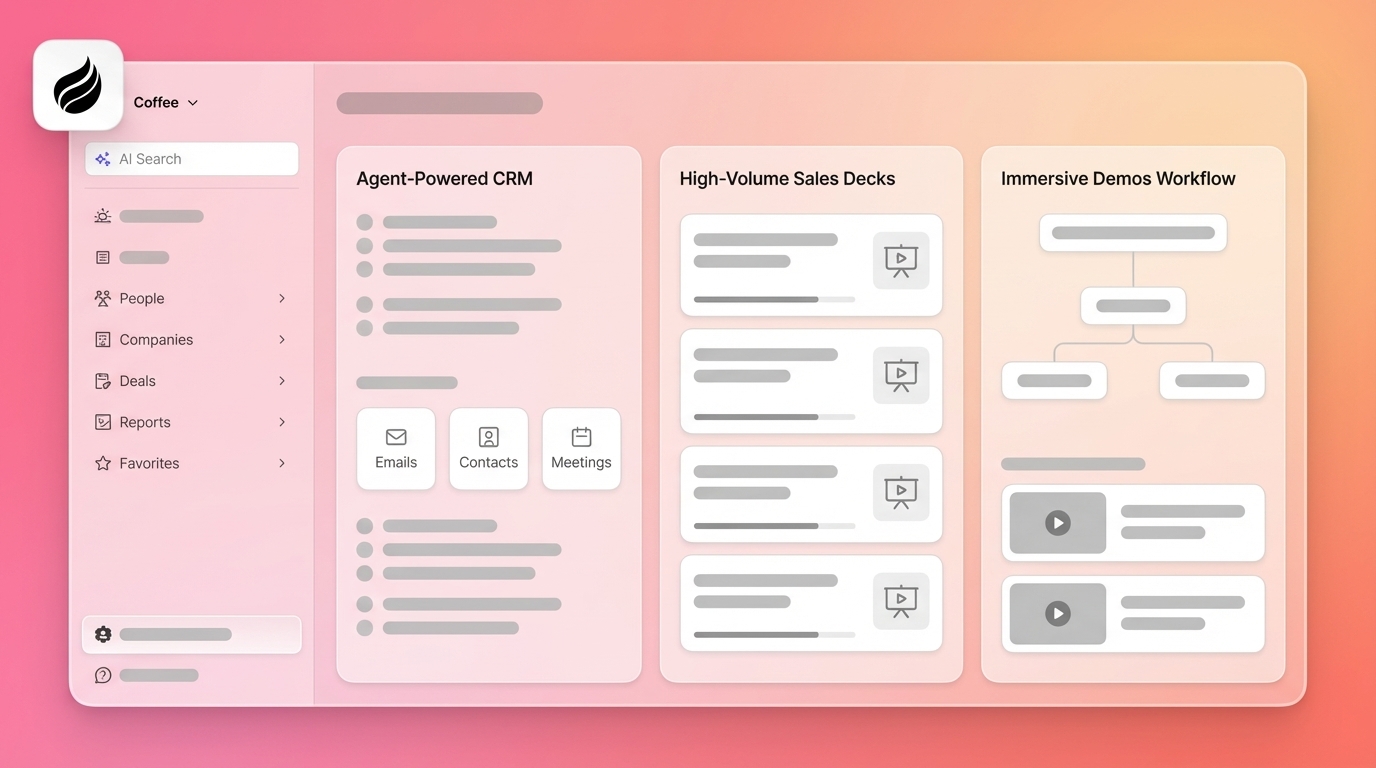
Coffee operates as an autonomous agent that solves the fundamental CRM problem by automating data entry and improving data quality. It is available as a Standalone CRM for small businesses and as a Companion App for existing Salesforce or HubSpot installations. Coffee’s agent handles the labor of putting good data in so teams consistently get reliable data out.

Coffee’s core strengths center on eliminating manual sales work through autonomous data management. The agent delivers the weekly time savings mentioned above by automatically creating contacts and companies from email and calendar data, enriching records with professional information, and logging all sales activities without human intervention. This clean data foundation enables intelligent meeting orchestration with briefings and summaries. Pipeline comparison features then remove the need for manual reporting by using the agent’s complete activity capture. Together, these capabilities reduce tool fragmentation by unifying functions that usually require several separate tools.

The platform’s current focus sits with small to mid-market companies rather than very large enterprise deployments. Coffee’s ideal customer profile includes SMB and mid-market teams that struggle with CRM adoption, data quality issues, and fragmented sales stacks. The pricing model uses simple seat-based billing with unlimited agent labor included.
Coffee integrates natively with Salesforce and HubSpot, Google Workspace, Microsoft 365, and hundreds of tools through Zapier. The agent unifies capabilities that DeckRobot and Lightfield provide separately and delivers comprehensive sales automation that addresses root data quality issues.
DeckRobot for High-Volume Sales Deck Production
DeckRobot targets enterprise sales teams that need high-volume deck production with consistent quality and personalization. The platform scores 9.2/10 in G2’s 2025 Sales Tech Grid for presentation automation, reflecting strong user satisfaction with its AI-driven pitch personalization.
Key strengths include real-time deck customization based on CRM data, advanced AI-powered pitch personalization, and intuitive automation that requires minimal training. This preparation efficiency translates to 18% quota attainment uplift, with users reporting $100K+ annual productivity gains from streamlined deck workflows.
DeckRobot’s limitations include shallow CRM integrations compared to more comprehensive platforms and a strong dependency on clean input data for best performance. The platform works best for teams with standardized pitch processes and consistent data hygiene practices.
The ideal customer profile includes enterprise sales organizations focused on high-volume deal closing with standardized pitches, teams that require consistent branding across many presentations, and organizations with established CRM data quality processes.
Lightfield CRM Sales Workflow for Immersive Demos
Lightfield specializes in immersive VR sales simulations and AI-powered narrative creation for complex B2B demonstrations. The platform achieves an 8.7/10 rating for VR capabilities with basic Salesforce and HubSpot connectivity, which makes it suitable for enterprise sales environments that rely on interactive 3D experiences.
Lightfield’s primary strengths include dynamic story creation that adapts to customer contexts, immersive VR demonstrations that increase customer engagement, and CRM integration that keeps data synchronized across platforms. The platform excels at turning complex technical products into understandable visual experiences.
Significant limitations include hardware requirements that limit scalability for remote teams and a higher total cost of ownership due to hardware and software components. The strong VR focus may not fit every sales scenario or customer preference.
Lightfield’s ideal customer profile includes enterprise sales teams with complex B2B demos, organizations selling technical products that require visualization, and companies with dedicated IT support for VR hardware management. The platform works best for high-value, long-cycle sales processes where immersive demonstrations create a clear competitive advantage.
Side-by-Side Comparison Table and Tradeoffs
The following table highlights how each platform handles four critical sales capabilities. It shows where Coffee’s comprehensive automation contrasts with DeckRobot’s and Lightfield’s more specialized focus.
| Capability | Coffee | DeckRobot | Lightfield |
|---|---|---|---|
| Data Automation | Full autonomous agent | Basic deck data sync | Automated data ingestion |
| Deck/Narrative Generation | AI-powered meeting briefings and summaries | Advanced deck customization | Dynamic narrative creation |
| CRM Enrichment | Automatic contact/company creation | Limited enrichment features | Basic CRM synchronization |
| Pipeline Intelligence | Week-over-week comparison | Deck performance tracking | Demo engagement metrics |
DeckRobot wins in specialized deck automation, and Lightfield excels in immersive customer experiences. Both platforms still depend on Coffee’s data foundation to reach full potential. Coffee provides the weekly time savings mentioned earlier by addressing root data quality issues that limit other tools’ effectiveness.
The 2026 tradeoffs center on AI maturity compared with specialized functionality. Coffee’s agent-first approach delivers comprehensive automation across the sales workflow. DeckRobot and Lightfield offer deep specialization in narrow use cases. Cost-value comparisons favor Coffee’s unified approach over fragmented point solutions.
Sales Workflow Impact, ROI, and Recommended Stacks
Effective workflow combinations pair DeckRobot for quarterly business reviews with Coffee’s data automation, or Lightfield for customer calls with Coffee’s meeting summaries and follow-up automation. Coffee’s ROI advantage comes from this substantial time elimination and delivers productivity gains comparable to DeckRobot’s while providing broader automation coverage.

Recommended technology stacks position Coffee as the core data and automation layer, with DeckRobot or Lightfield as specialized presentation tools. This structure maximizes each platform’s strengths while protecting data quality and workflow efficiency. Teams should choose Coffee when comprehensive data automation and pipeline visibility matter more than highly specialized presentation features.
Start automating your sales stack with Coffee to achieve superior ROI through unified data intelligence and presentation capabilities that remove the need for multiple specialized tools.
Implementing Coffee and Avoiding Common Pitfalls
Coffee implementation uses simple one-click authentication with existing CRM and email systems, which enables immediate data automation without complex setup. Most teams complete onboarding in under 30 minutes, and the agent begins capturing and enriching data as soon as connections are active.
Common pitfalls include skipping data audits before implementation, even though Coffee’s agent automatically identifies and fixes many data quality issues during onboarding. Teams should also avoid running Coffee in parallel with full manual data entry during the first two weeks, because this can create duplicate records and confuse the agent’s learning. Finally, leaders should ensure that all team members connect their email and calendar within the first week so the agent has enough context to reach maximum accuracy.

Frequently Asked Questions
What are the pricing differences between DeckRobot and Lightfield for sales teams?
Both platforms use seat-based pricing models, with DeckRobot offering quick payback periods for enterprise teams. Lightfield requires additional hardware investments for VR capabilities, which increases total cost of ownership. Coffee provides a more cost-effective option by consolidating multiple tool functions into a single agent-powered platform and removing the need for separate deck automation and data management tools.
Which platform is best for sales deck automation in 2026?
Coffee combined with DeckRobot delivers strong results by ensuring clean data inputs for advanced deck customization. Coffee’s autonomous agent manages data quality and CRM automation, while DeckRobot focuses on presentation excellence. This combination removes the data quality issues that limit standalone deck automation tools and still maximizes presentation impact.
How do Lightfield’s CRM integrations compare to other platforms?
Lightfield offers basic Salesforce and HubSpot connectivity, which is stronger than DeckRobot’s shallow CRM connections. However, Lightfield does not match the comprehensive data automation that Coffee provides. Coffee’s agent-powered approach delivers deeper CRM integration by actively managing data entry, enrichment, and pipeline intelligence instead of simple synchronization.
Why choose Coffee over DeckRobot and Lightfield for pipeline management?
Coffee’s autonomous agent delivers superior pipeline intelligence through continuous data capture and analysis. DeckRobot tracks deck performance, and Lightfield measures demo engagement. Coffee goes further by providing full pipeline visibility with week-over-week comparisons, automatic activity logging, and predictive insights. The agent removes manual reporting and gives sales leadership actionable intelligence.
What are the key 2026 updates for sales automation platforms?
Coffee leads 2026 sales automation with agent-powered stack unification that removes the need for multiple specialized tools. DeckRobot and Lightfield continue to improve their specific capabilities, but Coffee’s comprehensive approach addresses the core data quality challenge that limits all other platforms. The shift toward autonomous agents marks the future of sales technology and moves teams from passive tools to active workforce augmentation.
Conclusion: Why Coffee Anchors the Modern Sales Stack
Coffee’s autonomous agent unifies and outperforms specialized tools like DeckRobot and Lightfield by solving the data quality problem that limits most sales technology. DeckRobot excels in deck automation, and Lightfield delivers immersive experiences, yet both depend on the data foundation and workflow automation that Coffee provides. Experience Coffee’s autonomous agent approach and see how agent-powered intelligence delivers superior ROI and comprehensive automation compared with specialized point solutions.