Tie timeline to a compelling regulatory or fiscal event
Average B2B sales cycle lengthened to 6.7 months in 2025 from 4.9 months in 2019
Lead Discovery with Need
Buyers complete about 70% of their B2B journey independently before contacting vendors, so they arrive at first contact already committed to a shortlist. Direct budget questions at that stage feel transactional and erode trust. Starting with Need keeps the focus on business impact, which later supports budget creation.
Use these AI-ready discovery scripts in a sequence that moves from process to time cost to outcomes. Start with a process-level question to surface operational pain: “Walk me through what your current process looks like when a deal stalls in the pipeline, what data are you missing, and what does that cost you per quarter?” Then quantify the time cost: “If you could eliminate one manual step your team does today before every forecast call, what would it be and how many hours a week does it consume?” Finally, anchor the conversation to business outcomes: “What is the business outcome you are trying to achieve in the next two quarters that prompted this conversation?”
AI processes qualification signals quickly and accurately compared to manual note taking. That speed matters when Need shifts mid-cycle and you must adjust qualification in real time.
Agent in Action: Coffee’s Agent joins every discovery call, transcribes the conversation in real time, and structures Need notes against BANT criteria in Salesforce or HubSpot. Reps skip manual entry, and gaps surface immediately so they can re-engage before the deal advances.
Join a meeting from the Coffee AI platform
Let Coffee’s Agent handle Need qualification automatically on every discovery call.
Map the Buying Committee in Detail
Once you establish the business need, the next step is identifying who will evaluate and approve the solution. Buying committees now involve 6–10 stakeholders according to Gartner 2024 data, and 74% of buying teams experience internal conflict before reaching consensus. Treating Authority as a simple yes or no check leads to inaccurate forecasts and missed deals.
Modern Authority qualification maps five roles that work together across the committee. The Economic Buyer holds budget approval authority and signs off on spend. The Technical Evaluator checks stack fit and security so the solution can pass review. End Users validate day-to-day usability and adoption risk. The Champion advocates internally and spends political capital to move the deal forward. The Blocker surfaces objections that can stall or kill the deal, which you must address early.
Use these scripts to map the committee in a logical flow. Start by expanding beyond your contact: “Beyond yourself, who else will be evaluating this decision, and who has the final sign-off on budget?” Then identify end users: “Who on your team would be most affected day-to-day, and have they been involved in conversations like this before?” Finally, uncover potential blockers: “Is there anyone internally who might push back on a change like this, and what would their concern typically be?”
Identifying a Champion early reduces the risk of losing enterprise deals in the decision stage because you gain an internal guide through the committee.
Agent in Action: Coffee’s Agent enriches every contact mentioned on a call by pulling job titles, LinkedIn profiles, and org relationships. It then writes structured committee maps back to the CRM record, so RevOps sees a live view of every stakeholder without manual updates.
Build people lists automatically with Coffee AI CRM Agent
Turn Budget into a Shared Business Case
Many B2B buyers now require a formal business case for tech investments. Budget often does not exist as a pre-allocated line item for new SaaS tools, and it gets created once the ROI case is strong enough to justify reallocation. With AI spend more than tripling year-over-year, AI-related budget conversations now appear in almost every tech evaluation.
Use these scripts to build the business case with your buyer instead of asking for a number. Start by surfacing current spend: “What are you currently spending, in tools, headcount, or time, to solve this problem today?” Then align on ROI expectations and audience: “If we could show a 3-month ROI, which internal stakeholder would need to see that model, and in what format?” Finally, clarify funding source: “Is this coming from an existing software budget, a new AI initiative line, or would it require a new approval?”
Agent in Action: Coffee’s Agent captures every budget signal mentioned on a call, such as funding source, approval chain, and ROI threshold. It logs these as structured data in the CRM opportunity record, so forecast models reflect real budget status instead of rep assumptions.
Use these scripts to anchor Timeline to compelling events. First, look for hard deadlines: “Is there a board review, fiscal year-end, or compliance deadline that makes solving this by a specific date critical rather than optional?” Then explore operational impact: “What happens to your team if this problem is not resolved before Q3 planning kicks off?” Finally, quantify delay: “If the evaluation runs longer than expected, what is the cost of delay in concrete terms, such as revenue, headcount, or risk?”
Buying cycles vary when external advisors or legal teams get involved, so early timeline anchoring becomes a material forecasting variable that your CRM should capture.
Agent in Action: Coffee’s Agent flags timeline mentions in call transcripts, maps them to CRM close date fields, and alerts RevOps when a stated deadline conflicts with the current projected close. Teams see risk before the deal slips.
Keep Qualification Continuous, Not One-and-Done
Continuous qualification protects your forecast from data decay. A single BANT check at discovery captures a snapshot of a moving target. AI helps combat data decay rates of 22.5% to 70.3% annually by continuously validating lead information. Budget gets reallocated, Champions leave, and timelines shift when new compliance requirements surface. Continuous qualification catches these changes before they turn into forecast errors.
Agent in Action: After every call, email, and meeting, Coffee’s Agent re-scores each BANT dimension against the latest interaction data and surfaces qualification gaps directly in the pipeline view. Heads of Sales gain a continuously validated forecast without interrogating reps.
Replace static qualification snapshots with Coffee’s continuously validated pipeline view.
Agent in Action: Coffee’s Agent structures call notes against BANT, MEDDIC, or SPICED based on the deal profile configured in the CRM. The right framework gets applied every time without rep discretion introducing variability.
How Coffee’s AI Agent Runs BANT for You
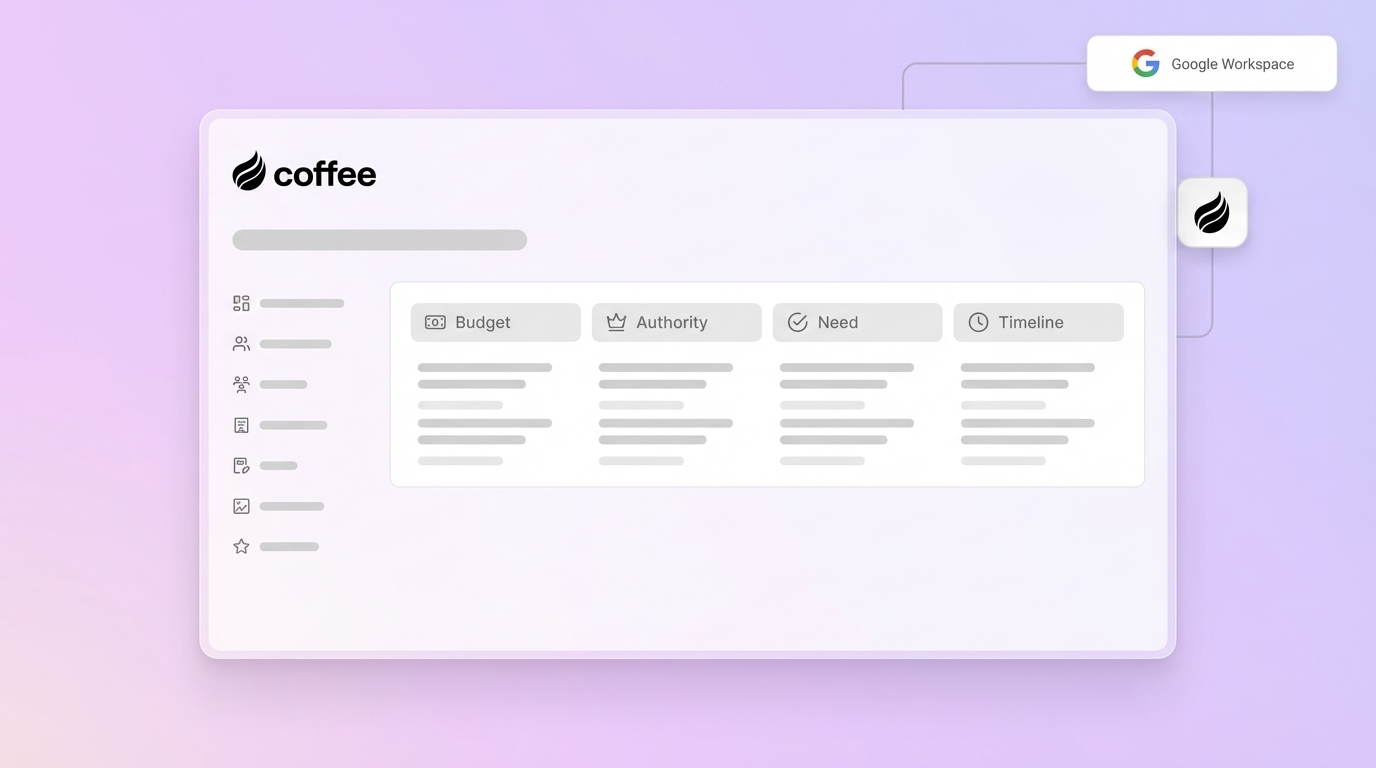
The workflow Coffee’s Agent executes on every deal removes the human bottleneck from qualification. Before each call, the Agent prepares a briefing with attendee roles, past interaction context, and open BANT gaps from prior calls. During the call, the Agent joins via Zoom, Teams, or Meet, transcribes in real time, and tags Budget, Authority, Need, and Timeline signals as they appear in the conversation.
Automated meeting prep with Coffee AI CRM Agent
After the call, the Agent writes structured BANT notes back to the Salesforce or HubSpot opportunity record, auto-creates or enriches contacts mentioned, drafts a follow-up email, and flags any qualification dimension that remains unanswered. Between calls, the Agent monitors email threads and calendar updates for signals that change any BANT dimension and updates the CRM record without prompting. During pipeline review, the Agent surfaces week-over-week changes and highlights deals where BANT data has degraded or where a stated timeline now conflicts with the projected close date.
Create instant meeting follow-up emails with the Coffee AI CRM agent
Modern BANT functions as a continuously validated data model that must survive multi-stakeholder committees, mid-cycle budget creation, and lengthening buying cycles. Teams that apply a consistent sales qualification framework see better conversion rates, but only when that framework runs on every rep and every call. Manual execution guarantees inconsistency, while an autonomous agent that executes updated BANT and MEDDIC practices after every interaction and writes structured data back to Salesforce or HubSpot keeps forecasts accurate in 2026.
Coffee’s Agent is built to handle that work on every deal and at every stage without adding tasks to a rep’s day.
Put an autonomous qualification agent to work on your pipeline with Coffee’s 14-day trial.
Frequently Asked Questions
What is the biggest difference between traditional BANT and modern BANT in 2026?
Traditional BANT was designed for single-buyer, short-cycle deals where budget was pre-allocated and one person held decision authority. Modern BANT in 2026 accounts for buying committees that now average 6 to 10 stakeholders, budgets that are created mid-cycle once ROI is demonstrated, needs that shift multiple times during evaluation, and timelines anchored to regulatory or fiscal events instead of arbitrary purchase dates. The sequence also changed, and modern practice starts with Need to establish business impact before any budget conversation, because leading with budget questions early signals a transactional intent that erodes trust with informed buyers.
When should a sales team use MEDDIC instead of BANT, and can they be used together?
BANT works best as a fast triage filter for deals under $50K ACV with sales cycles under 90 days and small buying groups. MEDDIC fits when deal size exceeds $100K, cycles run longer than 90 days, five or more stakeholders are involved, or a formal procurement process such as an RFP or security review is required. The two frameworks work well together. High-performing teams use BANT at the SDR stage to qualify inbound volume quickly, then hand off to AEs who apply MEDDIC’s deeper dimensions, including Metrics, Economic Buyer, Decision Criteria, Decision Process, Identify Pain, and Champion, to manage the opportunity through close. Coffee’s Agent can structure notes against either framework, or both at once, based on the deal profile configured in the CRM.
How does Coffee’s Agent handle BANT qualification without manual data entry?
Coffee’s Agent joins every sales call via Zoom, Teams, or Google Meet, transcribes the conversation in real time, and tags Budget, Authority, Need, and Timeline signals as they are spoken. After the call, the Agent writes structured qualification notes directly to the Salesforce or HubSpot opportunity record, enriches any new contacts mentioned with job titles and LinkedIn profiles, drafts a follow-up email for the rep to review, and flags any BANT dimension that remains unanswered. Between calls, the Agent monitors email threads and calendar updates for signals that change qualification status and updates the CRM record without any rep action. Pipeline data then reflects the actual state of every deal at all times, not the last time a rep remembered to log a note.
Why does continuous BANT qualification matter more than a single discovery check?
Continuous BANT qualification matters because deals change significantly between discovery and close. Budgets get reallocated when fiscal priorities shift, Champions leave the company or lose internal influence, and timelines accelerate when a compliance deadline appears or slow when a new stakeholder joins the evaluation. Each change can invalidate the original qualification data and produce forecast errors if the CRM is not updated. Continuous qualification, which re-validates every BANT dimension after every interaction, keeps pipeline stages and close date projections aligned with current deal reality instead of stale discovery notes. Coffee’s Agent performs this re-validation automatically and surfaces gaps in the pipeline view so RevOps can act before a deal slips.
What results can sales teams expect from implementing modern BANT practices?
Sales teams that apply a consistent, updated qualification framework see measurable improvements across core pipeline metrics that matter to Heads of Sales and RevOps. A well-implemented framework can lift stage-to-stage conversion rates, shorten average cycle length, raise win rates on qualified deals, and reduce the no-decision rate. Accounts qualified against verified data signals move through qualification faster and convert to pipeline more often. Consistency is the critical variable, and teams where reps apply the framework on every call outperform those where usage is optional. An autonomous agent that executes qualification practices on every interaction, regardless of rep experience or workload, turns a methodology into a repeatable and measurable result.