Written by: Doug Camplejohn, CEO & Co-Founder, Coffee | Last updated: July 26, 2026
Key Takeaways for Sales Teams
- Fathom delivers reliable Zoom, Meet, and Teams recording, but full CRM sync sits behind the Business plan and still needs human review of AI suggestions.
- Lightfield automates data capture after a single inbox and calendar connection, yet its record caps create a scaling ceiling for growing teams.
- Neither Fathom nor Lightfield supports in-person or mobile calls, so field reps and traveling executives still have CRM data gaps.
- Coffee Companion App sits on top of existing HubSpot or Salesforce and writes structured BANT, MEDDIC, and SPICED fields directly into the CRM with no record limits or manual review.
- Teams ready to remove manual CRM updates after every sales call can see Coffee pricing and plans today.
Evaluation Criteria for Sales Call Recording Tools
Seven criteria matter most for a 5–30 person sales team choosing between a call recorder and a more integrated solution in 2026.
- Recording quality on Zoom, Meet, and Teams: Bot reliability, transcription accuracy, and multi-speaker handling across the three dominant video platforms.
- Automatic versus manual CRM sync: Whether structured data such as deal stages, custom fields, and action items writes to HubSpot or Salesforce without human copy-paste after every call.
- 2026 pricing and free-tier limits: Total cost of ownership per seat, what the free tier actually covers, and where paywalls appear for sales-critical features.
- Sales coaching: AI scorecards, keyword alerts, and manager-facing analytics built into the platform.
- In-person and mobile support: Whether field reps or traveling executives can capture calls outside of video conferencing.
- Implementation effort: Time to first value, admin overhead, and integration complexity with existing CRM configurations.
- Scalability for 5–30 person teams: Record limits, seat minimums, and whether the tool grows without hidden cost jumps.
Side-by-Side Comparison Matrix
| Criterion | Fathom | Lightfield | Coffee |
|---|---|---|---|
| Supported platforms | Zoom, Google Meet, Microsoft Teams only | Calls, emails, and meetings | Zoom, Teams, Meet plus email and calendar streams |
| Transcription accuracy | 90–95% for English transcription | Not independently benchmarked in available sources | AI-native transcription with structured CRM output |
| Automatic CRM sync (HubSpot/Salesforce) | Full field-level sync available only on the Business plan (not lower tiers) with a 2-user minimum and no per-domain user limits specified | Automatic sync after one-time inbox and calendar connection | Autonomous agent syncs contacts, deals, fields, and activities to existing HubSpot or Salesforce instance |
| Free tier | Unlimited recordings, advanced AI summaries capped at 5 calls per month, and CRM sync available only on the Business plan | Free plan available with trial-based access and sign-up required | Pricing at coffee.ai/pricing |
| Entry paid price (monthly) | $20 per user per month (Premium); Business at $34 per user per month for full CRM sync | $89 per seat per month (Starter); Pro at $899 per workspace per month billed annually, including one full seat and support | See coffee.ai/pricing |
| Record limits | No per-recording limits and no per-meeting or per-minute overages | 30,000 records on Startup; 100,000 on Pro | No artificial record ceilings |
| Sales coaching | AI scorecards and coaching metrics on the Business plan only, with temporary access for Team plan users for 30 days after the trial | Call intelligence included on Startup; advanced sequencing on Growth at $2,000+ per workspace per month billed annually | BANT, MEDDIC, and SPICED structured notes with pipeline intelligence built in |
| In-person and mobile support | No mobile app and no in-person or phone call recording | Not documented in available sources | Agent captures email and calendar data regardless of meeting format |
| Implementation effort | Low for recording, and CRM field mapping requires Business plan configuration | White-glove migration on Pro and self-serve setup in minutes on Startup | Simple authentication, then the agent begins syncing immediately |
Setup, Onboarding, and Daily Use
Setup and onboarding. Fathom connects to a calendar and joins scheduled meetings automatically as a bot participant. Fathom botless Zoom recording launched on April 15, 2026, yet the core experience still relies on a visible bot that some hosts block. Lightfield requires a one-time inbox and calendar connection, then contacts, meetings, and emails sync automatically without further manual effort. Coffee deploys as a Companion App on top of existing HubSpot or Salesforce instances through a single authentication step, and the agent begins capturing and writing data immediately.
Data Capture and CRM Maintenance
How each tool handles CRM data. Fathom attaches summaries to contact records, creates action items, fills custom fields, and advances deal stages automatically, but only on the Business plan mentioned earlier. On Team and lower tiers, CRM field sync remains locked to that Business plan with a 2-user minimum and no per-domain user limits specified. AI-suggested field updates in Fathom still require human review before syncing, which reintroduces a manual step.
Lightfield structures every interaction into a continuously updated record, yet its record caps create a ceiling that growing teams will eventually hit. Coffee’s agent writes structured data, including BANT, MEDDIC, and SPICED fields, directly into the existing CRM without a human review gate.
Usability for Frontline Reps
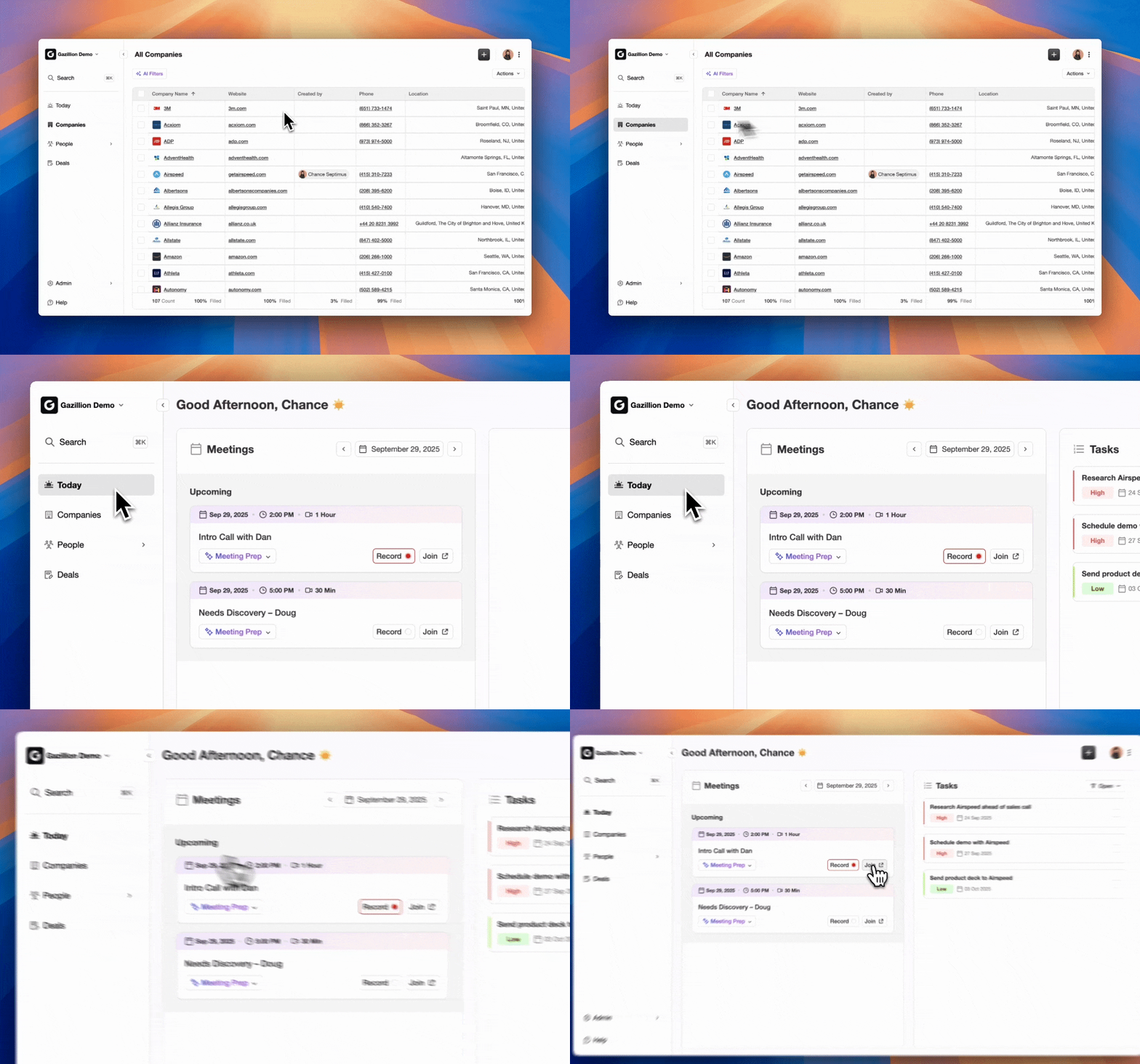
Day-to-day rep experience. G2 reviewers in July 2026 praise Fathom’s clickable transcripts that link directly to the corresponding moment in the recording, which reduces time spent re-listening to calls. The absence of a mobile app means field reps and traveling executives cannot use Fathom for non-video meetings. Coffee surfaces a Today page briefing before each call and drafts follow-up emails in Gmail for rep review, so reps stay in a single workflow.


Manager Visibility and Coaching
Manager visibility. Fathom’s Business plan includes AI scorecards, keyword alerts, and a Deal View that aggregates call insights into HubSpot or Salesforce deal records. Global team call search and shared folders are available on the Team plan. Coffee’s Pipeline Compare feature tracks week-over-week deal changes automatically and surfaces stalled opportunities without requiring a manager to run a manual CSV export.
Integration Depth and Complexity
Integration complexity. Fathom’s HubSpot integration is certified and widely used, which signals a mature and tested connection. Lightfield’s integration depth with existing Salesforce configurations such as custom objects, required fields, and forecasting hierarchies is not fully documented in available sources, which creates a meaningful gap for teams with complex CRM setups. Coffee is purpose-built to understand the depth of Salesforce and HubSpot integrations, including quotas, forecasting, and required fields.
See how Coffee’s agent removes manual CRM updates after every sales call.
Best-Fit Use Cases by Team Stage
Early-stage teams (1–5 reps) with no CRM budget. Fathom’s free tier provides unlimited recordings and transcription, which makes it a practical starting point. The 5-summary-per-month cap and CRM sync limitations on lower tiers remain acceptable constraints at this stage. Lightfield’s $89 per user per month Startup entry point is difficult to justify without a dedicated RevOps function.
Growing sales organizations (5–15 reps) evaluating HubSpot or Salesforce. A 5-person team on Fathom Business pays $1,500 per year with annual billing, while the same team on Lightfield Startup pays approximately $445 per month ($5,340 per year). The cost gap is significant for this size. Coffee’s Companion App sits on top of the existing CRM, so teams keep their system of record and add an agent that keeps it accurate.
Teams locked into Salesforce or HubSpot (15–30 reps). At this scale, incomplete CRM data compounds into forecast errors and pipeline blind spots. Post-call notes and CRM updates can consume substantial time per day for high-volume reps without AI automation. Coffee’s agent handles the full data-in process across contacts, activities, deal stages, and custom fields, so the CRM reflects ground truth without rep intervention.
Operational and Long-Term Considerations
Cross-functional ownership shapes long-term success. A call recorder owned by individual reps produces inconsistent data quality when some reps use it and others do not. Nearly 70% of sales reps report being overwhelmed by the number of tools in their tech stack, and adding a standalone recorder to an existing CRM stack increases that burden. Tools that combine recording, enrichment, and CRM sync into a single agent reduce coordination overhead for RevOps.
Data hygiene at scale is a compounding problem because bad data costs organizations through missed opportunities and compounding decision errors. This is why a recorder that attaches a transcript to a CRM record without writing structured fields into the right objects does not solve the data quality problem; it relocates it.
Training needs differ by tool and affect rollout. Fathom requires reps to understand which plan tier unlocks which CRM features and to review AI-suggested field updates before they sync. Lightfield’s record limits require an admin to monitor usage as the team grows. Coffee’s agent model minimizes rep-facing configuration, so the agent does the work and reps interact mainly with outputs rather than settings.
Risks, Limitations, and Common Misconceptions
Fathom’s CRM sync is not fully automatic on most plans. Tools that only record calls still leave reps copying details into the CRM. Fathom’s free and Team tiers do not include field-level sync, so a rep on those plans still performs manual CRM updates after every call. The Business plan resolves this, but at the price point noted above the cost approaches that of a more integrated solution.
Lightfield’s record limits are a hidden scaling risk. The Startup tier caps at 30,000 records. A 10-person team running active outbound sequences can approach this ceiling faster than expected, which triggers an upgrade to the Pro tier at $899 per workspace per month billed annually, a significant cost jump.
Neither tool covers in-person or mobile calls. Fathom has no mobile app and provides no support for recording in-person meetings or mobile phone calls. Teams with field reps or executives who take calls outside of Zoom, Meet, or Teams will have coverage gaps in their CRM data regardless of which video-conferencing recorder they choose.
Overbuying on coaching features. Lightfield’s Growth tier at $2,000+ per workspace per month billed annually includes sequencing, account scoring, and third-party signal enrichment. For a 10-person team that primarily needs accurate CRM data from calls, this tier represents significant overbuying relative to the core problem.
Compare Coffee’s CRM sync approach to Fathom and Lightfield before you commit to a recorder.
Decision Framework for 5–30 Person Teams
| Team Situation | Best Fit | Reason |
|---|---|---|
| Solo seller or team under 3 reps, no CRM budget | Fathom Free | Unlimited recordings at no cost, and CRM sync limitations remain acceptable at this scale |
| 5–15 reps on HubSpot or Salesforce needing full field sync | Coffee Companion App | Agent writes structured data into existing CRM without replacing the system of record and without record caps |
| Team replacing a legacy CRM entirely | Lightfield or Coffee Standalone | Both offer a fresh system of record, Coffee includes the agent layer, and Lightfield has record limits to monitor |
| 15–30 reps with complex Salesforce configuration | Coffee Companion App | Deep understanding of Salesforce quotas, forecasting, required fields, and custom objects |
| Team needing coaching analytics without full CRM automation | Fathom Business | AI scorecards and Deal View at $25 per user per month annual, at a lower cost than Lightfield Pro |
Frequently Asked Questions
How long does implementation take for each tool?
Fathom connects to a calendar in minutes and begins joining scheduled meetings automatically, so the recording layer is live the same day. Full CRM field sync, however, requires the Business plan and a configuration step to map AI outputs to the correct HubSpot or Salesforce fields, which typically takes a few hours for a RevOps admin familiar with the CRM’s field structure. Lightfield’s Startup tier supports self-serve setup without an admin, and the Pro tier includes white-glove migration support for teams moving from complex Salesforce configurations. Coffee activates through a single authentication to the existing HubSpot or Salesforce instance, and the agent begins capturing emails, calendar events, and call data immediately with no extended onboarding period for the core sync functionality.
What migration effort is required when switching from Fathom or Lightfield?
Switching from Fathom mainly involves disconnecting the bot from calendar integrations and removing the HubSpot or Salesforce app connection. Historical transcripts and summaries stored in Fathom are not automatically portable to another system, so teams should export any records they need to retain before deactivating. Switching from Lightfield is more involved because Lightfield may serve as the system of record for some teams, and the Pro tier includes white-glove migration support specifically for this scenario. Coffee’s Companion App model avoids this problem entirely for teams already on HubSpot or Salesforce, since it layers on top of the existing CRM rather than replacing it, so there is no migration of historical CRM data when adopting Coffee.
How do the tools handle data quality and reporting in HubSpot or Salesforce?
Fathom’s Business plan writes AI-generated summaries, action items, deal stages, and custom field values directly into HubSpot or Salesforce deal records. AI-suggested field updates require a human review step before they finalize, which preserves accuracy but reintroduces a manual touchpoint. Fathom’s Deal View aggregates call insights at the deal level and gives managers a consolidated view without leaving the CRM. Lightfield structures every captured interaction into a continuously updated record, yet its value as a reporting layer depends on whether teams use it as the system of record or alongside an existing CRM, a distinction that affects where reports are run. Coffee’s agent ensures that the data entering HubSpot or Salesforce is structured and complete from the moment a call ends, so reports and forecasts from those CRMs reflect actual deal activity rather than whatever a rep remembered to log.
Which option scales best for a 5–30 person sales team?
Fathom scales without per-recording overages, and cost is determined by seat count and billing period, which keeps budgeting predictable. The constraint is that full CRM automation requires the Business plan for every rep who needs it, and coaching features are gated at that same tier. Lightfield’s record limits create a scaling risk, since a 10-person team on the Startup tier can reach the ceiling faster than expected during active outbound periods, and the jump to Pro at $899 per workspace per month billed annually is steep. Coffee’s agent model scales with the team without artificial record ceilings or feature gates tied to CRM sync depth. Because Coffee is purpose-built to handle the complexity of Salesforce and HubSpot at the configuration level, including quotas, forecasting hierarchies, and required fields, it remains reliable as team size and CRM complexity grow together.
Conclusion: Choosing Between Recorders and an Agent
The core problem with choosing between Fathom and Lightfield is that neither fully resolves the recorder-versus-CRM tradeoff for a 5–30 person sales team on HubSpot or Salesforce. Fathom delivers reliable recording quality and a mature HubSpot integration, yet full CRM field sync sits behind the Business plan paywall, and a human review step remains in the automation chain. Lightfield automates more of the data capture process but introduces record limits and a price point that is difficult to justify for teams that primarily need accurate CRM data from calls rather than a full platform replacement.
Coffee removes this tradeoff. As an autonomous agent that joins calls on Zoom, Teams, and Meet, captures structured data, and writes it directly into existing HubSpot or Salesforce instances, including custom fields, deal stages, and activity logs, Coffee eliminates the manual steps that both recorders leave behind. Reps stop acting as data entry clerks. Managers get pipeline data that reflects what actually happened on calls. RevOps stops maintaining a fragmented stack of point solutions.
Explore Coffee pricing and see how it replaces manual CRM updates for your team.