Written by: Doug Camplejohn, CEO & Co-Founder, Coffee
Key Takeaways
- Sales reps lose about 25% of their time to manual CRM data entry. AI tools like Coffee remove this work and keep the pipeline updated automatically.
- Freshsales offers Freddy AI copilot with partial automation. Monaco focuses on outbound but still needs manual oversight. Coffee reaches a 10/10 autonomy score.
- Top evaluation criteria include AI autonomy, data enrichment, integrations, and pricing. Coffee leads with agent-led data unification across Google, Microsoft, and Salesforce.
- Coffee ranks #1 among 9 alternatives, saving 8-12 hours weekly by automating contacts, enrichment, meetings, and intelligence as a standalone or companion CRM.
- SMBs that want hands-off CRM management should choose Coffee. Start a Coffee trial to see autonomous sales acceleration in practice.
Freshsales vs Monaco CRM: AI Automation Comparison 2026
Freshsales operates as a traditional CRM enhanced with Freddy AI for lead scoring, deal recommendations, and email automation. Pricing includes Free, Growth at $11 per user each month, Pro at $47 per user each month, and Enterprise at $71 per user each month, billed in USD. The platform focuses on workflow automation and omnichannel communication with AI-assisted data features.
Monaco presents itself as an AI-native CRM built for outbound sales workflows. The platform features automated outreach campaigns, meeting coordination, and proprietary prospect database integration. Monaco’s architecture integrates AI workflows directly into the CRM foundation, though pricing remains undisclosed following their $35M funding round.
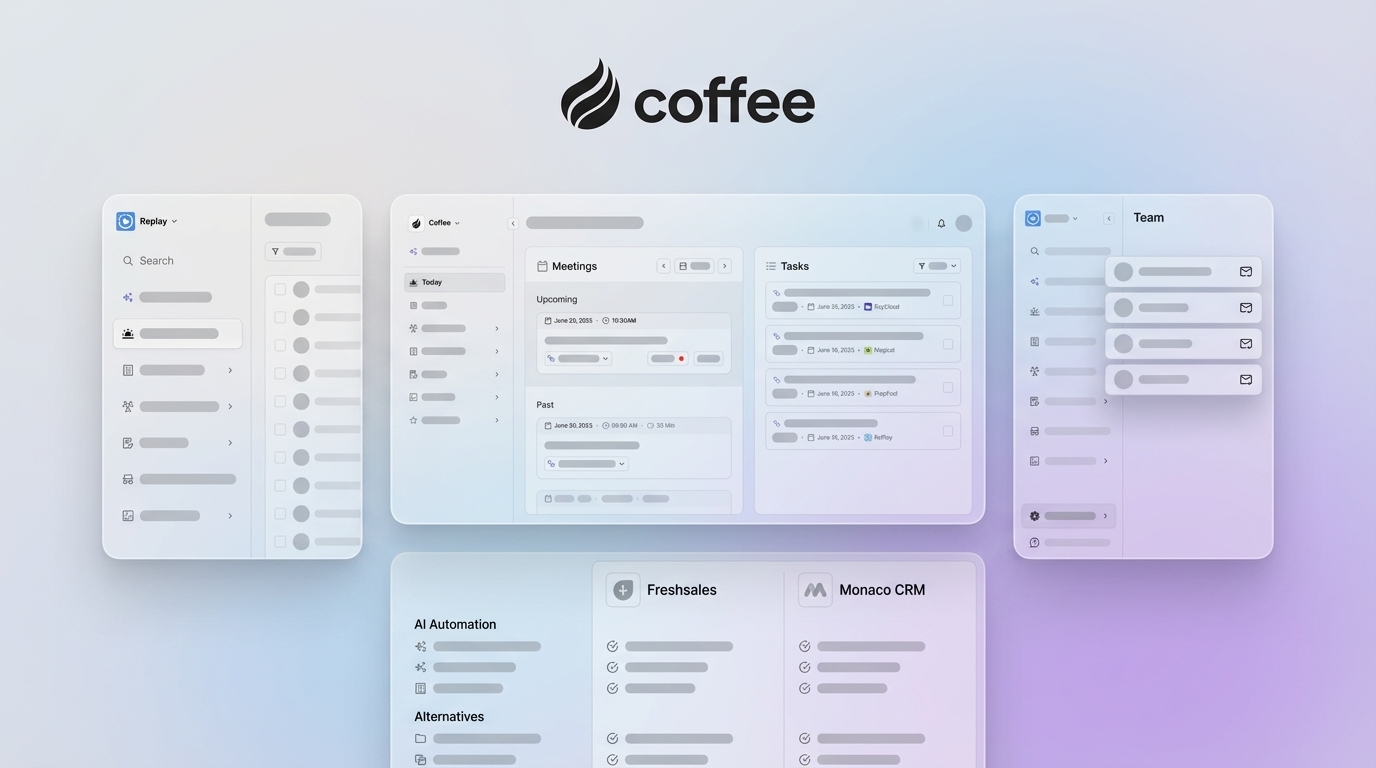
The following comparison highlights how autonomy scores rise as platforms move from partial assistance to complete automation across data entry, enrichment, meetings, and pipeline intelligence.
| Feature | Freshsales | Monaco | Coffee |
|---|---|---|---|
| AI Autonomy Score (1-10) | 4 | 6 | 10 |
| Data Entry Automation | Partial | Moderate | Complete |
| Contact Enrichment | Auto-fill | Proprietary DB | Auto-enrichment |
| Meeting Automation | Scheduling only | Coordination | Briefings + summaries |
| Pipeline Intelligence | Predictions + alerts | Limited | Compare feature |
| Outbound Sequencing | Basic sequences | Advanced | Agent-driven |
| Integrations | Standard | AI-native | Google/MS + Salesforce |
| Pricing Model | Tiered ($11-71) | Undisclosed | Seat-based |
| User Experience | Traditional | Outbound-focused | Agent-assisted |
| Scalability | Enterprise-ready | Growing | SMB to mid-market |
Freshsales offers Freddy AI capabilities including auto-enrichment but with less agent autonomy than Coffee. Monaco excels in outbound automation yet still needs manual pipeline oversight. Coffee reaches a 10/10 autonomy score by fully automating data entry, enrichment, and task logging so CRM records stay current without human effort.
See Coffee’s automation advantage with a free trial and experience autonomous agent capabilities.
How to Evaluate AI-Driven CRM Automation Tools
Effective evaluation of AI CRM for outbound sales starts with AI autonomy levels and the gap between copilot assistance and true agent automation. Data quality forms the base, as businesses using AI within their CRM are 83% more likely to exceed sales goals when accurate data powers predictive analytics and lead scoring.
Key criteria include autonomous data enrichment, smooth integration with existing tech stacks like Salesforce and HubSpot, comprehensive outbound execution, and clear pricing models. Coffee’s agent-led approach meets these requirements by handling unstructured data from emails and call transcripts while maintaining a built-in data warehouse for historical context. Traditional CRMs that rely on relational databases struggle to match this level of context and automation.

Top Freshsales and Monaco CRM Alternatives for AI-Driven Automation
1. Coffee – An autonomous CRM agent that removes manual CRM upkeep for sales teams. Coffee works as both a standalone CRM for small businesses and a companion app for existing Salesforce or HubSpot instances. The platform automatically creates contacts, enriches company data, logs activities, and generates meeting briefings and summaries. Coffee delivers the time savings mentioned above through complete automation of data unification and task management. A growing company generating tens of millions in revenue replaced its spreadsheet-based sales process with Coffee and now runs automated pipeline reviews with seamless Google Workspace integration.

2. HubSpot with Breeze AI – Features autonomous agents for data enrichment and customer journey analysis across marketing, sales, and service functions. Strengths include broad ecosystem integration and a strong market presence. Limitations include complex pricing tiers and continued reliance on manual data input for best results. This option fits mid-market companies with dedicated RevOps teams.
3. 11x.ai – Focuses on autonomous SDR functionality with AI-powered prospecting, outreach, and CRM-first workflows that integrate with Salesforce, HubSpot, and more. The platform manages inbound and outbound flows including lead qualification and meeting scheduling. This choice works well for companies that want deep automation across the entire sales funnel.
4. MarketBetter – Positions itself as an outbound command center with integrated prospecting and sequencing tools. Strengths include unified outbound workflow management and competitive pricing. Limitations include lighter pipeline intelligence and forecasting capabilities. This platform suits sales teams that prioritize outbound prospecting.
5. Clay – Provides advanced data enrichment workflows with direct integrations to HubSpot, Salesforce, and other CRMs for importing, enriching, and updating records. The platform excels at data sourcing and validation from multiple providers with simple setup. Clay works best for data-driven teams that add it as an automation layer on top of existing CRMs.
6. Day.ai – Focuses on processing unstructured data from emails, calls, and documents. Strengths include advanced natural language processing and document analysis. Limitations include a narrow scope without full CRM features. Teams that want to extract insights from existing communication data gain the most value here.
7. Clarify CRM – A modern CRM built with AI-first architecture and contemporary user experience design. Strengths include an intuitive interface and modern data handling. Limitations include a smaller integration ecosystem and limited market presence. This option fits startups that want a modern CRM without legacy complexity.
8. Attio – Features AI agents and natural language search capabilities with flexible data modeling. Strengths include customizable workflows and a modern interface. Limitations include manual configuration needs and limited automation depth. Tech-savvy teams that require flexible CRM customization benefit most.
9. Pipedrive AI – A traditional CRM enhanced with AI-powered pipeline analysis and deal scoring. Strengths include an established user base and straightforward implementation. Limitations include ongoing manual data entry and basic automation. This option suits small businesses that want gradual AI enhancements to a familiar CRM model.
Coffee ranks #1 for autonomous agents, so start a trial to experience hands-off CRM management.
Side-by-Side Tradeoffs and Choosing the Right Fit
Coffee leads in autonomy and data quality for growing SMBs that want to stop maintaining CRM records by hand. This autonomy advantage comes from Coffee’s combined capabilities: the platform enriches data through licensed data partners and captures conversational intelligence through its AI meeting bot, which creates a single, consistent data foundation. By consolidating these functions, Coffee lowers total cost of ownership and improves data accuracy compared with stacks that rely on several separate tools. Freshsales and Monaco offer strong AI features but still require manual oversight for full pipeline management.

Selection decisions depend on company size and automation needs. Small to mid-market businesses gain the most from Coffee’s agent-led approach, while larger enterprises with complex, custom workflows may still prefer traditional CRM flexibility. Budget-conscious teams should look at total cost of ownership, because Coffee often replaces multiple tools for enrichment, meeting intelligence, and automation, which reduces overall spend compared with fragmented point solutions.
Book a Coffee demo to see how agent-led automation fits your team’s daily workflow.
Implementation, Common Pitfalls, and FAQ
Coffee implementation uses simple Google Workspace or Microsoft 365 authentication, with Day 1 data synchronization and immediate agent activation. This fast start can tempt teams to evaluate Coffee like a standard CRM based on feature checklists. The most common pitfall comes from focusing on features instead of automation outcomes, which causes teams to underestimate the 8-12 hours each week they can reclaim when the agent handles CRM upkeep.
What are the key differences between Freshsales and Coffee?
Freshsales operates as a traditional CRM with Freddy AI copilot assistance that supports auto-enrichment and activity logging. Coffee deploys autonomous agents that handle the entire workflow by creating contacts, enriching company information, logging activities, and generating meeting summaries without human intervention. This agent-led model delivers the time savings and autonomy advantages described earlier in the comparison.

Which Monaco alternatives offer strong AI automation for outbound sales?
Coffee provides the most comprehensive alternative to Monaco’s outbound-focused approach by combining autonomous prospecting with complete CRM automation. Monaco specializes in outbound sequences and meeting coordination, while Coffee’s agent manages end-to-end sales workflows including data unification, enrichment, meeting management, and pipeline intelligence. This approach removes the need for several separate tools and delivers deeper automation.
What is the leading autonomous AI CRM for 2026?
Coffee stands out as a leading autonomous AI CRM solution for 2026, with agent-based automation that removes manual CRM upkeep for sales teams. Copilot-assisted platforms like Freshsales and specialized tools like Monaco still depend on human input, while Coffee’s agents manage full sales workflows from contact creation through pipeline analysis. The platform works as both a standalone CRM and a companion app for existing Salesforce or HubSpot instances.
How does Coffee’s pricing compare to Freshsales and Monaco?
Coffee uses transparent seat-based pricing where you pay for human users and the autonomous agent’s unlimited work is included. Freshsales relies on tiered pricing from $11 to $71 per user each month, and Monaco’s pricing remains undisclosed. Coffee’s model often lowers total cost of ownership by replacing separate enrichment, conversation intelligence, and automation platforms.
Does Coffee integrate with existing Salesforce and HubSpot installations?
Yes, Coffee operates as a companion app that deploys autonomous agents on top of existing Salesforce or HubSpot instances. The agent manages data entry, enrichment, and task automation while the existing CRM remains the system of record. Teams gain Coffee’s automation benefits without moving away from current CRM investments.
Conclusion
Coffee leads the shift from manual CRM maintenance to autonomous agent automation, which removes the data entry burden from sales teams. Freshsales and Monaco provide helpful AI assistance, yet Coffee delivers full agent-led automation for truly hands-off CRM management.
Start your Coffee agent trial today and remove manual CRM updates from your team’s workload.