Written by: Doug Camplejohn, CEO & Co-Founder, Coffee
Key Takeaways
- Day.ai excels at AI-native call transcription and summaries but falls short on data unification and collaboration for growing sales teams.
- Real 2026 user reviews highlight Day.ai limitations in legacy integrations, pipeline intelligence, and structured data management compared to competitors.
- HubSpot and Salesforce still rely on manual data entry, while Attio offers more flexibility but does not deliver full automation.
- Coffee’s agent-led CRM automates both structured and unstructured data and runs in companion mode alongside existing systems.
- Teams save 8-12 hours weekly with Coffee’s full sales process automation, so get started with Coffee today for true CRM transformation.
How Day.ai CRM Works for Sales Teams (day ai crm review)
Day.ai operates as an AI-native CRM that removes manual data entry through conversational intelligence. The platform includes an AI meeting assistant that joins video calls, records and transcribes conversations, generates human-quality summaries, highlights key moments, identifies action items, and logs them into the CRM. Key 2026 updates include autopilot enrichment and natural language querying capabilities.
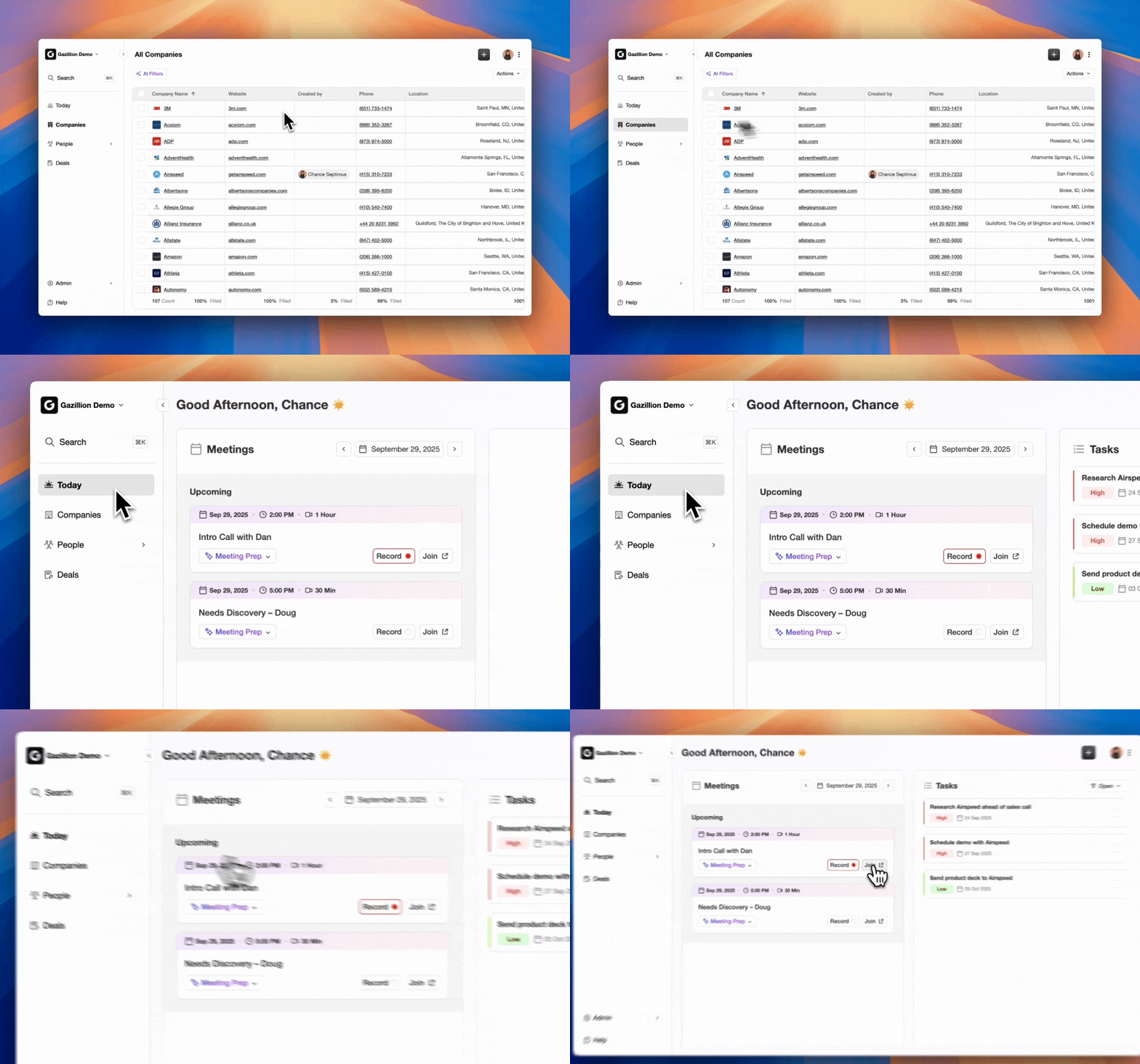
Day.ai Pros:
- Automatic call transcription and summary generation
- Zero manual entry for conversation data
- Natural language CRM queries
- Real-time B2B data enrichment
Day.ai Cons:
- Limited integration ecosystem compared to legacy CRMs
- Requires high trust and broad data access
- Smaller feature set for complex sales processes
- Emerging pricing model that creates uncertainty
Day.ai performs strongly for unstructured data capture, yet teams that want automation across both structured and unstructured data usually find Coffee’s agent-led approach more effective for full CRM transformation.
What 2026 Users Really Say About Day.ai (day ai crm real user reviews reddit)
Real 2026 user experiences show that Day.ai delivers mixed results across different team sizes and sales motions. Sales professionals consistently praise the platform’s call capture capabilities but also point out clear gaps in data unification and team collaboration.
Reddit users frequently share feedback such as: “Great for individual call notes but struggles with team-wide data consistency, spent hours fixing enrichment errors that wasted more time than manual entry.” LinkedIn discussions emphasize: “Saves 2-3 hours weekly on meeting summaries but provides no pipeline visibility or forecasting intelligence.” SourceForge reviewers note: “Organizes messy conversation data faster than competitors, but requires strict process discipline to maintain accuracy.”
Common positive themes include effortless call recording, automatic action item extraction, and reduced note-taking workload. Users also report recurring challenges with unmonitored data accuracy, limited integration with existing tech stacks, and gaps in structured data management that keep teams stuck in spreadsheets or legacy CRMs.
Industry professionals stress the need to verify reviews before trusting them. AI detectors like Pangram Labs provide detailed confidence scores suitable for bulk processing to verify review authenticity, which helps teams separate genuine user experiences from promotional content.
Most 2026 evaluators agree that Day.ai works best for solo practitioners who focus on call intelligence. The platform falls short when teams need full data unification, pipeline management, and legacy system integration, where Coffee.ai’s proactive agent delivers stronger automation.
Balanced View of Day.ai CRM Pros and Cons (day.ai crm pros and cons)
| Pros | Cons | User Evidence |
|---|---|---|
| Deep Gmail and Zoom integrations | Limited team collaboration features | “Works great solo, breaks down with multiple users” – Reddit |
| Automatic conversation logging | No historical data warehouse | “Lost all context when records updated” – LinkedIn |
| Natural language queries | Accuracy requires constant monitoring | “Enrichment errors create more work than they save” – SourceForge |
| Zero manual note-taking | Weak pipeline intelligence | “Great summaries, zero forecasting capability” – Industry Forum |
Reviews suggest that Day.ai focuses heavily on a conversational interface, which can feel less friendly for less tech-savvy teams compared to alternatives. The platform’s strength in unstructured data processing becomes a constraint when teams need full CRM functionality beyond call intelligence.
Day.ai vs HubSpot, Salesforce, Attio and Coffee (day.ai vs hubspot, day.ai vs salesforce, day.ai vs coffee.ai)
| Feature | Day.ai | Legacy (HubSpot/Salesforce) | Coffee |
|---|---|---|---|
| Data Automation | Unstructured only | Manual entry required | Full structured and unstructured |
| Legacy Integration | Limited ecosystem | Extensive but complex | Companion mode for existing CRMs |
| Pipeline Intelligence | Basic reporting | Advanced but manual setup | Automated insights with data warehouse |
| Adoption Ease | Simple for individuals | Complex team onboarding | Agent handles complexity |
Attio leads HubSpot in ease of customization (9.4/10 vs lower) and ease of use (9.1/10 vs 8.6/10), which makes it more flexible for sales-led teams without marketing overhead. However, Attio provides far more flexible data modeling than HubSpot’s clunky custom objects and offers a faster, cleaner UX without bloat, yet still requires some manual data entry that Coffee’s agent removes entirely.

Real-world scenarios make these differences clear. SMBs that move off spreadsheets benefit from Coffee’s standalone CRM with full agent automation. HubSpot users who struggle with “garbage in, garbage out” see Coffee’s companion mode fix data quality issues while they keep their existing platform. Day.ai serves teams that care only about call intelligence but lacks the broad automation needed for full CRM transformation.
Get started with Coffee to see how agent-led automation delivers 8-12 hours weekly savings across your entire sales process, not just call capture.

User-Voted Best AI CRM for 2026 (best ai crm 2026)
Based on 2026 user feedback and real-world implementations, Coffee stands out as the top choice for US growing teams that want comprehensive CRM automation. A company generating tens of millions in revenue and building custom AI solutions rejected Salesforce and HubSpot because of heavy manual work, then chose Coffee’s agent for automated data entry, actionable pipeline intelligence, and smooth team integration. The agent’s ability to handle both structured and unstructured data while preserving historical context in a built-in data warehouse directly addresses the core limitations users report with Day.ai and legacy alternatives.
Why Coffee Outperforms Day.ai for CRM Automation
Day.ai CRM real user reviews and comparisons show a platform that excels at conversation intelligence but struggles with end-to-end CRM automation. Day.ai removes manual note-taking and delivers strong call summaries, yet real 2026 users consistently report gaps in data unification, team collaboration, and pipeline management that keep them tied to legacy systems or spreadsheets.
Coffee’s agent-led approach solves these issues by automating the complete sales process, from data entry through pipeline intelligence. Teams can use Coffee as a standalone CRM or as a companion layer on top of existing HubSpot or Salesforce instances. For teams that want CRM transformation beyond call capture, Coffee delivers the level of automation that Day.ai promises but does not fully achieve. Get started with Coffee to experience agent-led CRM automation that saves 8-12 hours weekly while keeping data accurate and reliable.

FAQ
Day.ai vs Coffee for Sales Teams
Coffee works better for sales teams that want comprehensive automation through an agent-led approach that handles both structured and unstructured data. Day.ai focuses on call transcription and conversation summaries, while Coffee’s agent automates the entire sales process, including data entry, pipeline management, and forecasting. Coffee supports both standalone CRM and companion modes for existing HubSpot or Salesforce users, which delivers 8-12 hours weekly savings compared to Day.ai’s narrow focus on conversation intelligence.
Day.ai Value for Growing Sales Teams
Day.ai delivers strong value for individual contributors who care about call intelligence but shows clear limits for growing teams that need full CRM functionality. Users consistently report challenges with team collaboration, data consistency across multiple users, and missing pipeline management features. Growing teams usually need structured data automation, forecasting capabilities, and legacy system integration that Day.ai does not handle effectively.
What Coffee Users Report in 2026
Coffee users highlight the agent philosophy that removes manual data entry while delivering full CRM automation. One notable case study features a company generating tens of millions in revenue that chose Coffee over Salesforce and HubSpot specifically for automated data entry, pipeline intelligence, and agent flexibility. Users consistently praise the platform’s ability to unify structured and unstructured data while preserving historical context through its built-in data warehouse.
Day.ai vs HubSpot Data Handling
Day.ai handles unstructured conversation data better than HubSpot’s manual approach, while HubSpot offers strong structured data management with features like auto-de-duplication and automatic tracking for emails and forms. HubSpot provides no-code workflow automation and unified data in one database but can suffer from data quality issues without careful setup. Coffee.ai’s companion mode addresses this by acting as an intelligent agent on top of HubSpot, providing automated data entry while preserving HubSpot’s advanced features.
How to Spot Fake AI CRM Reviews
Teams can spot fake AI CRM reviews by checking metadata for unusual creation patterns, using AI detection tools that analyze writing patterns, and cross-referencing reviewer profiles across multiple platforms. Reviews that lack specific use case details, repeat the same phrases, or focus heavily on promotional language without practical examples often signal low credibility. Genuine reviews usually include concrete pain points, implementation timelines, and balanced pros and cons based on real usage scenarios.