Written by: Doug Camplejohn, CEO & Co-Founder, Coffee
Key Takeaways
- AI-driven sales tools raise forecast accuracy to 90-98% by unifying data automatically, far above legacy CRMs at 60-75%.
- Agent-led platforms like Coffee cut 71% of manual data entry time, saving reps 8-12 hours each week through autonomous CRM updates.
- Tool fit depends on team size: Coffee suits SMBs, while Clari and Salesloft fit enterprises, with agent-led tools outperforming passive options.
- Core buying criteria include forecast accuracy, data automation depth, CRM integration quality, and clear pricing that keeps ownership costs low.
- Teams see immediate data hygiene gains and stronger forecasting when they adopt Coffee for agent-led pipeline management.
How We Evaluate AI Pipeline and Forecasting Platforms
Our analysis centers on five factors that separate modern AI tools from legacy systems. Forecast accuracy comes first, with companies improving CRM data hygiene seeing up to 30% accuracy gains. Data unification shows whether a tool can handle structured CRM fields and unstructured sources like email threads and call transcripts. The gap between agent-led automation and passive AI matters, because agents like Coffee manage data entry proactively while passive tools still depend on humans. Integration depth with Salesforce and HubSpot shapes adoption and daily usage. Transparent pricing then determines long-term total cost of ownership for scaling teams.

Top 10 AI Pipeline Management and Sales Forecasting Tools
1. Coffee: Agent-Led CRM and Forecasting
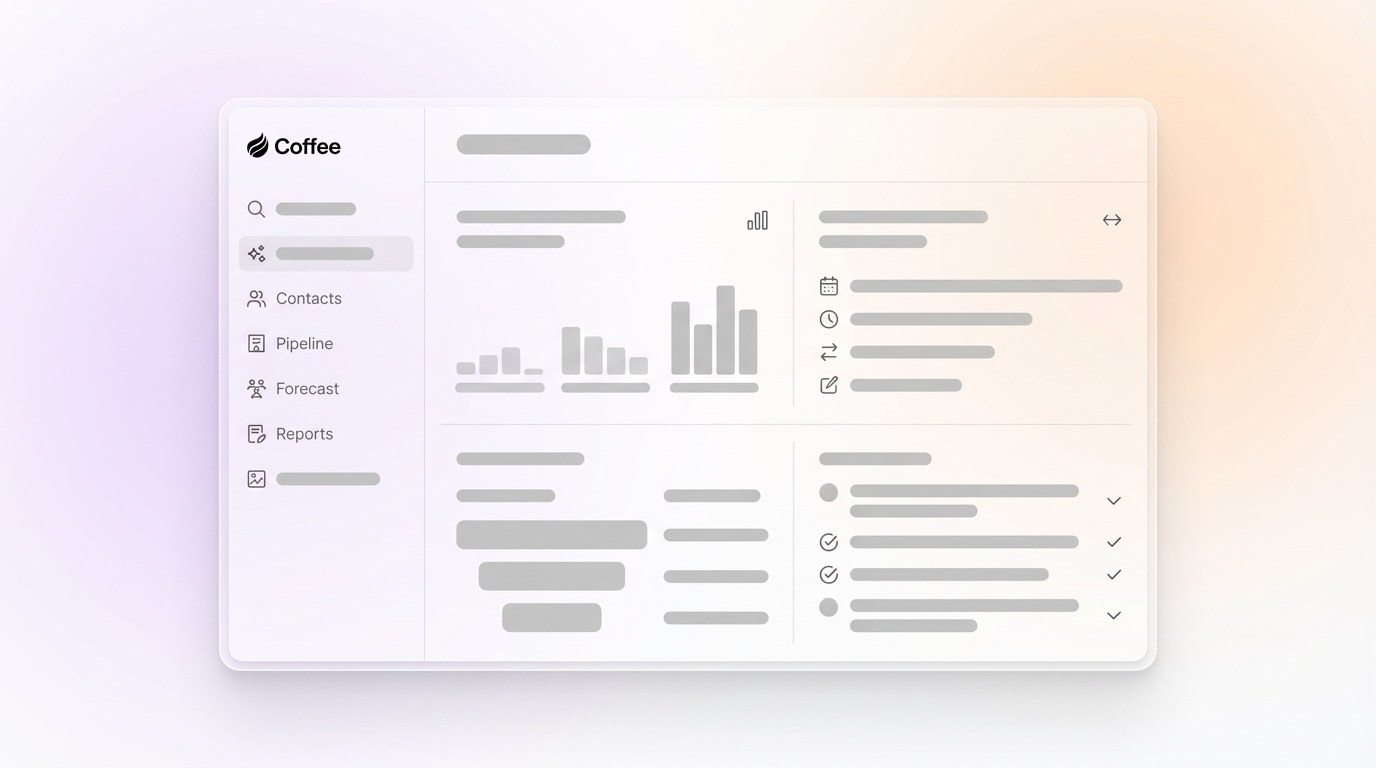
Coffee acts as an autonomous CRM agent that removes manual data entry and surfaces accurate pipeline insights. Unlike passive tools, Coffee connects to Google Workspace or Microsoft 365, then automatically creates contacts, enriches company records, and logs activities.

Strengths:
- Saves reps 8-12 hours per week through automated data entry and enrichment
- Pipeline Compare view shows week-over-week pipeline changes without spreadsheets
- Works as a standalone CRM or as a Salesforce/HubSpot companion
- Built-in data warehouse keeps historical context intact
- Meeting briefings and automated follow-up workflows

Limitations: Current integrations run through Zapier, with deeper native connections on the roadmap.
Best For: SMB teams with 1-20 employees and small to mid-market teams that want agent-led automation. Pricing is seat-based with unlimited agent labor included.

2. Clari vs Gong vs Coffee for Revenue Teams
Clari delivers AI revenue forecasting with confidence intervals and detailed deal inspection. The platform focuses on pipeline health scoring and forecast tracking for mature revenue organizations.
Strengths:
- Advanced revenue forecasting with confidence intervals
- Deal inspection that highlights stakeholder engagement
- Automatic activity capture from connected systems
- Strong adoption across large enterprises
Limitations: Functions as a passive layer that still needs manual CRM maintenance, and pricing can be complex.
Best For: Enterprise revenue teams that have dedicated RevOps support.
3. Salesforce Einstein for Native Salesforce AI
Salesforce Einstein offers opportunity management, customizable stages, lead scoring, and workflow automation. As Salesforce’s native AI layer, it integrates deeply with the core platform.
Strengths:
- Native integration across the Salesforce ecosystem
- Customizable sales stages with probability tracking
- Einstein lead scoring for prioritizing outreach
- Robust workflow automation features
Limitations: Requires significant Salesforce expertise and still relies on manual data entry.
Best For: Large Salesforce deployments with experienced administrators.
4. Salesloft for Revenue Orchestration
Salesloft delivers sales engagement, revenue orchestration, and the Rhythm AI engine that prioritizes actions based on buyer signals.
Strengths:
- Rhythm AI that ranks next-best actions
- Conversation intelligence for call reviews
- Deal management features for pipeline control
- Support for MEDDPICC methodology
Limitations: Enterprise pricing at $125 per user each month, along with complex workflow setup.
Best For: Growing sales teams and enterprises with detailed, multi-step processes.
5. Outreach for Enterprise Sequences
Outreach Kaia offers AI assistant features at $100 per user each month for enterprise sales engagement and sequence tuning.
Strengths:
- AI-driven sequence optimization for outbound motions
- Enterprise-grade security and compliance
- Advanced analytics on engagement and performance
- Multi-channel outreach across email, calls, and more
Limitations: Higher cost and a steep training curve for new teams.
Best For: Enterprise organizations with complex outbound programs.
6. Apollo for Prospecting and Sequences
Apollo combines AI-powered sequences with a large B2B contact database that supports SMB and mid-market prospecting.
Strengths:
- Built-in prospecting database with firmographic filters
- AI sequence optimization for outbound campaigns
- Accessible pricing for smaller teams
- Email deliverability and warmup tools
Limitations: Limited forecasting depth and only basic CRM features.
Best For: SMB teams that focus heavily on outbound prospecting.
7. Amplemarket for Signal-Driven Outreach
Amplemarket offers a signal-to-sequence workflow with Duo AI Copilot, including agents dedicated to research and sequencing.
Strengths:
- Multi-agent AI architecture for specialized tasks
- Signal detection and automated research
- Integrated prospecting and outreach workflow
- Modern, intuitive interface
Limitations: Newer platform with capabilities that continue to evolve.
Best For: Growth-stage companies that want cutting-edge AI workflows.
8. Monday Sales CRM for Visual Pipelines
Monday Sales CRM provides visual pipeline boards, lead capture, enrichment, and custom dashboards.
Strengths:
- Visual pipeline management with drag-and-drop boards
- Highly customizable workflows and automations
- Tight connection to project management features
- User-friendly interface for non-technical teams
Limitations: Limited depth for advanced forecasting.
Best For: Teams that want visual project management combined with CRM.
9. Gong for Conversation Intelligence
Gong focuses on conversation intelligence and revenue insights through call analysis and deal risk detection.
Strengths:
- Advanced call and meeting analysis
- Deal risk identification based on engagement patterns
- Competitive intelligence from recorded conversations
- Coaching insights for managers and reps
Limitations: Operates mainly as a passive analysis tool centered on conversations.
Best For: Teams that prioritize conversation analysis and coaching programs.
10. HubSpot Sales Hub for All-in-One Growth
HubSpot Sales Hub combines marketing and sales automation with basic AI for lead scoring and email improvements.
Strengths:
- Unified marketing and sales platform
- Free tier that supports early-stage teams
- Extensive app marketplace for integrations
- Robust email marketing automation
Limitations: Limited AI depth and continued reliance on manual data entry.
Best For: Small businesses that need integrated marketing and sales tools.
Side-by-Side Tool Comparison and Takeaways
| Tool | Accuracy | Data Automation | Best For/Pricing |
|---|---|---|---|
| Coffee | Industry-leading | Agent-Led | SMB/Mid-market, Seat-based |
| Clari | 85-90% | Passive | Enterprise, Custom pricing |
| Salesforce Einstein | 67-72% | Passive | Large orgs, $150+/user/month |
| Salesloft | 80-85% | Passive | Mid-market, $125/user/month |
Agent-led tools like Coffee outperform passive options because they fix the root cause of forecast misses: poor data hygiene. Passive tools show a wide range of accuracy that depends on human data entry, while agent-led platforms reach higher accuracy through autonomous data management.
Solving Data Hygiene Issues and Picking a Platform
Team size and your current tech stack shape which tool fits best. Coffee works especially well for teams leaving Salesforce complexity or HubSpot limits, thanks to its dual-deployment model. AI-augmented sales teams see 20-30% higher win rates and 15-25% larger average deal sizes, which often covers implementation costs. Start with a pilot that tracks forecast accuracy gains, rep time saved, and adoption before rolling out to the full team. Get started with Coffee for AI-driven pipeline management and see immediate benefits from automated data hygiene.
2026 Agentic AI Trends and Rollout Advice
Agentic AI will power about 40% of enterprise applications by 2026, turning agent-led tools into core team members instead of side utilities. Teams can avoid vendor lock-in by choosing platforms with open APIs and easy data export. Coffee follows a simple rollout plan: connect email and calendar, confirm automatic contact creation, train the team on Pipeline Compare, and measure forecast accuracy within 30 days.
FAQ
AI Sales Forecast Accuracy Compared to Manual Methods
AI sales forecasting tools reach 75-98% accuracy, while manual methods usually stay between 60-75%. Accuracy depends on data quality and the sophistication of the platform. Agent-led tools like Coffee achieve the highest accuracy because they keep data clean through automated entry and enrichment. Manual forecasting struggles with human bias, inconsistent CRM updates, and spreadsheet models that go stale quickly.
Best AI Forecasting Option for Salesforce Users
Coffee’s Companion App gives Salesforce users agent-led automation without forcing a platform switch. Salesforce Einstein offers native capabilities but still needs heavy manual data entry and admin oversight. Coffee adds an intelligent layer that handles data input automatically, so Salesforce data stays accurate with less effort. This agent model removes the “garbage in, garbage out” problem that affects many Salesforce setups.
Coffee vs Clari for Pipeline Management
Coffee works as an autonomous agent that prevents data quality issues, while Clari analyzes pipeline data that already exists. Coffee automatically creates contacts, logs activities, and maintains hygiene, and Clari depends on clean data to produce insights. For SMB and mid-market teams, Coffee’s agent-led model removes the manual work that often weakens Clari’s outputs. Coffee also offers clear seat-based pricing, while Clari uses a more complex enterprise model.
Data Security in Agent AI Platforms
Agent AI tools like Coffee maintain SOC 2 Type 2 compliance and follow GDPR with enterprise-grade security controls. Encryption in transit and at rest protects sensitive sales data, and role-based access limits who can see what. Reputable vendors avoid using customer data to train public AI models, which keeps proprietary sales information private. Coffee processes data in secure environments and maintains audit trails for compliance teams.
Typical Pricing for SMB AI Sales Tools
SMB-focused AI sales platforms usually charge per seat, with prices from $50 to $150 per user each month. Coffee uses transparent seat-based pricing where you only pay for human users and get unlimited agent labor included. This structure contrasts with metered models that bill for AI usage or data volume. Total cost of ownership often falls because agent-led tools replace several point solutions across CRM, enrichment, and intelligence.
Migrating from HubSpot to Agent-Led AI
Migration from HubSpot starts with data export, field mapping, and a phased move to agent-led automation. Coffee’s Companion App lets teams keep HubSpot while adding an agent layer, which reduces migration risk. The agent connects to email and calendar, then enriches existing records and maintains hygiene automatically. Many teams see forecast accuracy improve within 30 days as the agent removes manual data entry.
Difference Between Agent AI and Passive AI Tools
Agent AI tools like Coffee take action by managing data entry, creating records, and executing tasks on their own. Passive AI tools review existing data and provide recommendations but still rely on humans to update the CRM. Agents remove the manual work that causes poor data quality, while passive tools inherit every data gap. This difference explains why agent-led platforms reach 90-98% forecast accuracy, compared to 60-75% for passive tools that suffer from “garbage in, garbage out” issues.
Conclusion: Why Agent-Led Tools Win in 2026
The 2026 AI landscape favors agent-led platforms that fix the root cause of forecast misses, which is poor data hygiene from manual entry. Passive AI tools add insight layers, but only agents like Coffee remove the 71% time waste that produces unreliable forecasts. Get started with Coffee and join the agent-led shift to reach 90% or higher forecast accuracy through autonomous data management.