Written by: Doug Camplejohn, CEO & Co-Founder, Coffee | Last updated: June 19, 2026
Key Takeaways
- Hard exit criteria turn subjective stage progression into objective, verifiable CRM field conditions that improve forecast accuracy.
- Five agent-driven tactics, including enforcing exit criteria, scoring buyer signals, purging stale deals, nightly accuracy analysis, and automated change detection, remove data noise at scale.
- Buyer-behavior signals such as meeting engagement, email velocity, and stakeholder breadth provide real-time forecasting inputs that manual CRM entry cannot capture.
- Automated stale-deal purges and post-mortem MAPE calculations keep pipelines clean and refine win-rate assumptions without extra manual work.
- Coffee’s autonomous agent executes all five tactics inside existing Salesforce or HubSpot instances, so you can start enforcing pipeline discipline automatically from day one.
Stage Exit Criteria That Lock In Forecast Discipline
Exit criteria function as the enforcement mechanism that turns a stage name into a contract; without them, stage progression is merely optimism recorded in CRM. Each stage should carry two to four objective, verifiable conditions written in the past tense and mapped to a single forecast category. Deals must not advance based on internal activity alone, because a proposal sent is not the same as a proposal reviewed by a decision-maker.
Here are concrete Salesforce and HubSpot field examples by stage.
- Discovery → Qualified: Discovery Call Completed = TRUE, Pain Point Confirmed (SPICED) logged, ICP Score ≥ 70, Next Step Date set.
- Qualified → Solution Fit: Budget Confirmed = TRUE, Decision Maker Identified = TRUE, Use Case documented in MEDDPICC Metrics field.
- Solution Fit → Technical Validation: Technical Stakeholder Introduced = TRUE, Demo Completed Date logged, Champion Confirmed = TRUE.
- Technical Validation → Contract Ready: Pricing Discussion Date logged, Legal Contact Identified = TRUE, Paper Process Owner named, Mutual Close Plan attached.
- Contract Ready → Closed Won: MSA Sent Date logged, Verbal Commit = TRUE, Signed Contract Date populated.
A manual process depends on a rep remembering to check these fields before dragging a card forward. Coffee’s agent enforces them automatically. When a required field is empty, the deal is blocked from advancing and the rep receives a contextual prompt, not a manager interrogation.
MEDDPICC supplies the qualification checklist that becomes exit criteria. These criteria then map to SPICED’s buyer-aligned lifecycle arc, so each stage reflects actual buyer progress instead of internal activity. Salesforce forecast categories convert this verified position into a committable number, with Commit at roughly 90 percent confidence, Best Case at 33 to 50 percent, and Pipeline at about 25 percent. The agent applies all three frameworks at once and writes structured notes back to the CRM after every call.
Weekly Pipeline Review Checklist That Reinforces Exit Criteria
Organizations with a formal pipeline management process see roughly 28% higher revenue growth than those without one. Teams need a structured weekly review to keep exit criteria enforced and forecasts honest. The bottleneck is execution, because most teams still export CSVs and build comparison slides manually. Coffee’s Pipeline Compare feature removes that step by surfacing week-over-week changes automatically.
Use this repeatable 30-minute weekly review agenda.
- Minutes 0–5, stage-movement audit: Review Coffee’s Pipeline Compare output. Identify every deal that progressed, regressed, or stalled since last week without a logged activity.
- Minutes 5–10, missing exit-criteria flags: Address any deals the agent blocked from advancing. Confirm or correct the underlying field data.
- Minutes 10–18, at-risk deal triage: Review deals flagged for stale close dates, missing decision-maker contacts, or declining engagement scores. Assign clear owner actions.
- Minutes 18–25, commit and best-case validation: Confirm that every deal in Commit category carries a Verbal Commit = TRUE field and a signed Mutual Close Plan, reflecting the roughly 90 percent confidence threshold this category requires.
- Minutes 25–30, new pipeline quality check: Verify that all deals created in the past seven days passed the agent’s qualification threshold before entering Stage 1.
Buyer-Behavior Signals That Sharpen Forecasts
Traditional stage-based forecasting relies on manual CRM entry that lags behind actual buyer intent by weeks. Behavior-based signals close that gap and keep forecasts current. AI forecasting models evaluate dozens of variables per deal, including number of stakeholder meetings logged, days in stage relative to average sales cycle length, and company size, to generate individualized win probabilities.

These signals carry the most forecasting weight.
- Meeting engagement: Number of attendees per call, multi-threading score based on contacts from the buyer’s organization who have appeared on at least two calls, and executive sponsor presence.
- Email response velocity: Time from outbound send to reply, where declining velocity acts as a leading indicator of deal risk.
- Pricing-page and proposal interaction: Pricing-page visits and webinar attendance function as forecast-relevant signals that stage-based CRMs never capture.
- Stakeholder breadth: Eighty-nine percent of buying decisions involve two or more departments with an average of 13 stakeholders, so single-contact CRM records systematically undercount deal complexity.
Coffee’s meeting intelligence bot joins every call, transcribes it, identifies attendees, and writes structured BANT, MEDDIC, or SPICED fields back to the CRM record automatically. Engagement scores update in real time without rep input. That stream feeds confidence scoring that reflects actual buyer behavior instead of a rep’s optimism.
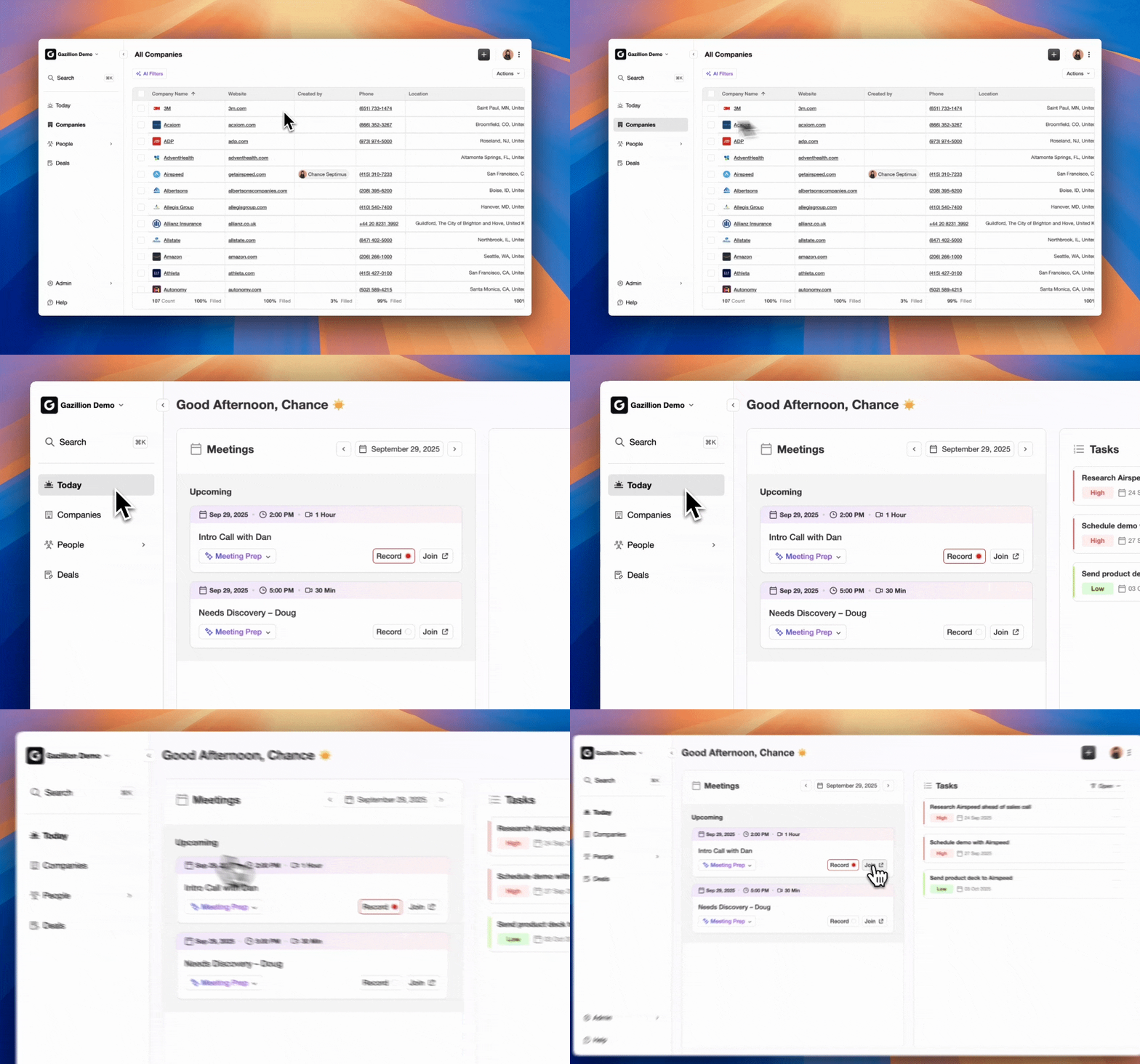
See how Coffee captures buyer signals in real time and turns them into forecast-ready data.
Stale-Deal Purge Rules That Keep Pipelines Honest
A bloated, outdated pipeline distorts forecasts and distracts teams, so pipeline hygiene must operate as a weekly routine. B2B contact data decays at 2.1% per month, and within a year, up to 70% of a database becomes unreliable. Manual purge routines depend on a rep or manager remembering to act, which rarely happens consistently.
Coffee’s agent enforces a rules-based purge cadence without human intervention.
- Day 14 of inactivity: The agent flags the deal as At-Risk and sends the rep a prompt to log a next step or update the close date.
- Day 30 of inactivity: The agent moves the deal to a Recycled stage, removes it from the active forecast, and triggers a re-qualification sequence.
- Day 60 with no re-qualification response: The agent marks the deal Closed Lost with reason code “Stale — No Buyer Engagement” and archives the record.
- Close-date regression trigger: Any deal whose close date has been pushed more than twice in 90 days is automatically downgraded one forecast category.
These rules run nightly. The pipeline that managers review on Monday morning reflects actual deal health, not last quarter’s wishful thinking.
Nightly Post-Mortem Forecast Accuracy Analysis
Forecast error is commonly measured by MAPE = 100 * mean(|Actual − Forecast| / Actual), and accuracy is often expressed as 100 minus MAPE. Directional bias is measured separately to identify whether the organization systematically over-forecasts or under-forecasts.
Coffee’s agent runs these calculations nightly across three levels.
- Total revenue: Compares committed forecast to closed-won revenue for the trailing seven days.
- Segment level: Breaks accuracy by deal size tier, such as SMB versus mid-market, and by rep, which surfaces coaching opportunities hidden in aggregate numbers.
- Stage-conversion update: Recalculates win rate by stage using the trailing 90-day closed dataset and updates stage probability weights automatically, so no manual model refresh is required.
A common mistake in SaaS forecasting is skipping post-mortem analysis of forecast versus actual results, which prevents teams from refining assumptions and building better models over time. When the agent runs this analysis every night, the model improves continuously instead of once per quarter.
Agent vs. Manual: The Data-Quality Trade-off
| Metric | Manual Process | Agent-Driven Process | Impact |
|---|---|---|---|
| Forecast accuracy | 50–70% | 85–95% | Up to 35-point accuracy gain |
| Data error rate | Higher | Lower | Fewer bad-data-driven forecast misses |
| Rep time on data entry | roughly 25% of workweek | Automated by agent | Eight to twelve hours per week returned to selling |
| Win rate improvement | Baseline | Significant | Direct revenue impact from cleaner pipeline |
Frequently Asked Questions
How long does Coffee take to integrate with Salesforce or HubSpot?
Integration requires a single authentication step. Once connected, the Coffee Agent immediately begins syncing data, enriching records, and writing insights back to your existing Salesforce or HubSpot instance. Most teams are fully operational within one business day. No professional services engagement or custom development is required for standard deployments.
Is Coffee SOC 2 Type 2 compliant?
Yes. Coffee is SOC 2 Type 2 and GDPR compliant. Customer data is never used to train public AI models. For teams in regulated-adjacent industries that need to evaluate security posture, Coffee’s compliance documentation is available upon request during the sales process.
What is Coffee’s pricing model?
Coffee uses seat-based pricing. You pay for human seats, and the agent’s labor, including data entry, meeting intelligence, pipeline enforcement, and post-mortem analysis, is included without metering on AI usage or automated processes. There are no per-workflow or per-API-call charges. Full pricing details are available at coffee.ai/pricing.
Can the agent enforce hard exit criteria without changing our existing stage names?
Yes. Coffee’s Companion App operates as an intelligent layer on top of your existing Salesforce or HubSpot configuration. It reads your current stage structure and maps exit criteria rules to your existing field schema. Stage names, forecast categories, and pipeline architecture remain unchanged. The agent enforces the criteria you define without requiring a CRM rebuild or migration.
Conclusion
Forecast accuracy is a data-quality problem, and data quality is an enforcement problem. Manual discipline fails because it relies on busy humans to do work an agent can handle automatically every night, at every stage, across every deal. Try Coffee’s autonomous agent and replace pipeline guesswork with enforced precision.