Written by: Doug Camplejohn, CEO & Co-Founder, Coffee | Last updated: June 27, 2026
Key Takeaways for Salesforce-Focused Sales Teams
- Mid-market sales teams gain the most value from Salesforce note automation that removes manual entry and captures structured data in custom objects and fields.
- Coffee’s Companion App is the only evaluated bot-free solution that maps meeting notes directly into Salesforce using MEDDIC, BANT, and SPICED frameworks without Zapier or middleware.
- Compared to Agentforce + Flow, MeetGeek, and Granola, Coffee delivers faster implementation and deeper customization for teams without dedicated Salesforce admins.
- Bot-free architecture lowers adoption friction and improves data quality because notes follow methodology templates immediately after each call.
- Teams ready to automate accurate Salesforce data can review Coffee’s pricing plans and choose a seat-based option that fits current headcount.
Evaluation Criteria for 2026 Salesforce Note Automation
Seven criteria define this comparison. First, depth of custom object and field mapping inside Salesforce. Second, native support for sales methodologies such as MEDDIC and BANT without Zapier. Third, bot-free versus bot-based architecture and its downstream effects. Fourth, workflow automation that writes structured data inside Salesforce. Fifth, implementation effort for mid-market teams without dedicated Salesforce architects. Sixth, measurable data quality impact on pipeline accuracy. Seventh, long-term scalability as headcount and deal volume grow.
The table below focuses on four of these criteria: customization power, native object mapping, methodology enforcement, and pricing transparency. It provides a quick snapshot before the detailed category-by-category analysis that follows.
Ranked Comparison Table: Coffee vs Agentforce, MeetGeek, and Granola
| Tool | Customization Power | Native Salesforce Object Mapping | Methodology Enforcement (MEDDIC / BANT / SPICED) | Pricing Transparency |
|---|---|---|---|---|
| Coffee Companion App | High, with custom summary formats and Intelligence layer launched February 2026 | Direct write to custom objects and fields, no middleware required | Native MEDDIC, BANT, and SPICED template enforcement | Seat-based, published on pricing page |
| Agentforce + Flow | High, but requires certified Salesforce admin or developer to configure | Native, requires Flow build-out per use case | Configurable via Flow prompts, no out-of-box methodology templates | Add-on licensing, variable by edition |
| MeetGeek | Moderate, template library available with limited custom field targeting | Via Salesforce integration, field mapping requires manual configuration | Partial, keyword-based highlights instead of structured enforcement | Tiered SaaS, published publicly |
| Granola | Low to moderate, note formatting is flexible but Salesforce write-back is limited | No direct custom object mapping documented as of Q2 2026 | None native, relies on manual copy-paste or Zapier | Seat-based, published publicly |
Category-by-Category Analysis of Salesforce Note Tools
This analysis covers six practical categories that map to the earlier criteria. These categories are setup and onboarding, data capture and maintenance, usability for frontline reps, manager visibility, integration complexity, customization depth, and ongoing administrative burden.
Setup and Onboarding Speed
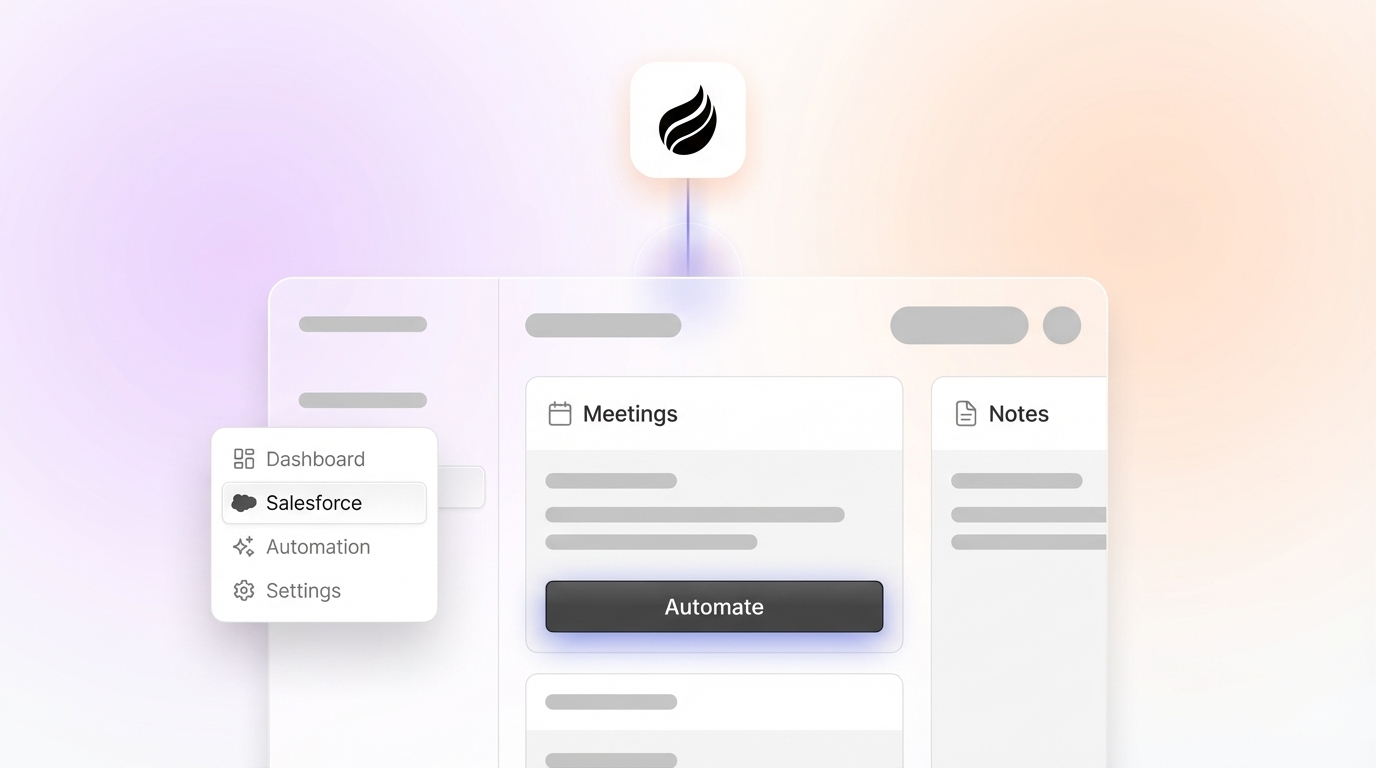
Coffee’s Companion App connects to Salesforce via OAuth authentication and begins writing structured data immediately. Agentforce + Flow requires a certified admin to design and test each Flow before any automation runs. MeetGeek requires manual field mapping during setup. Granola requires no Salesforce configuration because it does not write to Salesforce natively, which makes it unsuitable for teams whose primary requirement is CRM data hygiene.
Data Capture and Ongoing Maintenance
Coffee captures meeting transcripts and structures them against the chosen methodology template, such as MEDDIC, BANT, or SPICED, then writes the output directly to the relevant Salesforce Opportunity or custom object. Agentforce can perform similar structured capture but needs a pre-built prompt template and Flow action for each object type. MeetGeek writes a summary to the Activity record but does not populate custom fields without additional configuration. Granola produces local notes that require manual transfer into Salesforce.
Usability for Frontline Reps on Calls
Coffee operates without a visible meeting bot, so reps join calls normally while the agent processes the transcript in the background. MeetGeek deploys a bot that joins as a named participant, which some prospects notice. Agentforce does not record calls independently and depends on a connected telephony or conferencing integration. Granola runs as a desktop application and requires the rep to initiate and manage each session.
Manager Visibility into Pipeline and Deals
Coffee’s Pipeline Compare feature surfaces week-over-week deal changes automatically and gives managers structured insight without manual reporting. Agentforce surfaces data through standard Salesforce reports and dashboards, which require prior configuration by an admin. MeetGeek and Granola do not provide pipeline-level visibility natively and focus instead on call-level content.
Integration Complexity with Salesforce
Coffee writes directly to Salesforce without Zapier and targets both standard and custom objects. Agentforce is native to Salesforce but requires Flow logic for each automation path. MeetGeek uses a published Salesforce integration that covers standard objects, while custom object mapping requires additional steps. Granola has no documented native Salesforce integration as of Q2 2026.
Customization Depth and Product Roadmap
Coffee’s customization roadmap includes three major releases that work together. Custom Meeting Briefings and Summaries, launched in February 2026, allow teams to define exact output formats and write them back to Salesforce records. An Intelligence layer released in the same month lets administrators store deep context on business model, ICP, and competitive positioning so AI suggestions match the specific sales motion. Improved summary templates released in November 2025 are customizable to match team workflows and remain writable back to Salesforce. No competing tool in this comparison offers equivalent customization depth without developer involvement.
Ongoing Administrative Burden for RevOps
Coffee’s agent-led architecture reduces ongoing admin work because the system adapts to new meeting types through template updates instead of Flow rebuilds. Agentforce + Flow requires admin intervention whenever a new object type, methodology field, or automation path is added. MeetGeek requires periodic review of field mappings as the Salesforce schema evolves. Granola requires no Salesforce administration because it does not integrate at the object level.
Explore Coffee’s pricing to see how template-based customization eliminates ongoing admin costs.
Bot-Free Versus Bot-Based Tradeoffs in Note Automation
Bot-based tools such as MeetGeek join calls as a named participant. This creates three operational risks that compound adoption friction. Prospects may feel discomfort that changes conversation dynamics. Teams depend on the bot receiving a calendar invite, which fails when invites are not sent correctly. Leaders also manage a separate vendor relationship that sits outside Salesforce governance. Bot-free agents like Coffee avoid these issues by processing audio or transcript data without joining as a visible participant, which reduces adoption friction for both reps and prospects. Data quality improves because the agent structures notes against a defined template immediately after the call instead of relying on a rep to review and approve a bot-generated summary before it reaches Salesforce.
Custom Object Mapping and Methodology Enforcement Examples
A MEDDIC enforcement workflow in Coffee maps Metrics, Economic Buyer, Decision Criteria, Decision Process, Identify Pain, and Champion to discrete custom fields on the Salesforce Opportunity record. After each call, the agent populates each field based on what was discussed, flags gaps where MEDDIC criteria were not addressed, and writes a structured summary to the Activity record. BANT enforcement follows the same pattern across Budget, Authority, Need, and Timeline fields. SPICED maps Situation, Pain, Impact, Critical Event, and Decision. Agentforce can replicate this behavior but requires a custom prompt action and Flow step for each methodology field. MeetGeek surfaces keyword highlights that approximate MEDDIC categories but does not write to custom fields without additional configuration. Granola does not enforce methodology structure in Salesforce.
Agentforce + Flow Compared to Coffee on Workflow Automation Depth
Agentforce combined with Flow represents Salesforce’s native answer to structured automation. For teams with a dedicated Salesforce admin, it offers deep configurability across any object in the org. The limitation is build time. Each automation path, such as summarizing a call, extracting MEDDIC fields, updating Opportunity stage, or creating a follow-up Task, requires a discrete Flow that must be designed, tested, and maintained. Coffee’s Companion App delivers equivalent structured output through a single authenticated connection, with methodology templates and custom summary formats managed through the Coffee interface instead of the Salesforce Flow builder. For mid-market teams without a full-time Salesforce architect, the implementation and maintenance gap between the two approaches is significant.
Best-Fit Use-Case Scenarios for Each Tool
Small-to-mid-market teams committed to Salesforce with limited admin capacity: Coffee’s Companion App delivers a fast path to structured, methodology-enforced notes in Salesforce without requiring Flow expertise. Growing sales organizations frustrated by manual entry: Coffee removes the rep data entry step entirely, and notes are structured and written to Salesforce automatically. Teams seeking stack consolidation: Coffee replaces standalone recording tools, note-taking apps, and enrichment add-ons with a single agent that handles all three functions and writes the output to Salesforce.
See how Coffee’s unified platform can replace your current stack, then view pricing.
Operational and Long-Term Considerations for RevOps
Cross-functional ownership matters at scale. Coffee’s template and Intelligence layer configuration sits with RevOps, not with a Salesforce admin, which shortens the change management cycle when methodology or summary format requirements evolve. This ownership model also influences cost predictability because seat-based pricing scales linearly without per-process or per-automation fees. The RevOps-driven configuration ensures data hygiene compounds over time. Structured methodology fields populated consistently from day one produce a historical dataset that supports accurate forecasting, quota modeling, and rep coaching without retroactive data cleaning.
Risks and Limitations Across the Compared Tools
Agentforce + Flow carries a risk of over-engineering. Teams that build complex Flow automations for note capture often find that schema changes or Salesforce upgrades break existing flows and create hidden maintenance debt. MeetGeek’s bot dependency introduces a single point of failure if calendar invites are not sent correctly. Granola’s lack of native Salesforce write-back makes it unsuitable as a primary note automation solution for Salesforce-committed teams. Coffee’s primary limitation is that deeper integrations beyond Salesforce and HubSpot currently route through Zapier, which adds a dependency for teams requiring connections to non-standard tooling. Teams with highly regulated data environments should verify compliance requirements before deployment.
Decision Framework Summary Matrix for Tool Selection
| Constraint | Best-Fit Option | Rationale |
|---|---|---|
| No dedicated Salesforce admin | Coffee Companion App | No Flow build-out required, templates managed in Coffee UI |
| Full Salesforce admin team available | Agentforce + Flow | Maximum native configurability within existing Salesforce governance |
| Bot-free requirement | Coffee Companion App | Only evaluated tool with bot-free architecture and native Salesforce write-back |
| MEDDIC / BANT / SPICED enforcement needed | Coffee Companion App | Native methodology templates, no middleware required |
| Budget-constrained, needs basic transcription only | MeetGeek | Lower entry cost, acceptable for standard Activity logging without custom fields |
| Local note-taking without CRM integration | Granola | Suitable for personal productivity, not for Salesforce data hygiene goals |
Frequently Asked Questions About Salesforce Note Automation
How long does implementation typically take for mid-market teams?
Coffee’s Companion App connects to Salesforce through a standard OAuth authentication flow, and most mid-market teams complete initial setup and begin writing structured notes to Salesforce within one business day. Configuring custom methodology templates such as MEDDIC, BANT, or SPICED and defining custom summary formats typically takes an additional one to three days, depending on the complexity of the Salesforce schema. Agentforce combined with Flow often requires two to six weeks because each automation path must be designed and tested by a certified Salesforce admin before it goes live.
What internal expertise is required to maintain custom object mappings?
Coffee’s template and Intelligence layer configuration is managed through the Coffee interface and does not require Salesforce admin credentials or Flow expertise. A RevOps manager or Head of Sales can update methodology templates, adjust summary formats, and modify which Salesforce fields receive structured output without opening the Salesforce setup menu. Agentforce + Flow maintenance requires a Salesforce admin for any changes to object mappings, prompt actions, or automation logic. MeetGeek field mapping adjustments require access to the MeetGeek integration settings and familiarity with Salesforce field API names.
How much migration effort is involved when switching from a bot-based note taker?
Switching from a bot-based tool such as MeetGeek to Coffee follows three steps. Teams disconnect the existing Salesforce integration from the bot tool. They authenticate Coffee’s Companion App to the Salesforce org. They then configure the methodology templates and custom summary formats. Historical notes stored in the bot tool’s platform do not migrate automatically, so teams should export and archive that data before decommissioning the prior tool. Because Coffee writes structured data to Salesforce records going forward, the Salesforce instance itself becomes the system of record for all future meeting data and simplifies long-term data governance.
What measurable impact on Salesforce data quality and pipeline accuracy can teams expect?
The primary impact appears in field completion rates on custom methodology objects. Teams that previously relied on manual rep entry typically see incomplete MEDDIC or BANT fields on most Opportunities because reps deprioritize data entry after calls. With Coffee’s automated structured capture, methodology fields are populated consistently after every meeting, which gives managers accurate qualification data for pipeline reviews. Secondary impacts include reduced time spent on manual CRM updates, since Coffee’s agent handles data entry that would otherwise consume eight to twelve hours per rep per week, and improved forecast accuracy because deal stage progression ties to verified methodology criteria rather than rep self-reporting.
Conclusion: Choosing the Right Salesforce Note Automation Solution in 2026
Poor Salesforce data quality in mid-market sales organizations often traces to two failure points. Reps deprioritize manual note entry, and fragmented bot-based tools produce unstructured summaries disconnected from custom objects and methodology fields. The tools evaluated in this guide address those failure points with different levels of effectiveness. Agentforce + Flow offers deep native configurability for teams with Salesforce admin capacity. MeetGeek provides accessible transcription with partial Salesforce integration. Granola serves personal productivity without CRM write-back. Coffee’s Companion App is the only bot-free agent in this comparison that maps structured meeting notes directly into Salesforce custom objects, enforces methodology templates described earlier, and delivers rich customization through a purpose-built interface that requires no Flow expertise or third-party middleware. For mid-market sales leaders and RevOps teams whose primary requirement is accurate, methodology-enforced Salesforce data without added administrative complexity, Coffee’s Companion App stands out as the strongest fit in 2026.
Ready to automate methodology-enforced Salesforce data? View Coffee’s pricing plans.