Written by: Doug Camplejohn, CEO & Co-Founder, Coffee | Last updated: June 24, 2026
Key Takeaways
- Real-time Salesforce meeting notes automation captures and structures conversation data directly into opportunity records, so reps stop typing notes.
- Invisible autonomous agents avoid prospect objections and compliance issues that visible bots trigger in regulated and enterprise environments.
- Direct mapping from your chosen qualification framework to named Salesforce fields keeps opportunity data structured without rep review or reconciliation risk.
- Mobile ambient capture brings the same structured logging to in-person meetings, closing coverage gaps left by virtual-only tools.
- See how real-time logging changes your team’s workflow with a free Coffee trial.
Choosing a Real-Time Salesforce Notes Add-On for Your Reps
- Invisible vs. visible operation. Start by deciding whether a visible bot joining the call creates friction with prospects. Enterprise buyers and regulated-industry contacts often object when third-party bots appear in their meetings. An invisible autonomous agent removes that objection entirely and keeps the focus on the conversation.
- Methodology field auto-logging. Confirm that the tool maps structured qualification data directly to named Salesforce opportunity fields, not just to a notes text block. For example, BANT requires Budget, Authority, Need, and Timeline. MEDDIC requires Metrics, Economic Buyer, Decision Criteria, Decision Process, Identified Pain, and Champion. SPICED requires Situation, Pain, Impact, Critical Event, and Decision. Each element should land in its own field automatically.
- Salesforce native vs. third-party trade-offs. Native add-ons installed from the AppExchange write data inside Salesforce’s permission model, which aligns with IT and security expectations. Third-party tools that sync via API create a second system of record, which introduces reconciliation risk and potential data latency when syncs fail or lag.
- In-person meeting support. Virtual-only tools leave field reps and executives who run face-to-face meetings without coverage. Verify whether the solution supports mobile or ambient audio capture for in-person scenarios so those conversations also enrich the CRM.
- Rep adoption friction. A tool that forces reps to review, correct, and re-enter data before it reaches Salesforce recreates the manual-entry problem it claims to solve. Measure how many post-call steps a rep must complete before the opportunity record updates, and treat every extra step as adoption friction.
Start your Coffee trial to watch opportunity fields populate in real time while reps stay focused on selling.
Side-by-Side Comparison of 2026 Options
| Solution | Invisible Operation | Methodology Auto-Logging to SF Opportunity Fields | In-Person Meeting Support | Estimated Weekly Time Savings per Rep |
|---|---|---|---|---|
| Coffee Companion App | Yes, autonomous agent, no visible bot | Yes, configured methodology mapped to named opportunity fields | Yes, mobile ambient capture | 8–12 hours (per Coffee's published product data) |
| Visible-bot tools (e.g., Gong, Fathom) | No, bot joins call visibly | Partial, summaries logged, structured field mapping requires manual review | Not supported for most configurations | Not independently verified at field-mapping level |
| Generic AI note-taker apps | No, bot joins call visibly | Not supported, output is unstructured transcript or summary | Not supported | Not independently verified |
| Salesforce native Einstein features | Yes, no external bot | Partial, Einstein Conversation Insights surfaces keywords, field auto-population requires custom configuration | Limited, dependent on telephony integration | Not independently verified at methodology-field level |
The comparison table above highlights invisible operation as Coffee's first major differentiator. Understanding why that matters requires a closer look at how visible bots affect real sales conversations.
Invisible Operation and Visible Bot Friction
Visible bots appear in the participant list of a Zoom, Teams, or Google Meet session. Prospects see a third-party recorder, which introduces legal, trust, and compliance objections, especially in financial services, legal, and enterprise procurement contexts. Sales teams report losing deals at the discovery stage when prospects decline to continue after a bot joins uninvited.
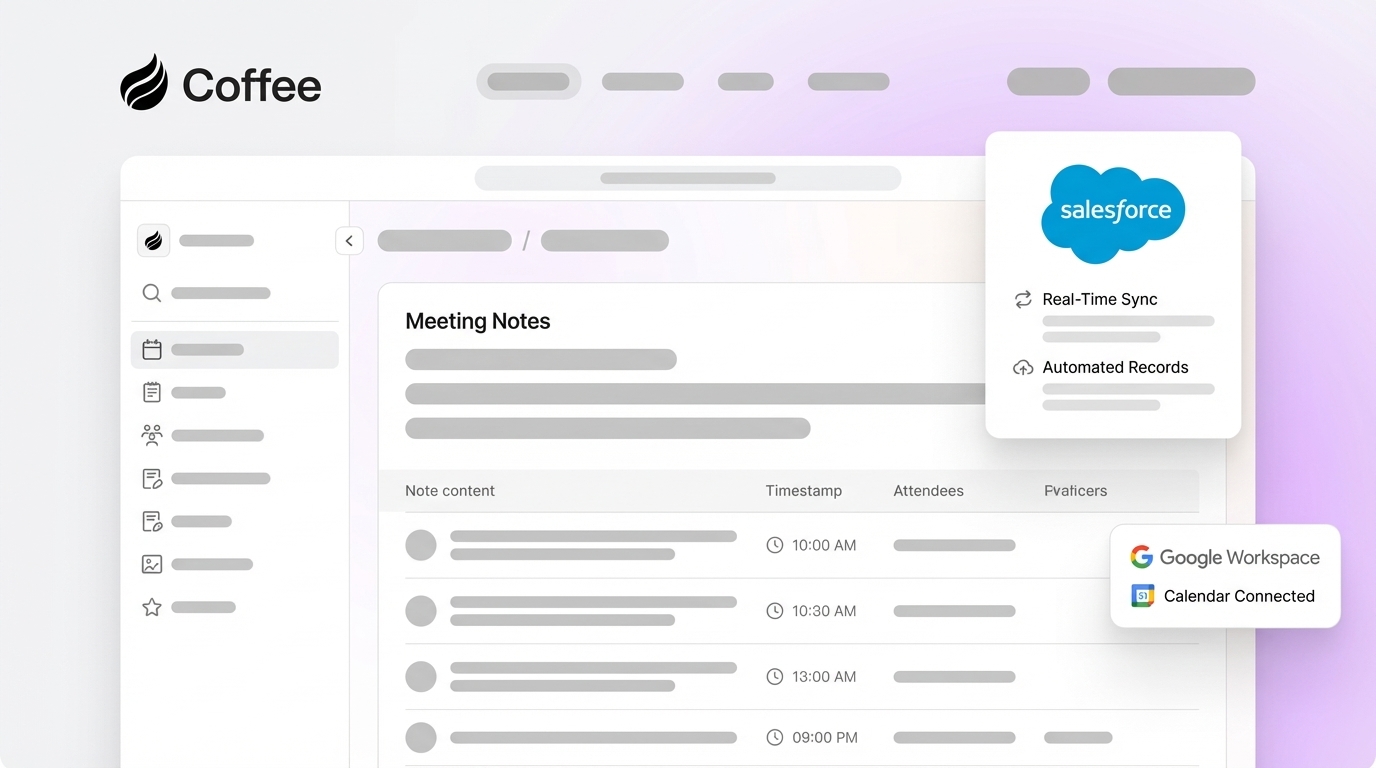
By 2026, this preference for bot-free calls has become a mainstream requirement. Many enterprise procurement policies now mandate explicit consent workflows that visible bots complicate. Coffee's Companion App operates as an autonomous agent that connects to Google Workspace or Microsoft 365 calendars and processes audio through the rep's own device, so no visible participant appears in the call. The agent transcribes, structures, and writes data to Salesforce in real time while the rep stays focused on the conversation instead of tool management.
Methodology Field Auto-Logging for Real Qualification Data
Generic AI note-takers fail at qualification because they produce unstructured summaries that land in a Salesforce notes field or in a separate application. A rep still needs to read the summary, pull out qualification signals, and manually populate opportunity fields. The manual work remains, only shifted into a different format.
Coffee's agent structures its output according to the framework the sales team has configured. For a MEDDIC deployment, the agent follows the qualification sequence. It starts by capturing Metrics, the quantified business impact the prospect states, and writes that to a custom opportunity field. Once the economic buyer is identified on the call, the agent maps that decision-maker to the opportunity's key contact role. Decision Criteria and Decision Process populate dedicated text fields that describe how and when the prospect will choose. Identified Pain flows into the opportunity description to anchor the business case. Finally, the Champion is recorded in a relationship field, which completes the qualification picture. BANT and SPICED follow equivalent direct field mappings, and no rep review is required before data appears in the record.
Competing visible-bot tools usually log a call summary to the activity timeline. Extracting structured methodology data from that summary and populating opportunity fields remains a manual step, which is why teams report recovering the time previously consumed by post-call data entry, the 8–12 hours per week documented in the comparison above.
Salesforce Native Features and Third-Party Sync Trade-Offs
Salesforce’s native Einstein Conversation Insights operates inside the platform’s permission and data governance model, which satisfies IT and security requirements without extra review. The limitation is depth. Einstein’s out-of-the-box field population is shallow, surfacing keyword mentions and sentiment but not autonomously populating structured methodology fields on the opportunity record without significant custom configuration and Salesforce admin effort.
Third-party tools that sync via API introduce a second system of record. When a rep updates a field in the third-party tool and the sync fails or lags, the Salesforce opportunity shows stale data. Pipeline forecasts built on that data become unreliable and require manual correction.
Coffee's Companion App authenticates directly to Salesforce and writes structured data back to the opportunity as the system of record. It handles both structured data, such as field values, and unstructured data, such as transcript text and email content, in a single agent pass, which no legacy Salesforce add-on or standalone note-taker currently matches.
Extending Coverage to In-Person Meetings
Virtual-meeting-only tools miss a large portion of selling activity. Field sales, executive briefings, trade show conversations, and on-site discovery sessions produce no CRM data unless a rep types notes afterward. That gap recreates the same manual-entry problem that AI note-takers claim to solve for virtual calls.
Coffee's agent supports ambient audio capture via mobile, which enables the same real-time transcription and structured field-logging pipeline for in-person meetings that it delivers for Zoom, Teams, and Google Meet sessions. The opportunity record is updated with the same configured methodology fields whether the meeting was virtual or face-to-face. Consistent coverage across meeting types directly addresses the root cause of poor CRM data quality, which appears whenever reps must manually enter notes and choose to skip it.
Data Quality, Opportunity Health, and Rep Adoption
Low CRM adoption usually follows a predictable pattern. Reps find post-call data entry burdensome, skip or abbreviate it, and opportunity records become unreliable. Forecasts built on incomplete records force managers to run interrogation-style pipeline reviews to fill gaps verbally, which consumes additional selling time.
Coffee's agent removes the post-call step entirely. Because the opportunity record updates in real time, the rep’s only required action is to conduct the meeting. The agent handles transcription, methodology extraction, field population, summary generation, and follow-up email drafting. See how autonomous field-logging changes your pipeline review quality and book a demo to watch it populate live opportunity records.
Platform Compatibility Across Zoom, Teams, and Meet
Coffee's Companion App supports Zoom, Microsoft Teams, and Google Meet through its calendar and workspace integrations with Google Workspace and Microsoft 365. The agent detects scheduled meetings, joins the audio stream through the rep's authenticated session, and processes the transcript regardless of which conferencing platform the prospect prefers. After initial authentication, no per-platform configuration is required.
Tracking the Right Sales Methodology for Your Team
Coffee supports BANT, MEDDIC, and SPICED as configurable templates. The sales team or RevOps admin selects the active framework, and the agent maps extracted signals to the corresponding Salesforce opportunity fields on every call. Teams that run multiple methodologies across different segments can assign frameworks by opportunity type or record type within Salesforce.
Scenario-Based Use Cases for Small-to-Mid-Market Salesforce Teams
Scenario 1: AE team losing deals at discovery due to bot friction. A 15-person SaaS sales team sells into financial services. Prospects routinely decline to continue discovery calls when a visible bot joins. Switching to Coffee's invisible agent removes the objection, and MEDDIC fields populate automatically without changing the rep's call behavior.
Scenario 2: RevOps leader with unreliable pipeline data. A Head of RevOps at a 200-person company runs weekly pipeline reviews where 40% of opportunity fields are blank or stale because reps skip post-call entry. Coffee's agent writes structured data to every opportunity in real time, so pipeline reviews become data-driven instead of anecdote-driven.
Scenario 3: Field sales team with in-person-heavy discovery. A manufacturing company's AEs conduct most discovery in person at customer sites. Generic AI note-takers provide no coverage. Coffee's mobile ambient capture extends the same structured logging pipeline to every in-person meeting.
Objective Risks and Practical Limitations
No automation tool removes all manual work. Coffee's agent requires an initial configuration session to map methodology fields to the correct Salesforce opportunity fields. This work is a one-time RevOps task, not ongoing maintenance, but it remains a real implementation step. Audio quality in noisy in-person environments can reduce transcription accuracy, which affects the quality of extracted methodology signals.
Teams in heavily regulated industries such as healthcare and finance should confirm that Coffee's SOC 2 Type 2 and GDPR compliance posture matches their data residency requirements before deployment. Coffee's current third-party integrations beyond Salesforce and HubSpot run through Zapier, so teams that need deep native integrations with other stack components should confirm compatibility before committing.
Practical Decision Framework and Checklist
Use the following criteria to match your team's constraints to the right solution. Start by diagnosing where your current process breaks down. If prospect-facing bot friction is killing deals, invisible operation becomes non-negotiable because a visible recorder will only amplify the problem. Once you address how prospects perceive your tooling, examine what happens to the data.
If pipeline forecast accuracy suffers because opportunity fields stay blank, you need methodology auto-logging to named fields rather than summaries that still require manual extraction. Coverage gaps come next. If your reps conduct in-person meetings that produce zero CRM data, in-person support is not optional. Finally, consider your existing infrastructure investment. If your team has already built Salesforce configuration, validation rules, and required fields, a solution that writes directly to Salesforce as the system of record avoids reconciliation overhead and preserves the work you have already done. Coffee satisfies all four criteria, and no other single solution in the 2026 market does.
Frequently Asked Questions
How long does it take to implement Coffee's Companion App on an existing Salesforce instance?
Implementation requires authenticating Coffee to your Salesforce instance and Google Workspace or Microsoft 365 environment. The authentication process uses a token-based setup with copy-paste into the Settings tab for instant validation. Mapping methodology fields to specific Salesforce opportunity fields is a RevOps configuration task that depends on the complexity of your opportunity record layout. Teams can begin capturing and logging structured call data soon after completing the setup.
Does switching to Coffee require migrating data out of Salesforce?
No. Coffee’s Companion App integrates with your existing Salesforce instance without creating a parallel system. See the “Salesforce Native vs. Third-Party Sync Trade-Offs” section above for details on how this approach avoids reconciliation overhead.
How does Coffee handle data security and privacy for call recordings?
Coffee is SOC 2 Type 2 certified and GDPR compliant. Call audio and transcript data are not used to train public AI models. Data processed by the Coffee agent is handled under the terms of Coffee's data processing agreement, which is available to enterprise customers for legal review. Teams in regulated industries should review the DPA against their specific compliance requirements before deployment.
Can Coffee scale as the sales team grows beyond mid-market?
Coffee's pricing is seat-based, so adding reps means adding seats. The agent's processing capacity scales with the seat count without additional configuration. Coffee's current ideal customer profile is small to mid-market companies. Very large enterprises with complex custom Salesforce configurations, multi-org environments, or multi-year security review requirements should discuss their specific architecture with Coffee's team before committing.
What happens to methodology data if a call is partially transcribed due to audio issues?
If audio quality degrades during part of a call, the agent logs the methodology fields it can extract from the available transcript and leaves unpopulated fields blank instead of inserting inaccurate data. The rep receives a post-call summary that flags which fields were not populated, which allows targeted manual review only where the agent could not achieve confidence.
Conclusion: Applying the Final Decision Framework
The decision reduces to four criteria: invisible operation, direct methodology field-logging to Salesforce opportunity records, in-person meeting support, and zero post-call manual steps for reps. In 2026, Coffee's Companion App is the only solution that satisfies all four simultaneously. Visible-bot tools address transcription but not structured field population or in-person coverage. Salesforce-native features address data governance but not autonomous methodology extraction. Generic AI note-takers address neither structured logging nor invisible operation.
For quota-carrying AEs and Heads of Sales at small-to-mid-market Salesforce teams, the 8–12 hours per week recovered from manual data entry becomes a clear, measurable outcome. Put your Salesforce opportunity records on autopilot and start your free trial now.