Written by: Doug Camplejohn, CEO & Co-Founder, Coffee | Last updated: June 23, 2026
Key Takeaways for Modern Sales Teams
- Agent-first CRM automation replaces manual data entry with an autonomous AI agent that captures, enriches, and logs sales data from emails, calls, and calendars in real time.
- An 8-week implementation roadmap guides teams from process mapping and KPI definition through agent deployment, high-value automation, champion enablement, and quarterly audits.
- Starting with sales process mapping and clear KPIs ensures automation targets real inefficiencies and delivers measurable ROI such as increased selling time and at least 90% CRM field completion.
- Prioritizing data quality, auto-logging, and simple launch configurations drives adoption while avoiding common pitfalls like over-configuration or skipping baselines.
- Teams ready to eliminate manual CRM work can explore Coffee’s pricing and deployment options today.
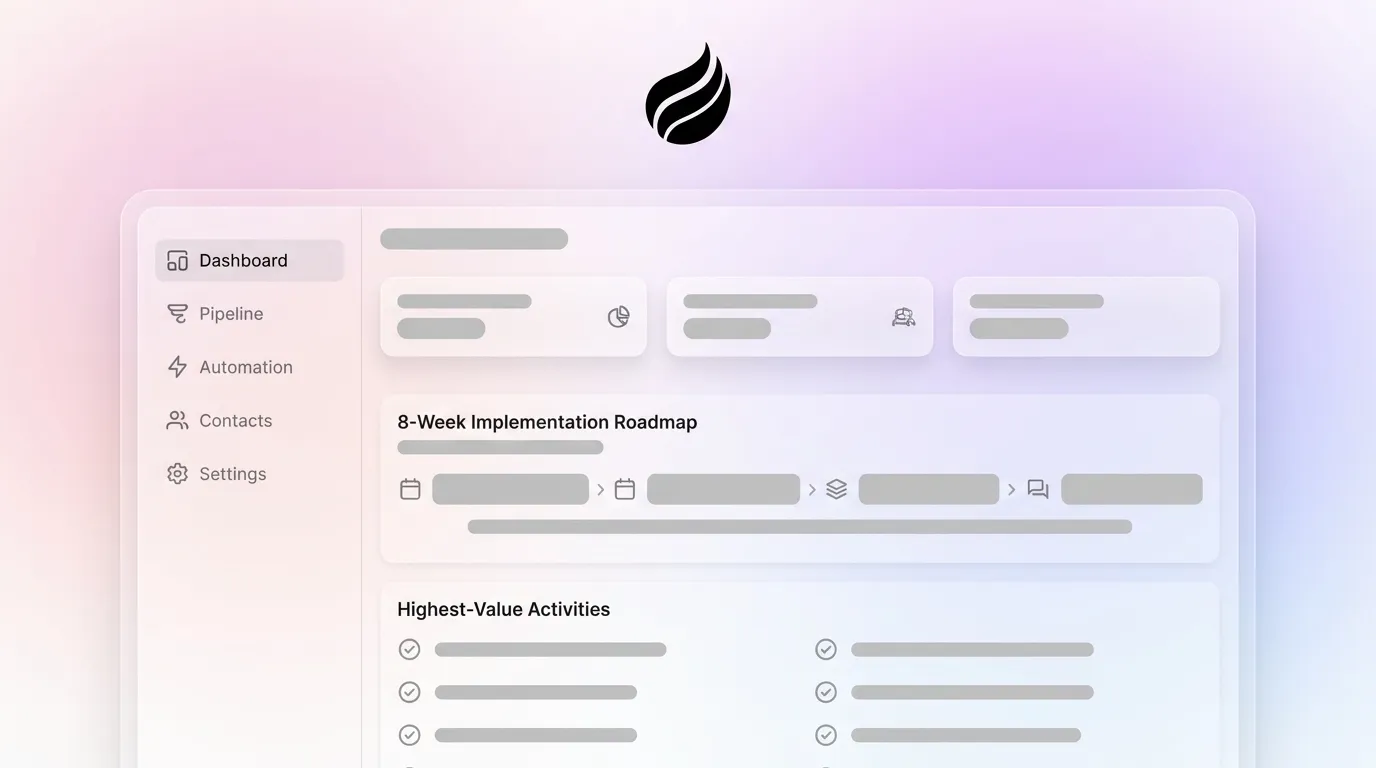
8-Week CRM Automation Implementation Roadmap
| Phase | Owner | Key Actions | Success Metric |
|---|---|---|---|
| Week 1–2: Audit & Map | RevOps / Head of Sales | Document current sales process steps, identify all manual data-entry touchpoints, catalog existing tools (CRM, enrichment, recording) | Process map completed, tool inventory finalized |
| Week 3: Define KPIs | RevOps | Set baseline metrics: rep selling time %, CRM field completion rate, pipeline forecast accuracy | KPI dashboard live with pre-automation baselines |
| Week 4: Deploy Agent | RevOps + IT | Connect Coffee to Google Workspace or Microsoft 365, authenticate Salesforce or HubSpot (Companion) or activate Standalone CRM, verify auto-logging | Agent capturing 100% of email and calendar activity |
| Week 5: Automate High-Value Activities | Head of Sales | Enable auto-contact creation, meeting briefings, post-call summaries, and follow-up drafts, configure sales methodology (BANT, MEDDIC, or SPICED) | Zero manual contact creation, post-call summaries delivered within 5 minutes |
| Week 6: Champion Enablement | Head of Sales | Identify 2–3 power users, run live walkthroughs, collect friction feedback, publish internal use-case library | Champions logging zero manual activities |
| Week 7: Simplify & Prune | RevOps | Remove redundant point solutions (enrichment tools, standalone recorders), consolidate stack, confirm data parity | Tool count reduced, cost savings documented |
| Week 8: Measure & Iterate | RevOps | Compare KPIs against baselines, run first Pipeline Compare review, schedule quarterly audit cadence | Rep selling time increased, CRM field completion rate ≥ 90% |
Map Your Sales Process Before You Automate
Automating a broken process produces broken results faster. Document every step a rep takes from first contact to closed-won before activating any agent or workflow. Identify where data is created, where it is lost, and which handoffs rely entirely on human memory.
Common mapping outputs include a stage-by-stage activity list that defines what the agent must track, a tool inventory showing where data lives today so you can identify redundant systems to retire, and a gap analysis highlighting fields that are routinely empty in the current CRM so they become early automation targets. Together, this map becomes the configuration guide for the automation agent and prevents scope creep during deployment.
Define Business Outcomes and KPIs Up Front
Clear business outcomes keep automation honest and measurable. Establish numeric baselines before Week 4 deployment so post-implementation comparisons are credible. Recommended KPIs include:
- Rep selling time as a percentage of total working hours (industry baseline: 35% for teams relying on manual CRM entry)
- CRM field completion rate (target: at least 90% after agent deployment)
- Hours per week spent on manual data entry per rep (target reduction: 8–12 hours)
- Pipeline forecast accuracy (measured via week-over-week Pipeline Compare)
- Time-to-follow-up after a discovery call (target: under 10 minutes with automated drafts)
Automate Highest-Value Activities First
Focusing on the highest-value activities first delivers visible wins and faster buy-in. Prioritize the tasks that consume the most rep time and produce the most downstream data value. For most sales teams, that order is contact and company creation, activity logging, meeting summaries, and follow-up drafting.

Coffee's agent handles all four automatically after connection to a calendar and email provider. Reps receive pre-meeting briefings, the agent joins calls via Zoom, Teams, or Meet to record and transcribe, and post-call summaries with next steps arrive before the rep closes their laptop. This sequence alone recovers the 8–12 hours per week that manual entry consumes.

Keep Your Launch Configuration Simple
Simple launch configurations drive adoption and trust. Configure the agent to handle the three or four highest-friction tasks identified in the process map, then expand once those are stable. Avoid automating every edge case in Week 4 because complexity added before reps trust the agent creates confusion, not efficiency.
A clean launch configuration focuses on this core loop, the four activities described above, plus Pipeline Compare for weekly reviews. Everything else is additive once the team confirms the basics are working.

Protect Data Quality with Auto-Logging
Data quality determines whether CRM automation delivers value or noise. Legacy systems struggle here because they depend on reps to enter data consistently, and as noted earlier, the majority of sales reps report excessive time spent on data entry, which means they skip it when under pressure.
Coffee's agent solves this structurally. It ingests unstructured data such as email threads, call transcripts, and calendar metadata and writes clean, enriched records back to the CRM without human input. Job titles, funding data, and LinkedIn profiles are appended via licensed enrichment partners. Last activity and next activity fields update autonomously. The result is a CRM that reflects reality rather than what a rep remembered to type.
Drive Adoption with Sales Champions
Champions turn a new tool into a team habit. Identify two or three reps who are early adopters or influential peers and onboard them in Week 6 before a full rollout. Their visible productivity gains, including fewer admin tasks, faster follow-ups, and cleaner pipeline reviews, create organic pull from the rest of the team.
Champions should document specific time savings and share them in team meetings. A rep who recovers two hours per day for selling activities is a more persuasive argument than any vendor deck. Pair champion enablement with a short internal use-case library that shows exactly how the agent handles the tasks reps dislike most.
Run Quarterly Audits to Keep Automation Aligned
Quarterly audits keep automation aligned with a changing sales motion. Sales processes evolve, new tools enter the stack, and agent configurations that were optimal at launch can drift away from current workflows. Schedule a quarterly audit covering field completion rates, agent activity logs, tool redundancy review, and KPI comparison against the prior quarter's baseline.
Quarterly audits also surface opportunities to expand automation scope, such as new sequences, additional enrichment fields, or Visitor Identification activation for inbound pipeline generation. Before beginning the 8-week roadmap, assess whether your team has the foundational elements in place so these audits build on a solid base.
Readiness Checklist for Agent-Led CRM Automation
| Dimension | Not Ready | Partially Ready | Ready |
|---|---|---|---|
| Team Size | Solo founder, no sales motion | 2–5 reps, informal process | 5–50 reps, defined stages |
| Current CRM | Spreadsheets or Notion only | CRM active but < 50% field completion | CRM active, team uses it daily |
| Process Maturity | No documented sales stages | Stages defined, not enforced | Stages defined and tracked |
| Change-Management Capacity | No internal champion identified | One champion, no exec sponsorship | Champion + Head of Sales aligned |
Once you confirm readiness, you can focus on avoiding the most common mistakes that derail early automation projects.
Common Pitfalls to Avoid
- Automating before mapping: Deploying an agent against an undocumented process embeds existing inefficiencies at scale.
- Skipping KPI baselines: Without pre-automation benchmarks, ROI cannot be demonstrated and budget renewals become difficult.
- Over-configuring at launch: Excessive complexity in Week 4 delays time-to-value and erodes rep trust before the agent proves itself.
- Ignoring data quality signals: Low field completion rates after deployment indicate the agent is not connected to the right data sources, not that automation has failed.
- No champion program: Top-down mandates without peer advocates produce compliance, not adoption.
These pitfalls become even clearer when you compare how legacy CRMs and agent-led systems handle core automation challenges.
Legacy vs. Agent-Led CRM Automation
| Dimension | Legacy CRM (Salesforce / HubSpot) | Agent-Led CRM (Coffee) |
|---|---|---|
| Data Entry | Manual, rep-dependent, fields routinely empty | Autonomous, agent captures email, calendar, and call data automatically |
| Unstructured Data Handling | Not supported natively, transcripts and emails require third-party tools | Native ingestion of emails, transcripts, and calendar metadata into structured records |
| Pipeline Visibility | Requires manual CSV exports or paid add-ons (e.g., Gong) | Built-in Pipeline Compare, week-over-week changes surfaced automatically |
| Stack Complexity | Requires separate enrichment (ZoomInfo), recording (Fathom), and outreach (SalesLoft) tools | Enrichment, recording, summaries, and pipeline intelligence consolidated in one agent |
Coffee Deployment Models for Different Sales Stacks
Coffee operates two deployment models so teams can hire the agent regardless of their current stack.
Standalone CRM: Designed for teams of 1–20 that have outgrown spreadsheets but find legacy CRMs expensive and maintenance-heavy. The Coffee agent powers the entire system of record, including contacts, companies, activities, pipeline, and forecasting, without requiring a separate CRM license.
Companion App: Designed for teams of 5–50 already committed to Salesforce or HubSpot. A simple authentication deploys the Coffee agent as an intelligent layer on top of the existing instance. The agent handles all data-in work such as contact creation, enrichment, activity logging, and call summaries and writes clean records back to Salesforce or HubSpot. The system of record stays intact, while the manual entry disappears.
Both models include seat-based pricing with no metering on agent actions or LLM usage. The agent's labor is unlimited, and teams pay only for human seats. Review pricing for both deployment models and choose the one that fits your current stack.
Frequently Asked Questions
How deeply does Coffee integrate with Salesforce and HubSpot?
Coffee's Companion App connects to Salesforce and HubSpot through a simple authentication flow. Once authenticated, the agent reads existing records, enriches them with job titles, funding data, and LinkedIn profiles, and writes activity logs, meeting summaries, and next steps back to the primary CRM. Coffee is built with an understanding of Salesforce's complexity, including quotas, forecasting, and required fields, which distinguishes it from newer CRM alternatives that lack this integration depth. Additional tool connections are available via Zapier, with deeper native integrations on the product roadmap.
Is Coffee SOC 2 and GDPR compliant?
Yes. Coffee is SOC 2 Type 2 certified and GDPR compliant. Customer data is not used to train public AI models. For U.S. sales teams in non-regulated industries, this covers standard enterprise security requirements. Teams in heavily regulated sectors such as healthcare or finance with multi-year security review requirements fall outside Coffee's current ideal customer profile.
How does Coffee's built-in enrichment compare to dedicated tools like ZoomInfo or Apollo?
Coffee's agent provides enrichment data such as job titles, company funding, and LinkedIn profiles via licensed data partners at a quality level sufficient for most SMB and mid-market use cases. It is not positioned as a replacement for enterprise-grade data providers in organizations that require exhaustive contact databases, but it eliminates the need for a separate enrichment tool subscription for the majority of teams in the 1–50 rep range. The practical benefit is stack consolidation, where one agent replaces the CRM, enrichment tool, call recorder, and pipeline reporting add-on.
How does Coffee's seat-based pricing work?
Coffee uses straightforward seat-based pricing. Teams pay per human user, and the agent's activity, including data capture, enrichment, logging, summaries, and pipeline analysis, is included without usage caps or per-action metering. There are no additional charges for LLM calls or automated processes. This model makes cost predictable as teams scale and removes the variable billing that accompanies usage-based automation platforms.
Conclusion: Move to Agent-First CRM Automation
CRM automation in 2026 functions as an architectural decision, not a minor configuration project. Teams that deploy rule-based workflows on top of legacy systems reduce some friction but preserve the core problem, which is that humans remain responsible for data quality. Agent-first automation removes that dependency entirely.
The 8-week roadmap above gives sales leaders and RevOps teams a structured path from process mapping to measurable ROI. The critical variable is not the timeline, but the decision to replace manual entry with an agent that captures, enriches, and logs data autonomously from day one.
Coffee is the only solution that delivers this in both a Standalone CRM and a Companion deployment for existing Salesforce and HubSpot instances. The agent handles the busywork, and reps handle selling. Start your free trial and put an agent to work on your pipeline today.