Written by: Doug Camplejohn, CEO & Co-Founder, Coffee | Last updated: July 4, 2026
Key Takeaways for RevOps and Sales Leaders
- HubSpot works as your system of record, while Coffee adds an AI agent layer that handles data accuracy and entry tasks for your team.
- Most 10-50 person B2B sales teams see faster ROI and less disruption by keeping HubSpot and layering Coffee on top instead of replacing the CRM.
- Coffee automates contact creation, activity logging, enrichment, and meeting summaries, saving reps 8-12 hours per week on manual CRM work.
- Teams of 1-20 people benefit most from Coffee Standalone, while 20-50 person teams already on HubSpot gain the most from the Companion App integration.
- Eliminate manual HubSpot data entry and reclaim hours each week, get started with Coffee today.
How This Coffee vs HubSpot Comparison Works
Six criteria structure this comparison: data quality and automation depth, implementation effort, workflow fit for sales reps, manager visibility and pipeline intelligence, integration requirements, and ongoing administrative burden. Each criterion maps directly to the friction points that drive RevOps leaders to evaluate alternatives in the first place. The table below shows how Coffee’s AI agent layer addresses each friction point by taking over manual work that HubSpot leaves to humans, with the biggest gains in data quality and ongoing administrative burden.
Side-by-Side Comparison: HubSpot Alone vs HubSpot + Coffee
| Criterion | HubSpot Standalone | Coffee AI Agent Layer (on HubSpot) |
|---|---|---|
| Data quality & automation depth | Manual entry required, over 50% of CRM records are typically incomplete, with 76% of organizations reporting less than half their CRM data accurate and complete | Auto-creates contacts, logs activity, enriches records from email/calendar/calls without human input |
| Implementation effort | Quick setup, HubSpot Sales Hub is well-documented for 10-50 person B2B teams | 1-3 weeks for a 3-5 workflow integration, simple OAuth authentication to HubSpot |
| Workflow fit for reps | Reps serve the software, roughly 60% of working hours spent on non-selling tasks | Software serves reps, meeting briefings, call recording, and follow-up drafts handled automatically |
| Manager visibility & pipeline intelligence | Manual CSV exports, pipeline reviews require rep interrogation | Pipeline Compare visualizes week-over-week deal changes automatically, no spreadsheets required |
| Integration requirements | Native HubSpot ecosystem, App Marketplace, Zapier, and custom API paths available | Connects via Zapier today, deeper native integrations on roadmap |
| Ongoing administrative burden | High, data hygiene depends entirely on rep compliance | Low, agent handles data entry, enrichment, and activity logging continuously |
When Replacing HubSpot with Coffee Makes Sense
Replacement is rarely the right answer for established teams. Most companies enhance existing use cases rather than replace platforms with AI. Frans Riemersma’s February 2026 analysis at martech.org explains this clearly: AI agents add probabilistic decision-making on top of deterministic systems of record. The CRM keeps responsibility for data integrity and policy enforcement, while the agent interprets signals and acts.
HubSpot had 299,458 customers worldwide as of Q1 2026. Teams embedded in that ecosystem carry workflow history, contact records, and reporting configurations that are expensive to migrate. The practical decision centers on whether the cost of migration exceeds the cost of augmentation. For teams with 20 or more people already on HubSpot, augmentation with Coffee’s Companion App usually offers lower risk and faster payback.
Replacement fits teams of 1-20 people that have not committed to HubSpot, still manage sales in spreadsheets or Notion, and want an agent-first system from day one. Coffee’s Standalone CRM is built for that profile.
How Coffee Automates HubSpot Data Entry
The core failure mode of HubSpot and every legacy CRM is dependency on human data entry. CRM audits routinely find that reps spend 10-15 hours weekly on data tasks, and sales professionals report that AI saves them time and streamlines their process.
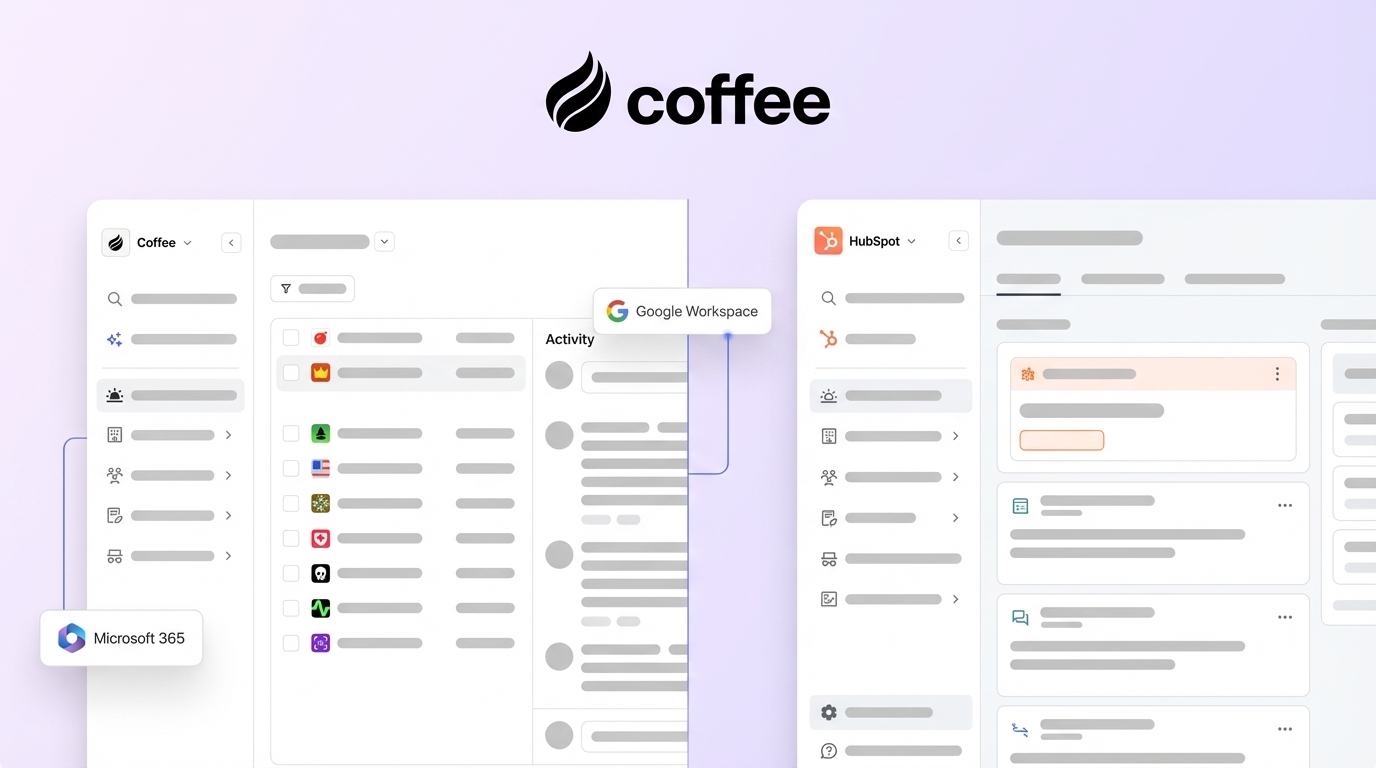
When Coffee connects to Google Workspace or Microsoft 365, the agent scans emails and calendars to auto-create contacts and companies in HubSpot. It logs last activity and next activity autonomously, enriches records with job titles, funding data, and LinkedIn profiles via licensed data partners, and writes call transcripts and meeting summaries directly back to HubSpot records. The result is 8-12 hours of weekly time savings per rep, a figure consistent with AI CRM deployments that save more than 5 hours per week on automated data entry alone, plus additional savings on pipeline review time that drops from 45 minutes daily to 5-10 minutes of validating recommendations. For a 20-person team, that productivity recovery compounds into substantial annual gains.

Try Coffee’s automation layer and remove manual HubSpot data entry from your reps’ calendars.
Coffee Companion App: Meeting-to-CRM Workflow on HubSpot
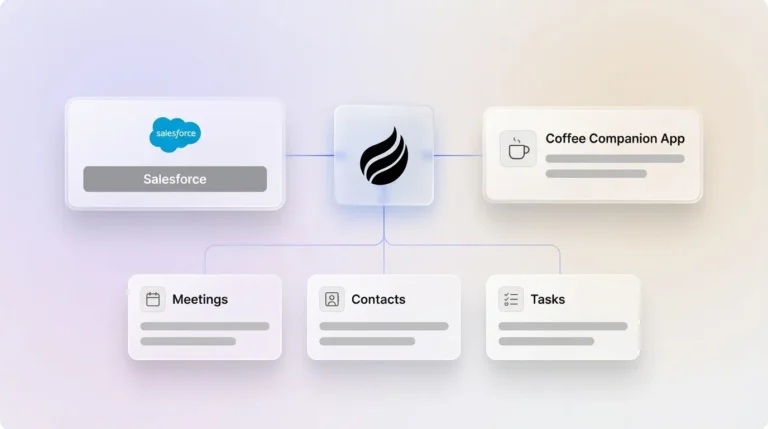
The automation capabilities described above, such as contact creation, activity logging, and enrichment, reach HubSpot users through Coffee’s Companion App. In this configuration, the same agent operates as an intelligent layer on top of an existing HubSpot instance.
Before a meeting, the agent prepares a briefing on attendees, their roles, and prior interaction history. During the call, Coffee’s AI bot joins via Zoom, Teams, or Google Meet to record and transcribe. After the call, the agent generates a structured summary organized by BANT, MEDDIC, or SPICED depending on team preference, identifies next steps, and drafts a follow-up email in Gmail for the rep to review and send. All outputs write back to the corresponding HubSpot contact and deal records automatically.

This workflow closes a gap that HubSpot’s native Breeze AI cannot close. Breeze treats each request as a one-shot prompt with no persistent state, while Coffee maintains memory of prior actions, rep preferences, and deal context across days and weeks. Breeze is limited to the CRM edge and does not orchestrate cross-tool workflows, while Coffee coordinates actions across tools.
Visitor Identification extends this intelligence to anonymous website traffic. A single tracking pixel identifies visitors by name, title, email, and LinkedIn profile, surfaces real-time Slack alerts for high-fit accounts, and, unlike point solutions such as RB2B or Warmly, recommends the specific two or three individuals inside a visiting company who match the buyer persona. Those prospects are added to HubSpot with enrichment pre-filled, ready for outbound action. A mid-market B2B company can generate substantial monthly pipeline from identified visitors and cover tool costs with that incremental revenue.

Pipeline Compare: Fixing HubSpot Reporting at the Source
HubSpot’s pipeline reporting reflects whatever data reps have entered. When entry is incomplete, as noted earlier this affects over 50% of records in typical audits, pipeline reviews turn into interrogation sessions rather than strategic discussions. Coffee’s Pipeline Compare feature solves this at the source.
Because the agent captures all deal activity in a built-in data warehouse, it can visualize week-over-week changes such as which deals progressed, which stalled, and which were added. Managers see an accurate, current pipeline without manual CSV exports or rep-by-rep status calls. Roughly 25% of organizations have deployed agentic AI as of early 2026, so teams that adopt Pipeline Compare now gain a structural reporting advantage over competitors that still rely on manual updates.
Coffee vs HubSpot for Sales Teams Under 50 People
Team size acts as the primary segmentation variable in this decision. For teams of 1-20 people that have not yet committed to a CRM, Coffee Standalone is the recommended path. These teams have outgrown spreadsheets but find HubSpot’s manual maintenance model to be an expensive chore. The agent manages the system of record entirely, with no legacy migration required.
For teams of 20-50 people already running HubSpot, the Coffee Companion App usually fits better. HubSpot Sales Hub is well-suited for 10-50 person B2B teams seeking a unified CRM with native marketing, sales, and service hubs, so the platform’s strengths in contact management, sequences, and reporting remain intact. Coffee adds the autonomous data layer that HubSpot’s architecture cannot provide natively, without requiring a platform migration.
See Coffee’s pricing for your team size and choose between Standalone and Companion App.
Operational Considerations and Scaling Coffee on HubSpot
Change management represents the most underestimated cost in any CRM augmentation project. A typical external agent integration covering 3-5 HubSpot workflows requires 1-3 weeks: two days scoping, three to five days integration, and one to two weeks of supervised observation before full autonomy. Coffee’s authentication model, a simple OAuth connection to HubSpot, compresses the technical setup. The supervised observation period is where data hygiene matters most. Agentic AI tasks fail at high rates when CRM data inputs are poor, so teams with rampant duplicate records should address hygiene before activating full automation.
The supervised observation period addresses initial data quality, but long-term scaling introduces a different concern, which is cost predictability. Coffee’s seat-based pricing model means the agent’s labor scales with the team without metered LLM costs. As headcount grows from 20 to 50, the agent absorbs proportionally more data entry work without a corresponding increase in per-process fees, unlike usage-based AI tools where cost can spike unpredictably as automation volume increases.
Risks and Limitations of Coffee Compared to HubSpot Alone
Third-party integrations beyond HubSpot currently route through Zapier. HubSpot API rate limits vary by tier, and agents that loop on contacts or deals can exhaust quotas and temporarily freeze the portal unless batching and exponential backoff are implemented. Teams with high-volume contact creation workflows should confirm rate limit headroom before deployment.
Coffee is SOC 2 Type 2 and GDPR compliant, and data is not used to train public models. Teams in heavily regulated industries such as healthcare and financial services that require multi-year security reviews fall outside Coffee’s current ICP.
HubSpot remains preferable as a standalone system for teams that need deep marketing automation, a large App Marketplace ecosystem, or enterprise-grade custom objects and reporting. HubSpot’s Breeze AI layer offers comprehensive capabilities spanning the customer journey, and teams already extracting value from Breeze Intelligence should evaluate whether Coffee’s enrichment coverage meets their specific data requirements before switching enrichment providers.
Decision Framework: Coffee vs HubSpot Checklist
Use this checklist as a simple decision tree. Start with the Standalone list if you do not have a CRM, then move to the Companion App list if you already run HubSpot, and finally confirm that HubSpot-only still fits if neither Coffee option matches your constraints.
Choose Coffee Standalone if:
- Team size is 1-20 people with no existing CRM commitment
- Current workflow is spreadsheets or Notion
- No dedicated RevOps resource to maintain HubSpot
- Priority is speed and automation over marketing hub features
Choose HubSpot plus Coffee Companion App if:
- Team size is 20-50 people already on HubSpot
- HubSpot records are incomplete due to manual entry failure
- Reps spend more than 8 hours per week on CRM administration
- Pipeline reviews require manual CSV exports or rep status calls
- Website visitor identification is an active pipeline gap
Stay with HubSpot Standalone if:
- Team is already extracting full value from Breeze AI and native automation
- Marketing automation is the primary use case, not sales data quality
- Industry compliance requirements exceed Coffee’s current certifications
Frequently Asked Questions
How long does it take to set up Coffee on top of HubSpot?
The technical connection between Coffee and HubSpot uses a simple OAuth authentication, which typically takes minutes. Configuring the agent to cover three to five core workflows, such as contact creation, activity logging, meeting intelligence, and pipeline tracking, generally requires one to three weeks total, including a supervised observation period before full autonomy is enabled. Teams with clean HubSpot data move through this phase faster than those with duplicate records or missing fields.
Does adding Coffee require migrating away from HubSpot?
No. The Companion App is designed to sit on top of an existing HubSpot instance. HubSpot remains the system of record, and Coffee’s agent handles the data-in process so that records stay accurate without human effort. No contact, deal, or pipeline data needs to be migrated. The agent writes enriched data and meeting outputs back into HubSpot’s existing properties and records.
How does Coffee’s data enrichment compare to dedicated tools like ZoomInfo or Apollo?
Coffee’s enrichment, including job titles, funding data, and LinkedIn profiles, is sourced via licensed data partners and is built into the agent at no additional per-record cost. For most B2B use cases at the 10-50 person team scale, the coverage is sufficient to eliminate a separate enrichment subscription. Teams with highly specialized data requirements, such as direct-dial phone numbers at enterprise scale or intent data from specific publishers, may still benefit from a dedicated enrichment provider alongside Coffee.
What does Coffee’s pricing model look like relative to HubSpot?
Coffee uses seat-based pricing, so you pay for human seats and the agent’s labor is included without metered LLM usage fees or per-process charges. HubSpot Sales Hub Professional starts at $100 per seat per month in 2026, with Breeze AI included at capped credit levels. Moving beyond those limits requires Enterprise tier or add-ons, which scales quickly for a 10-seat team. Coffee’s model is designed to be additive rather than multiplicative, so the agent absorbs more work as the team grows without a corresponding cost spike.
Is Coffee secure enough for a B2B sales team handling sensitive deal data?
Coffee is SOC 2 Type 2 and GDPR compliant. Data processed by the agent is not used to train public AI models. For most B2B sales environments such as SaaS, professional services, and technology, these certifications meet standard procurement requirements. Teams in heavily regulated industries such as healthcare or financial services that require multi-year security reviews or industry-specific compliance frameworks should evaluate whether Coffee’s current certification scope meets their specific obligations before deployment.
Conclusion: Matching Coffee and HubSpot to Your Team Profile
HubSpot functions as a capable system of record with a large ecosystem and a well-established SMB footprint. Its limitation is structural, because it depends on human data entry to function and humans are unreliable data entry clerks. Coffee’s AI agent resolves that dependency by automating contact creation, activity logging, meeting intelligence, and pipeline tracking while leaving HubSpot’s strengths intact.
For teams of 20-50 already on HubSpot, the Companion App delivers the time savings described earlier without a platform migration. For teams of 1-20 starting fresh, Coffee Standalone removes the manual CRM burden entirely from day one. The data is consistent: teams using AI are 3.7x more likely to hit quota, and most companies that adopt AI choose augmentation over replacement.
Automate your HubSpot workflow with Coffee and shift your reps’ time from admin work to selling.