Written by: Doug Camplejohn, CEO & Co-Founder, Coffee | Last updated: July 3, 2026
Key Takeaways
- An autonomous AI CRM agent captures and structures customer data without manual entry, replacing passive databases that rely on human compliance.
- Coffee saves sales reps 8–12 hours per week by automatically logging emails, calls, and activities while enriching records with licensed data.
- Small teams of 1–20 employees benefit from Coffee Standalone as a complete system of record, while mid-size teams of 20–100 can layer Coffee Companion onto Salesforce or HubSpot.
- Coffee’s built-in data warehouse preserves historical deal context and powers advanced pipeline visibility features like Pipeline Compare and Suggested Leads from website visitors.
- Ready to eliminate manual data entry? Start a Coffee plan today.
How an AI CRM Agent Works in Practice
Traditional CRMs act as storage containers. They hold whatever a human types into them and return exactly that, no more and no less. An AI CRM agent connects to email, calendar, and call data, infers relationships and deal states, and then writes structured records on its own. The agent handles the labor, and the human focuses on selling.
The distinction matters because a passive database amplifies the data entry burden over time, while an autonomous agent removes that burden from the team.
Best AI CRM Comparison Table
The table below highlights how Coffee’s autonomous agent, unstructured data handling, and data warehouse differ from both legacy and modern CRMs. Use it to see where time savings, data quality, and historical tracking diverge across options.
| Solution | Hours Saved on Data Entry per Rep/Week | Handles Unstructured Data (Emails/Calls) | Companion Mode for Salesforce/HubSpot | Built-in Data Warehouse for Historical Tracking |
|---|---|---|---|---|
| Coffee (Standalone) | 8–12 hrs | Yes | N/A (system of record) | Yes |
| Coffee (Companion) | 8–12 hrs | Yes | Yes — Salesforce & HubSpot | Yes |
| Legacy CRMs (Salesforce, HubSpot, Pipedrive) | 0, manual entry required | No, structured fields only | Native (no agent layer) | No, field updates overwrite history |
| Modern CRMs (Clarify, Day.ai) | Partial, limited automation scope | Partial, Day.ai focuses on unstructured, Clarify limited | Limited integration depth | No |
Hours-saved figures reflect Coffee’s published agent capabilities. Legacy CRM savings reflect a baseline of zero autonomous capture. Modern CRM characterizations reflect publicly available product positioning as of mid-2026.
Eliminate manual data entry from your sales workflow by connecting Coffee to your email and calendar today.
The capabilities above map to different buyer contexts depending on team size and existing infrastructure. The next sections walk through what that means for small teams and for mid-size teams on Salesforce or HubSpot.
Best AI CRM for Small Teams Building from Scratch
Teams of 1–20 employees need low implementation effort, high data quality from day one, immediate workflow fit, and no dedicated RevOps resource. Coffee’s Standalone CRM meets each of these criteria for early-stage companies.
Connection to Google Workspace or Microsoft 365 triggers automatic contact and company creation, with no import and no manual setup. Once those foundational records exist, the agent enriches them with job titles, funding data, and LinkedIn profiles via licensed data partners, which removes the need for a separate Apollo or ZoomInfo subscription. With enriched contacts in place, activity logging for last contact, next step, and deal stage then updates on its own after every email and call.

Founders and early sales hires who have outgrown spreadsheets but find HubSpot’s manual overhead prohibitive gain a system that stays current without human maintenance. Only 35% of a sales rep’s time is currently spent selling, and Coffee’s agent helps reclaim the rest.
AI CRM Agent vs. Passive Database Outcomes
The architectural difference between an AI CRM agent and a passive database shapes data quality, forecast accuracy, rep adoption, and pipeline visibility.
Passive databases rely on human compliance. Manual data entry is consistently reported by salespeople as their biggest challenge when using their CRM, and SDRs spend only 28% of their time actually selling, with the remainder consumed by research, data entry, and administrative tasks. When humans skip logging, the database degrades, management sees stale pipeline data, and forecasts become unreliable.
Coffee’s agent architecture inverts this dynamic. The agent ingests unstructured data such as email threads, call transcripts, and calendar events, then writes structured records back to the CRM automatically. Because the input stays clean and continuous, the output remains accurate. Coffee’s AI search on deals, released in January 2026, answers natural-language questions such as “Which deals are stuck in negotiation?” or “What is closing this month?”, which depends on a reliable data foundation.
The practical result is that Coffee saves reps 8–12 hours per week, compared to the 5.5 hours per week sales representatives currently spend on manual CRM data entry alone, before counting time lost chasing data across disconnected tools.
Best AI CRM Companion for HubSpot and Salesforce
Teams of 20–100 employees that already use Salesforce or HubSpot rarely want to replace their system of record. These teams need an agent layer that fixes data quality without disrupting workflows, quotas, forecasting configurations, or required fields.
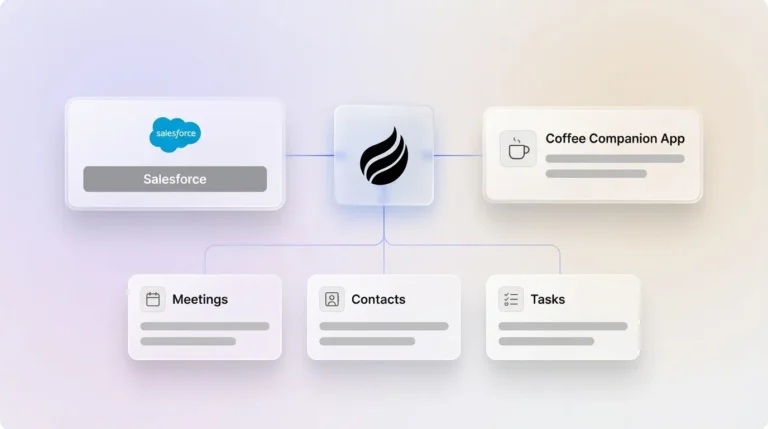
Coffee’s Companion App deploys through simple authentication against an existing Salesforce or HubSpot instance. After that connection, the agent handles all data capture, logs emails, transcribes calls, enriches contacts, and writes clean, structured data back to the primary CRM. Coffee’s improved summary templates, released in November 2025, are customizable to match specific workflows and writable back to Coffee, HubSpot, or Salesforce, which preserves existing field structures.
Newer alternatives such as Day.ai and Clarify lack the integration depth to handle Salesforce’s complexity across quotas, forecasting hierarchies, required fields, and custom objects. Coffee’s companion mode is built for that complexity, which makes it a practical AI CRM companion for established mid-market teams.
Best AI CRM for Fully Removing Data Entry
Removing data entry requires more than auto-logging emails. Teams need an agent that handles unstructured data at scale, maintains historical context, and runs without prompts.
Coffee’s agent scans emails and calendars to auto-create contacts and companies, logs every interaction as an activity, enriches records continuously, joins calls via AI meeting bot to record and transcribe, and generates post-call summaries with next steps and draft follow-up emails. Coffee’s Intelligence layer, introduced in February 2026, allows teams to define business model, ICP, and competitive context so the agent delivers tailored suggestions and insights rather than generic outputs.

The agent also supports BANT, MEDDIC, and SPICED qualification frameworks. Every call produces structured, consistent data regardless of which rep ran the meeting.
Let Coffee’s agent handle every data entry task your team currently does manually.
2026 Buyer-Size Decision Framework
1–20 employees: Choose Coffee Standalone. The agent acts as the system of record, handles all data capture from day one, and requires no existing CRM infrastructure. Pipeline Compare visualizes week-over-week deal movement automatically and replaces manual CSV exports and spreadsheet reviews.
20–100 employees: Choose Coffee Companion. The agent layers onto Salesforce or HubSpot, fixes data quality without migration, and writes enriched records back to the existing system. The built-in data warehouse preserves historical context that legacy CRM field updates permanently overwrite.
Both models include Coffee’s agent-led data warehouse, which stores the full history of every deal state change. Pipeline Compare can then surface progressed deals, stalled opportunities, and new additions in a single view without manual preparation.
Visitor Identification and Suggested Leads
Most CRMs, AI-enabled or otherwise, operate only on known contacts. Coffee extends pipeline intelligence to anonymous website traffic through a single tracking pixel installed in the site’s <head> tag.
Once active, Coffee identifies visitors by name, title, email, and LinkedIn profile, alongside company, pages visited, time on site, and visit frequency. Real-time Slack notifications surface high-fit visitors immediately. One click adds the prospect to Coffee with all enrichment pre-filled.
Suggested Leads create the main differentiator. Competitors such as RB2B and Warmly surface either the visiting company or undifferentiated people lists. Coffee uses the team’s defined buyer persona to recommend the two or three specific individuals inside that visiting company most worth contacting, with LinkedIn profiles ready for immediate outreach or auto-enrollment into a drip campaign.

Addressing Common Objections
Integrations: Coffee currently connects to external tools via Zapier, with deeper native integrations on the product roadmap. For most small-to-mid-size teams, Zapier coverage provides enough flexibility for day-one deployment.
Security and compliance: Coffee is SOC 2 Type 2 and GDPR compliant. Customer data is not used to train public models, which makes it appropriate for teams handling sensitive commercial information.
Data quality: Coffee’s enrichment, sourced via licensed data partners, matches dedicated tools such as Apollo for the majority of use cases and is included in the seat price rather than billed as a separate line item.
Practical Decision Checklist
- Team size 1–20, no existing CRM → Coffee Standalone
- Team size 20–100, on Salesforce or HubSpot → Coffee Companion
- Need unstructured data capture for calls and emails → Coffee, since legacy CRMs cannot handle this natively
- Need historical pipeline tracking without spreadsheets → Coffee, with its built-in data warehouse
- Need website visitor identification with persona-matched leads → Coffee Visitor ID plus Suggested Leads
- Need SOC 2 Type 2 and GDPR compliance → Coffee qualifies
- Large enterprise with custom multi-year security review requirements → Coffee is not the right fit
Frequently Asked Questions
How long does it take to implement Coffee?
The Standalone CRM begins implementation as soon as you connect Google Workspace or Microsoft 365. The agent starts auto-creating contacts and logging activities within minutes of authentication. Most small teams avoid data migration and professional services entirely. The Companion App for Salesforce or HubSpot deploys through a simple authentication flow, after which the agent begins syncing and enriching data without manual configuration of individual fields.
How difficult is it to migrate existing CRM data to Coffee?
Teams moving from spreadsheets or lightweight CRMs such as Pipedrive can import existing records directly. Teams using Coffee as a Companion on top of Salesforce or HubSpot do not need migration, because the existing system of record remains in place and Coffee’s agent writes enriched data back to it. This model keeps risk low for established teams with years of historical CRM data.
How is Coffee priced?
Coffee uses seat-based pricing. Each human user occupies a seat, and the agent’s labor for data capture, enrichment, meeting recording, pipeline tracking, and visitor identification is included without additional metering on AI usage or process volume. There are no separate charges for LLM calls or automation runs, which keeps cost predictable as teams scale.
How does Coffee handle data security?
Coffee is SOC 2 Type 2 certified and GDPR compliant. Customer data processed by the agent is not used to train public AI models. For teams in lightly regulated industries that handle commercial sales data, Coffee meets standard enterprise security requirements. Teams in heavily regulated sectors such as healthcare or finance with multi-year security review cycles fall outside Coffee’s current ideal customer profile.
What should a sales leader evaluate when comparing any AI CRM in 2026?
Sales leaders should first check whether the system captures data autonomously or still relies on human input. A CRM that requires manual logging will degrade in quality over time regardless of its AI features. Leaders should also review whether the tool handles unstructured data such as call transcripts and emails, whether it maintains historical deal state in a data warehouse rather than overwriting fields, whether it can function as a companion on existing infrastructure or only as a standalone replacement, and whether its integration depth matches the complexity of the current tech stack. Pricing transparency, especially whether AI usage is metered separately, is another practical consideration for growing teams.
Conclusion: Choosing an AI CRM Agent in 2026
The core problem with legacy CRMs has not changed, because they remain passive databases that depend on human compliance to stay accurate. Sales teams lose significant time chasing data across disconnected systems, which stems from architectures that were never designed to capture data autonomously.
Coffee’s agent architecture addresses this problem at the source. Teams of 1–20 gain a fully automated system of record from day one with the Standalone CRM. Teams of 20–100 already on Salesforce or HubSpot fix data quality without migration or disruption through the Companion App. Both models include the built-in data warehouse, Pipeline Compare, and Visitor Identification with Suggested Leads, which remain unavailable in any legacy or modern passive CRM.
Replace manual data entry with Coffee’s autonomous agent and get accurate pipeline intelligence every week.