Written by: Doug Camplejohn, CEO & Co-Founder, Coffee
Key Takeaways
- Manual data entry causes low CRM adoption, incomplete forecasts, and shadow systems in spreadsheets.
- B2B SaaS teams should choose a Salesforce alternative based on GTM motion and whether they replace Sales Cloud, Service Cloud, or both.
- AI-first CRMs like Coffee automate data entry so reps spend more time selling and less time logging activity.
- Teams locked into Salesforce contracts can improve data quality by layering an agent on top instead of migrating.
- Coffee works as both a standalone AI-first CRM for small teams and a Companion App that keeps Salesforce accurate with minimal manual effort.
Compare Coffee Plans For Your Team
Why B2B SaaS Teams Are Leaving Salesforce In 2026
Salesforce carries 25 years of legacy baggage, and legacy CRMs assume humans will reliably input data. That assumption fails in day-to-day sales work. Salesforce's NRR is projected to land between 105% and 108% in 2026, down from a historical peak of 110–115% in 2021–2023, and the Sales Cloud logoff rate in 2026 is estimated at 12–15%, meaning one in seven licensed users is not active.
The forum language is consistent: "too much admin," "reps won't log," "shadow CRM in spreadsheets." These complaints focus on a system that forces reps to serve the software instead of the software serving them. According to market data shared by Coffee, 71% of sales reps say they spend too much time on data entry, which leaves only 35% of their time for actual selling. 79% of opportunity data that sales reps collect never makes it into the CRM, and CRM adoption failure stems from legacy systems relying on fallible human data entry, and the fix is deploying an agent to handle the manual logging.
Mid-market teams leave Salesforce because adoption is low, attribution is hard to trust, and admin costs are too high. Custom fields get used incorrectly, workflows break, and integrations lose sync. The AI-native CRM versus traditional CRM conversation really focuses on who does the data entry: the rep or the agent.
Which CRM Is The Best Salesforce Alternative For B2B SaaS?
The best Salesforce alternative for B2B SaaS depends on your GTM motion and what you replace. For most teams, the choice comes down to three paths. You can replace Salesforce with an AI-first CRM, keep Salesforce and layer an agent on top to fix data quality, or move to a simpler tool that still requires manual entry. The table below shows that no single alternative wins in every scenario, so match your GTM motion to the second column and choose the path that fits.
| Platform | Best Fit (GTM Motion) | What It Replaces | Main Trade-off |
|---|---|---|---|
| Coffee (Standalone CRM) | Inbound, outbound, or PLG teams of 1–20 that want data entry fully automated | Salesforce Sales Cloud, HubSpot, Pipedrive, spreadsheets | Newer product; large enterprises with complex custom workflows are outside the ICP |
| HubSpot | Inbound-led teams needing marketing + CRM in one place | Salesforce Sales Cloud for SMB and mid-market | HubSpot moved from Niche Player to Challenger in Gartner's 2026 CRM Sales Platforms Magic Quadrant; bolted CRM onto a marketing tool; breaks down at scale for complex B2B SaaS sales motions |
| Attio | PLG companies and founder-led sales with modern UI preference | Salesforce or HubSpot for early-stage PLG | Relies on the same passive database logic; lacks deep Salesforce/HubSpot integration understanding for mid-market teams |
| Pipedrive | Sales-led SMB SaaS with simple linear pipelines | Salesforce Sales Cloud for small teams | Still requires manual data entry, adds another silo; see also Pipedrive vs. Salesforce for SaaS teams |
| Close | High-velocity inside sales with native calling | Salesforce Sales Cloud for call-heavy SMB teams | AI layer added onto a mature calling platform, reactive rather than proactive on data entry |
| Keep Salesforce + Coffee Companion App | Mid-market teams locked into Salesforce contracts with custom objects, quotas, and forecasting dependencies | Fragmented point solutions (ZoomInfo, Gong, Fathom) layered on Salesforce | Requires existing Salesforce license; best path when migration cost exceeds benefit |
See Coffee Pricing For Your Scenario
Salesforce Alternatives For B2B SaaS Companies By Scenario
The following scenarios are organized by GTM motion and what you replace. They do not follow a ranked list. For a broader overview of Salesforce alternatives for B2B SaaS companies, see the full guide to sales team CRM alternatives to Salesforce and top Salesforce replacement options in 2026.
Best Overall For B2B SaaS Teams That Want Data Entry Handled: Coffee
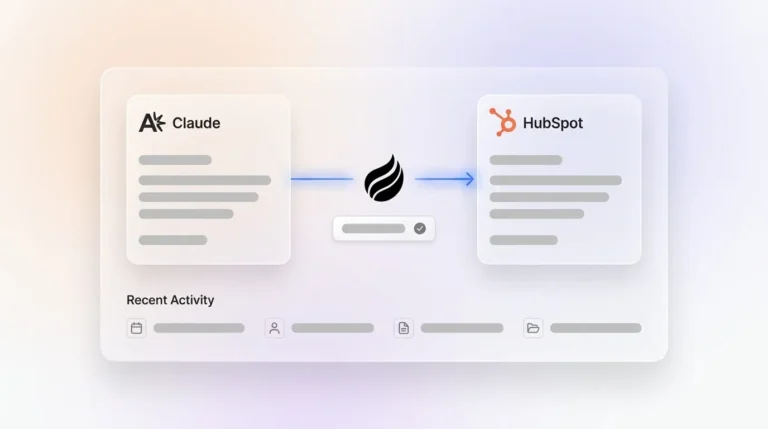
Coffee operates a dual model that covers both small teams and mid-market deployments. As a standalone AI-first CRM, it serves small teams of 1–20 employees such as founders, early sales hires, and operators who have outgrown spreadsheets and want to avoid becoming data entry clerks for HubSpot or Pipedrive. As a Companion App, it deploys the Coffee Agent as an intelligent layer on top of existing Salesforce or HubSpot instances and handles the "data in" process so the system of record stays accurate with minimal human effort.
Once connected to Google Workspace or Microsoft 365, Coffee automatically creates and enriches contacts and companies, logs activity, and generates AI meeting briefings and post-call summaries. These tasks represent the manual work that usually causes adoption failure. That same data powers the rest of the workflow. Pipeline Compare visualizes week-over-week changes without CSV exports, Visitor Identification turns anonymous website traffic into named, qualified prospects, Lead Finder builds targeted prospect lists via natural language search, and Campaigns runs multi-step email sequences natively from the rep's own mailbox.

Coffee is the only solution that works with both structured and unstructured data on a built-in data warehouse, so historical context is preserved even when a field is updated. In February 2026, Coffee introduced an Intelligence layer that allows users to define and store deep context on business model, product specifics, ICP, and competitors for tailored AI suggestions and insights. Coffee meets teams where they are, either as the system of record or as an agent layer. That distinction defines the AI CRM versus traditional CRM conversation in 2026.

Best All-In-One Default For Inbound Teams: HubSpot
HubSpot suits inbound-led teams that need marketing and CRM in one place. HubSpot reported 299,458 paying customers and $3.45 billion in ARR as of Q1 2026, growing roughly 23% year over year. For HubSpot versus Salesforce in B2B SaaS, the trade-off is clear. HubSpot bolted a CRM onto a marketing tool and did not start as a unified intelligence system. It often breaks down at scale for complex B2B SaaS sales motions with multi-stakeholder deals and custom object dependencies. Gartner's 2026 Magic Quadrant for CRM Sales Platforms, authored by Adnan Zijadic, Guy Wood, and Wendy Butler-Mafuz and published August 6, 2026, moved HubSpot from Niche Player to Challenger, which marks progress but still falls short of Leader status.
Best CRM For PLG Companies: Attio
In a PLG context, Attio often beats Salesforce on modern UI and flexibility for founder-led or product-led teams. It surfaces product usage signals and handles the relationship graph well at early stages. The limitation appears for mid-market teams. Attio relies on the same passive database logic as legacy CRMs and lacks the deep Salesforce and HubSpot integration understanding needed when quotas, forecasting, and required fields already exist.
Best CRM For Sales-Led SMB SaaS: Pipedrive And Close
Pipedrive and Close both serve high-velocity, sales-led SMB SaaS teams with simple linear pipelines. Pipedrive versus Salesforce for SaaS is a straightforward trade: less complexity, lower cost, and faster setup. Close adds native calling and SMS for call-heavy teams. Both tools still require manual data entry and add another silo to the stack, so the core data entry problem simply moves into a different system.
Best Path For Teams That Must Keep Salesforce: Coffee Companion App
Many mid-market B2B SaaS teams cannot fully migrate off Salesforce, and this scenario rarely appears in standard alternatives lists. These teams often remain locked into Salesforce contracts with custom objects, quotas, and forecasting dependencies that they cannot unwind in 90 days. The Coffee Companion App deploys the Coffee Agent as an intelligent layer that handles the "data in" process, automatically syncing, enriching, and writing insights back to Salesforce so the system stays accurate with minimal human effort. A simple authentication starts the connection.

Coffee released improved summary templates in November 2025, customizable to match workflows and writable back to Coffee, HubSpot, or Salesforce. This capability reflects genuine integration depth with quotas, forecasting, and required fields, rather than a surface-level sync. Newer alternatives like Day.ai and Clarify do not yet match this level of integration depth for sophisticated Salesforce and HubSpot environments.
See How The Companion App Is Priced
Keeping Salesforce While Fixing Data Quality
The Companion App described above is more than a fallback for teams that cannot migrate. For many B2B SaaS teams, it represents the right long-term answer. The agent-layer path stands as a legitimate third option alongside full replacement and staying as-is. Coffee's Companion App reflects a deep understanding of Salesforce and HubSpot integrations, including quotas, forecasting, and required fields, which many newer tools do not handle well at mid-market complexity.
Coffee is SOC 2 Type 2 and GDPR compliant and does not use customer data to train public models. The agent handles the "data in" process autonomously, so Salesforce stays accurate and forecasts reflect reality. Teams with complete activity data and conversation scoring report 3% to 8% forecast variance, versus 10% to 20% for teams relying on manual CRM updates. For a company forecasting $10M per quarter, that difference means being off by about $500K instead of $1.5M.
Migration Reality Check For Salesforce Replacements
Migration cost usually decides any Salesforce replacement discussion, yet most top-10 listicles ignore it. Custom objects, required fields, quotas, forecasting dependencies, and integration rebuilds do not appear as simple line items in a feature comparison table. They translate into months of internal time and five- to six-figure consulting fees.
A typical mid-market Salesforce deployment with a partner runs $50,000–$150,000 and takes 3–9 months of internal time. Licensing rarely reaches half the total bill, and a well-scoped implementation usually lands between 1 and 2.5 times the annual license cost in year one. Simple CRM migrations may take a few weeks, while larger projects with customizations and multiple business systems can take several months.
For many B2B SaaS teams, layering an agent on top of Salesforce is faster and cheaper than ripping it out. Coffee's seat-based pricing model means you pay for human seats, and the agent's unlimited labor is included with no metering on LLM usage. That economics model changes the build-versus-migrate calculus significantly for teams under contract.
How AI Changes CRM: System Of Record Versus Data Entry
AI replaces the data entry while the CRM remains the system of record. The shift from passive databases to agent-led systems changes who does the work of populating the system, not whether a system of record exists. Salesforce defines agentic CRM as a system used by humans as well as autonomous AI agents that plan, execute, and adapt multi-step workflows without requiring human approval at each step. Coffee follows the same principle that good AI requires good data. The agent ensures accurate data flows into the system so reliable insights come out.
81% of sales professionals now use AI at least occasionally, up from 54% in 2024, according to Salesforce's State of Sales research. AI built on incomplete CRM data underperforms regardless of model sophistication, which makes automated data capture a foundational requirement.
Who Should Stay On Salesforce
Large enterprises with complex, custom workflows often gain more by staying on Salesforce. Organizations the size of Chase or PwC with multi-region data models, deeply customized Apex code, and hundreds of integrated systems usually fall into this category. Heavily regulated industries such as healthcare and financial services that require multi-year security reviews and pre-built compliance components, including Financial Services Cloud and Health Cloud, also sit outside Coffee's current ICP. For these organizations, switching cost exceeds the benefit, and the depth of the Salesforce ecosystem remains genuinely hard to replace.
Conclusion: Choosing Your Salesforce Alternative Path
Manual data entry, rather than Salesforce itself, creates most CRM pain for B2B SaaS teams. Every symptom, including low logging rates, inaccurate forecasts, and shadow CRMs in spreadsheets, traces back to a system that relies on humans to perform work that an agent can handle. Choosing a Salesforce alternative becomes a decision about which path fits your situation. You can replace Salesforce with an AI-first CRM, keep Salesforce and fix the data with an agent layer, or move to a simpler tool and accept the same manual entry problem in a cheaper package.
Coffee is the only option that supports all three paths in one product family. As a standalone CRM, it manages the full system of record for teams of 1–20. As a Companion App, it deploys the Coffee Agent on top of Salesforce or HubSpot for mid-market teams that cannot or should not migrate. In both cases, the agent handles data entry, enrichment, activity logging, meeting intelligence, pipeline tracking, prospecting, and outreach. Reps focus on selling, and managers forecast on data that stays accurate.
Explore Coffee For Your Salesforce Scenario