Legacy CRMs rely on manual data entry, so sales reps lose 20–29 hours per week on admin work and forecasts stay unreliable.
Traditional automation tools like Zapier cannot process unstructured data or preserve historical context across interactions.
Autonomous AI CRM agents capture email, calendar, calls, and web data in real time, enrich records, and write clean updates back to Salesforce or HubSpot with zero rep input.
Teams using AI agents report roughly 60% less manual data entry, about 5 hours saved per rep weekly, and more accurate pipeline forecasts.
The Problem: How Legacy CRMs Create Manual Data Work
Legacy CRM platforms function as systems of record, not systems of understanding. They store contact details, deal stages, and activity logs in structured databases. They store data but rarely interpret it or automatically identify patterns. This architecture creates three compounding problems for sales teams.
Fragmented data and tool sprawl. Without an agent to unify information, reps toggle between a CRM, an enrichment tool, a sequencing platform, and a call recorder. They manually stitch outputs together and still lack a single reliable view. 76% of CRM users report that less than half of their organization’s CRM data is accurate and complete.
The manual entry grind. 71% of sales reps say they spend too much time on data entry, leaving only 35% of their time for selling. This time drain compounds the next problem. Even when reps enter data, it does not stay accurate for long.
Data decay and AI readiness failure.CRM data decays roughly 30% per year because of job changes, acquisitions, and human error. The records reps worked hard to create become unreliable within months. Many organizations say their CRM data is not prepared for AI use, so the AI features in Salesforce and HubSpot remain ineffective until the underlying data problem is solved. Some organizations report losing revenue because of poor CRM data quality.
Common Team Complaints
“I spend more time updating the CRM than actually selling.”
“Our pipeline data is always stale by the time leadership reviews it.”
“Half our team tracks deals in a spreadsheet because the CRM is too much work.”
“We bought Gong, ZoomInfo, and Salesforce separately, and none of them talk to each other cleanly.”
“The CRM shows what we entered, not what actually happened on the call.”
Why Traditional Automation and Point Solutions Fall Short
Rule-based automation tools such as Zapier workflows, native CRM triggers, and basic email sync address symptoms, not the structural problem. They operate on fixed if-this-then-that logic that relies on one-way triggers without ongoing context retention.
Three specific failure modes make point solutions inadequate.
Historical context lost on field updates. Traditional CRMs rely on relational databases where overwriting a field erases the prior value. Teams lose a clear record of what changed, when, and why because no built-in data warehouse preserves that history.
Many RevOps teams spend 40–60% of their time on repetitive tasks such as manual reporting, data cleanup, pipeline reviews, and CRM updates. Rule-based tools were supposed to remove this work but cannot because they depend on clean data that never arrives.
The Solution: Autonomous AI Agents for CRM Data Capture
An autonomous AI CRM agent continuously ingests structured and unstructured data from email, calendar, calls, and web traffic. It maintains full historical context in a built-in data warehouse, enriches contact and company records automatically, and performs bidirectional writes to Salesforce, HubSpot, or a standalone CRM. Human data entry is no longer required.
Join a meeting from the Coffee AI platform
This approach differs fundamentally from rule-based automation. AI agent architecture enables continuous observation of status changes, evaluation against business rules and historical patterns, and autonomous execution of actions such as modifying records or invoking APIs. Agents use hybrid short-term working memory for immediate context and long-term persistent memory stored in vector databases. This design lets the system retain context across every interaction instead of treating each event as isolated.
Automated meeting prep with Coffee AI CRM Agent
8-Step End-to-End Workflow: How an AI CRM Agent Operates
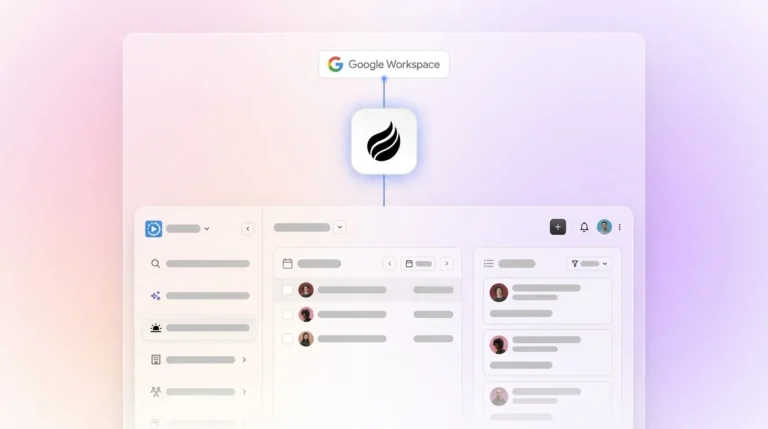
Connect Google Workspace or Microsoft 365. A simple OAuth authentication gives the agent read and write access to email and calendar. Teams avoid manual data migration.
Scan email and calendar activity. The agent immediately parses threads and meeting invites. It identifies contacts, companies, and deal signals using NLP.
Create and enrich contacts and companies. The system creates records and augments them with job titles, funding data, and LinkedIn profiles via licensed enrichment partners. Teams no longer need separate Apollo or ZoomInfo subscriptions.
Join calls, transcribe, and structure notes. The agent attends Zoom, Teams, and Meet calls as a bot. It records, transcribes, and structures outputs against sales methodologies like BANT, MEDDIC, or SPICED.
Log activities and next steps automatically. Post-call summaries, action items, and follow-up drafts flow back to the CRM record. Last activity and next activity fields stay current without rep input.
Surface visitor-identified leads. A tracking pixel identifies anonymous website visitors by name, title, and company. Real-time Slack alerts highlight high-fit prospects ready for outreach.
Generate Pipeline Compare insights. Because the agent captures history in a built-in data warehouse, it visualizes week-over-week pipeline changes such as progressed deals, stalled opportunities, and new additions. Manual CSV exports and spreadsheet reviews become unnecessary.
Measurable Benefits for Sales Teams
Eliminating manual CRM data entry produces clear, measurable gains for sales teams in 2025–2026 studies.
Consistent productivity lift around 40%.AI can increase sales productivity by up to 40% through reduced admin work and better lead prioritization. Teams that reinvest saved time into selling activities see the strongest gains.
Improved forecast accuracy. Clean, complete, real-time data directly improves pipeline visibility. Poor data quality, including inaccurate CRM records and disconnected systems, reduces the reliability of AI-generated insights and remains the primary barrier to accurate forecasting.
Reduced shadow-CRM usage. When the CRM updates itself, reps stop maintaining parallel spreadsheets and Notion docs. Adoption rises because the system finally serves the rep.
Built-in data warehouse preserves full history of every change, enabling week-over-week pipeline comparison and longitudinal deal analysis that directly addresses the data decay problem discussed earlier.
Dual deployment model. The solution should function both as a standalone CRM for teams without an existing system and as a companion layer on top of Salesforce or HubSpot for teams already committed to those platforms.
Real-time structured and unstructured ingestion. Batch syncs no longer suffice. The agent must process email, calendar, call transcripts, and web visitor data in real time.
Built-in enrichment and data warehouse. Strong options avoid separate enrichment subscriptions or external data warehouses. The agent should consolidate the stack instead of extending it.
Recommended Solution: Coffee for Autonomous CRM Data Capture
Coffee provides a clear implementation path for small-to-mid-sized sales teams that want to eliminate manual CRM data entry in 2026. It combines structured and unstructured data ingestion, a built-in data warehouse with full historical context, and a dual deployment model in a single agent.
Build people lists automatically with Coffee AI CRM Agent
Coffee deploys in two modes. As a Standalone CRM, it replaces legacy systems for teams of 1–20 that have outgrown spreadsheets but find Salesforce and HubSpot too maintenance-heavy. As a Companion App, it layers on top of existing Salesforce or HubSpot instances, handling all data capture and enrichment while writing clean records back to the system of record. Teams avoid migrations and keep familiar interfaces.
Building a company list with Coffee AI
Key differentiators include:
SOC 2 Type 2 and GDPR compliance. Data is not used to train public models.
Seat-based pricing. The agent’s labor is unlimited and included in the per-seat cost.
Documented time savings. Reps reclaim 8–12 hours per week previously lost to manual entry.
Built-in data warehouse. Pipeline Compare visualizes week-over-week deal changes without spreadsheets or add-ons.
Visitor Identification with Suggested Leads. Unlike standalone tools that surface company-level data, Coffee identifies named individuals and recommends the two or three specific contacts inside a visiting company who match the buyer persona.
Stack consolidation. Coffee replaces separate enrichment, call recording, and forecasting tools.
What is the difference between an AI CRM agent and a traditional CRM with automation features?
A traditional CRM with automation features, such as Salesforce with workflow rules or HubSpot with sequences, still depends on humans to input the underlying data. Automation in these systems triggers actions based on data that already exists in structured fields. An AI CRM agent like Coffee operates upstream of that process. It captures data from raw, unstructured sources like email threads, call transcripts, and calendar events, structures that data automatically, and writes it into the CRM without any human input. The agent handles the “data in” step that legacy automation assumes a rep has already completed.
Will an AI CRM agent replace sales reps’ jobs?
An AI CRM agent removes administrative work so reps can sell more. It takes over data entry, note-taking, activity logging, and follow-up drafting. It does not replace relationship-building, negotiation, or strategic account management. The measurable outcome is that reps spend more time on revenue-generating activities. Coffee functions as a co-pilot that handles busywork so reps can focus on the conversations that close deals. The agent increases rep capacity instead of substituting for it.
How does Coffee handle data security and privacy?
Coffee is SOC 2 Type 2 and GDPR compliant. Data processed by the Coffee Agent is not used to train public AI models. For teams using Coffee as a Companion App on top of Salesforce or HubSpot, the agent authenticates via standard OAuth and operates with the permissions granted during setup. Role-based access controls ensure that data surfaced by the agent respects existing CRM permission structures. Teams in heavily regulated industries such as healthcare or finance that require multi-year security reviews fall outside Coffee’s current ideal customer profile.
Can Coffee work alongside an existing Salesforce or HubSpot investment?
Coffee’s Companion App model is designed for teams committed to Salesforce or HubSpot. After a simple authentication, the Coffee Agent begins scanning email and calendar, creating and enriching records, logging activities, and writing structured data back to the existing CRM. The system of record remains Salesforce or HubSpot, while Coffee handles the data capture layer that those platforms require humans to manage manually. This approach removes the need to migrate data or retrain teams on a new interface.
How quickly does Coffee deliver measurable results?
Coffee begins capturing data immediately after connecting Google Workspace or Microsoft 365. Teams see CRM records populate and enrich within the first session. Reps often reclaim 8–12 hours per week starting in the first week of use. Pipeline Compare insights become available as soon as the agent has enough pipeline history to generate week-over-week comparisons, typically within two weeks. No lengthy implementation cycle, custom data modeling, or professional services engagement is required.
Conclusion: Move from Manual Entry to Autonomous Data Capture
Legacy CRMs will not fix themselves. As long as data entry remains a human responsibility, records stay incomplete, forecasts stay unreliable, and reps spend their most productive hours as data clerks. An autonomous AI agent that captures every interaction at the source, across structured and unstructured channels, and writes clean records back to the system automatically provides the only durable path to “good data in, good data out.” Coffee delivers this architecture for small-to-mid-sized sales teams, deploys in minutes, and consistently helps reps reclaim 8–12 hours per week. See how Coffee works for your team and explore pricing options.
How to Eliminate Manual CRM Data Entry for Sales Teams