
Last updated: March 30, 2026
Key Takeaways for Startup CRM Automation
- Sales reps lose most of their week to non-selling work like CRM updates, which leaves only about one-third of their time for actual selling.
- Coffee leads this list as the top CRM automation tool, using AI agents to remove manual CRM updates from your team’s workload.
- Founders should weigh automation depth, pricing, adoption ease, integrations, and AI capabilities when choosing a CRM for a small sales team.
- Traditional CRMs such as HubSpot and Pipedrive still depend on human upkeep, while Coffee processes unstructured data and updates records on its own.
- Startups typically reclaim 8–12 hours each week with Coffee’s automation, and you can review Coffee’s pricing to estimate your own time savings before committing.
How to Evaluate CRM Automation for Startup Sales Teams
Start with automation depth, because the amount of work your CRM handles directly controls how much time your reps get back. That time savings then needs to justify the subscription cost, so pricing becomes the next key factor for teams with 1–20 reps. Even powerful tools fail when reps avoid them, which makes ease of adoption essential for any early-stage company. After that, compare the remaining technical capabilities that shape long-term fit:
- Integrations: Native connections to Google Workspace, Zoom, and other core tools your team already uses
- AI Capabilities: Proactive agents that act on your data versus systems that only store information
- Data Quality: Ability to interpret emails and call transcripts and turn them into structured records
- Scalability: Support for growth without the clutter and overhead of heavy enterprise platforms
These criteria address a core friction point: 23% of CRM users worldwide struggle with manual data entry, which ranks alongside tool integration as a top complaint. The right automation platform pays for itself through time savings while staying simple enough that your team actually uses it every day.
Top 9 CRM Automation Tools for Startup Sales Teams
1. Coffee – AI Agent-Led CRM for Hands-Off Data Entry
Coffee stands apart as the world’s best CRM Agent that behaves like an autonomous teammate instead of static software. Traditional CRMs depend on constant human updates, while Coffee’s AI agent handles data entry, meeting orchestration, and pipeline intelligence without extra effort from your reps.

Key Strengths:
- Automatic data capture: Scans emails and calendars to create and update contacts and companies without human input
- Meeting orchestration: Joins calls, generates summaries, and drafts follow-ups directly in Gmail
- Pipeline Compare: Shows week-over-week pipeline changes through a built-in data warehouse
- Unstructured data processing: Reads email text and call transcripts that legacy systems usually ignore
- Intelligence layer: Coffee introduced an Intelligence layer in February 2026 that lets teams store deep context on business model, product details, ICP, and competitors for tailored AI suggestions

Limitations:
- Higher per-seat cost than basic CRMs
- Newer platform with a still-maturing integration ecosystem
Best for: Startups moving beyond spreadsheets that want to remove CRM busywork completely. One customer generating tens of millions in revenue switched from spreadsheets and saved 8–12 hours per week through Coffee’s automated workflows.

Pricing: Seat-based pricing with unlimited agent labor included
2. HubSpot Sales Hub – Automation with Built-In Marketing
HubSpot combines CRM automation with inbound marketing tools, which appeals to startups that want one connected platform. HubSpot Sales Hub includes visual deal pipelines, email tracking and meeting scheduling, sales workflows, AI email drafting and conversation summaries, call logging, and reporting dashboards.
Key Strengths:
- Free tier: Supports unlimited users with core CRM features
- Marketing integration: Connects lead nurturing from marketing through to sales
- Workflow automation: Visual builder for follow-up sequences
- AI features: Email drafting and conversation summaries
Limitations:
- Teams still spend hours each week updating records by hand
- Marketing email sends capped at 2,000 per month on the free plan
- Built as a marketing platform first and a CRM second
Best for: Marketing-led startups that need integrated inbound automation
3. Pipedrive – Visual Pipeline Automation for Deal-Driven Teams
Pipedrive offers drag-and-drop pipeline management, customizable stages, activity scheduling, email integration, workflow automation, and sales dashboards. The product focuses tightly on pipeline visibility for sales teams.
Key Strengths:
- Visual pipeline: Intuitive drag-and-drop board
- Activity automation: Automated reminders and follow-up prompts
- Email integration: Tracks opens and replies
- Workflow builder: Automates routine pipeline tasks
Limitations:
- Less advanced AI than agent-led platforms
- Contact creation, activity logging, and deal updates all require human input
- More basic reporting than full enterprise systems
Best for: Sales-focused startups that care most about clear pipeline visualization
Pricing: Lite $14/user/month, Growth $39, Premium $59, Ultimate $79 (annual)
4. Salesforce Essentials – Enterprise-Grade Automation for Scaling Startups
Salesforce CRM delivers predictive lead scoring, opportunity insights, automated workflows, customizable pipelines, advanced reporting, and territory management. It offers broad automation capabilities along with significant complexity.
Key Strengths:
- Predictive analytics: AI-driven lead scoring and forecasting
- Advanced workflows: Support for complex automation logic
- Extensive integrations: Connects to nearly any business tool
- Scalability: Supports growth from startup to large enterprise
Limitations:
- Steep learning curve and configuration overhead
- Often requires a dedicated admin
- Higher cost for advanced functionality
Best for: Fast-growing startups that expect enterprise-level requirements
5. monday CRM – Visual Boards with Automation and AI
Monday CRM provides visual pipeline boards, automation recipes for routine updates, AI summaries of changes, and customizable workflows and reports. It brings project management style views into sales operations.
Key Strengths:
- Visual interface: Kanban-style boards for managing deals
- Automation recipes: Pre-built workflows for common tasks
- AI insights: Pattern detection in deal activity
- Customization: Flexible fields and views
Limitations:
- Project management focus may not fit pure sales teams
- Automation recipes still need manual configuration
Best for: Startups that manage projects and sales in the same workspace
Pricing: Basic $12/user/month, Standard $17, Pro $28 (annual billing)
6. Close – CRM with Built-In Calling and SMS
Close combines CRM with native calling and SMS, which helps inside sales teams automate outreach at scale. The product suits high-velocity sales motions.
Key Strengths:
- Built-in dialer: Automated calling workflows
- SMS automation: Text message sequences
- Email automation: Drip campaigns and follow-ups
- Activity tracking: Automatic logging of calls, texts, and emails
Best for: Inside sales teams that rely heavily on phone outreach
7. Zoho CRM – Automation Inside a Larger Business Suite
Zoho CRM includes an AI sales assistant, customizable pipelines, workflow automation, approval routing, lead scoring, forecasting, and conversation intelligence. It integrates with the broader Zoho ecosystem.
Best for: Startups that want CRM plus a wider set of business applications
Pricing: Standard $14/user/month, Professional $23, Enterprise $40, Ultimate $52 (annual)
8. Freshsales – AI-Driven Lead Qualification
Freshsales focuses on AI-powered automation for lead scoring and deal insights, which fits inbound-heavy teams with many new leads.
Key Strengths:
- AI lead scoring: Predictive qualification models
- Deal insights: AI analysis of opportunities
- Workflow automation: Custom trigger-based processes
Best for: Inbound-focused startups handling large lead volumes
9. Copper – CRM Built for Google Workspace
Copper delivers Google Workspace-native CRM with automatic data capture, customizable pipelines, workflow triggers, and a Chrome extension for Gmail and LinkedIn. It fits teams that live in Google tools all day.
Best for: Startups fully committed to the Google Workspace ecosystem
Pricing: Starter $9/user/month, Basic $23, Professional $59, Business $99 (annual)
Side-by-Side Comparison of CRM Automation Depth
The table below compares how each platform balances automation depth, price range, and suitability for early-stage teams, with Coffee clearly leading on hands-off automation.
| Tool | Automation Depth | Pricing (/user/mo) | Startup Rating |
|---|---|---|---|
| Coffee | AI Agent (Full) | Seat-based | 5/5 |
| HubSpot | Workflow Builder | $20-150 | 4/5 |
| Pipedrive | Basic Automation | $14-79 | 4/5 |
| Salesforce | Advanced Workflows | $25-175 | 3/5 |
| monday CRM | Visual Recipes | $12-28 | 4/5 |
Coffee leads in automation depth through its agent-led approach that handles unstructured data and removes the need for manual record updates. Legacy systems often start cheaper, yet they depend on ongoing human maintenance, which reduces their real cost-effectiveness over time.
Why AI Agents Like Coffee Fit 2026 Startup Sales Teams
The move from passive software to active agents marks a major shift in CRM technology. AI agents have moved from experiments to core sales infrastructure in 2026, according to Keith Kirkpatrick, VP and Research Director at The Futurum Group.
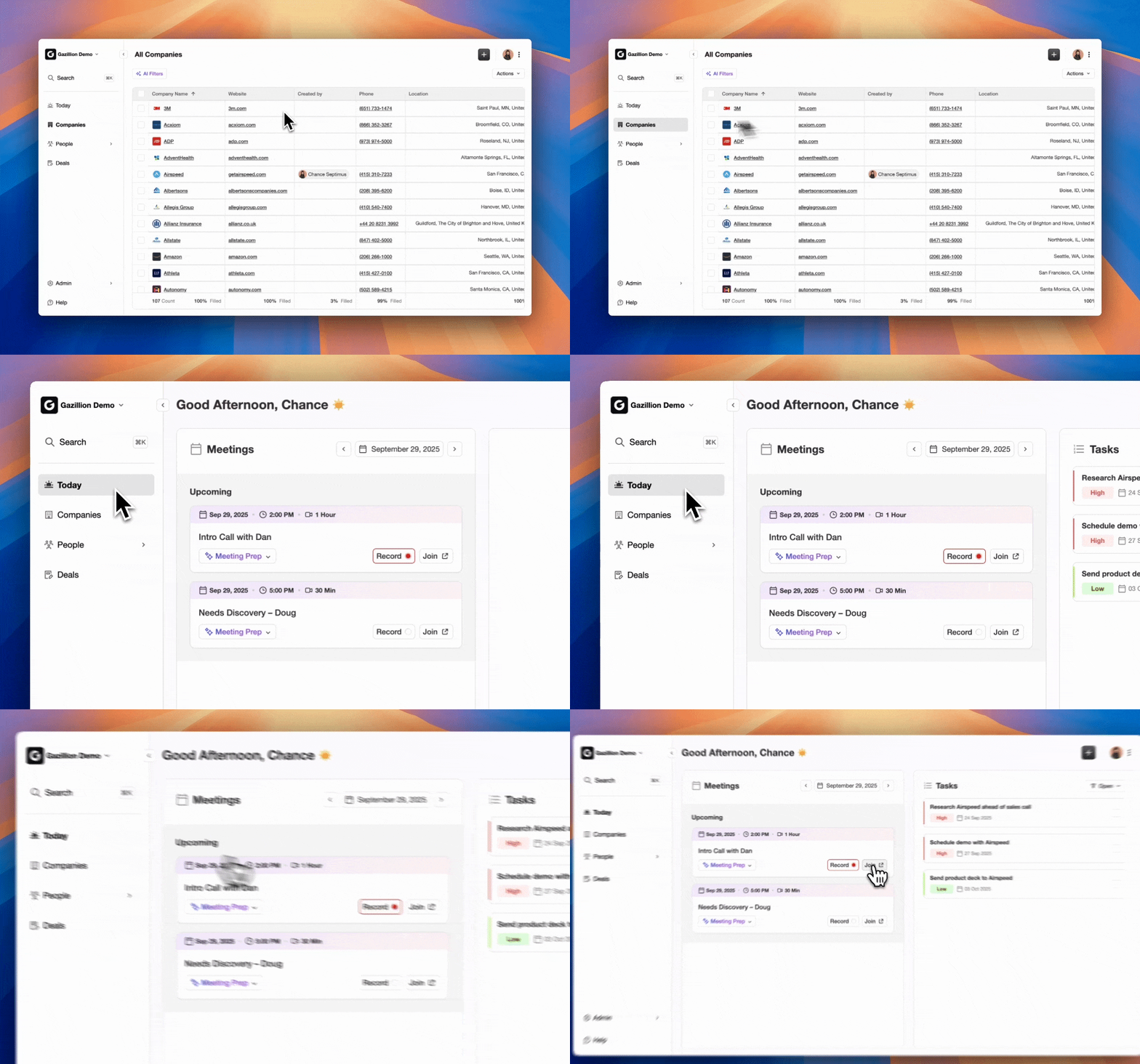
Coffee’s quick-start flow shows this shift in practice. You connect Google Workspace or Microsoft 365 in under a minute, and the agent immediately begins filling your CRM with clean, structured data. This approach avoids the adoption problems that appear in traditional systems where sales teams view the CRM as too work-intensive because of constant manual updates.

Implementation success also depends on avoiding vendor lock-in and keeping data portable. Coffee supports this through API access and standard data formats, which helps teams avoid getting stuck in tools that no longer fit.
Explore Coffee’s agent-led automation to remove repetitive CRM work from your sales process.
FAQ
What is the best free CRM automation option for startups?
HubSpot offers the most complete free CRM with basic automation, unlimited users, and unlimited contacts. Zoho CRM provides a free tier for up to three users with lead scoring and workflow automation. Free plans rarely include the deeper automation that unlocks major time savings, while Coffee’s trials showcase full agent capabilities so teams can see the difference between passive and active CRM systems.
How does HubSpot compare to Coffee for startup sales teams?
HubSpot relies on human-driven data capture and manual workflows, while Coffee’s AI agent manages data capture and process automation on its own. HubSpot shines in marketing integration and ecosystem maturity, yet teams still spend meaningful time maintaining CRM records. Coffee removes that upkeep, which makes it a stronger fit for lean startups without dedicated CRM admins.
Can Coffee replace tools like ZoomInfo for data enrichment?
Coffee includes built-in enrichment that automatically adds job titles, company details, and LinkedIn profiles to contact records. This reduces the need for separate enrichment tools and avoids fragmented data. The agent keeps records fresh as new information appears in email threads and meeting participant lists.
How secure are AI-powered CRM systems for startup data?
Modern AI CRM platforms such as Coffee maintain SOC 2 Type 2 and GDPR compliance, along with encryption and strict access controls. AI agents also reduce human error in data handling and keep audit trails of automated actions. Customer data stays out of public AI training sets, which protects proprietary information.
What are the main limitations of Pipedrive for growing startups?
Pipedrive still depends on manual work for creating contacts, logging activities, and updating deals. It offers automation for basic tasks, yet it lacks AI that can interpret emails and calls and then update records. As teams grow, many outgrow Pipedrive’s reporting and look for more advanced forecasting tools.
Conclusion: Choosing the Right CRM Automation for Your Startup
Coffee emerges as the leading CRM automation tool for startup sales teams in 2026, delivering agent-led automation that removes repetitive CRM upkeep and scales with your company. Traditional CRMs such as HubSpot and Pipedrive provide workflow builders and basic automation, but Coffee’s autonomous intelligence turns sales teams from data clerks into focused sellers.
Use the comparison table above to match tools to your current stage and needs. For startups that want to cut CRM busywork and reclaim selling time, Coffee’s agent-led model delivers standout productivity gains. Try Coffee’s AI agent approach to experience the next generation of sales automation.