Written by: Doug Camplejohn, CEO & Co-Founder, Coffee | Last updated: July 10, 2026
Key Takeaways for Monaco Replacement
- Autonomous AI agents now log data without human prompts and save reps 8–12 hours per week on manual entry.
- Monaco CRM requires full manual logging with no autonomous agent, so it stays labor-intensive for small teams despite low setup friction.
- Attio, Folk, HubSpot, Pipedrive, and Freshsales offer cheaper seats but rely on assistive or rule-based features that still need human input.
- Coffee provides fully autonomous inbox, calendar, and call logging, which suits 1–20 person teams that want zero-setup data capture.
- Teams replacing Monaco can compare Coffee’s pricing to Monaco’s seat costs and remove the data-entry tax while gaining accurate pipeline visibility.
The Problem: Manual Data Entry Still Drains Sales Time
71% of sales reps say they spend too much time on data entry, leaving only 35% of their time for actual selling. That imbalance reflects a structural issue, not a training gap. Legacy CRMs assume humans will reliably populate fields. They do not, which creates a cycle of bad data, weak forecasts, and spreadsheets quietly becoming the real system of record.
Manual and low-judgment work, including data entry, follow-up scheduling, and report generation, consumes approximately 67–72% of a sales rep’s time. Agentic AI addresses this at the root. Unlike traditional automation that follows hard-coded rules and needs human rewriting for every new scenario, AI agents process unstructured data such as emails, documents, and conversations, maintain context, reason through problems, and adapt in real time without predefined rules.
The shift from AI-assisted CRM to agentic AI marks the move from a system that tells you what to do to one that does it for you. For small teams replacing Monaco, that distinction decides whether the new platform eliminates the data-entry tax or only reduces it.
2026 Comparison: Monaco vs Cheaper AI-Driven CRMs
The following comparison evaluates nine platforms against Monaco’s baseline, measuring both cost and autonomous capability. Each platform is assessed on the hours of manual work it removes per rep per week, which shows whether you are buying a cheaper tool or real time back.
The table below ranks each platform by 2026 seat price and estimated autonomous logging hours saved per rep per week. The key takeaway is that only Coffee delivers double-digit weekly time savings through fully autonomous logging, while every other option still requires significant human input. Hours-saved figures reflect autonomous inbox and calendar logging only, and assistive features that need human prompts are excluded from that column.
| Platform | 2026 Seat Price (USD/month) | Autonomous Logging Hours Saved/Week | Key Limitation |
|---|---|---|---|
| Monaco CRM | Premium tier (baseline for comparison) | 0–1 hr (manual entry required) | No autonomous agent, full manual logging |
| Attio | ~$36/user (Plus plan) | 1–2 hrs (rule-based sync) | Passive data model, no autonomous reasoning layer |
| Folk | ~$20/user (Standard plan) | 1–2 hrs (Gmail sync, manual enrichment) | Lightweight, limited pipeline intelligence |
| HubSpot Smart CRM | Professional plan (annual) | 2–3 hrs (Breeze AI assistive) | Lacks autonomous capabilities and cannot create or customize agents |
| Pipedrive (Growth) | $39/user (annual) | 1–2 hrs (AI Sales Assistant, assistive only) | AI features assistive, not autonomous, no inbox agent |
| Freshsales (Pro) | $39/user (annual) | 2–3 hrs (Freddy AI, assistive scoring) | Freddy AI is assistive, autonomous logging needs configuration |
| Day.ai | Pro starts at $40/mo and is priced per agent rather than per user/seat | 3–4 hrs (unstructured data focus) | Productivity-layer focus, limited Salesforce/HubSpot integration depth |
| Reevo | Reevo pricing starts at $49/user/month for the Basic tier | 3–4 hrs (AI activity capture) | Early-stage, limited enterprise integration maturity |
| Coffee | Seat-based (agent labor included) | 8–12 hrs (fully autonomous inbox, calendar, and call logging) | Best fit for 1–20 person teams, large enterprise custom workflows not supported |
1. Monaco CRM (Baseline). Monaco requires manual field population for contacts, activities, and deal stages. There is no autonomous inbox or calendar agent. Setup friction stays low, but ongoing human labor remains high. For teams of one to twenty, the real cost includes the hours burned every week keeping records current.
2. Attio. Attio delivers an AI-native CRM with a flexible data model at approximately $36/user/month on the Plus plan, with a free tier for up to three seats. Its sync capabilities reduce some manual entry. The underlying architecture still uses a passive data model, so logging remains rule-based rather than agent-driven.
3. Folk. Folk targets early-stage teams with a clean UI and Gmail integration at roughly $20/user/month. Enrichment stays largely manual, and pipeline intelligence is limited. It works as a step up from spreadsheets but does not provide autonomous logging.
4. HubSpot (Smart CRM Professional). HubSpot’s Breeze AI includes predictive lead scoring, email sentiment analysis, and sales forecasting on the Professional plan. These features assist reps rather than act for them. HubSpot lacks autonomous capabilities and the ability to create or customize agents. Integration effort for Monaco migrants sits at a moderate level.
5. Pipedrive (Growth). Pipedrive’s AI Sales Assistant provides next-step recommendations and deal prioritization on the Growth annual plan. The assistant surfaces suggestions, but it does not log autonomously. Reps still open the CRM and update records themselves.
6. Freshsales (Pro). Freshsales offers AI-driven lead scoring and sales forecasting via Freddy AI at $39/user/month on the Pro annual plan. Freddy AI acts as an assistive layer and needs configuration before it approaches autonomous behavior. It delivers strong value for budget-conscious SMBs that can tolerate some manual logging.
7. Day.ai. Day.ai captures unstructured data from meetings and email threads and surfaces relationship context automatically. Its autonomous logging covers productivity-layer interactions well. Newer alternatives still lack the depth required for sophisticated Salesforce and HubSpot integrations involving quotas, forecasting, and required fields.
8. Reevo. Reevo offers AI activity capture with a modern interface. Reevo pricing starts at $49/user/month for the Basic tier. It suits teams that want more automation than Pipedrive but are not ready for a full agent-first platform. Integration maturity continues to develop.
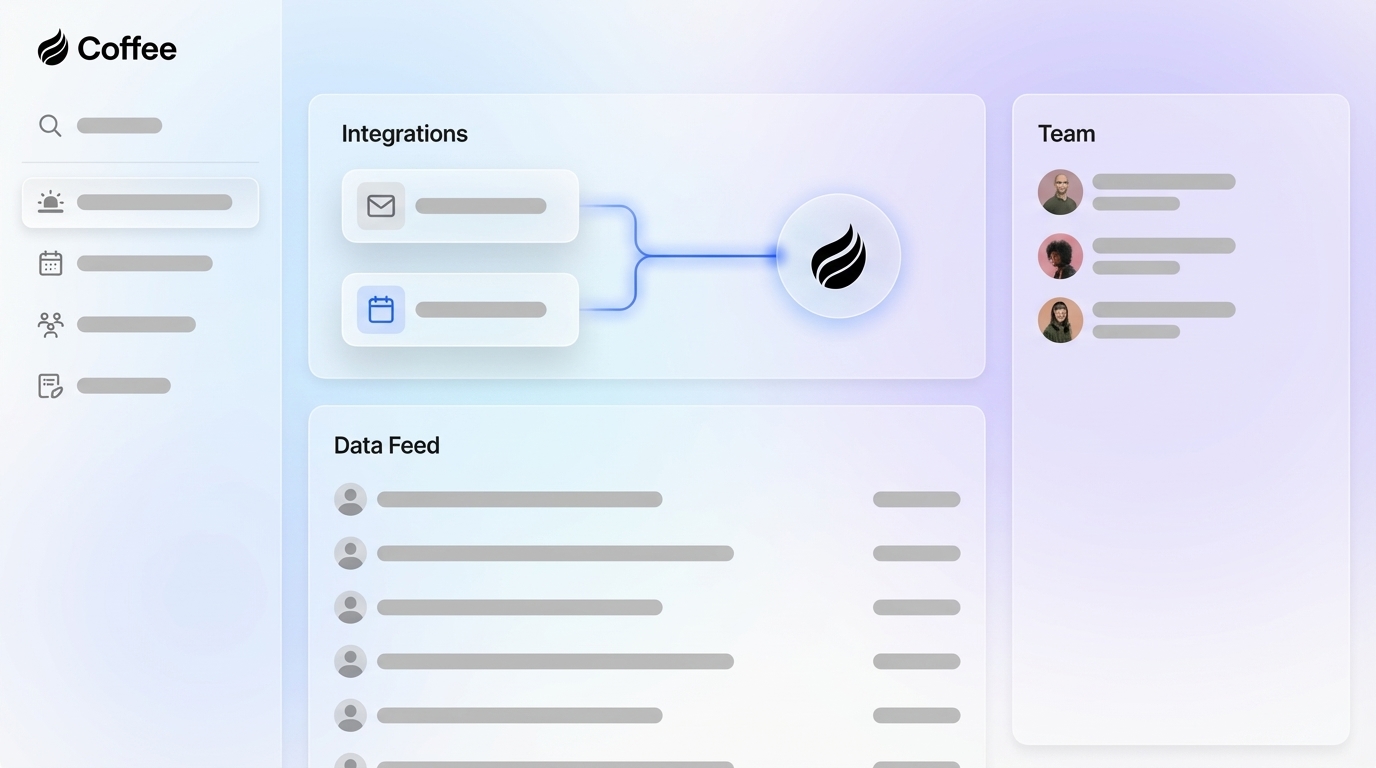
9. Coffee. Coffee deploys an autonomous agent that connects to Google Workspace or Microsoft 365 and immediately starts creating contacts, logging activities, enriching records, and generating post-meeting summaries without human input. The agent saves reps 8–12 hours per week on data capture alone. Coffee operates as a standalone CRM for teams of one to twenty or as a companion layer on top of existing Salesforce and HubSpot instances.
See how Coffee’s pricing scales with your team
Which AI Approach Actually Removes Data Entry?
The critical distinction in 2026 is between assistive AI and agentic AI, as Gartner notes. That distinction, introduced earlier, determines how much human input each platform requires per logged interaction. The table below translates the conceptual difference into operational terms so you can see how much work still lands on your reps.
| Approach | How Logging Works | Human Input Required | 2026 Example |
|---|---|---|---|
| Assistive AI | Suggests fields, rep confirms or edits | Every interaction | HubSpot Breeze, Pipedrive AI Assistant |
| Rule-based Automation | Triggers on fixed conditions (e.g., email received) | Rule setup and maintenance | Zapier + legacy CRM |
| Agentic AI | Perceives, reasons, and logs without prompts | Zero ongoing input | Coffee Agent |
After a meeting ends, AI agents can generate a call summary, log the interaction in the CRM, update the deal stage based on the conversation, and create follow-up tasks for the sales rep to review, which reduces manual data entry to zero. Only agent-first systems reach this level for both structured fields and unstructured data such as email threads and call transcripts.

Can an AI Agent Replace Your CRM or Just Sit on Top?
Salesforce’s State of Sales research shows significant adoption of AI agents among sellers, with many reps saying the technology frees them for higher-value work. That shift means the CRM no longer acts as a database that reps maintain. It becomes a system the agent maintains on their behalf.
The more precise question concerns whether a standalone agent CRM can replace a legacy platform entirely or whether an agent companion on top of Salesforce or HubSpot fits better. For teams of one to twenty without deep Salesforce customization, a standalone agent CRM removes the overhead of maintaining a legacy system. For teams already committed to Salesforce or HubSpot, a companion agent that writes enriched data back to the existing system of record preserves the investment while removing the manual entry burden. This companion model also explains why enterprise adoption has accelerated, because in 2026, 67% of surveyed enterprises had moved beyond the pilot stage with AI agents (up from 31% in 2024), largely by layering agents on top of existing systems rather than replacing them.

Best-Fit AI CRM Options by Team Type
Different team profiles face different constraints, so the right platform depends on current stack, growth trajectory, and tolerance for change.
Early-stage founder teams (1–5 people)
- Still operating in spreadsheets or Notion
- Need zero-setup logging from day one
- Cannot afford a dedicated RevOps hire to maintain a legacy CRM
- Best fit: Coffee Standalone CRM, which delivers the 8–12 hour weekly savings described above, or Folk as a lightweight entry point
Growing sales orgs (6–20 people) outgrowing spreadsheets
- Require pipeline visibility and deal-stage tracking
- Want enrichment without paying separately for Apollo or ZoomInfo
- Need a platform that scales without adding admin overhead
- Best fit: Coffee Standalone CRM, with Freshsales Pro as a budget alternative that uses manual configuration
Teams committed to Salesforce or HubSpot
- Have existing data, workflows, and quotas in a legacy system
- Suffer from low adoption and missing activity data
- Need an agent layer that writes back to the system of record
- Best fit: Coffee Companion App, with HubSpot Breeze for teams already on HubSpot Professional
Operational considerations apply across all profiles. Change management stays minimal for agent-first platforms because reps stop being asked to log anything and the agent handles entry. This shift in responsibility also changes data-hygiene ownership, since the agent maintains record quality going forward and removes ongoing manual cleanup. That automation only works if the starting dataset is clean, which is why an initial audit of existing records remains necessary before migration and why organizations must audit, deduplicate, and standardize data before deploying AI agents for autonomous CRM functions.
Decision Framework: Match Budget, Team Size, and Autonomy
| Budget | Team Size | Autonomy Required | Acceptable Autonomy Level | Recommended Platform |
|---|---|---|---|---|
| Under $30/seat | 1–5 | No | None or Assistive | Folk, Attio (free tier) |
| Under $45/seat | 1–20 | No | Assistive | Freshsales Pro, Pipedrive Growth |
| Flexible (agent labor included) | 1–20 | Yes | Full Autonomous | Coffee Standalone CRM |
| Existing Salesforce/HubSpot investment | 5–50 | Yes | Full Autonomous on top of legacy CRM | Coffee Companion App |
| Enterprise budget | 50+ | Yes | Full Autonomous with complex custom workflows | Salesforce Agentforce, Creatio |
Start your Monaco migration with Coffee
Frequently Asked Questions
How long does implementation take for autonomous logging?
Agent-first platforms like Coffee begin autonomous logging shortly after you connect Google Workspace or Microsoft 365, and teams usually become fully operational within a few business days. The agent scans existing emails and calendar events to populate contacts, companies, and activity history without manual configuration. Assistive platforms like HubSpot or Pipedrive need additional workflow setup, field mapping, and testing before logging approaches anything close to autonomous behavior, which typically takes one to three weeks depending on team size and existing data hygiene.

What migration effort is required from Monaco?
Migration from Monaco usually involves exporting contacts, companies, deals, and activity history as CSV files and importing them into the new platform. Agent-first CRMs like Coffee can enrich imported records automatically by filling in missing job titles, LinkedIn profiles, and company data, so the migration improves data quality rather than simply transferring existing gaps. The more significant effort often involves deduplication of existing records before import. Teams can typically complete a Monaco migration quickly, while larger datasets benefit from a short data audit first.
Which platforms hold SOC 2 Type 2 certification?
Coffee is SOC 2 Type 2 and GDPR compliant, and customer data is not used to train public models. Pipedrive maintains SOC 2 Type 2 certification. For the other platforms, certification status should be confirmed directly with the vendor before committing, especially for teams handling sensitive customer data. Any platform under evaluation for a regulated-adjacent industry should provide a current SOC 2 report on request.
How do teams measure hours saved on data entry?
The most reliable baseline measurement uses a two-week time audit before switching platforms, where reps log time spent on CRM updates, contact creation, activity logging, and meeting note entry. After deploying an autonomous agent, teams repeat the same audit. Coffee customers typically report the time savings outlined in the comparison section, which reflects the removal of manual contact creation, activity logging, enrichment lookups, and post-meeting note entry. Teams can also track proxy metrics such as CRM record completeness rates, percentage of deals with logged last activity, and time between a meeting occurring and its summary appearing in the system, which approach 100% completeness and near-zero lag with a fully autonomous agent.
Conclusion: Choose an Agent That Removes Manual Entry
Platforms that deliver measurable time savings in 2026 are not the ones with the longest feature lists. They are the ones where the agent does the work without being asked. B2B sales organizations using AI can cut time spent on prospecting and meeting prep substantially. For teams replacing Monaco, the real decision concerns whether you accept a cheaper version of the same manual problem or adopt an agent that removes it.
Attio, Folk, Pipedrive, and Freshsales reduce costs. Coffee removes the data-entry tax. For small-to-mid-sized teams that cannot afford to have reps acting as data entry clerks, the agent-first approach offers the only reliable path to accurate pipeline visibility without ongoing human maintenance.