
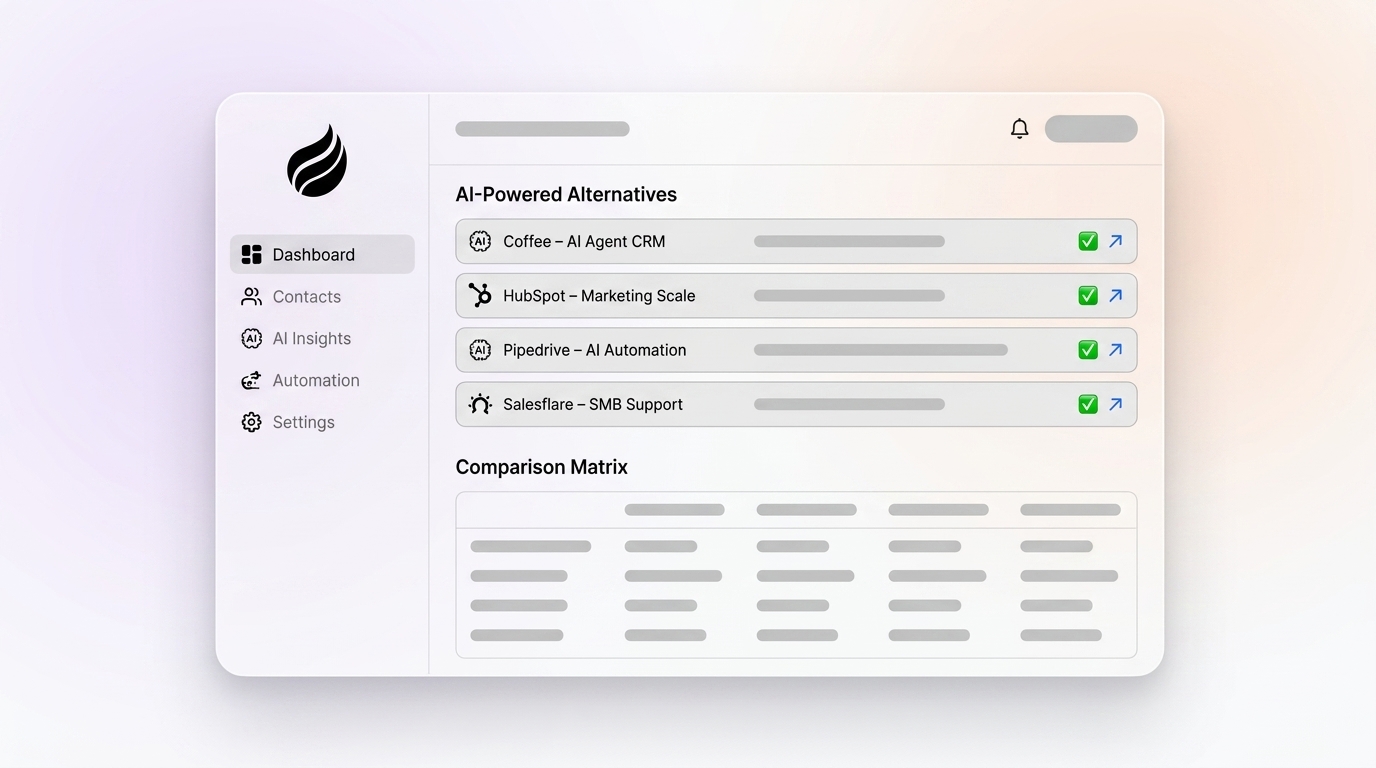
Key Takeaways for Replacing Attio
- Attio’s manual data entry slows sales teams, while AI-powered tools like Coffee capture emails, calendars, and contacts automatically.
- Coffee stands out as the leading Attio alternative with agent-based architecture, pre-call briefings, call transcription, and predictive pipeline intelligence.
- Platforms such as HubSpot, Pipedrive, and Salesflare add helpful AI features but do not match Coffee’s unstructured data handling and autonomy.
- Coffee saves teams 8–12 hours each week and connects to Google Workspace or Microsoft 365 in about 5 minutes.
- Switch to Coffee today to remove manual busywork and align your CRM with 2026’s AI-driven sales motion.
Why Attio’s Passive CRM Holds Teams Back
Attio’s core limitation comes from its passive architecture that relies on manual stitching of emails, calendars, and customer data. Unlike agent-based CRMs, Attio does not include a true data warehouse for historical context, so sales reps end up acting as data entry clerks. Sales representatives spend 70% of their time on non-selling tasks, and manual CRM updates drive much of that waste.
Modern sales teams need zero-touch data entry that automatically captures emails and calendar interactions. This foundation enables AI-powered enrichment that fills contact details without human intervention. That enriched data then supports pipeline intelligence that tracks changes autonomously and flags risk without manual reports. The strongest Attio alternatives deliver this full chain of capabilities through agent architectures rather than passive databases.

The table below shows how Coffee performs against the four essential criteria that separate true AI agents from basic automation tools.
| Criteria | Must-Have Feature | Coffee Score |
|---|---|---|
| Automation Depth | Zero-human data entry vs basic triggers | 10/10 |
| Data Sources | Unstructured data processing (emails, calls) | 10/10 |
| AI Outputs | Actionable insights and briefings | 10/10 |
| Setup Complexity | 5-minute implementation | 9/10 |
Try Coffee’s zero-touch automation and see how an agent-first CRM changes daily workflows.
#1: Coffee – The Agent CRM Revolution
Coffee directly addresses every criterion in the table above through its agent-first architecture. Rather than bolting AI features onto a passive database, Coffee represents a shift from static CRM records to active AI agents. It works as a standalone CRM for SMBs and as a companion app for existing Salesforce or HubSpot setups. Coffee’s agent automatically creates and enriches contacts from Google Workspace or Microsoft 365 without human effort.

The Coffee Agent manages meetings autonomously with pre-call briefings, automatic call recording and transcription, and post-meeting summaries with clear action items. Coffee’s AI intelligence layer, launched in February 2026, stores deep context on business models and competitors for tailored insights. The Pipeline Compare feature then visualizes week-over-week changes automatically and removes the need for manual spreadsheet exports.

Pros: Zero-touch data entry, unstructured data processing, built-in data warehouse, SOC2/GDPR compliance, simple seat-based pricing.
Cons: Current integrations run through Zapier, with deeper native integrations planned, and the platform is newer than some legacy CRMs.
Coffee saves sales teams 8–12 hours per week by handling data entry, enrichment, and pipeline tracking autonomously. A recent case study shows an AI solutions company replacing spreadsheets with Coffee’s agent-led approach and gaining automated pipeline reviews plus custom briefings through API access.

The following comparison highlights the architectural differences that drive Coffee’s productivity gains over Attio.
| Feature | Attio | Coffee | Advantage |
|---|---|---|---|
| Data Entry | Manual input required | Zero-touch automation | Coffee |
| Email/Calendar Sync | Basic connection | AI agent processing | Coffee |
| Historical Data | Limited retention | Built-in data warehouse | Coffee |
| AI Insights | Basic reporting | Predictive intelligence | Coffee |
While Coffee leads in agent-based automation, other platforms may better fit specific use cases or existing tech stacks. The alternatives below offer different balances between AI depth and traditional CRM features.
Other Top Attio Alternatives to Consider
HubSpot – AI Features with Marketing Scale
HubSpot delivers strong AI capabilities such as predictive lead scoring and automated email sequences, yet it still depends on significant manual data entry. Compared with Attio’s limited automation, HubSpot adds workflow triggers and basic enrichment that improve daily operations. However, only 19% of sales reps use AI features built directly into their sales tools, which highlights adoption and complexity challenges.
Best for: Growing teams that need tight marketing and CRM integration.
Pipedrive – Straightforward AI Automation
Pipedrive focuses on simplicity with AI features like deal probability scoring and activity reminders. It feels easier to use than Attio’s more complex interface and helps teams stay on top of follow-ups. However, it lacks advanced unstructured data processing that modern sales teams now expect from AI-driven systems.
Best for: Small teams that prioritize ease of use over deep AI.
Salesflare – AI Support for SMB Pipelines
Salesflare automatically captures email interactions and surfaces AI-driven insights for small businesses. It offers stronger automation than Attio’s mostly manual approach and reduces some data entry. Teams still need to add or correct contact details manually to maintain complete profiles.
Best for: SMBs that want automatic email tracking with light AI.
Close – Calling-Centric AI CRM
Close combines built-in calling with AI features such as conversation intelligence and automated follow-ups. It gives sales teams a better calling experience than Attio and supports outbound-heavy motions. Enrichment and unstructured data processing remain limited compared with agent-based alternatives.
Best for: High-volume calling teams that live on the phone.
Breakcold – Social Workflow Automation
Breakcold connects social media activity with workflow automation that goes beyond Attio’s basic triggers. It supports social selling motions and helps reps act on social signals quickly. The platform still lacks the comprehensive AI agent capabilities needed for true zero-touch data management.
Best for: Teams that rely heavily on social selling workflows.
Folk – Modern Interface with Light Automation
Folk offers a cleaner interface than Attio and includes basic automation features. Many Attio vs Folk comparisons focus on design and usability, yet both tools still depend heavily on manual data entry. Neither platform processes unstructured data through an AI agent in the way Coffee does.
Best for: Teams that value modern design and simple workflows.
Side-by-Side Comparison Matrix for Attio Alternatives
Now that each alternative’s strengths and gaps are clear, the matrix below consolidates the key differences. Use it to quickly see which platform matches your automation needs, budget, and sales motion.
| Alternative | Auto Data Entry Level | AI Capabilities | Pricing/User | Best For |
|---|---|---|---|---|
| Coffee | Zero-touch agent automation | Predictive intelligence, briefings | Seat-based, simple | Agent-led automation |
| HubSpot | Workflow triggers | Lead scoring, sequences | HubSpot’s additional core seats start at $45/mo | Marketing integration |
| Pipedrive | Basic automation | Deal probability, reminders | $14+/month | Simplicity |
| Salesflare | Email capture | Contact insights | $29+/month | SMB email tracking |
| Close | Limited automation | Call intelligence | Close pricing starts at $9 per user per month | Sales calling |
| Breakcold | Social workflows | Basic AI features | $29+/month | Social selling |
| Folk | Manual with triggers | Limited AI | $20+/month | Modern UI |
Coffee tops the list for automated data entry and AI capabilities, offering the only true agent-based architecture among Attio alternatives. Gartner predicts AI agents will outnumber human sellers 10-to-1 by 2028, so Coffee’s agent-first design positions teams for that shift.
Best-Fit Use Cases and 2026 AI Sales Trends
Coffee works as the ideal Attio replacement for SMBs that want zero-touch automation. Larger organizations can deploy Coffee as an intelligent layer on top of existing HubSpot or Salesforce instances without ripping out current systems. AI SDRs will handle more than 30% of initial sales outreach by the end of 2026, and agent-based CRMs will sit at the center of that change.
The Attio vs Folk debate misses the bigger picture because both platforms rely on passive architectures. Coffee’s agent-led approach aligns with 2026’s move toward autonomous sales workflows, predictive intelligence, and continuous pipeline monitoring.
Implementation Steps and Decision Framework
Security concerns around AI agents are addressed through SOC2 Type 2 and GDPR compliance, and Coffee never uses your data to train public models. Coffee’s 5-minute setup connects to Google Workspace or Microsoft 365 and immediately begins autonomous data capture and enrichment.
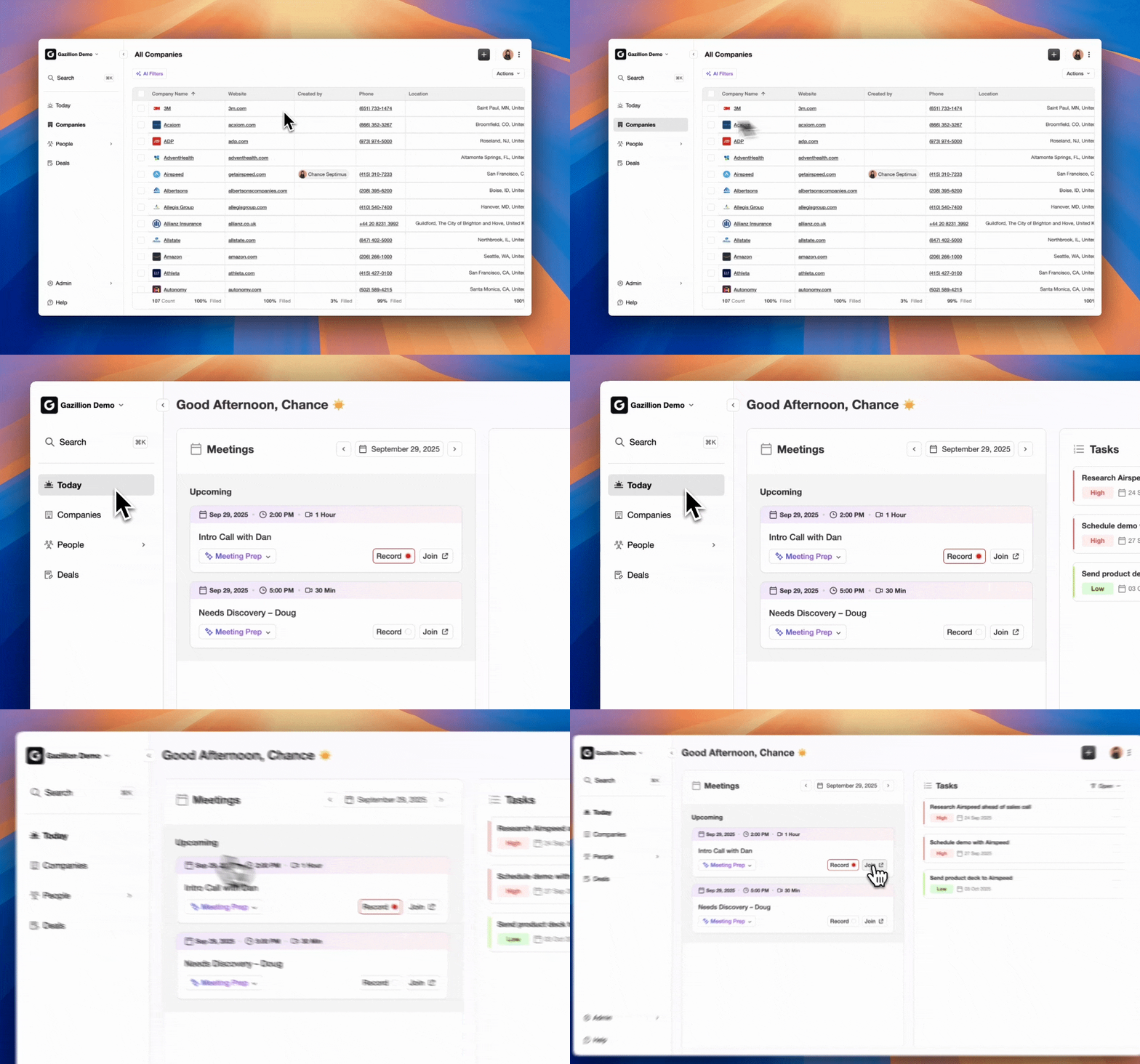
Use this decision framework when choosing an Attio alternative. Start by confirming that the platform offers an agent-based architecture, because that capability enables everything else. Next, verify zero-touch data entry and unstructured data processing, which both depend on a built-in data warehouse. Finally, check that the pricing model stays simple enough to scale without surprise costs.
Start your Coffee trial once you confirm these boxes are checked and you are ready to shift away from manual CRM work.
Frequently Asked Questions
What’s the best free Attio alternative with AI features?
Most AI-powered CRM alternatives require paid plans, but HubSpot offers a free tier with basic AI features such as lead scoring. For full AI automation, including zero-touch data entry and unstructured data processing, Coffee’s agent-based approach delivers far more value than free tools that still rely on manual updates.
How do Attio’s automations compare to AI agent alternatives?
Attio’s automations use trigger-based workflows that require manual setup and ongoing maintenance. AI agents like Coffee instead process unstructured data autonomously and learn from real interactions. Traditional automation struggles with edge cases and format changes, and that fragility explains why AI agents handle varied inputs from emails, calendars, and call transcripts more reliably.
What’s the difference between Coffee and HubSpot for automated data entry?
Coffee operates as an autonomous agent that captures and processes all customer interactions without human intervention. HubSpot still requires manual data entry and depends on users to design and trigger workflows. Coffee’s agent architecture handles unstructured data such as email content and call transcripts, while HubSpot focuses mainly on structured database fields.
Should I choose Attio vs Folk for my sales team?
As noted earlier, both platforms share the same passive architecture limitations and require significant manual data entry. Rather than choosing between two similar manual systems, consider Coffee’s agent-based approach, which removes the data entry burden and adds stronger AI insights and automation.
How difficult is migrating from Attio to an AI-powered alternative?
Migration complexity varies by platform, but Coffee offers one of the smoothest paths. It supports automatic data import and immediately applies agent-based processing to your existing contacts and deals. Once connected to your email and calendar systems, the agent starts capturing new interactions with minimal setup compared with traditional CRM migrations.
Which is the best AI CRM for 2026?
Coffee leads the AI CRM category in 2026 with its agent-first architecture that handles both structured and unstructured data autonomously. Unlike traditional CRMs that bolt on AI features, Coffee was built from the ground up as an intelligent agent that removes manual data entry and delivers predictive insights plus automated workflow management.
Experience Coffee’s agent-led CRM and leave Attio’s manual data entry behind.