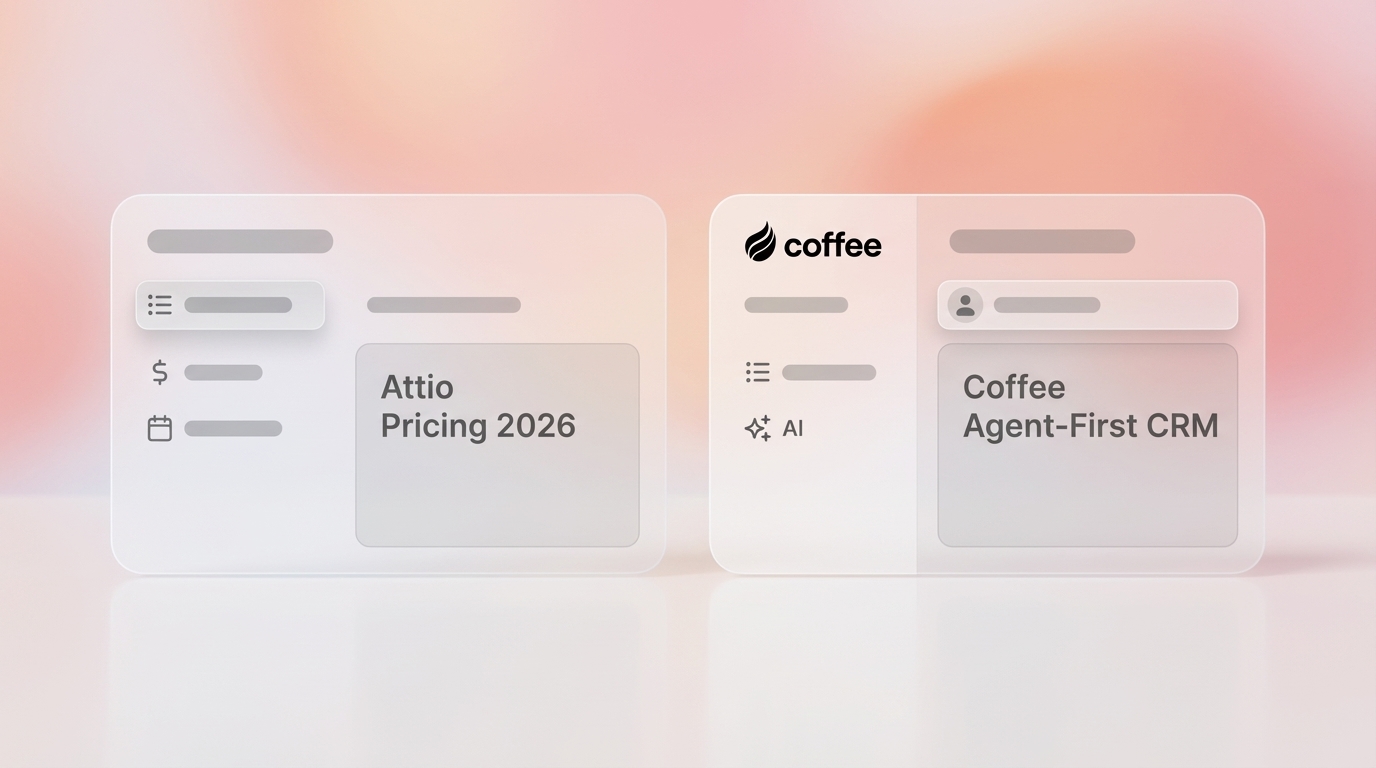
Written by: Doug Camplejohn, CEO & Co-Founder, Coffee | Last updated: June 28, 2026
Key Takeaways for Attio vs Coffee Costs
- Attio offers four 2026 plans: Free (3-seat limit), Plus ($29/seat/mo annual), Pro ($69/seat/mo annual), and custom Enterprise. Every tier still relies on manual data entry.
- For a 5-person team, annual software spend ranges from $0 to roughly $4,140 on Pro. Hidden labor costs can exceed $100k per year.
- Monthly billing adds a 24% premium, and Enterprise pricing is opaque, which makes accurate budgeting difficult without a sales conversation.
- Coffee’s agent automates contact creation, activity logging, and enrichment. Teams reclaim the 8–10 hours per rep per week usually lost to CRM maintenance.
- See how Coffee’s agent pricing compares on the Coffee pricing page.
2026 Attio Pricing Table by Plan
| Plan | Annual (per seat/mo) | Monthly Billing (per seat/mo) | Key Limit |
|---|---|---|---|
| Free | $0 | $0 | 3 seats max, limited objects |
| Plus | $29 | $36 | Unlimited seats, basic automations |
| Pro | $69 | $86 | Advanced automations, reporting |
| Enterprise | Custom | Custom | SSO/SAML, unlimited objects, SLA |
Note on figures: Attio publishes a live public pricing page showing its 2026 rates. The figures above are from the provider's site and are subject to change. Monthly billing carries approximately a 24% premium over annual billing for both Plus ($36 vs $29) and Pro ($86 vs $69) tiers. Verify current pricing directly with Attio before budgeting.
How Expensive Is Attio at Each Tier?
Free: This tier is capped at 3 seats with restricted object types and no automation sequences. It works for solo founders validating a pipeline, but it does not function as a true team tool.
Plus ($29/seat/mo annual): This plan unlocks unlimited seats and basic workflow automations. A 5-person team pays roughly $1,740/year. A 10-person team pays roughly $3,480/year. Automations stay limited in complexity, so reps still handle significant manual logging.
Pro ($69/seat/mo annual): This tier adds advanced reporting, enrichment integrations, and deeper automation. A 5-person team pays roughly $4,140/year. A 10-person team pays roughly $8,280/year. Most scaling teams land here, and this is usually where sticker shock begins.
Enterprise: Pricing is custom and negotiated directly with Attio's sales team. This tier is required for SSO/SAML, unlimited custom objects, dedicated support SLAs, and advanced security controls. Budget unpredictability is the primary complaint from RevOps leaders at this level.
How Long Attio's Free Plan Stays Viable
Attio's Free plan is technically permanent, but its 3-seat ceiling makes it a non-starter once a second sales hire joins. Common upgrade triggers include needing a fourth user, requiring email sequence automations, or needing reporting beyond basic list views. Teams that start on Free almost always migrate to Plus within 60–90 days of adding headcount. That shift converts a $0 line item into a recurring per-seat cost that scales with every hire.
Attio CRM Pricing Per Month vs Annual
Choosing monthly billing over annual on Attio carries a meaningful premium. Monthly billing carries approximately a 24% premium over annual billing for both Plus ($36 vs $29) and Pro ($86 vs $69) tiers. For a 10-person team on Pro paying monthly instead of annually, that difference is approximately $2,100 per year in pure billing overhead. Budget-conscious teams effectively pay extra when they need cash-flow flexibility.
Attio Enterprise Pricing and Budget Predictability
Enterprise pricing is fully custom and requires a sales conversation. Typical inclusions at this tier are SSO/SAML authentication, unlimited custom object schemas, advanced permission controls, dedicated onboarding, and contractual SLAs. For companies with 15–20 employees evaluating Attio Enterprise, the lack of a published price floor makes accurate budgeting impossible without entering a sales cycle. This friction often delays procurement decisions.
Total Cost of Ownership for Attio vs Coffee
Attio's per-seat line item represents only part of the real cost. The larger, invisible expense is the human labor required to keep any passive CRM populated with accurate data.
Coffee's internal market data indicates that 71% of sales reps report spending too much time on data entry, leaving only 35% of their working hours for actual selling. At a conservative estimate of 8–10 hours per rep per week lost to manual logging, note-taking, and record updates, the dollar cost becomes significant.

5-person team on Attio Pro (annual): $4,140/year in software plus roughly 2,080 hours/year in manual data entry labor (5 reps × 8 hrs/week × 52 weeks, using the 8-hour weekly baseline above). At a blended fully loaded cost of $50/hour for a sales rep, that labor equals $104,000/year. Total TCO is approximately $108,140/year.
As team size grows, this labor cost scales linearly while the software cost remains a small fraction of total spend. 12-person team on Attio Pro (annual): $9,936/year in software plus roughly 4,992 hours/year in manual labor. At $50/hour, that labor equals $249,600/year. Total TCO is approximately $259,536/year.
Coffee's seat-based pricing includes the agent's unlimited labor. Reps stop acting as data clerks. The agent handles contact creation, activity logging, meeting summaries, and enrichment automatically, which collapses that 8–10 hour weekly drain toward zero.

See Coffee's transparent pricing and calculate your team's savings.
Attio vs Coffee: Data, Automation, and Scale
| Criteria | Attio | Coffee |
|---|---|---|
| Data Quality | Human-dependent, reps must log manually | Agent auto-creates contacts, enriches records, logs all activity from email/calendar |
| Automation Depth | Rule-based workflows, limited on Plus | Agent-driven: meeting briefings, post-call summaries, follow-up drafts, pipeline compare |
| Implementation Effort | Manual schema setup, ongoing admin required | Connect Google Workspace or M365, agent begins populating CRM immediately |
| Scalability | Cost scales linearly per seat, no labor offset | Agent labor is unlimited per seat, adding headcount does not multiply admin burden |
Attio's modern UI and flexible data model are genuine strengths for teams that want to build custom object schemas. Its architecture still functions as a passive database and stores only what humans put in. Coffee's agent actively ingests unstructured data such as emails, call transcripts, and calendar events and structures it automatically. Attio's current architecture does not replicate this behavior.

Three Realistic Cost Scenarios for Attio vs Coffee
Scenario 1 – Early-stage startup (3 reps): Attio Free works until the fourth hire. At that point, the team upgrades to Plus at $29/seat/mo, which adds $1,044/year in software cost plus the full manual-entry labor burden. This moment becomes the first real cost inflection point. Coffee's agent model at a comparable seat price removes that labor cost from day one, so it becomes the lower-TCO choice even when the software line item looks similar.
Scenario 2 – Scaling team (8 reps on Pro): Attio Pro costs $6,624/year. Applying the same labor assumption, 8 reps × 8 hrs/week × 52 weeks × $50/hr equals $166,400/year in labor. Total TCO is roughly $173,024. Coffee's agent absorbs the data-entry hours and reduces effective TCO materially. The ROI case for switching usually becomes clear within the first quarter.
Scenario 3 – Established team (15 reps approaching Enterprise): Attio Enterprise pricing is custom and opaque, which creates planning risk from budget uncertainty alone. Coffee's transparent seat-based pricing scales predictably. The agent's pipeline intelligence (week-over-week compare, automated forecasting) also replaces expensive add-ons like Gong or ZoomInfo that Attio users typically bolt on separately.
Compare Coffee's pricing across these same scenarios.
When Attio Makes Sense vs When Coffee Wins
Choose Attio if: Your team has a dedicated RevOps resource to maintain schema and data hygiene, you need highly customized object relationships, and your reps stay disciplined about manual logging. This combination is rare, but some teams operate this way.
Choose Coffee if: You have 1–20 employees, no dedicated CRM admin, and you need the system to stay accurate without rep effort. Coffee also fits if you are already on Salesforce or HubSpot and want the agent to handle data quality without migrating your system of record.
Frequently Asked Questions
What is Attio CRM's pricing in 2026?
Attio offers four plans: Free (up to 3 seats), Plus (at the $29 annual rate noted above), Pro (at the $69 annual rate noted above), and Enterprise (custom quote). Monthly billing adds approximately a 24% premium over annual rates. These figures are from Attio's public pricing page, so confirm directly with Attio for current rates.
Is Attio free forever?
Attio's Free plan has no time limit, but it caps users at 3 seats and restricts automation and object types significantly. Most teams outgrow it within weeks of their first or second sales hire and must upgrade to a paid plan, which converts a $0 cost into a recurring per-seat expense.
What are the hidden costs of Attio CRM?
The most significant hidden cost is manual data-entry labor. Attio, like all passive CRMs, relies on reps to log activities, update records, and maintain data quality. At 8–10 hours per rep per week, a 5-person team loses over 2,000 hours annually to CRM maintenance. That labor cost dwarfs the software subscription itself.
How does Coffee's pricing compare to Attio?
Coffee uses straightforward seat-based pricing where the agent's labor is included at no additional charge. Unlike Attio, where each seat adds both a software cost and a human-labor cost, Coffee's agent absorbs the data-entry work. Coffee's effective cost per seat decreases as a share of total team productivity, while Attio's effective cost increases with every manual hour logged.
Can Coffee work alongside my existing CRM instead of replacing it?
Yes. Coffee offers a Companion App model that deploys the agent on top of existing Salesforce or HubSpot instances. The agent handles data ingestion, enrichment, and logging, then writes clean data back to your system of record. Teams that are committed to their current CRM can still remove the manual-entry burden without a full migration.
Conclusion: Choosing Between Attio and Coffee
Attio CRM pricing in 2026 looks straightforward on paper, with four tiers, predictable per-seat rates, and a free entry point. The real cost emerges when you factor in the manual labor every passive CRM demands from your reps. For small US sales teams with 1–20 employees, that hidden TCO routinely exceeds the software cost by a factor of 10 or more.
Coffee's agent model addresses this problem directly. The agent handles data entry, meeting intelligence, enrichment, and pipeline tracking, so your reps spend their time selling instead of maintaining a database. Pricing is transparent, seat-based, and scales without multiplying your admin burden.
Explore Coffee's pricing and see what your team's real CRM cost could look like.