Written by: Doug Camplejohn, CEO & Co-Founder, Coffee | Last updated: July 12, 2026
Key Takeaways for Sales Teams Choosing AI Meeting Assistants
- AI meeting assistants have moved from simple transcription to CRM-connected agents that write structured data into Salesforce or HubSpot with no manual effort.
- Sales teams gain the most value from tools that remove post-call data entry, which can consume up to two-thirds of a rep’s time and hurt forecast accuracy.
- Native CRM integrations beat Zapier connections by writing specific fields like deal stage, next steps, and MEDDIC qualifiers directly into records.
- Leading tools such as Coffee, Fireflies.ai, and tl;dv offer strong accuracy, compliance certifications, and deep automation, while standalone recorders like Otter.ai lag in CRM write-back.
- Teams ready to remove manual CRM entry can get started with Coffee to automate data capture and keep pipeline records clean.
Why AI Meeting Assistants Matter More for Sales Than Other Teams
Sales teams hold AI meeting assistants to a higher standard than general knowledge workers. A product manager needs clean notes. A sales rep needs those notes to appear as a structured CRM record with contacts updated, deal stages advanced, and follow-up tasks logged automatically. Sales teams spend up to two-thirds of their time on non-selling activities such as manually updating the CRM after calls. The return on any meeting tool depends on how much of that post-call data entry it removes.
Standalone Transcription vs. Agent-Style Assistants That Write to Your CRM
The market splits into two clear categories. Standalone transcription tools such as Otter.ai, tl;dv, and early versions of Fathom capture audio and produce a transcript or summary. The rep still decides what to copy into the CRM. Agent-style assistants go further. They parse the conversation for structured fields like contact name, deal stage, next steps, and MEDDIC qualifiers, then write those fields directly into Salesforce or HubSpot records without prompting.
This distinction has a direct impact on forecast accuracy. Companies that improve their AI CRM setups are more likely to see significant ROI. When reps skip manual entry, which happens often, pipeline data degrades and forecasts built on that data lose reliability. The defining factor separating tools is whether they automate data entry into CRM and project management tools rather than requiring manual follow-up.
Five Criteria Sales Teams Should Use to Judge AI Meeting Assistants
Five criteria determine real-world value for sales teams at 10–50 person tech companies.
- CRM integration depth: Native write-back to Salesforce and HubSpot fields compared with Zapier connections that require ongoing maintenance.
- Transcription accuracy under real conditions: AssemblyAI’s 2026 benchmarks report word error rates of 4.35–6.24% (roughly 94–96% accuracy) on accented English, general speech, and webinar audio.
- Post-meeting automation: Whether the tool generates summaries, action items, and follow-up drafts and pushes them to the CRM without rep intervention.
- Privacy and compliance: Effective January 1, 2027, amended CCPA requires businesses using automated decision-making technology for significant decisions to give notice, allow opt-out, respond to access requests, and conduct privacy risk assessments. SOC 2 Type II and GDPR compliance now serve as baseline requirements.
- Pricing transparency: Per-seat pricing with no metered LLM usage fees is easier to budget than consumption-based models.
How Top AI Meeting Assistants Compare on Sales-Critical Features
The table below compares leading AI meeting assistants against these criteria so you can see how each tool performs on accuracy, CRM integrations, pricing, and compliance.
| Tool | Transcription Accuracy | CRM Integrations | Pricing (2026) | Privacy Certifications |
|---|---|---|---|---|
| Otter.ai | 93–95% in clean audio with native English speakers | Limited native CRM, primarily Salesforce via third-party connectors | Free tier, paid plans from ~$16.99/user/month | Class action filed August 2025 alleging undisclosed recording and model training |
| Fireflies.ai | High accuracy, received a perfect 5/5 rating for action item recognition from eWeek | Fireflies.ai auto-syncs notes, action items, and summaries to Salesforce, HubSpot, Pipedrive, and other CRMs such as Salesflare and Microsoft Dynamics 365 | Fireflies.ai pricing starts from $0 (free) or $10/user/month for the Pro plan billed annually | SOC 2 Type II, GDPR, HIPAA (BAA for enterprise), zero data retention policy with third-party vendors |
| Fathom | Competitive accuracy, offers unlimited recording and transcription on its free tier | CRM integration for Salesforce and HubSpot on paid tiers | Free tier available, paid plans required for CRM sync | SOC 2 Type II, GDPR compliant |
| tl;dv | Competitive accuracy across Zoom, Teams, and Meet | Native integrations with Salesforce and HubSpot, Zapier for broader stack | Free tier, paid plans from ~$29/user/month | tl;dv holds SOC 2 and GDPR certifications, its infrastructure providers hold ISO 27001, and customer data is never used to train AI models |
| Zapier (AI integrations) | Not a native recorder, accuracy depends on connected transcription source | Middleware connecting meeting tools to CRMs, requires workflow configuration | Usage-based, free tier available | SOC 2 Type II, GDPR compliant |
| Coffee | High accuracy via AI meeting bot joining Zoom, Teams, and Meet | Native write-back to HubSpot and Salesforce, customizable templates and briefings sync directly to CRM records, also operates as standalone CRM | Seat-based pricing, unlimited agent labor included | SOC 2 Type II, GDPR compliant, data not used to train public models |
Setup Effort and Real-World Transcription Accuracy on Sales Calls
Transcription accuracy rates of 85–90% apply in optimal conditions, but accuracy drops in environments with background noise, heavy accents, technical jargon, or multiple overlapping speakers. Sales calls often include product jargon, pricing discussions, and multi-party conference lines. Real-world accuracy on these calls matters more than vendor figures from controlled tests.
In 2026, the quality differentiator has shifted from raw accuracy to structure. Leading tools now produce decisions, action items with owners and deadlines, and CRM-ready field outputs instead of only raw transcripts. Setup effort also varies. Bot-based tools such as Fireflies, Coffee, and tl;dv join calls automatically after calendar authorization. Botless tools require device-level configuration and cannot join remote participants’ audio streams.
Post-Meeting Automation into Salesforce and HubSpot
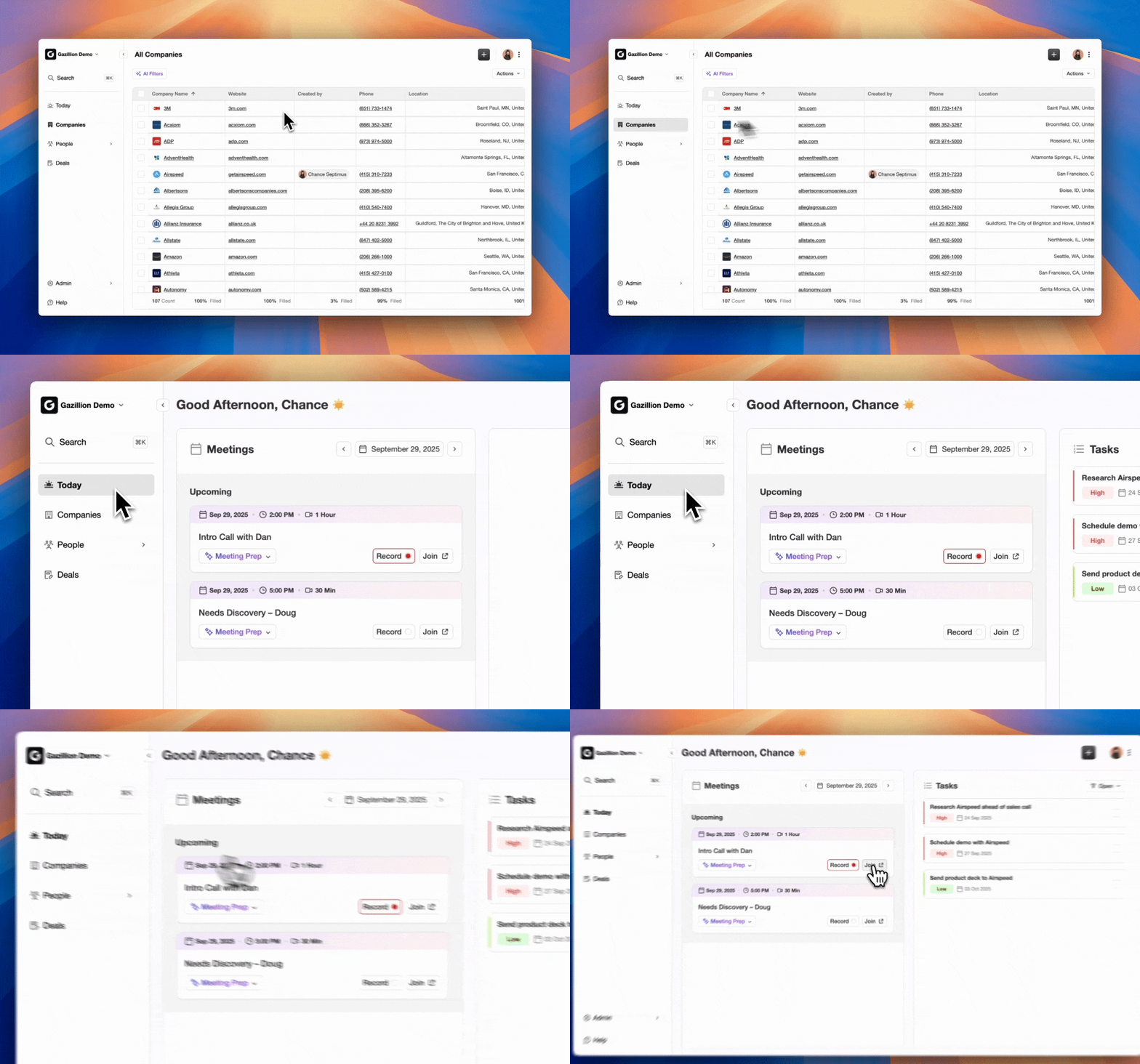
Native integrations write structured data directly to CRM objects such as contact records, opportunity fields, and activity logs. These flows avoid intermediate steps. Zapier connections require workflow maintenance and often break when either platform updates its API. Fireflies.ai saves an estimated 10–15 minutes of manual data entry per sales call through automatic syncing of notes, action items, and summaries to CRM records.

Coffee’s improved summary templates, released in November 2025, are customizable to match workflows and writable back to Coffee, HubSpot, or Salesforce. Building on this foundation, Coffee launched Custom Meeting Briefings and Summaries in February 2026, enabling users to define exact formats, from high-level executive summaries to granular technical breakdowns, before each call. Because these formats are predefined, the structured output feeds directly into CRM fields instead of creating a free-text block that reps must parse manually.

Sales Methodologies, Structured Notes, and Long-Term CRM Hygiene
MEDDIC, BANT, and SPICED frameworks depend on consistent field population across every deal. When reps manually enter qualification data, fields often get skipped, abbreviated, or omitted. Tools that enforce methodology templates at the transcript level, extracting Economic Buyer, Decision Criteria, or Budget directly from call audio, create CRM records that remain useful for forecasting months later.
Coffee’s AI meeting bot structures notes according to BANT, MEDDIC, or SPICED so qualification data enters the system in a consistent format on every call. Over time, this consistency separates a CRM that supports accurate forecasting from one that becomes a graveyard of incomplete records.
How AI Meeting Assistants Shape CRM Data Quality and Forecasts
By eliminating the manual data entry discussed earlier, AI meeting assistants can reclaim those lost hours for actual selling activities. Companies also report saving several hours per week per employee when they adopt AI meeting assistants.
Those time savings only improve forecast reliability when the data written to the CRM is structured and complete. Transcription-only tools produce a summary that a rep may or may not act on. Agent-style tools write specific field values such as next step, close date, stakeholder name, and qualification status directly to the opportunity record. That difference separates a CRM that reflects reality from one that reflects whatever reps remembered to type.
Best-Fit Tools for Early-Stage Teams and CRM-Committed Teams
Early-stage teams of 1–20 people that have outgrown spreadsheets but find Salesforce or HubSpot too maintenance-heavy can use Coffee’s Standalone CRM as the system of record. The agent handles data entry from day one, and there is no legacy architecture to integrate.
Teams of 20–50 already running Salesforce or HubSpot can use Coffee’s Companion App, which authenticates against the existing instance and writes enriched data back to it. Fireflies.ai works well for teams that need broad CRM compatibility across Pipedrive or Zoho in addition to Salesforce and HubSpot. Fathom suits teams with tighter budgets that accept manual CRM entry on the free tier. tl;dv fits teams that prioritize privacy certifications alongside CRM sync.
Operational Realities: Bot Privacy, In-Person Calls, and Change Management
All-party consent states such as California, Florida, Illinois, and Massachusetts create legal risk for AI transcription tools that automatically join meetings without explicit advance consent. California Invasion of Privacy Act violations expose organizations to the greater of $5,000 or three times actual damages per violation.
Visible bots, which appear as a named participant on the call, provide a natural consent signal but can affect prospect behavior. Botless recording avoids the visible participant but requires device-level setup and cannot capture remote audio from other participants’ microphones. In-person meetings need a separate mobile recording workflow that most tools support only partially. Change management also matters. Reps who see the tool as surveillance instead of assistance will disable it, which removes any data quality benefit.
Risks to Watch: Zapier Maintenance, Partial Automation, and Overbuying
Zapier-based CRM integrations require ongoing maintenance whenever either connected platform updates its API. Teams that build complex Zaps to mimic native functionality often spend more time maintaining the integration than they save on data entry. Partial automation, where the tool writes a summary to a CRM note field but does not update opportunity stage, close date, or contact roles, creates the appearance of CRM hygiene without the substance.
Overbuying also presents a risk at the high end. Highest-ROI AI sales automation deployments require clean CRM data foundations before AI activation, phased rollout starting with prospecting, and explicit KPIs tied to pipeline metrics rather than activity metrics. Purchasing a full conversation intelligence platform before establishing baseline CRM data quality produces expensive noise instead of insight.
Decision Framework: Match Your Constraints to the Right Tool
The following criteria map tool categories to common sales team constraints.
- No existing CRM, 1–20 person team: Coffee Standalone CRM, where the agent handles the full system of record.
- Committed to Salesforce or HubSpot, 10–50 person team, needs deep native write-back: Coffee Companion App or Fireflies.ai.
- Budget-constrained, willing to accept manual CRM entry: Fathom free tier.
- Privacy-first, ISO 27001 required: tl;dv.
- Needs broad CRM compatibility beyond Salesforce and HubSpot: Fireflies.ai with more than 50 native integrations.
- Needs methodology-structured notes (MEDDIC, BANT, SPICED) written to CRM: Coffee.
Frequently Asked Questions
How long does it take to set up an AI meeting assistant with Salesforce or HubSpot?
Most bot-based tools, including Coffee, Fireflies, and tl;dv, connect to Salesforce or HubSpot through an OAuth authentication flow that takes under 15 minutes. The bot then joins calendar-linked calls automatically. The more time-consuming step involves configuring which CRM fields receive which data outputs, especially for teams using custom objects or required fields in Salesforce. Coffee’s Companion App reflects deep knowledge of Salesforce and HubSpot architecture, including quotas, forecasting fields, and required field validation, which reduces configuration errors that simpler tools encounter.
What does an AI meeting assistant cost in 2026?
Pricing ranges from free tiers with limited CRM sync, such as Fathom and Otter.ai, to per-seat paid plans starting around $16–$29 per user per month for tools like Fireflies and tl;dv. Coffee uses seat-based pricing where the agent’s labor, including data entry, enrichment, summaries, and CRM write-back, is included without metered usage fees. Teams evaluating total cost should consider tools the AI meeting assistant can replace. A full-stack agent that handles enrichment, recording, and CRM logging can consolidate spend across ZoomInfo, a standalone recorder, and a forecasting add-on.
Do AI meeting assistants work with Microsoft Teams as well as Zoom and Google Meet?
Yes. Coffee, Fireflies, tl;dv, and Fathom all support Zoom, Google Meet, and Microsoft Teams through bot-based joining. The bot receives a calendar invite, joins as a named participant, and records the session. Botless recording, which captures audio at the system level without a visible participant, is available in some tools but usually stays limited to the device running the software and cannot capture remote participants’ audio on Teams or Meet. Teams-heavy organizations should verify that the bot can join external meetings, not just internal ones, before purchase.
How do AI meeting assistants handle data security and privacy compliance?
The baseline certifications for sales use cases are SOC 2 Type II and GDPR compliance. Coffee holds both and does not use customer data to train public AI models. Teams in regulated industries or all-party consent states such as California, Florida, Illinois, and Massachusetts need to verify that their chosen tool supports explicit consent workflows, either through meeting invite notifications or verbal consent prompts, before the bot joins. Vendor terms of service should be reviewed for data retention periods, third-party sharing, and model training clauses, because these vary significantly across tools and have been the basis for litigation in 2025–2026.
How do I evaluate whether a tool’s transcription accuracy is sufficient for my sales calls?
Run a structured pilot and record five to ten representative sales calls using the tool, then compare the transcript against a manual review of the same calls. Measure word error rate on product names, pricing figures, and prospect names, since these fields are most likely to appear in CRM records. Accuracy above 90% on these high-value terms provides a reasonable threshold for sales use. Also test speaker diarization. The tool must correctly attribute statements to the rep versus the prospect for MEDDIC or BANT extraction to remain reliable. If the tool conflates speakers, qualification data written to the CRM will be structurally incorrect even when overall word accuracy looks strong.